


On the map, Ruka–Kuusamo sits just below the Arctic Circle in northeast Finland, surrounded by forests, fells and fast rivers. In reality, it feels like an outdoor playground that never closes. With one of Finland’s longest ski seasons, a serious network of hiking and biking trails, and easy access to national parks such as Oulanka, this compact region has quietly become one of the country’s most reliable year round adventure destinations.
Get the latest updates straight to your inbox!
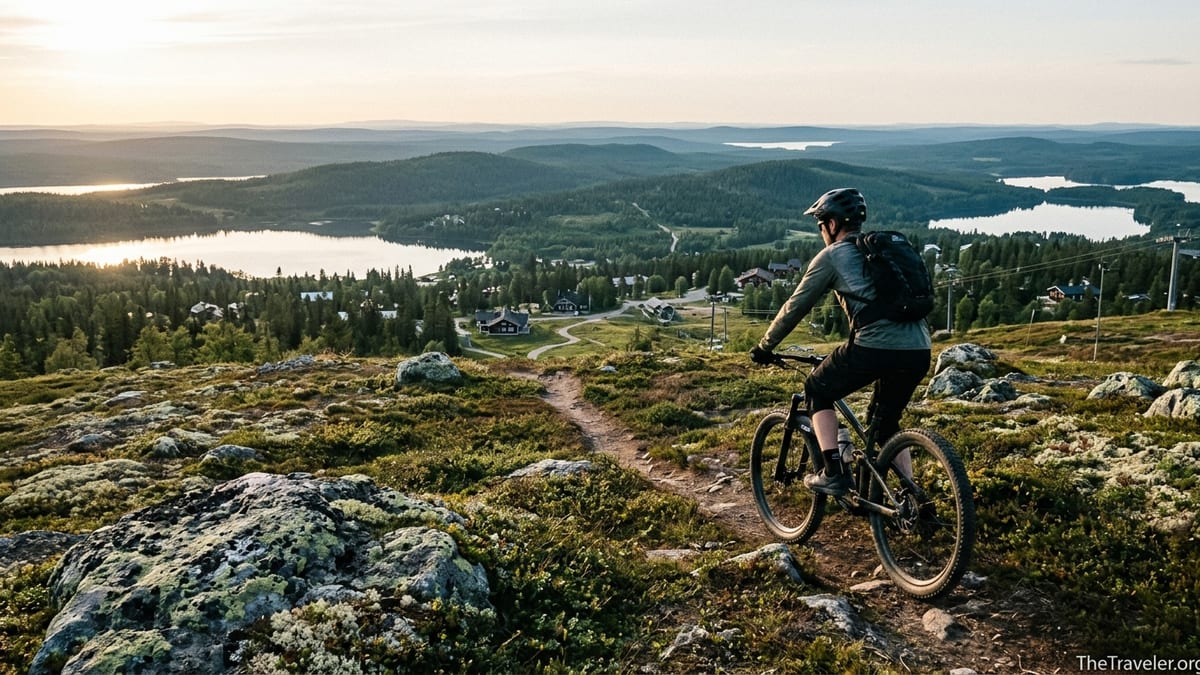
A Fellside Hub With Big-Mountain Energy
Ruka is built around the Rukatunturi fell, a relatively modest summit by Alpine standards, but one that packs an impressive amount of infrastructure into a compact footprint. The ski resort has around 40 slopes and more than 20 lifts in winter, including a modern gondola that runs between Ruka Village and the quieter Ruka Valley side. Many of the runs are floodlit, extending ski days well into the afternoon twilight and evening during the shorter months. The atmosphere is intimate rather than overwhelming, which makes it appealing to first-time visitors to the Arctic who still want plenty of choice.
Kuusamo, the nearby town about 25 minutes away by road, provides the backbone of services: the airport, supermarkets, gear shops and local operators. Kuusamo Airport has regular domestic connections from Helsinki, and in winter there are often direct seasonal charter flights from elsewhere in Europe, which means you can land within a short transfer of your accommodation without a long overland journey. For many travelers, that combination of easy access and wilderness surroundings is what tips Ruka–Kuusamo ahead of more remote Lapland destinations.
What sets the area apart is how seamlessly the resort-style comforts sit next to real, raw nature. A guest staying in a ski-in ski-out apartment in Ruka Village can be at a trailhead into quiet forest or a frozen lake within minutes. Many properties come with private saunas and large drying cabinets, so after a day on the slopes, a snowshoe excursion or a rafting trip, you can warm up and reset quickly. It feels more like an all-season base camp than a traditional ski village, with the infrastructure to support adventures in every direction.
Ruka has also become a regular feature on the international winter sports calendar. Each late November it hosts Ruka Nordic, where the FIS World Cup in cross-country skiing, ski jumping and Nordic combined opens the season. Temporary grandstands, media zones and athletes’ areas pop up around the ski jumps, and visitors can combine watching world-class sport with their own days on the slopes. That annual spotlight has helped drive investment into lift systems, snowmaking and trails that benefit ordinary visitors throughout the long winter.
Winter: Reliable Snow and Classic Arctic Experiences
Ruka–Kuusamo is primarily known as a winter destination for good reason. The ski season typically stretches for more than 200 days, often starting in October and running into early May, thanks to efficient snowmaking and the region’s cold, continental climate. Locals talk about “skiing at Halloween and again at May Day,” and for visitors this lengthens the window for planning a snow holiday outside peak Christmas and February breaks. For families or budget-conscious travelers, that translates into quieter slopes and often better accommodation value in early December or late March.
Downhill skiers and snowboarders will find an array of terrain concentrated on the fell. Beginner-friendly green and blue runs spill down towards Ruka Village, while steeper reds and blacks face towards Saarua and the east side. There is a snow park scene with jumps and rails that attracts freestyle riders, and several of the main chairlifts and gondolas remain open into the evening under lights. Because the mountain is compact, it is common to ski from one side to the other and back over lunch, using the gondola as a simple connector rather than needing long transfers or shuttles.
Yet alpine skiing is only part of the winter story. Ruka–Kuusamo is laced with hundreds of kilometres of groomed cross-country ski trails, some starting right from the village and others threading their way towards the frozen lakes and forests closer to Kuusamo. In practice, this means that a typical day can be as relaxed or as athletic as you like. One morning you might join a guided classic-ski excursion that loops around the fell for a few hours, stopping at a simple laavu shelter to grill sausages over an open fire. The next day you could rent skate skis from a local shop and test yourself on more challenging loops used by Finnish club skiers.
For many visitors, the highlight of winter is the layer of classic Lapland-style experiences that sit on top of the ski infrastructure. Local operators based in Ruka and Kuusamo run husky sledding safaris through snow-laden spruce forests, evening snowmobile tours out onto open fells in search of a glimpse of the northern lights, and reindeer farm visits that end with coffee and pulla buns around a fireplace. Because distances are short, you can often fit a half-day husky tour and an afternoon on the slopes into a single day. For those who prefer slower-paced exploration, guided snowshoe walks and fatbike tours on compacted winter trails offer a quieter way to move through the landscape in the blue light of midwinter.
Summer: Bike Parks, Whitewater and Midnight Sun
In the past decade, Ruka–Kuusamo has invested heavily in becoming a true summer adventure destination rather than simply going quiet when the snow melts. The Ruka Bike Park now uses multiple lifts to access a web of downhill and enduro-style trails, ranging from beginner-friendly flow lines to rockier, root-filled technical descents. Riders can rent modern full-suspension bikes, body armor and full-face helmets from on-mountain shops, and buy lift passes or fun passes that bundle bike park access with other attractions such as the summer sled track and zipline.
On non-biking days, visitors turn their attention to the region’s rivers. Oulanka National Park, about an hour from Ruka Village, is one of the best-known whitewater destinations in Finland. Local operators such as Basecamp Oulanka guide rafting trips down the gentle family sections of the Oulankajoki and Kitkajoki rivers and more demanding whitewater stretches with class III and IV rapids. A short, family-friendly rafting excursion might last a couple of hours and cost in the region of 60 euros per adult, including gear and guiding, while longer “wild route” trips are priced higher per person or per raft. After tackling the rapids, groups often walk a short section of the Pieni Karhunkierros loop back through the forest, giving a taste of the national park’s famous Bear Trail.
Summer in Kuusamo is about light as much as temperature. From June into early August, nights are short and bright, with the sun barely dipping below the horizon around the summer solstice. This creates a long window every day for hiking, trail running and lake paddling. It is entirely realistic to set out on an evening hike from Ruka Village at nine or ten o’clock and still have good daylight for photography by the time you reach a viewpoint over Lake Kitkajärvi. Guided canoe and packraft tours take advantage of the calm conditions often found in the late evening, when winds drop and the water mirrors the shoreline pines.
Because Ruka Village stays open, with restaurants, cafes and a handful of summer events, the area does not feel like a resort in hibernation. Terrace bars serve local craft beers after bike park laps, and families line up for the summer sled track that snakes down the side of the fell. For travelers who want a single base where teenagers can ride laps in the bike park, younger children can try mini golf or disc golf, and adults can sneak off to a longer hike, Ruka’s compact layout makes co-ordinating plans easy without a car once you are checked in.
Spring and Autumn: Quiet Seasons for Hikers and Photographers
Between the peak seasons of deep winter and high summer, Ruka–Kuusamo slows down slightly but never fully stops. In April and early May, as the sun climbs higher but snow still lingers on the slopes and trails, ski touring and cross-country skiing can be excellent. Locals take advantage of the firmer snowpack to head off groomed trails and explore open fells on skis or snowshoes. It is a good time for visitors who want to combine strong daytime sun with relatively cold nights and do not mind softer snow in the afternoons. Accommodation prices often ease a little after Easter, and lift queues are minimal.
By late May and early June, lower trails begin to clear of snow while higher sections can still be patchy. This shoulder period requires more flexibility, but rewards are significant. Birdlife in and around Oulanka National Park is at its most active; capercaillie, Siberian jay and various owls can sometimes be seen or heard from trails at dawn and dusk. Photographers make the most of snow still clinging to north-facing slopes while river levels, swollen with meltwater, thunder through canyons like Kiutaköngäs.
Autumn is arguably when Ruka–Kuusamo is at its most beautiful and least crowded. From early September into early October, the larch and birch forests flare into orange, yellow and deep red. The famous multi-day Karhunkierros, or Bear Trail, often completed over three to five days between Hautajärvi and Ruka, becomes a highlight for fit hikers. Along the trail, simple wilderness huts and lean-to shelters provide basic overnight accommodation free of charge, with firewood stacks and pit toilets, while more comfortable options such as Basecamp Oulanka offer warm beds for those who prefer a hot shower at the end of the day.
For photographers, autumn is a season of contrast. The first frosts silver the ground in the mornings, while days can still be mild and calm. Northern lights viewing picks up again as nights darken, and because many of the lakes around Kuusamo are relatively small and sheltered, they often provide still reflections of auroras and autumn colors. A simple evening plan might involve driving a short way from Ruka Village, parking at a lakeside lay-by, and waiting with a thermos of coffee and a tripod. Even if the aurora forecast does not deliver, the silence and soft light are often reward enough.
National Parks, Trails and Wild Water
Ruka–Kuusamo’s claim to being one of Finland’s best adventure destinations rests as much on its surroundings as on the resort itself. Oulanka National Park, stretching along the Oulankajoki and Kitkajoki river valleys, is the best known of several protected areas within day-trip range. Its network of trails includes both the full-length Karhunkierros and shorter day routes like Pieni Karhunkierros, a 12 kilometer loop that takes in hanging bridges, riverside cliffs and the photogenic Myllykoski mill. Wooden duckboards lead through wetlands, and in many places the sound of whitewater is a constant backdrop.
Beyond Oulanka, there are numerous other hiking and paddling options. To the north and east lie the quieter forests and fells near the Russian border, where routes are less frequented and big mammals such as brown bears and wolverines still roam, mostly unseen. A number of hides and wildlife photography camps operate in this wider region, offering overnight stays in purpose-built blinds where visitors can watch for bears and eagles across small forest ponds. These experiences are tightly regulated and run in co-operation with landowners and authorities, and they give photographers a chance to observe large carnivores without disturbing them in the wild.
On the water, paddlers can choose from multi-day journeys down gentle sections of the Oulankajoki in packrafts or open canoes, and more technical kayaking on parts of the Kitkajoki where rapids are graded up to class IV. Local guides are valuable here not just for safety, but for their understanding of flows, access points and any seasonal restrictions. In high water conditions during spring snowmelt, some rapids are only recommended for very experienced paddlers with solid rescue skills, while in late summer family groups might float the same sections as relaxed day trips stopping for lunch on gravel bars.
Anglers also find plenty to occupy them around Kuusamo, where license-controlled fishing areas cover stretches of the Oulankajoki, Kitkajoki and smaller forest lakes. Typical target species include grayling, trout and whitefish. Many visiting fly fishers choose to book guided days through local operators who arrange permits, transport and equipment, as well as advice on patterns and techniques suited to local conditions. For non-fishing family members, it is often possible to combine a day on the riverbank with nearby hikes or a sauna session back at a riverside lodge.
Practicalities: Getting There, Staying There, Getting Around
For international visitors, the simplest way to reach Ruka–Kuusamo is to fly to Helsinki and connect to a domestic flight to Kuusamo Airport. Flying time between Helsinki and Kuusamo is roughly an hour and a half. From the airport, it is about 25 kilometers to Ruka Village. Many hotels and larger apartment complexes can arrange shared shuttle transfers, and during the winter season there is usually a bus schedule that matches common flight arrivals. Renting a car from Kuusamo Airport is straightforward and can offer more flexibility, especially if you plan to explore Oulanka National Park independently or visit multiple trailheads in a single trip.
Accommodation options run from simple cabins and camping areas to full-service hotels and apartment-style ski-in ski-out complexes. In Ruka Village itself, several properties are integrated directly with the base area, meaning guests can walk out of the ski room and clip into their skis or bikes. Many cabins in the wider Kuusamo region sit on lakeshores and come with private saunas, rowing boats and wood-fired hot tubs. For those hiking the Karhunkierros, accommodation can be a mix of pre-booked guesthouses along the route, simple wilderness huts that cannot be reserved but are free to use, and tent or hammock camping where permitted.
Getting around without a car is possible, particularly in winter, when ski buses connect Ruka, Kuusamo and some of the surrounding accommodation clusters. However, for summer and shoulder-season visitors who want to reach trailheads early or return late, a rental car significantly widens options and reduces waiting time. Road conditions in winter are generally good, as Finland maintains its main roads meticulously, but drivers should be comfortable on snow and ice and allow extra time for journeys in heavy snowfalls or during cold snaps when visibility can drop.
Food and drink in Ruka–Kuusamo range from basic cafes at lift bases and trailheads to more ambitious bistros in Ruka Village and Kuusamo town. Many menus lean on local ingredients such as reindeer, wild mushrooms, berries and lake fish. A common pattern for active days is to pack a simple picnic from the supermarket in the morning and eat lunch at a laavu shelter or riverside fire site, then enjoy a hot restaurant meal in the evening. Most Finnish cafes and restaurants accept card payments, including contactless, and staff are used to international visitors who may not speak Finnish.
The Takeaway
Ruka–Kuusamo earns its reputation as one of Finland’s best year round adventure destinations not through one standout feature, but through a rare balance of factors. It combines one of the country’s longest and most reliable ski seasons with a genuinely developed summer offering built around bike parks, hiking and whitewater. It anchors that with easy access via Kuusamo Airport and compact resort-style convenience in Ruka Village, yet places you on the doorstep of Oulanka National Park and a broader landscape of rivers, fells and forests.
For travelers, this means flexibility. A family can visit in February and mix downhill skiing with husky rides and aurora hunting without long transfers. A group of friends can come back in July to lap the bike park, raft the Oulanka and hike evening loops under the midnight sun. Solo hikers might return in September for a quieter Karhunkierros trek through blaze-colored forests and nights in wilderness huts. The setting remains the same, but the feel of the place shifts with the seasons.
If you are looking for an adventure base in Finland that works just as well for a long weekend as it does for a multi-week stay, and that invites repeat visits at different times of year, Ruka–Kuusamo deserves a serious look. It may not have the highest mountains or the most extreme conditions, but its blend of accessibility, variety and authentic northern atmosphere is hard to beat.
FAQ
Q1: When is the best time of year to visit Ruka–Kuusamo for skiing?
The main downhill ski season typically runs from late October to late April or early May, with the most reliable snow and daylight from December to March.
Q2: Is Ruka–Kuusamo suitable for beginners and families?
Yes. The ski resort has many gentle slopes, dedicated beginner areas, ski schools and family-friendly attractions such as the summer sled track and easy snowshoe routes.
Q3: Do I need a car to enjoy the area?
A car is not essential if you stay in or near Ruka Village, especially in winter when ski buses run, but renting one gives more flexibility for visiting national parks and trailheads.
Q4: How do I get to Ruka–Kuusamo from Helsinki?
The quickest option is a domestic flight from Helsinki to Kuusamo Airport, followed by a 25 to 30 minute transfer by shuttle, taxi or rental car to Ruka Village.
Q5: Can I see the northern lights in Ruka–Kuusamo?
Northern lights are visible on clear, dark nights from roughly September to April, though sightings are never guaranteed and depend on solar activity and cloud cover.
Q6: What summer activities are available if I do not mountain bike?
Non-bikers can hike in Oulanka National Park, join river rafting or canoeing trips, go berry picking, fish with local guides or simply enjoy scenic lift rides and village life.
Q7: Is it possible to hike the Karhunkierros Bear Trail without a guide?
Experienced hikers often complete the marked Karhunkierros independently, using wilderness huts and shelters, but many still choose a guide or package for logistics and local insight.
Q8: What kind of clothing should I pack for winter?
Pack layered clothing including a moisture-wicking base layer, insulating mid-layer, waterproof outer shell, warm hat, gloves, scarf or buff and insulated boots suitable for snow.
Q9: Are there vegetarian or vegan food options in Ruka–Kuusamo?
Most restaurants and cafes in Ruka Village and Kuusamo offer at least one vegetarian option, and vegan choices are increasingly common, especially in larger venues.
Q10: Is Ruka–Kuusamo overly crowded during peak season?
While the resort is busier during school holidays and event weekends, lift lines and trails are generally manageable compared with many Alpine resorts, especially outside the busiest weeks.