


The plane dipped below a band of low cloud and suddenly the forests appeared, an endless weave of dark spruce, frozen lakes and pale fells stretching to the Russian border. Kuusamo Airport is small enough that you can be off the tarmac and in a lakeside cabin in under an hour, but the landscape feels as remote as anywhere in the Arctic. I had come for a simple weekend in Ruka–Kuusamo and left with the answer to a question I had heard from Finns and repeat visitors for years: why do people keep coming back here, often season after season, sometimes for decades?
Get the latest updates straight to your inbox!
Arriving at the Edge of the North
Landing on a Friday afternoon, it took less than fifteen minutes from runway to rental car. Kuusamo Airport is compact and efficient, and most winter visitors arrive on direct charter flights from central Europe or via Helsinki on Finnair. From the airport, it is roughly a 25 minute drive to the Ruka ski village on well-maintained roads that are kept open even in deep winter. That short transfer is the first clue to Ruka–Kuusamo’s appeal: it feels like an edge of the map destination, yet logistics are easy enough to fit into a standard long weekend.
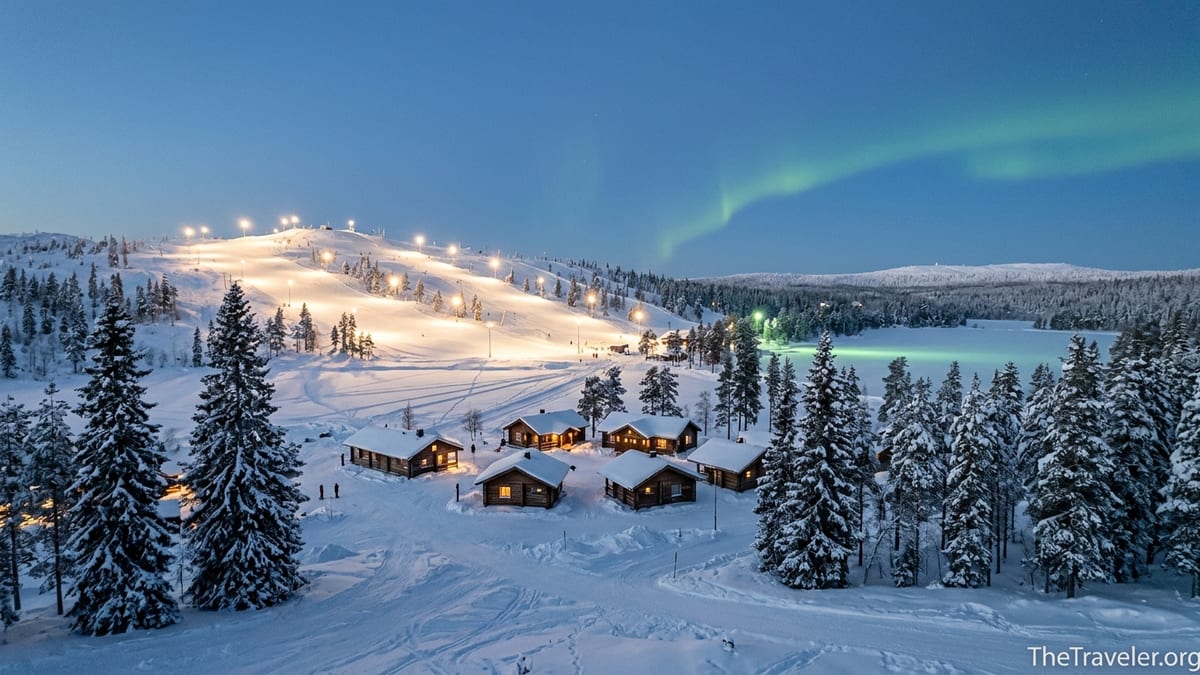
On my first evening I checked into a small log cabin on the outskirts of Ruka, the kind of place that has become a signature of the region. Many cabins sleep four to six people and come with a private sauna, drying cupboard for ski gear and a wood stove. Prices vary widely, but in shoulder season it is often possible to find a compact one-bedroom cabin within walking distance of the village for a nightly rate similar to a midrange city hotel. For families or groups, the value compared with more famous Alpine resorts is immediately noticeable.
As the daylight thinned, I walked up to the village itself. Ruka’s center is a cluster of low-rise hotels, restaurants, rental shops and supermarkets wrapped around the base of the fell. Overhead, the lights of the pistes glowed against a blue twilight sky. Locals picked up groceries at the small K-market, children clattered past in ski boots, and a line formed at a café window selling paper cups of hot blueberry juice. For a Friday evening in high season, it felt lively but never crowded, which is very much the rhythm here.
That first night set the tone for the weekend. Instead of the heavy nightlife you might find in some European ski towns, Ruka runs on a quieter schedule. After an early dinner of salmon soup and rye bread in a simple grill restaurant beside the slopes, most visitors seemed to drift back to their cabins, where the main late-night entertainment is watching the sky in case a band of green aurora appears over the trees.
Saturday on the Slopes and Trails
Ruka’s ski area is not huge by Alpine standards, but that is partly why visitors become loyal. The fell has a compact network of runs that loop back toward the same village base, which makes it unusually easy for mixed-ability groups to ski together. Families with teenagers can let more confident skiers range across steeper black runs while younger children are still close enough to meet for lunch without complicated rendezvous plans. A weekend lift pass in the 2025–26 main season sits in a range that is often noticeably lower than in flagship resorts of the Alps, and equipment rentals are widely available in the village shops.
I started Saturday morning with a few hours on the slopes. Ruka is known in Finland for its long season, sometimes opening as early as October and running until late spring, helped by extensive snowmaking and the northern climate. On the front side of the fell, wide groomed runs offered relaxed cruising, while the back slopes had steeper pitches and a snowpark that had attracted a crowd of local freestyle riders. The lift lines were short, even in the late morning peak, and ski school groups were small enough that instructors greeted parents by name when they dropped their children off.
By midday, I had already begun to understand one reason repeat visitors cite for returning: the way you can combine downhill skiing with other winter activities without the day feeling crowded. After lunch at a slopeside café, where a bowl of reindeer stew, mashed potatoes and lingonberry jam was both hearty and reasonably priced by Nordic standards, I traded ski boots for winter hiking gear and headed a short distance out of the resort.
Within a fifteen minute drive of the village, groomed winter trails cut into the forest, some reserved for cross-country skiing, others shared with snowshoers and fatbikes. It is entirely possible to ski in the morning and then spend an easy two or three hours exploring a frozen river valley on snowshoes in the afternoon. Guided snowmobile safaris, which typically cost under 100 euros per person for a couple sharing a machine, run daily from the Ruka area and follow established tracks through the forest, giving a taste of the wider Kuusamo landscape without demanding advanced driving skills.
Oulanka National Park: Wilderness Within Reach
On Sunday morning, I joined a small-group excursion into Oulanka National Park, which lies roughly 40 to 60 kilometers from Ruka depending on the trailhead. This park, shared between the Kuusamo and Salla municipalities, is one of Finland’s most celebrated wilderness areas, known for its deep river gorges, suspension bridges and the famous Karhunkierros, or Bear Trail, an 80 kilometer long-distance hiking route that has become a rite of passage for many Finns.
In winter, the park is transformed. The Oulanka River narrows into ice-framed rapids, and cliffs are quilted with snow. Our guide drove us out along a plowed road, stopping at a visitor center where maps, toilets and a café made the park feel remarkably accessible for first-time visitors. From there, we followed a section of the so-called Little Bear Trail, a popular day route that packs bridges, waterfalls and viewpoints into a manageable loop. Wooden duckboards that protect the fragile ground in summer were hidden under hard snow, but the trail was well marked, and our guide broke out a thermos of hot juice and gingerbread cookies at a lean-to shelter stocked with firewood.
For many travelers, Oulanka is the moment Ruka–Kuusamo starts to feel like more than a ski destination. The proximity of true wilderness is unusual. You might spend Saturday riding lifts and sipping cocoa in a warm café, then find yourself on Sunday staring down into a silent canyon where only the rush of water and an occasional raven disturb the air. Local operators offer experiences that lean into this contrast, such as wilderness lunches cooked over open fire in the park or overnight bear watching in nearby forests once the snow melts, when brown bears return and can sometimes be observed safely from hides near the Russian border.
Even a short foray into Oulanka reveals the infrastructure that encourages people to return season after season. Well marked trails, reservable wilderness huts and lean-to shelters mean that it is easy to expand your ambitions on a future trip, perhaps from a day hike on a first visit to a two or three night section of the Karhunkierros later on. Travelers who come in winter often return in autumn to see the ruska colors, when the leaves and ground plants turn copper and crimson and the same viewpoints feel entirely different.
Local Flavors and Slow Evenings
Food is another subtle reason people become loyal to Ruka–Kuusamo. The restaurant scene is not large, but it is quietly ambitious. In recent years, small dining rooms focused on local ingredients have gained national attention, and securing a reservation at one of the more creative kitchens is now part of the weekend ritual for many repeat visitors. Menus often highlight lake fish, game, foraged mushrooms and berries, prepared in a way that feels refined but not fussy.
On my Saturday night, I ate in a restaurant where the chef worked behind a low counter just a few steps from the front door. There were fewer than twenty seats, and the set menu leaned heavily on the surrounding region: trout cured with spruce tips, barley cooked in reindeer stock, a dessert built around wild blueberries and tangy spruce ice cream. The dining room filled with a mix of Helsinki couples on a ski break, German families and a local group celebrating a birthday. Reservations are usually essential on winter weekends, but prices for multi-course tasting menus remain relatively modest compared with major European capitals.
For travelers on a tighter budget, the village supermarkets and simple grill kiosks provide plenty of options. It is common to pick up ingredients for a cabin breakfast and late-night snacks, then splash out on one sit-down dinner during the weekend. Many cabins have well-equipped kitchens, and grilling sausages over a wood fire, either at a public lean-to shelter on the trails or in your own fireplace, is part of the Finnish outdoor culture that visitors quickly adopt. The combination of occasional restaurant splurges with mostly self-catered meals is one of the reasons a weekend here can feel indulgent without being extravagantly expensive.
Evenings in Ruka–Kuusamo are rarely frantic. There are a couple of bars that stay open late and a handful of venues with live music during busy weeks, but the typical night ends in a sauna, not a nightclub. After dinner I walked back through the village, passing small groups clustered around fire pits and families taking one last sled run behind the hotels. Back at the cabin, the ritual was simple: light the sauna, step out to the porch to scan for aurora, and then collapse into bed, pleasantly tired from a day outside.
Why People Return: Four-Season Appeal
Ask people in the Ruka–Kuusamo area why so many visitors return again and again, and one theme comes up repeatedly: the destination works in every season, but feels like a different place each time. Winter is the most famous period, when skiing, snowmobiling and husky safaris dominate, but spring brings bright, long days and reliable snow on the slopes while the rest of Europe is already in mud season. Summer opens up hiking, canoeing and mountain biking, with local outfitters offering guided rafting on the Oulanka River, family-friendly paddling on calmer stretches, and berry-picking walks through the forest.
Autumn is perhaps the insider favorite. In September, the air turns cool and mosquitoes disappear, but days are still long enough for full-day hikes on the Bear Trail or shorter loops closer to Ruka. The ruska foliage is especially vivid in Kuusamo, where the mix of birch, spruce and ground plants creates layers of color from treetops to forest floor. Many Finnish families schedule annual trips at this time of year, staying in the same cabins and walking the same trails, partly for the scenery and partly for the sense of ritual. For them, the question is not whether to return, but which month this year makes the most sense.
The practical side of that loyalty is clear when you look at the weekly activity programs that local operators publish for each season. A visitor arriving for a random weekend in February or July can typically rely on a menu of bookable small-group experiences: from short evening snowshoe walks and introductory cross-country lessons in winter to bear-watching hides and gentle river rafting in summer. Prices for these group excursions are usually transparent and displayed in advance, which makes it easier to plan a weekend budget. That reliability encourages travelers to book a future trip even before they have left the current one.
There is also a psychological dimension. Ruka–Kuusamo is large enough to offer variety but small enough to become familiar quickly. On a second visit you might recognize the cashier in the supermarket or the guide leading a snowmobile safari. Trails and viewpoints that were new on your first weekend become landmarks you look forward to revisiting. For many urban travelers, especially those from Helsinki, Germany and the Netherlands, that mix of novelty and comfort is what turns a satisfying one-off trip into an annual habit.
Planning Your Own Weekend in Ruka–Kuusamo
Designing a weekend in Ruka–Kuusamo is largely a matter of choosing a season and then balancing structured activities with time to simply wander. In winter, a common pattern for a Friday to Sunday stay is to ski or snowboard on both mornings, book one half-day guided activity such as a snowmobile safari or husky ride, and then reserve a full day for Oulanka National Park. Even with just two nights, it is possible to experience the essential flavors of the region: skiing, sauna, wilderness and at least one good restaurant meal.
For a more relaxed pace, particularly in summer or autumn, you might skip downhill skiing entirely and focus instead on hiking and river experiences. A sample summer weekend could include an evening arrival and sauna on Friday, a guided rafting or canoe trip on the Oulanka River on Saturday, and a section hike of the Bear Trail on Sunday, ending with a meal in the village before heading back to the airport. Car rental is helpful but not absolutely essential, as many local companies offer transfers to activity starting points from Ruka village or Kuusamo town.
Accommodation choice will shape the feel of your weekend. A modern apartment-hotel near the lifts offers maximum convenience for skiers who value walking out the door and straight onto the slopes. Traditional log cabins a short drive away provide quiet and more of a wilderness atmosphere, with frozen lakes and forest right outside. In summer, there are farm stays and countryside guesthouses closer to Kuusamo itself, appealing to travelers who are more interested in hiking and visiting local attractions than in the ski infrastructure.
Regardless of the season, it is worth booking key elements early. Winter lift passes, popular cabins and the most sought-after restaurants can sell out well ahead of peak weeks, especially around school holidays in Finland and central Europe. Many activities run with small group sizes to minimize environmental impact and ensure a more personal experience, which is part of their charm but also means last-minute spots can be limited. At the same time, leaving some space in your itinerary for serendipity is part of the pleasure here. Weather, aurora forecasts and spur-of-the-moment invitations from guides or fellow travelers often decide which trail or viewpoint you end up seeing.
The Takeaway
By Sunday night, as the airport’s single departure gate filled with people peeling off layers of wool and down, I realized how many of my fellow passengers were on at least their second or third visit. A German family in line ahead of me casually compared this winter’s snow conditions with those of three years earlier. A Finnish couple from Turku chatted about how they try a new cabin every time but always book the same husky safari operator. Nobody spoke as if they were ticking Ruka–Kuusamo off a list. They were talking about when to come back.
That, ultimately, is the answer to why a single weekend here can be surprisingly powerful. Ruka–Kuusamo offers much of what people look for in a northern escape: reliable snow in winter, glowing forests in autumn, accessible wilderness and genuine silence, along with a growing but not yet overwhelming dining scene. It packages those elements in a way that is logistically straightforward and financially manageable for many travelers, with enough variety that each visit can feel different from the last.
Standing on the snow-packed tarmac, watching the last line of dark trees recede beneath the wing, I understood why Ruka–Kuusamo inspires loyalty. It is not the most dramatic or glamorous destination in the north, and it does not try to be. Instead, it feels like a place you can return to at different stages of your life, finding new corners of forest, new stretches of river and new conversations each time. A single weekend is enough to begin that relationship. It rarely seems to be the last.
FAQ
Q1. Where is Ruka–Kuusamo and how do I get there for a weekend?
Ruka–Kuusamo is in northeast Finland, close to the Russian border, with most visitors flying into Kuusamo Airport and then driving about 25 minutes to the Ruka ski village.
Q2. Is a weekend really enough time to experience the area?
Yes, a Friday to Sunday stay is enough for a taste of skiing or hiking, a visit to Oulanka National Park, a sauna evening and at least one memorable local meal.
Q3. Do I need a car for a short visit to Ruka–Kuusamo?
A car is helpful, especially for reaching Oulanka National Park on your own schedule, but many activity companies offer transfers from Ruka village and Kuusamo town.
Q4. What is the best season to plan a weekend trip?
Winter is ideal for skiing and snow activities, while late summer and early autumn are excellent for hiking, rafting and enjoying the colorful ruska foliage.
Q5. How expensive is Ruka–Kuusamo compared with other Nordic destinations?
Overall costs are moderate by Nordic standards, with lift passes and cabins often cheaper than in major Alpine resorts and many travelers mixing self-catering with occasional restaurant meals.
Q6. Can beginners enjoy the skiing and activities here?
Yes, Ruka has gentle slopes, English-speaking ski schools and beginner-friendly excursions such as short snowshoe walks and easy snowmobile safaris designed for first-timers.
Q7. Is Oulanka National Park suitable for casual hikers on a weekend?
Oulanka offers well marked day trails like the Little Bear Trail, with maintained paths, bridges and shelters that are accessible for reasonably fit hikers without specialist gear.
Q8. Will I see the northern lights during a winter weekend?
There is a fair chance from roughly September to March when skies are clear, but displays are never guaranteed, so it is best to view them as a bonus rather than a promise.
Q9. What kind of clothing and gear should I pack?
Pack layered, windproof clothing, warm boots and a hat and gloves in winter, plus comfortable hiking shoes and rain protection in summer and autumn; technical equipment can be rented locally.
Q10. Is Ruka–Kuusamo suitable for families with children?
Yes, the compact ski area, family-sized cabins, short transfer from the airport and wide range of child-friendly activities make it a popular choice for family weekends.