


Most visitors who climb the hill above Florence stop at Piazzale Michelangelo, snap a few photos of the Duomo and the Arno, and head back down for gelato. Few realize that if they kept walking just ten minutes farther up the road, they would reach San Miniato al Monte, a serene hilltop basilica that offers what many locals quietly insist is the most beautiful view of Florence. Skipping it is not just missing another church. It is passing up one of the city’s most atmospheric, rewarding corners, where history, landscape and daily Florentine life converge above the crowds.
Get the latest updates straight to your inbox!
From Postcard Viewpoint to Real Florence
Piazzale Michelangelo has become the default “Florence from above” stop for tour buses and social media check-ins. On any given summer evening the square fills with selfie sticks, souvenir kiosks selling miniature Davids, and buskers covering pop ballads. The view is undeniably striking, with Brunelleschi’s dome, Giotto’s bell tower, and the Palazzo Vecchio all aligned above the Arno. Yet the atmosphere can feel more like an open-air mall than a Renaissance city. Many visitors assume this is as good as Florence’s panoramas get and turn back toward the river.
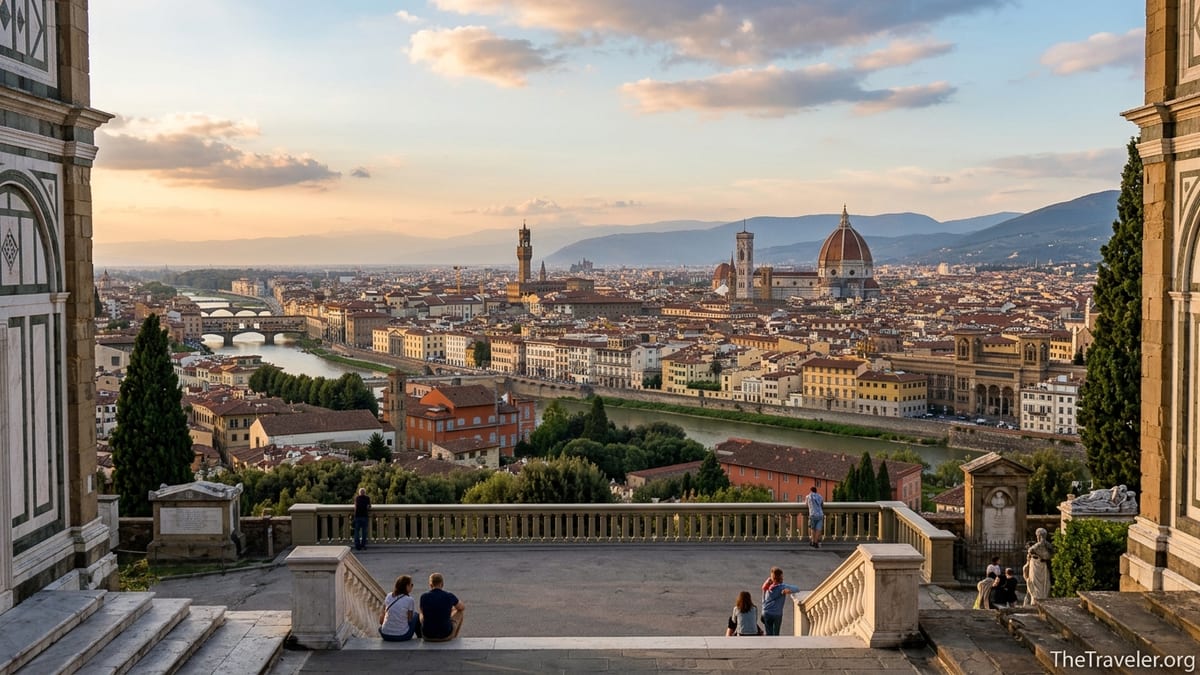
San Miniato al Monte sits just above this square, perched roughly one hundred meters over the Arno on the crest of Monte alle Croci. From the road, the basilica’s green and white marble facade looks like a smaller, older cousin of the Duomo’s, but its terrace opens onto a broader, quieter sweep of the city. You see not only the historic center and its terracotta roofscape but also the folds of the Tuscan hills dissolving into the distance. The soundscape shifts from amplified music to church bells, birds and the murmur of locals exchanging greetings at the top of the steps.
That change in mood is what makes the San Miniato view different. Where Piazzale Michelangelo delivers a spectacular backdrop, San Miniato offers context. From here you can trace the line of the old city walls, distinguish traditional neighborhoods like Oltrarno and Santa Croce, and even see how modern Florence creeps along the valley. It is a view that encourages you to linger, to point out landmarks with a map in hand, and to understand how the city is put together instead of just ticking off another viewpoint.
A Thousand Years Above the City
The basilica of San Miniato al Monte is not a scenic overlook built for tourism. It is one of Florence’s oldest and most significant Romanesque churches, with roots in the early 11th century. The church is named after Saint Minias, considered by tradition to be the city’s first Christian martyr. According to legend, after his beheading he picked up his own head and walked to the hill where the basilica now stands, choosing this high ground as the site of his burial and future sanctuary. Whether you believe the story or not, it underscores how long people have seen this hill as a place apart from the bustle below.
Over centuries the complex grew into an abbey that included the basilica, a monastery and, later, a bishop’s palace that served as a summer residence for Florence’s bishops. During the Renaissance and beyond, this height above the Arno was both strategic and symbolic. Defensive walls once wrapped around the hill, and in the 19th century the city built the grand staircases and ramps that now link the riverfront to Piazzale Michelangelo and up to San Miniato. Today, these layers of history remain visible in the massive stone fortifications beneath the church and in the monumental cemetery that spreads across the slopes.
When you stand on the terrace in front of the basilica and look over Florence, the sense of time is palpable. You are in a place that has watched the city evolve for nearly a millennium, from medieval commune to Medici duchy, from capital of Italy in the 19th century to global tourism magnet today. The view becomes more than pretty; it becomes a balcony over European history. That feeling is difficult to capture in a quick stop at a modern square full of food trucks and coach tours.
Getting There: The Ten Minutes Most Travelers Skip
One of the main reasons travelers miss San Miniato al Monte is simple geography and momentum. Guidebooks and city tours typically highlight Piazzale Michelangelo as the hilltop viewpoint. The square itself is already a climb from the riverside, whether you come up by taxi, bus or the famously steep staircases from the San Niccolò district. Once there, the idea of climbing higher can feel like an optional extra, something to do only if you have energy left.
In reality, the final stretch to San Miniato is short and manageable for most visitors. From the center of Piazzale Michelangelo, you follow the road that curves uphill behind the bronze David statue. It is roughly a ten-minute walk on a gently sloping road, with a final flight of steps leading to the church terrace. Visitors with reduced mobility can ask a taxi to continue up to the small parking area near the basilica, which typically costs only a few euros more than stopping at the square below, depending on traffic and time of day.
Public transport also brings you close. Several city buses run to the base of the hill from central hubs such as Santa Maria Novella station and Piazza San Marco. From there, you either walk the ramps and steps up to Piazzale Michelangelo and continue on to the basilica, or you switch to small local routes that stop near the cemetery entrance. Ride-sharing services operating in Florence often list “San Miniato al Monte” as a specific destination, which can be useful on hot days or late evenings when the climb back down feels long.
Because San Miniato is just beyond the range of most standard group tours, the atmosphere on the hill is noticeably different. Instead of large groups clustered around guides with headsets, you are more likely to see pairs of locals on an evening stroll, art students sketching the cityscape, and a handful of independent travelers who have deliberately sought the basilica out. The extra ten minutes to get here effectively filters out the majority of the crowds.
Planning Your Visit: Hours, Services and Practical Details
San Miniato al Monte remains an active religious site, so planning around its rhythms is important. The basilica typically opens in the morning and remains accessible through the afternoon, with a pause at midday. Exact hours can shift slightly by season and for religious festivals, but in general you can expect the church doors to be open from around 9 am into the early evening. The terrace and the steps in front of the facade often remain accessible even when the interior is closed, which means you can still enjoy the view outside at sunrise or after sunset.
Entrance to the basilica is free, though small donations are appreciated and help support the monastic community. Inside, modesty in dress is expected. Shoulders should be covered, and shorts should reach roughly to the knee. In practice, many summer visitors arrive in light clothing; bringing a lightweight scarf or shawl in your daypack makes it easy to adapt. Photography is generally permitted without flash, but during Mass and Vespers the focus shifts to prayer and music rather than pictures, and visitors are expected to be discreet and quiet.
Because San Miniato stands higher than Piazzale Michelangelo, temperatures can feel slightly cooler, particularly in the evening when breezes rise from the valley. Bringing a light layer, even in late spring or early autumn, can make your visit more comfortable when you sit on the stone steps for half an hour watching the city lights come on. There are no large cafes or bars on the terrace itself, so plan to bring a water bottle, especially if you are walking up from the center in the heat of the day. The nearest refreshment options are around Piazzale Michelangelo, where casual kiosks sell coffee, soft drinks and simple snacks at typical tourist prices.
Restrooms are limited in and around the basilica complex. Visitors often plan a stop in a cafe or bar near the base of the hill or at Piazzale Michelangelo before continuing up. Like elsewhere in Italy, buying a small drink, even a simple espresso, generally entitles you to use the facilities. Knowing this ahead of time can spare you from having to cut your hilltop visit short.
What You See From the Terrace
The view from San Miniato al Monte is not just wider than the one from Piazzale Michelangelo, it is more layered. Directly below, beyond the terraced cemetery, you see the tree-lined avenues and riverside walks of the Lungarno. To the left, the compact cluster of towers and domes marks the medieval core of Florence. The red-brick drum and pale stone ribs of the Duomo dominate the skyline, flanked by the slender silhouette of Giotto’s bell tower and the crenellated tower of the Palazzo Vecchio.
Looking slightly upstream, you can trace the sequence of bridges: the Ponte Vecchio with its goldsmith shops, the more understated Ponte Santa Trinita, and the modern spans farther west. On clear days, the hills of Fiesole and Settignano frame the city like a softly painted backdrop. In winter, when the air is crisp and humidity low, snow sometimes dusts the distant Apennines, offering a surprising Alpine note to this Tuscan panorama.
Because the terrace is higher and set back, the angle of view shifts. From Piazzale Michelangelo, Florence feels almost at eye level, a flat skyline stretching along the Arno. From San Miniato, you look slightly down and across, seeing how the city flows along the valley and up into the surrounding hills. Roof terraces, hidden cloisters, and the patchwork of gardens behind palazzi become more visible. This is where you start to understand why painters and photographers have returned to this hill for generations, seeking not just a skyline but a sense of place.
At different times of day, the character of the view changes. Early morning light glances off the Duomo and turns the river silver, with only a few commuters on the bridges. Midday can be harsh in summer, but in shoulder seasons it offers clear outlines and deep blue skies. Late afternoon and sunset are what draw most people, as the city’s terracotta tones glow warm and the stone of the basilica facade turns honey-colored. After dark, scattered pools of light reveal piazzas and streets, and the illuminated dome stands out like a lantern over the city.
Inside the Basilica and Around the Hilltop
Although the view is often what lures visitors up, skipping the interior of San Miniato would be another missed opportunity. The basilica is a textbook example of Tuscan Romanesque architecture, with a geometric green and white marble facade that predates the far larger Duomo by centuries. Inside, the high, timbered ceiling, patterned marble floor and dim arcades create a cool, contemplative space far removed from the crowded aisles of Florence’s most famous churches.
Descending into the crypt, you find one of the oldest parts of the complex, supported by low columns and clustered capitals. The high altar above is traditionally said to contain relics of Saint Minias, tying the site back to the city’s earliest Christian history. Frescoes, glazed terracotta details and mosaics from different periods reveal how each age left its mark here, from the simple devotional art of the Middle Ages to later Baroque chapels commissioned by wealthy Florentine families.
The surrounding monumental cemetery is another aspect that many travelers overlook. Spread across terraces below and beside the basilica, it is a sculptural landscape of elaborate family tombs, angels in weathered stone, and ivy-clad crosses. Well-known local figures, including artists and writers, are buried here, but even without recognizing names the atmosphere is striking: peaceful, slightly melancholic and intensely photogenic. Walking through the paths you catch frequent glimpses of the city between cypress trunks and marble statues, a reminder of Florence’s constant presence below.
On the hilltop itself, the former bishop’s palace and monastery buildings frame the church. Depending on the day and season, small shops or stalls operated by the monastic community may sell honey, herbal products or liqueurs produced according to traditional recipes. Buying a jar of honey or a bottle of herbal amaro here is a tangible way to support the community and carry a piece of San Miniato back home, far removed from the mass-produced souvenirs below.
The Soundtrack of San Miniato: Gregorian Chant and Vespers
What truly sets San Miniato al Monte apart from other viewpoints, however, is not only what you see but what you hear. On many afternoons and evenings, the resident monks chant Vespers in Gregorian style in the basilica’s choir. Visitors are welcome to sit quietly in the pews as their voices rise and fall in unison, filling the Romanesque nave with sound that seems to belong to another century. The effect is powerful even for those with no religious background, turning a simple visit into a sensory experience that lingers.
Timing your visit to coincide with these services can be one of the most memorable choices you make in Florence. A common pattern is to arrive in late afternoon, explore the interior and the cemetery, then attend Vespers. Emerging afterward onto the terrace, you often find the city below bathed in golden light, with the bells of other churches responding across the valley. It is a sequence few crowded itineraries allow for, yet it costs nothing and requires only some planning and a willingness to slow down.
Other churches in Florence, such as Santa Croce or Santa Maria Novella, also hold daily services, but the combination of chant, architecture and hilltop setting at San Miniato is unique. Many independent travelers who have packed days of museum visits and walking tours into their time in the city report that this quiet hour above Florence stands out in their memories as clearly as any painting by Botticelli or fresco by Giotto.
Even outside formal services, the hilltop is rich in subtle sound. Wind moves through the cypress trees in the cemetery, distant scooters buzz through the streets below, and from time to time the calls of swallows echo under the eaves of the basilica. Sitting on the steps with a simple picnic and listening as daylight fades can feel like stepping briefly out of the tourist rush and into something more grounded and local.
The Takeaway
In a city as dense with masterpieces as Florence, deciding what to see and what to skip is rarely easy. Yet the short walk from Piazzale Michelangelo up to San Miniato al Monte may be one of the clearest cases where a small extra effort yields an outsized reward. Choosing not to make that climb means settling for a crowded, commercialized version of Florence from above and missing the quieter, more layered perspective that the basilica’s terrace offers.
San Miniato is more than a viewpoint. It is a thousand-year-old church, a working monastery, a monumental cemetery and a balcony over both the city and its history. From the geometry of its marble facade to the sweep of roofs and hills beyond, from the chants of evening Vespers to the simple ritual of watching the lights come on in the valley, this hilltop condenses much of what travelers hope to find in Florence: beauty, depth and a sense of connection.
If your time in the city is short, it can be tempting to streamline your plans to only the largest names: the Duomo, the Uffizi, the Ponte Vecchio. Yet setting aside even an hour or two for San Miniato al Monte will likely change how you remember Florence. The climb may leave you slightly breathless, but the view and the atmosphere at the top ensure that you are not just collecting images, you are experiencing the city in a way many visitors overlook.
FAQ
Q1. Is San Miniato al Monte really worth visiting if I have already been to Piazzale Michelangelo?
Yes. The walk from Piazzale Michelangelo to San Miniato al Monte is short, and the terrace is quieter, higher and more atmospheric, with a broader view and a historic basilica to explore.
Q2. How long does it take to walk from central Florence to San Miniato al Monte?
From the Ponte Vecchio area, most visitors take between 30 and 40 minutes on foot, including the climb to Piazzale Michelangelo and the additional ten minutes up to the basilica terrace.
Q3. Are there entrance fees to visit the basilica and the terrace?
No. Entrance to San Miniato al Monte and access to the terrace are generally free, though small donations are welcome and help support the monastic community.
Q4. What is the best time of day to visit San Miniato al Monte?
Late afternoon leading into sunset is especially beautiful, while early morning offers calmer light and very few people. Midday visits are quieter in summer heat but the light is harsher for photography.
Q5. Can I reach San Miniato al Monte without climbing lots of stairs?
Yes. Taxis and ride-share cars can drive up to the area near the basilica, and some local buses stop close by, which reduces the number of steps you need to climb.
Q6. Is San Miniato al Monte suitable for families with children?
It can be a rewarding visit for families, especially older children who can manage the walk. The terrace and cemetery offer space to explore, but parents should supervise near steps and walls.
Q7. How should I dress when visiting the basilica?
Dress modestly, with shoulders covered and shorts or skirts at least to mid-thigh or longer. Carrying a light scarf or wrap is an easy way to adapt if you arrive in summer clothing.
Q8. Are there places to eat or drink near San Miniato al Monte?
There are no large cafes on the terrace itself, but you will find kiosks and small bars around Piazzale Michelangelo below, where you can buy coffee, soft drinks and simple snacks.
Q9. Can I attend a service or listen to Gregorian chant at San Miniato al Monte?
Yes. The monastic community regularly chants Vespers in the basilica. Visitors are welcome to sit quietly during services, but should respect the religious setting and avoid taking photos.
Q10. Is it safe to visit San Miniato al Monte in the evening?
In normal conditions, the area is considered reasonably safe, especially around sunset when other visitors are present. As always, take standard city precautions and plan your route back in advance.