


More news on this day
A broken rail has been identified as the cause of the recent freight train derailment near Sparks, Nevada, according to preliminary findings that are sharpening focus on track maintenance and inspection along one of the West’s busiest rail and highway corridors.
Get the latest news straight to your inbox!
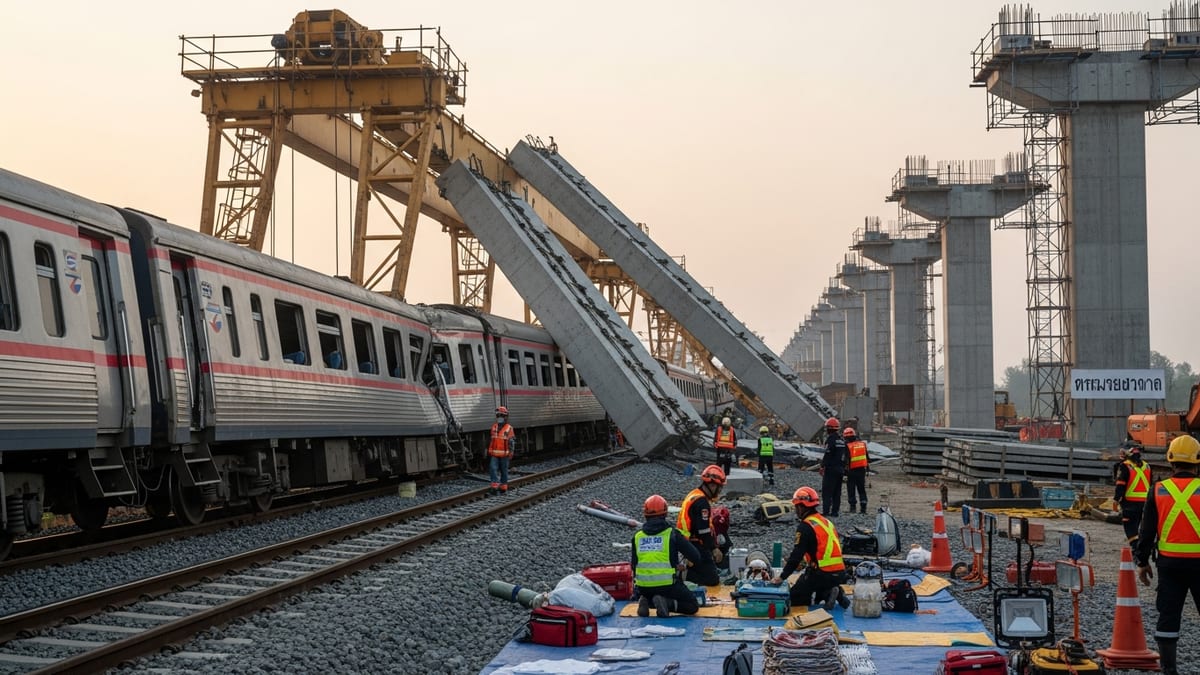
Preliminary Findings Point to Track Failure
Recent investigative updates into the Sparks-area derailment indicate that a fractured section of rail triggered the chain of events that sent multiple freight cars off the tracks near the Interstate 80 and USA Parkway interchange east of Sparks. Publicly available summaries of the ongoing investigation describe a sudden break in the steel rail under the moving train, consistent with a catastrophic rail failure.
The incident involved a Union Pacific freight consist operating through the critical east–west corridor between Reno and Fernley, an artery that also carries Amtrak’s California Zephyr. In the immediate aftermath, both rail and highway traffic were disrupted as crews worked to stabilize derailed cars, assess the condition of adjacent tracks, and clear debris from the right of way.
Investigators are now focused on understanding why the rail failed at that specific location. Early indications point toward an internal defect or developing fatigue crack that went undetected before it propagated through the rail head, ultimately causing the break as the freight train passed over the compromised section.
Disruptions Along the I‑80 and Rail Corridor
The derailment occurred in a tightly interwoven transport corridor, where the Union Pacific main line parallels Interstate 80 and serves industrial sites connected via USA Parkway. After the crash, portions of I‑80 were temporarily closed while responders staged heavy equipment and evaluated the stability of derailed cars, many of which came to rest close to the interstate embankment.
Rail operations through the area were curtailed as track crews inspected adjacent lines and removed damaged rail, ties, and ballast. Long-distance passenger services experienced significant delays, with at least one California Zephyr train held for hours while rail infrastructure was inspected and temporary speed restrictions were established through the derailment zone.
Freight movements also faced cascading impacts. The Union Pacific line through Sparks is a key link for intermodal, automotive, and bulk commodity traffic moving between California, the Mountain West, and the Midwest. With sections of track out of service and operating speeds reduced, railroads were forced to re-sequence trains, stage consists in nearby yards, and, in some cases, reroute traffic over alternate lines where capacity allowed.
Broken Rails as a Persistent Safety Challenge
The Sparks derailment aligns with a broader pattern in which broken or defective rails remain one of the leading causes of freight train accidents in North America. Federal Railroad Administration data and independent analyses indicate that rail flaws, including internal cracks and joint bar failures, account for a significant share of derailments each year, particularly on heavy-haul freight routes.
In many modern cases, rails fail not because of obvious surface damage but due to subsurface fatigue that grows over time under repeated axle loads. These defects can develop even on relatively new or previously tested rail if traffic volumes are high, environmental conditions are harsh, or support from ties and ballast is uneven. When such a flaw reaches a critical size, a rail can fracture suddenly under a passing train, leading to a loss of gauge or alignment that causes wheels to climb or drop off the track.
Past investigations into major derailments in the United States and Canada have repeatedly highlighted the challenge of detecting these internal defects before they become hazardous. Even lines that undergo regular ultrasonic or induction testing can experience occasional undetected flaws, particularly where geometry issues, welds, or joint bars complicate signal interpretation.
Scrutiny of Inspection and Maintenance Practices
The Sparks incident is expected to draw renewed attention to how frequently high-tonnage routes are tested and how quickly identified defects are addressed. Published safety reports in recent years have urged railroads to refine their inspection regimes, including shortening test intervals, improving data analytics, and prioritizing high-risk segments such as curves, bridges, and areas with known subsidence or drainage problems.
In the Nevada desert environment, wide temperature swings and intense solar exposure can also place additional stress on continuously welded rail. Thermal expansion and contraction can aggravate small flaws or affect the stability of the track structure if rail anchors, fasteners, or ballast conditions are marginal. The combination of heavy freight traffic, tight maintenance windows, and weather extremes creates a complex setting in which seemingly minor defects can progress more quickly than expected.
Industry observers note that modern freight operations increasingly rely on long, heavy trains to maximize efficiency, which can increase the dynamic forces acting on rails and track components. When a rail section with an undetected defect lies under the passage of such a train, the probability of a sudden break may rise, especially if the defect is located at a weld, joint, or transition point between different track structures.
Next Steps for Investigation and Safety Improvements
Investigators examining the Sparks derailment are expected to collect and analyze fragments of the broken rail to determine the precise nature of the fracture, including whether it originated from an internal inclusion, a bolt hole, a weld, or a surface defect that migrated inward. Metallurgical testing and fracture-surface analysis typically help establish how long a defect may have been growing and whether it would have been visible to existing inspection technologies.
Publicly available information indicates that the inquiry will also review recent track inspection records along the corridor, including the timing of the most recent rail flaw detection runs, geometry car measurements, and visual patrols. Any discrepancies between inspection findings and actual rail condition at the derailment site are likely to factor into future safety recommendations.
Depending on the final conclusions, the Sparks derailment could prompt calls for more frequent testing on high-traffic freight routes, deployment of advanced continuous monitoring systems, or changes in how railroads prioritize track segments for renewal. For local communities and rail users across northern Nevada, the incident underscores the continuing importance of robust track inspection and maintenance practices in preventing rare but high-impact derailments along a vital transportation corridor.