


Hidden in the working-class Rione Sanità district, the Basilica of Santa Maria della Sanità is one of Naples’ most atmospheric churches, built directly above the Catacombs of San Gaudioso. Visiting this complex is not just another church stop: it combines early Christian burial grounds, bold Baroque architecture and a very raw, lived-in neighborhood. Knowing what to expect before you go will help you appreciate its history and navigate the area with confidence.
Get the latest updates straight to your inbox!
Where You Are Actually Going: Church, Catacombs and Neighborhood
Santa Maria della Sanità is a 17th century basilica in the heart of Rione Sanità, a densely populated neighborhood just north of Naples’ historic center. The church sits above the Catacombs of San Gaudioso, one of the city’s main early Christian burial complexes. You enter the catacombs from inside the basilica, usually as part of a guided tour managed by the local cooperative that also runs the better-known Catacombs of San Gennaro.
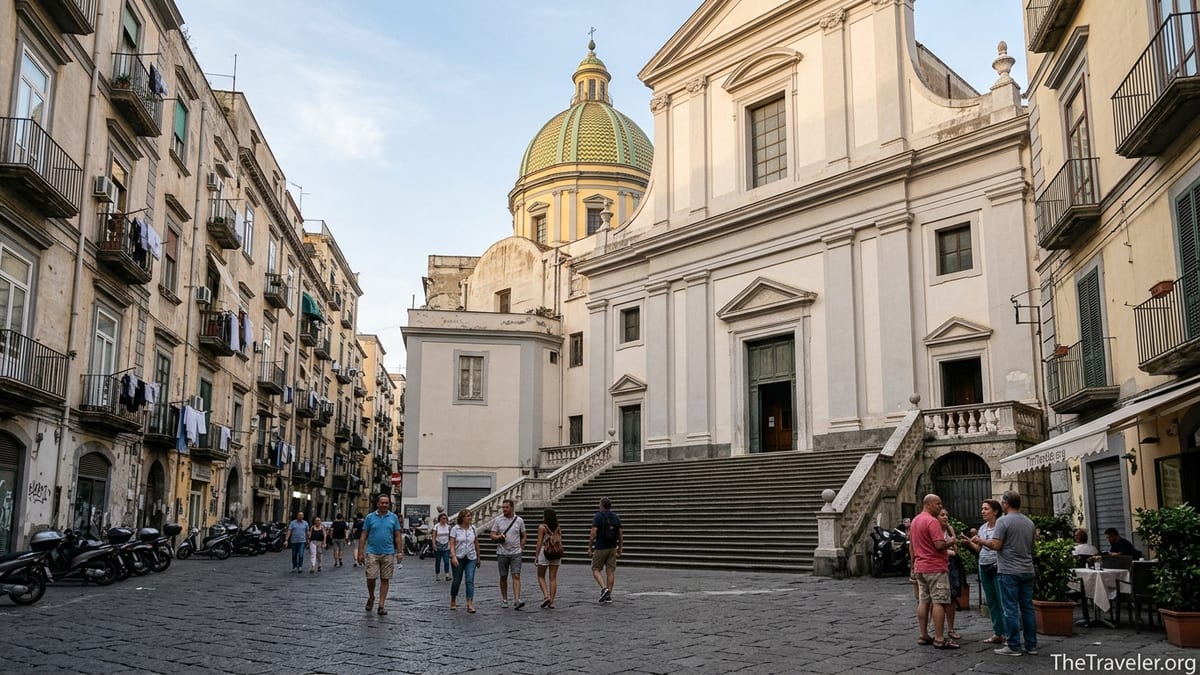
The basilica itself is striking, with a wide staircase leading up from the square, an oval plan, colorful yellow and green tiles on the dome and dramatic Baroque decorations inside. Many visitors are surprised that such a monumental church rises from what looks like an ordinary, slightly chaotic Neapolitan street, with scooters, laundry lines and market stalls just outside the doors.
Rione Sanità has a reputation that can worry first-time visitors, but it is also one of Naples’ most culturally rich areas, home not only to Santa Maria della Sanità and San Gaudioso but also the nearby Palazzo Sanfelice and Palazzo dello Spagnolo, known for their theatrical staircases. Today the neighborhood attracts a steady flow of visitors during the day for catacomb tours and street-food walks, while still being very much a local, low-income district.
When you see “Catacombs of San Gaudioso” on booking platforms, remember that the meeting point is inside Santa Maria della Sanità. Many travelers use the terms interchangeably, but technically the basilica is the church above ground and San Gaudioso is the underground complex below the presbytery.
Opening Times, Tickets and Guided Tours
The basilica itself generally keeps standard church hours, opening in the morning and again in the late afternoon or early evening for worshippers. Entry to the church is free, and you can walk in to admire the dome, paintings and side chapels without a ticket. The catacombs, however, are only accessible on a guided tour at fixed times.
The Catacombs of San Gaudioso are run together with the Catacombs of San Gennaro under a common ticketing system. In practice this means that a standard ticket bought for one site is usually valid for entry to the other within a long window, often several months rather than just a single day. For example, a visitor who books a morning tour in San Gaudioso might use the same ticket to visit San Gennaro in the afternoon or on another day of the same trip, subject to available tour slots. Exact conditions and prices change periodically, so it is wise to check the current details shortly before you travel.
Prices are in line with other major Naples attractions: expect to pay a moderate fee typical for a guided heritage visit, with reductions for children, students and seniors and free entry for very young children. Tours are offered in Italian and English at set times throughout the day. At busy periods such as Easter or late spring weekends, slots can sell out, so advance booking through the official operator or a reputable ticketing partner avoids disappointment.
Tours usually last about an hour. The guide will meet the group inside the basilica, give an overview of the church and its fresco of the Madonna della Sanità, then lead you down into the catacombs. If you plan to combine San Gaudioso and San Gennaro on the same day, it is realistic to schedule a morning visit here and an afternoon slot at San Gennaro, leaving time for lunch and transport between the two hills.
How to Get There and Navigate the Area
Reaching Santa Maria della Sanità from central Naples is relatively straightforward, but the last stretch takes you into a very local neighborhood. The simplest route for many visitors is the Line 2 metro to Cavour station, followed by a 10 to 15 minute walk. From Cavour, most travelers follow Via Santa Teresa degli Scalzi uphill and then turn into Rione Sanità, descending toward the basilica. It is a busy urban walk with traffic, narrow sidewalks and scooters, so allow extra time if you are with children or older travelers.
Another option is to combine the metro with a short taxi or ride-hail journey from around the National Archaeological Museum area. For instance, you could emerge at Museo station, have a quick look at the museum square, then take a licensed taxi up to Rione Sanità, asking to be dropped at “Basilica di Santa Maria della Sanità.” This is a good compromise if you are carrying luggage or have mobility issues, since the streets can be steep and uneven.
Public buses also run along Via Santa Teresa degli Scalzi, and some visitors prefer to ride up and then walk the last few minutes down into the neighborhood. This can feel less disorienting than approaching from the lower side streets. If you are staying further out, such as near the port or the Central Station, factor in possible delays on buses at busy times and leave a generous margin before your booked tour slot.
Navigating the immediate area around the basilica is intuitive once you arrive. The church sits on a raised platform above a small square where locals gather, children play football and vendors sell snacks. From here you can easily continue on foot to nearby palaces or to other sights in Sanità. Many travelers choose to walk back to the historic center after their visit, following the same main road downhill toward the Archaeological Museum, which takes around 15 to 20 minutes at a relaxed pace.
What You Will See Inside: Art, Architecture and Bones
Inside the basilica, the first impression is of height and light. The church has an unusual Greek-cross plan with a central dome, richly painted chapels and Baroque altarpieces by artists active in 17th century Naples. Look up at the dome’s bright yellow and green exterior tiles when you approach from the outside, then inside pay attention to the patterned floor and the interplay of white stone and colored marble around the altars.
One of the most important images is the ancient fresco of the Madonna della Sanità, considered the oldest known depiction of the Virgin Mary in Campania. According to tradition, its rediscovery in the mud centuries ago led to renewed devotion and the decision to build the basilica over the older burial site. The image is venerated by locals, so be discreet if services or personal prayers are taking place near the chapel where it is displayed.
Descending into the Catacombs of San Gaudioso, you enter a very different atmosphere. The tunnels and chambers are cut into soft tuff stone, with early Christian tombs, arcosolia and cubicula painted with symbols like fish, vines and lambs. The tomb of Saint Gaudiosus, a North African bishop exiled to Naples in the 5th century, is marked by a mosaic in a small chapel space, and the guide will usually pause here to explain how his burial transformed the site into a Christian cemetery and pilgrimage place.
Visitors also see later, more macabre adaptations from the 16th and 17th centuries. Neapolitan nobles and clergy were buried here using a technique where skulls were set into the walls while painted bodies below them depicted clothing and symbols of rank. Walking past these frescoed skeletons in wigs, armor or clerical robes is one of the most memorable parts of the tour. Guides often highlight how this practice inspired local artists and even modern cultural references, illustrating Naples’ long, complex relationship with death.
Practicalities: Clothing, Comfort and Accessibility
Because Santa Maria della Sanità is an active Catholic church, there is an expectation of modest dress, though enforcement is usually relaxed compared with some major Italian cathedrals. Shoulders and knees covered is a good guideline. A light scarf or shawl is useful if you are visiting in summer with sleeveless tops or shorts. Inside the catacombs, the temperature is noticeably cooler than outside, so even in August a thin layer can make the visit more comfortable.
The underground sections involve walking on uneven stone floors, some low ceilings and a number of steps. Sturdy, closed shoes with good grip are strongly recommended over sandals or heels. There are handrails in key spots, but the site is not fully accessible for visitors with serious mobility issues or those who cannot manage stairs. If you use a cane or have concerns, it is worth contacting the operator in advance to ask about current access arrangements and whether a shortened route is possible.
Photography rules vary over time and by area. In the church, taking unobtrusive photos without flash is usually accepted when no service is in progress, but you should avoid shooting people at prayer. In the catacombs, some tours allow limited photography without flash, while others restrict it to protect delicate frescoes and maintain a respectful atmosphere. Always follow the guidance given by your guide at the start of the visit. For travelers hoping to take detailed shots, a fast lens on a compact camera or phone with good low-light performance is more practical than a full-size tripod setup, which will not be permitted.
There are basic visitor facilities near the ticket desk, such as restrooms and a small information area. These are functional rather than luxurious. If you are combining this visit with others in the area, plan broader comfort breaks at cafes in the neighborhood or back in the historic center, where you will find more seating, air conditioning and food options.
Safety, Scams and Street Sense in Rione Sanità
Rione Sanità is historically a poor neighborhood with a complex social reputation, and some guidebooks and online forums describe it as rough around the edges. In recent years, increased tourism related to the catacombs and community projects has brought more visitors during the daytime, and many travelers report feeling broadly comfortable walking the main routes. Still, it is important to approach the area with realistic expectations and standard big-city caution.
Most issues that visitors might encounter are related to petty crime rather than violent incidents. Bag snatching and opportunistic theft can happen in crowded streets or on scooters passing close to the sidewalk. Carry only what you need for the visit, use a cross-body bag that closes securely and avoid displaying large cameras or thick wallets when not necessary. Keep phones in a front pocket or zipped bag rather than loosely in your hand at the edge of the road.
Common-sense behavior goes a long way: stick to busier streets, especially the main road connecting to the historic center, and avoid wandering into poorly lit side alleys late at night if you are unfamiliar with the area. If you are visiting the evening mass or a late tour, consider taking a taxi both ways rather than walking back through quiet streets, particularly if you are alone. Licensed taxis can be found near the Archaeological Museum or ordered by phone or app from your accommodation.
Most locals are used to visitors coming for the catacombs and are generally welcoming. You may be approached by people offering informal guiding services, souvenirs or parking assistance. It is fine to decline politely and continue to the official ticket desk inside the basilica, where staff wear recognizable badges or shirts. Paying only the official entrance fee and any pre-booked tours, rather than ad hoc “fees” in the street, minimizes misunderstandings and small scams.
Making the Most of Your Visit: Food, Culture and Nearby Sights
One of the rewards of coming out to Santa Maria della Sanità is the chance to experience a slice of everyday Naples beyond the more polished tourist routes. Before or after your catacomb tour, allow time to explore the surrounding streets. You will find small family-run bars selling espresso at local prices, bakeries with warm sfogliatelle and taralli, and street-food stands specializing in fried treats like cuoppo di frittura, a paper cone filled with fried vegetables or seafood.
For a simple lunch, many travelers choose a neighborhood pizzeria or trattoria a short walk from the basilica. These spots often serve classic Neapolitan pizzas cooked in wood-fired ovens, plates of pasta with local sauces like ragù napoletano or genovese, and seasonal vegetables. Prices are generally lower than in the most touristed streets near the waterfront, and menus are usually in Italian first with English translations added. It is normal to see a mix of local families, students and a few visitors fresh from the catacombs.
Culturally, Rione Sanità has become known for its street art and community projects aimed at reclaiming public spaces. As you walk, keep an eye out for murals and installations on building facades and underpasses, many of which reference local history or famous Neapolitans such as the comic actor Totò, who was born in this district. Some guided walking tours combine the catacombs with a wider look at these initiatives, giving more context to the neighborhood’s social changes.
Within a short radius you can also visit other baroque gems, including Palazzo Sanfelice and Palazzo dello Spagnolo, known for their dramatic internal staircases. These buildings are mainly residential today, so access may be limited to common areas, but even a quick look into the courtyards from the street offers a sense of their theatrical architecture. Combining Santa Maria della Sanità, the catacombs and a short loop through these palaces makes for a rich half day in this part of Naples.
The Takeaway
Visiting Santa Maria della Sanità and the Catacombs of San Gaudioso is one of the most distinctive experiences in Naples. The site brings together a monumental Baroque church, some of the city’s most evocative early Christian remains and a neighborhood that still feels unapologetically lived-in. It is not a polished museum designed solely for tourists, and that is precisely its appeal for many travelers.
To get the best from your visit, treat it as both a cultural and a neighborhood experience. Book your catacomb tour in advance, plan your route so that you arrive in good time, dress for a church and a cool underground space, and keep your belongings secure as you would in any major city. Allow yourself time before or after the tour to sit in a local café, watch life in the square and notice how the basilica serves the surrounding community as much as it does international visitors.
If you approach Santa Maria della Sanità with curiosity, respect and a bit of logistical preparation, you will come away with a deeper understanding of Naples’ layered history and the powerful ways in which this city lives alongside its dead. For many, it becomes a highlight that lingers in memory long after more famous sights have faded.
FAQ
Q1. Do I need to book tickets in advance to visit the Catacombs of San Gaudioso under Santa Maria della Sanità?
It is strongly recommended, especially in high season and on weekends, because visits are only possible on guided tours at fixed times and spaces can sell out.
Q2. Is Santa Maria della Sanità and Rione Sanità safe to visit during the day?
During daylight hours, most visitors feel comfortable on the main streets around the basilica, provided they use normal big-city precautions such as keeping valuables secure and avoiding quiet back alleys.
Q3. How long should I plan for a visit to the basilica and catacombs?
The guided catacomb tour usually takes about an hour. With time to explore the church, walk to and from the metro, and perhaps have a coffee or snack, plan around two to three hours in total.
Q4. Can I visit both the Catacombs of San Gaudioso and San Gennaro with one ticket?
Often a single ticket grants access to both sites within a generous time window, but exact conditions can change, so check the latest details before you go.
Q5. What should I wear when visiting Santa Maria della Sanità and the catacombs?
Dress modestly as for any active church, with shoulders and knees covered, and wear comfortable closed shoes suitable for cool, uneven underground floors.
Q6. Are the catacombs suitable for children or people who are claustrophobic?
Many children find the visit fascinating, but those sensitive to dark spaces, skulls and bones, or stories about death may find it unsettling. The tunnels are relatively spacious, yet visitors with strong claustrophobia should consider their comfort level in advance.
Q7. Is the site accessible for visitors with limited mobility or wheelchairs?
The basilica can usually be accessed with some assistance, but the catacombs involve stairs and uneven ground and are not fully suitable for wheelchairs or people who cannot manage steps.
Q8. Are there English-language tours available in the Catacombs of San Gaudioso?
Yes, English tours are regularly scheduled alongside Italian ones, particularly during busier periods. When booking, choose an English time slot or confirm the language with the operator.
Q9. Can I take photos inside the basilica and catacombs?
Discreet, no-flash photography is usually allowed in the church outside of services, while rules in the catacombs may limit or forbid photos to protect artworks, so always follow your guide’s instructions.
Q10. What other sights can I combine with a visit to Santa Maria della Sanità?
Many travelers pair it with the National Archaeological Museum, the Catacombs of San Gennaro or a walk to nearby baroque palaces in Rione Sanità, creating a full cultural day in this part of Naples.