


Travelers come to Florence and Pisa expecting great art, Renaissance palaces, and that classic shot of Ponte Vecchio reflected in the Arno River. Many never look beyond those famous bridge views. Yet the Arno, which runs more than 240 kilometers from the Apennines to the Ligurian Sea, offers a surprisingly rich mix of green spaces, boat trips, cycling routes, and small towns that can easily round out an Italian itinerary. The question is not just whether the Arno is worth a look, but how far beyond the postcards you should follow it.
Get the latest updates straight to your inbox!
Why the Arno Matters Beyond the Postcard
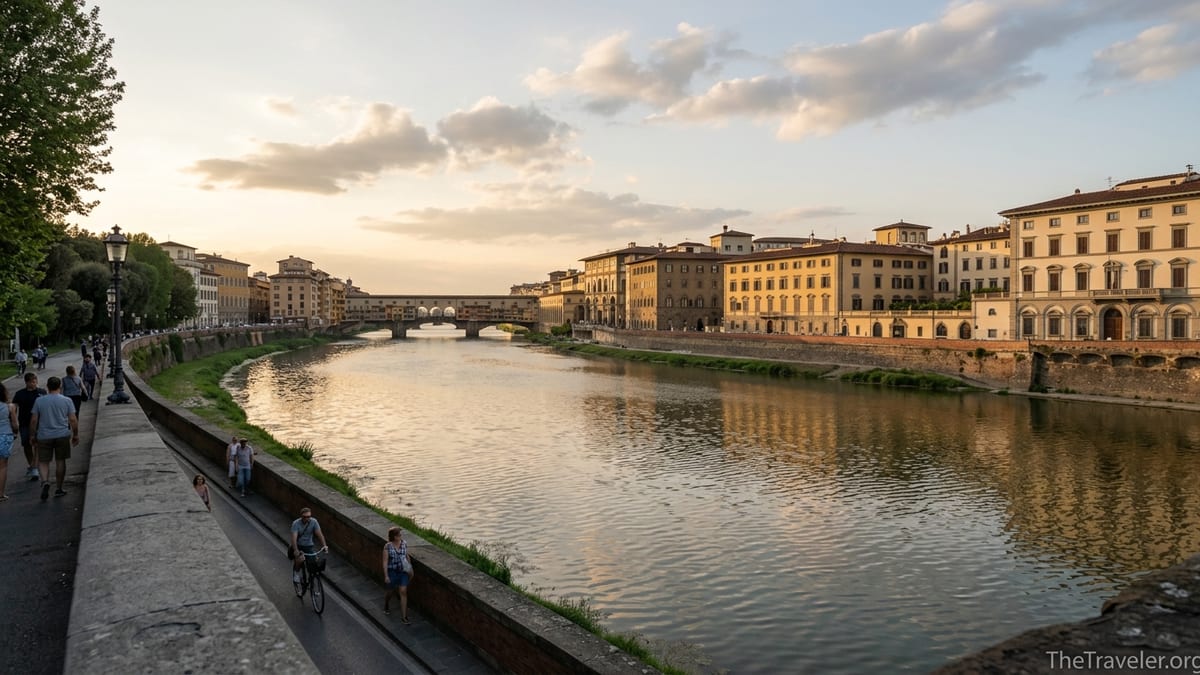
Stand on Florence’s Ponte Vecchio at sunset and it is easy to think you have “seen” the Arno. Soft orange light hits rows of ocher palazzi, and flat-bottomed boats glide beneath the bridge. Yet this is only a tiny fragment of a river that threads together much of Tuscany, touching cities like Florence and Pisa, industrial towns such as Pontedera, and quieter stretches where reed beds and herons replace church domes and traffic.
The Arno has always been central to Tuscan life. It carried wool and silk in medieval times, fed water to mills and workshops, and periodically flooded with enough force to reshape entire neighborhoods. Today, while its commercial function has faded, the river has become a stage for leisure and urban regeneration. Florence in particular has been pushing activities away from its saturated core and toward riverside spaces, from cycling paths along the lungarni to summer pop-up bars and cultural events near the water.
For visitors, this shift means that some of the most authentic moments in cities like Florence now happen at the river’s edge, not only in front of its bridges. Joggers on their pre-work run, families picnicking in Parco delle Cascine, students lingering on the parapets at twilight: all of these scenes show daily life in a way museum queues do not. Exploring the Arno, even for half a day, can balance an otherwise intense cultural program.
At the same time, the river is not an all-day destination for everyone. Outside urban centers, stretches can feel utilitarian, flanked by roads or light industry. Any decision to explore it beyond the famous views should weigh how much time you have, how active you want to be, and whether parks, bikes, and boats appeal to you as much as frescoes and wine bars.
Florence: The Arno as an Open-Air Living Room
If you are going to go deeper than bridge views, Florence is the natural place to start. Here the Arno curves through the historic center, with stone embankments called lungarni forming promenades on both sides. Walk five to ten minutes west from Ponte Vecchio and traffic noise quickly drops. You pass residential buildings, small neighborhood bars, and locals fishing from the stone steps down to the water.
One of the most rewarding ways to experience this stretch is on foot in the early morning or just before sunset. Leaving the crowded core near Piazza della Signoria, many visitors simply follow the river west past Ponte Santa Trinita and Ponte alla Carraia, then continue toward Parco delle Cascine. You will likely see commuters cycling into town, parents pushing strollers, and couples sitting on the low walls with takeaway espresso from small cafes just off the main streets. This feels less curated than the historic center yet remains within easy reach; from most points along the lungarno you are never more than a few blocks from a bus stop or tram line.
The city is also investing in riverside culture. In recent years, temporary summer venues with deck chairs and outdoor stages have appeared on some embankments, especially on the Oltrarno side. These are casual places where you might pay the price of an inexpensive spritz in exchange for live music and river views, rather than a formal cover charge. Exact venues and names change season by season, but the overall pattern is stable: Florence increasingly uses the Arno as a social spine, and travelers who linger along the river after dark often find a friendlier, more local atmosphere than in the crowded lanes around the cathedral.
For most visitors with two or three days in Florence, planning at least one unhurried riverside walk and one sunset outing along the Arno adds a different dimension to the trip. You are still in the city, but you are seeing how Florentines use the waterway as their communal living room rather than treating it purely as a scenic backdrop.
On the Water: Boat Tours, Rafting, and Kayaking
Seeing the Arno from the water is arguably the most compelling way to go beyond the bridges. In Florence, traditional flat-bottomed boats operated by historic renaioli crews offer short cruises that slip under Ponte Vecchio and other central bridges. Most outings last about an hour, typically scheduled in late afternoon and at sunset, and are priced in the range of a mid-level guided walking tour. Tickets bought through local agencies often bundle the cruise with a short stroll through the historic center, which can be useful if you want context as well as scenery.
These barchetto-style tours are low-key affairs. Boats usually carry a small group, and seating is on simple wooden benches without roof coverings, so bring a light jacket in spring or autumn and a hat in high summer. Some departures include a glass of wine or soft drink. They are particularly worthwhile if you are traveling with someone who cannot or does not want to walk long distances but still hopes to appreciate Florence from a different angle.
For active travelers, several operators now offer soft-rafting or kayaking on calmer stretches of the Arno within or just outside Florence. Morning departures often begin upstream where the current is gentle, then float past the historic center and finish near the western bridges. These half-day experiences typically include basic gear, an instructor, and a safety briefing, with prices similar to a small-group cooking class. Conditions can vary by season and rainfall, so flexible scheduling and checking the latest information with tour providers is essential.
Elsewhere along the river, particularly near Pontedera between Florence and Pisa, summer boat trips operate on quieter sections where willow trees and reed beds dominate the banks. Short cruises that run only on weekends or during local festivals give a sense of the Arno as a rural waterway rather than an urban backdrop. These are less widely publicized than Florence options and may suit repeat visitors or those staying in nearby agriturismi who want a low-key nature outing without long drives into the mountains.
Green Spaces: Parks, Paths, and Riverside Life
One of the strongest arguments for exploring the Arno lies in its parks. In Florence, Parco delle Cascine stretches for several kilometers along the north bank just west of the historic center. This is the city’s largest public park, with broad lawns, tree-lined avenues, and sports facilities. It began as a Medici hunting estate and has evolved into a green corridor that locals use for everything from birthday picnics to marathon training runs.
Visitors often reach Cascine from the center by walking or cycling along the lungarno, or by taking the tram that stops near the main entrance. Once inside, you can follow shaded paths that parallel the river, rent a bike from seasonal stands, or simply sit on the embankment watching rowers and the occasional fishing boat. On Tuesday mornings, parts of the park host a large local market where stalls may sell fresh produce, household goods, and inexpensive clothing, creating a scene that feels worlds away from the designer storefronts near Piazza della Repubblica.
Further downstream, closer to the confluence of the Arno and the Bisenzio rivers, Parco dei Renai near Signa offers a different kind of riverside leisure. This former quarry area has been redeveloped with small lakes, walking and cycling paths, and seasonal swimming zones. In summer, local families come for pedal boats, casual beach-style bars, and playgrounds. Travelers staying in Florence who are willing to make a half-day trip by regional train and short walk can escape city heat here and experience how residents of the broader Arno valley relax on weekends.
Beyond these larger parks, smaller riverside green spaces crop up in towns like Pisa, Empoli, and Cascina. They may not warrant a special journey on their own, but if you are passing through by train or car, allocating an hour to stretch your legs along the Arno can provide a welcome break from hill towns and highways. In Pisa especially, quiet spots by the water are only a short stroll away from the more congested streets leading to the Leaning Tower.
Cycling and Walking the Arno Valley
The Arno corridor is gradually becoming more attractive to cyclists and walkers. Around Florence, designated bike routes connect sections of the lungarno with Parco delle Cascine, then continue toward suburban neighborhoods and parks such as Parco dei Renai. The quality of infrastructure varies, but stretches close to the city are generally suitable for anyone comfortable riding in light urban traffic.
For visitors, renting a standard city bike or e-bike for half a day and following the river west from Florence’s center is one of the easiest active excursions. Rental shops typically charge about the price of a modest restaurant meal for a few hours, including a basic lock and sometimes a helmet. A simple itinerary might involve riding from the central lungarno to Parco delle Cascine, making a loop through the park’s avenues, then either returning the same way or continuing a bit farther downstream if you feel confident with route-finding.
Longer-distance cyclists sometimes follow informal Arno routes linking Florence with towns like Empoli and Pontedera, then onward to Pisa. These itineraries mix riverbank paths, farm roads, and low-traffic country lanes. They require more planning and a willingness to navigate changing surfaces, but the reward is a cross-section of Tuscany that many tourists never see: irrigation canals, small hamlets where roadside cafes offer simple panini and espresso, and occasional views back toward the Apennines or forward to the coastal plain.
Walkers can also benefit from riverside routes. A slow stroll along the Arno at the edge of sunset, especially in shoulder seasons like April, May, September, or October, can be an atmospheric way to decompress after crowded museums. Many hotels and guesthouses in Florence are within ten minutes’ walk of the river, so you do not need special equipment or maps. Simply stepping down to the lungarno and following whichever direction feels quieter can introduce you to a part of the city shaped more by local daily life than by souvenir stands.
Beyond Florence and Pisa: Small-Town Arno
Most visitors first meet the Arno in Florence and then again in Pisa, where it widens before bending toward the sea. Between and beyond these two cities, the river passes towns that rarely appear on standard itineraries yet can justify a stop if you are traveling by car or using regional trains. Places like Pontedera, Cascina, and San Giovanni Valdarno may not match the drama of hilltop centers like San Gimignano, but they show the Arno as part of a lived-in, working landscape.
Pontedera, for example, sits in the lower Arno valley and is known more for industry than for monuments. Yet its riverfront has been steadily improved, and in warmer months local organizations run occasional boat outings from simple docks near town. Joining one of these short cruises, often scheduled on summer weekends or during festivals, gives a sense of how the river once functioned primarily as a trade route and how it now serves recreation and environmental education.
Further upstream, in the direction of Arezzo, stretches of the Arno flow past vineyards and low hills. Here the river is closer in scale to a large country stream, with gravel bars and tree-lined banks. Visitors staying at agriturismi or wine estates near the valley floor sometimes have informal access to the water, whether for short walks or simply as a quiet place to sit at dusk. Local tourism offices in these smaller centers may have maps of short riverside trails or viewpoints that can be combined with winery visits or village sightseeing.
Is it worth planning a trip around these small-town sections of the Arno alone? For a first-time visitor with limited days, probably not. But for travelers who already know Florence and Pisa, or those building a slower, more region-focused itinerary using a rental car or bicycle, dipping in and out of the river corridor adds texture. It connects otherwise separate experiences into an understandable geography, showing how the same water that reflects Ponte Vecchio also irrigates fields and powers small hydroelectric works in the countryside.
Environmental Realities and Safety Considerations
Romantic views of the Arno can obscure a more complex reality. Like many European rivers running through dense urban and industrial areas, the Arno faces water-quality challenges, including runoff from agriculture and treated wastewater. Scientific studies and local monitoring agencies work to track and improve these conditions, and overall quality has gradually benefited from modern treatment plants and environmental regulations. Even so, most local authorities do not promote the central Arno as a casual swimming spot, especially within cities.
For visitors, this means the river is best experienced from boats, embankments, and designated recreational areas rather than as a place to jump in spontaneously. In summer, beach-style venues sometimes appear along the banks in and near Florence, with sand, deck chairs, and music. These are designed for sunbathing and socializing, not for full immersion. Where swimming is allowed in lakes or side channels, it is typically supervised or clearly signed, and lifeguards may be present during peak periods.
Flooding is another factor that shapes how the Arno can be enjoyed. Florence’s devastating 1966 flood remains a reference point in local memory, and while modern defenses reduce the risk of such catastrophic events, heavy rain in the Apennines can quickly raise water levels and alter currents. Boat operators are accustomed to adjusting schedules in response, sometimes canceling trips at short notice in case of strong flow or debris in the water. Travelers who book river activities should keep an eye on local forecasts, provide accurate contact details, and stay flexible.
Basic common sense goes a long way. Avoid descending unsupervised stone steps to waterside ledges during or after rain, as they can be slippery. Keep a respectful distance from the edge when taking photos, especially at night. If you are cycling or jogging along less lit stretches of the river early or late in the day, a small headlamp and bright clothing can improve visibility. None of this should deter you from enjoying the Arno, but it is worth remembering that this is a living waterway, not just a scenic lake in a park.
The Takeaway
So, is the Arno River worth exploring beyond the famous bridge views? For many travelers, the answer is yes, provided expectations are realistic. The Arno will not replace the Uffizi or the Leaning Tower as headline attractions, and long rural stretches can feel modest compared with dramatic Tuscan hillscapes. Yet as a thread running through Florence, Pisa, and the surrounding valley, the river quietly shapes many of the region’s most authentic urban and suburban experiences.
If you have limited time in Florence, think of the Arno as a complementary layer. An hour-long traditional boat ride at sunset, a riverside aperitivo on the lungarno, or a stroll out to Parco delle Cascine can show you aspects of the city that pure museum-going misses. With more days and an interest in active travel, you can add cycling along the river toward Cascine or Signa, or perhaps a weekend boat trip in the lower Arno valley from towns such as Pontedera.
For repeat visitors or those building slower itineraries, using the Arno as a unifying feature helps connect individual destinations into a coherent whole. You begin to see Tuscany not just as scattered icons on a map but as a landscape organized around water: from the Apennine foothills where the Arno rises, through the palaces and bridges of Florence, past the palazzi of Pisa, and finally out to the Ligurian Sea. Engaging with the river on its own terms, even briefly, adds depth and context to what might otherwise be a purely postcard-level relationship.
In practical terms, the Arno rewards curiosity more than it demands devotion. You do not need to devote an entire trip to it, but giving the river a few focused hours beyond the bridge views can transform your understanding of the cities and countryside it ties together. For travelers who care as much about atmosphere and everyday life as about checklists, that alone makes the Arno well worth exploring.
FAQ
Q1. Is it safe to swim in the Arno River in Florence or Pisa?
Swimming in the central stretches of the Arno is generally not recommended due to currents, boat traffic, and water-quality concerns. Locals typically use the river for boating and riverside recreation rather than open swimming, and safer options are designated pools or supervised lake areas in nearby parks.
Q2. Are Arno River boat tours in Florence worth the cost?
For most visitors, yes. Traditional flat-bottomed boat tours offer a quiet, low-angle view of Florence’s bridges and palaces, often at sunset, and last about an hour. Prices are comparable to a guided walking tour and can be especially good value if you prefer relaxed sightseeing over dense museum visits.
Q3. How much time should I budget to explore the Arno in Florence?
You can get a meaningful sense of the river with two to three hours: one hour for a boat tour or leisurely walk near the center, and another for a stroll or bike ride toward Parco delle Cascine. Travelers with more time can expand this into a half day by including a market visit or riverside aperitivo.
Q4. Can I rent a bike to follow the Arno River?
Yes. Several rental shops in Florence offer city bikes and e-bikes by the hour or day. A common route follows the river from the historic center to Parco delle Cascine and back. Surfaces are mostly paved, and the ride suits anyone comfortable cycling in light urban traffic.
Q5. Is Parco delle Cascine worth visiting for short stays?
If you enjoy parks and people-watching, Parco delle Cascine is a good use of time even on a brief trip. It provides shade, open lawns, local joggers and families, and a different perspective on Florence. You can reach it quickly by tram or a riverside walk from the center.
Q6. Are there Arno activities suitable for children?
Yes. Family-friendly options include short daytime boat rides in Florence, cycling or scootering on the wide paths of Parco delle Cascine, and seasonal play areas and small lakes at Parco dei Renai near Signa. As always near water, close supervision is essential.
Q7. When is the best time of year to explore the Arno?
Late spring and early autumn are ideal. From April to early June and from September into October, temperatures are usually comfortable for walking, cycling, and outdoor seating, and river levels are often stable. Summer can be very hot, so early mornings and evenings work best.
Q8. Do I need to book Arno River tours in advance?
In peak months such as May, June, September, and early October, it is wise to reserve popular boat tours a few days in advance, especially sunset departures. Outside these periods, same-day bookings are often possible, but checking schedules ahead of time helps avoid disappointment.
Q9. Is it easy to reach riverside parks like Parco dei Renai without a car?
Parco delle Cascine sits within Florence and is easily reached by tram or a walk along the river. Parco dei Renai near Signa can be reached by regional train plus a short walk or taxi, so it is accessible without a car if you are comfortable using local public transport.
Q10. If I have only one evening in Florence, should I prioritize the Arno or museums?
With a single evening, many travelers enjoy combining both: an hour or two in a museum that stays open late, followed by a sunset walk along the Arno and perhaps a drink on the lungarno. If you have already visited major collections elsewhere, an unhurried riverside evening can be a rewarding alternative to more indoor time.