


More news on this day
Hundreds of passengers aboard Amtrak’s Silver Meteor spent more than 20 hours stranded in north Florida this week after a fast-moving wildfire near a key rail corridor forced the New York–Miami service to halt, highlighting how extreme drought and fire conditions are increasingly disrupting long-distance rail travel.
Get the latest news straight to your inbox!
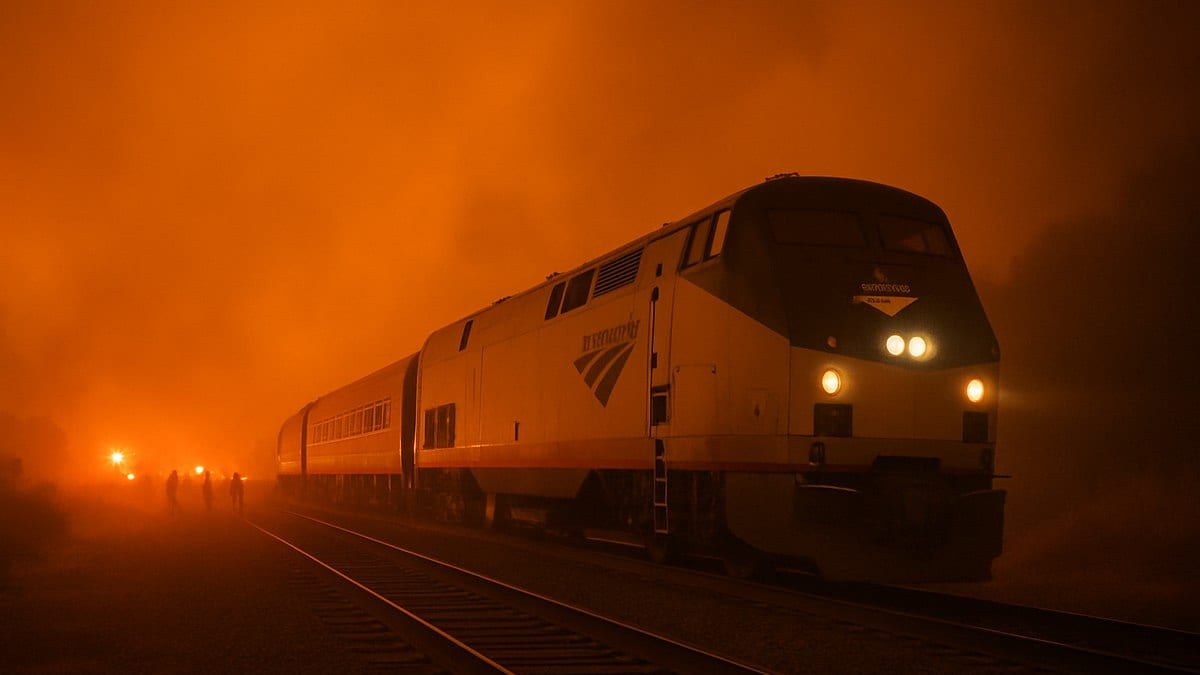
Train Halted as Railroad Fire Grows Along North Florida Line
Reports indicate that the delay unfolded as the so-called Railroad Fire burned along the border of Clay and Putnam counties in north Florida, an area where the Silver Meteor’s north–south route closely parallels active wildfire zones. Publicly available information from state wildfire trackers shows that the blaze, which started over the weekend, quickly expanded to more than 4,000 acres, prompting rail closures and operational slowdowns across the region.
According to published coverage and passenger accounts, a Silver Meteor train running through central and north Florida was ordered to stop as conditions worsened, with smoke, shifting winds and active firefighting operations making it unsafe to continue. The halted train remained on or near the main line for much of a day and night, as crews monitored the fire’s behavior and rail managers weighed options for moving equipment and people.
Travel blogs, local television outlets and social media posts describe a cascading disruption that began with the initial stoppage and extended into the following day. With the Railroad Fire continuing to burn and containment lines still being established, the Silver Meteor’s progress north was repeatedly delayed, turning what should have been a routine overnight leg into an ordeal that stretched beyond 20 hours.
By midweek, official wildfire updates showed higher containment percentages but also noted persistent hot spots near transportation corridors in the region. In response to the evolving situation, Amtrak adjusted schedules and modified where certain Florida trains would originate and terminate, limiting exposure to the worst-affected areas of north Florida.
Passenger Ordeal Highlights Onboard Service and Comfort Gaps
Accounts shared through social media posts and rail enthusiast forums suggest that conditions on board deteriorated as the hours passed. Some passengers reported shortages of food and bottled water, along with strain on onboard restrooms as the delay extended well beyond the train’s planned timetable. Several posts referenced air quality concerns inside the cars as smoke from the nearby wildfire drifted over the immobilized train.
While long-distance train crews are trained to handle routine delays, the extended halt in a semi-rural stretch of track appeared to expose gaps in contingency planning for extreme, wildfire-driven disruptions. Commentators in passenger-rights circles pointed to the difficulty of resupplying a stopped train that is not at a station, especially when nearby roads are also busy with emergency vehicles responding to the fire.
Publicly available posts from travelers described frustration with information flow as the delay lengthened. Some passengers recounted receiving periodic updates about the wildfire and rail traffic, while others said timetables for when the train might move again remained vague. In the absence of clear arrival estimates, travelers juggling connections, work obligations or medical needs were left to improvise.
Despite the challenges, reports indicate that most passengers remained on board until the route partially reopened and the Silver Meteor could proceed north to larger population centers, where alternative transportation options were more readily available. A handful of riders described arranging ride-share trips or private pickups once the train reached an accessible road crossing or station area, underscoring the improvisational choices some travelers felt compelled to make.
Network-Wide Disruptions and Service Changes Across Florida
The delays on the Silver Meteor came amid broader disruptions across Amtrak’s Florida services tied to the same wildfire outbreak. According to published schedules and corporate statements cited in media reports, the company temporarily canceled its Auto Train service between Sanford, near Orlando, and Lorton, Virginia, and truncated some Silver Meteor trips to start or end in Jacksonville instead of South Florida.
Other long-distance routes connecting Florida to the wider national network were also affected, with one Miami-to-Chicago service rerouted to begin and terminate farther north while the worst wildfire conditions persisted. Replacement buses were used on certain segments where highways remained open but rail traffic was halted, illustrating the patchwork of contingency options available when extended track closures occur.
Travel-industry analysts noted that these cascading changes can compound delays for days after an initial incident, as trainsets, crews and station staff are left out of position. Once the Railroad Fire forced closures in north Florida, trains and personnel that would normally cycle along the East Coast found themselves stranded or redeployed, complicating recovery efforts even after conditions along the line began to improve.
For passengers, the operational reshuffling translated into missed connections, last-minute bus transfers and altered boarding points. Online booking tools and third-party travel agencies reflected multiple schedule changes over several days, and rail watchers observed that northbound and southbound Silver Meteor runs remained vulnerable to further disruption as wildfire activity evolved.
Drought, Fire Season and Growing Climate Pressures on Rail
The disruption to the Silver Meteor is unfolding against a broader backdrop of historic drought conditions in parts of north and central Florida. According to publicly available drought-monitoring data, portions of the region entered the highest categories of dryness ahead of April, creating a landscape of stressed vegetation where even small ignition sources can quickly spark fast-moving fires.
State forestry updates and regional news reports have emphasized that the 2026 fire season in Florida began early and aggressively, with multiple large blazes burning at once across the peninsula. In this context, a mainline railroad threading through pine forests, grasslands and rural communities finds itself increasingly exposed to sudden closures whenever smoke, flames or firefighting operations intersect with the tracks.
Transportation experts and climate researchers have long warned that extreme weather and climate-linked hazards can have outsized effects on linear infrastructure such as railways. In the case of the Silver Meteor, the north–south spine that links Florida to the Northeast Corridor must contend not only with wildfires, but also with flooding, heat-related track stress and severe storms that can affect signals, power and right-of-way conditions.
For long-distance passengers, these pressures translate into a higher risk of major delays, even on routes with longstanding reputations for reliability. Observers note that the north Florida wildfire incident may join a growing list of climate-inflected disruptions to cross-country travel, prompting fresh scrutiny of how rail operators, public agencies and communities plan for and respond to hazards that can shut down key corridors for a day or longer.
Questions Raised Over Customer Care and Future Preparedness
In the wake of the north Florida incident, travel commentators and rail advocates are focusing on two parallel issues: protecting passengers during multi-hour emergencies and hardening the rail network against recurrent climate and wildfire threats. Comment sections and opinion pieces following the recent delay have questioned whether existing customer-care policies adequately address situations in which passengers are confined to a train for 20 or more hours without the ability to disembark easily.
Consumer advocates argue that clearer standards for food, water, medical access and sanitation during extraordinary delays could help prevent onboard conditions from deteriorating when trains are stuck away from stations. Discussions in rail forums also highlight the importance of transparent communication, suggesting that frequent, detailed updates can mitigate some of the anxiety and confusion that arise when passengers lack reliable information about when they will move again.
On a network level, transportation planners point to the Silver Meteor disruption as a case study in the need for more robust contingency planning in wildfire-prone regions. Potential measures described in public policy discussions include pre-identified detour routes where alternative tracks exist, improved coordination with wildfire management teams, and expanded agreements with bus and aviation partners to move stranded passengers when rail closures persist.
As the 2026 wildfire season continues, travelers heading through north Florida are being encouraged by travel advisers to monitor conditions closely, check train status frequently before departure and consider flexible itineraries that account for the possibility of sudden, fire-related delays. For passengers on the Silver Meteor and other long-distance services, the north Florida stranding serves as a reminder that scenic rail journeys across a changing climate now come with a growing set of variables.