


More news on this day
Georgia’s role on the Europe–Asia “Middle Corridor” has gained fresh momentum after the World Bank approved a 372 million dollar Trans-Caspian Transport Corridor project for the country, coinciding with domestic rail upgrades that are already shortening journeys between Tbilisi and the Black Sea coast.
Get the latest news straight to your inbox!
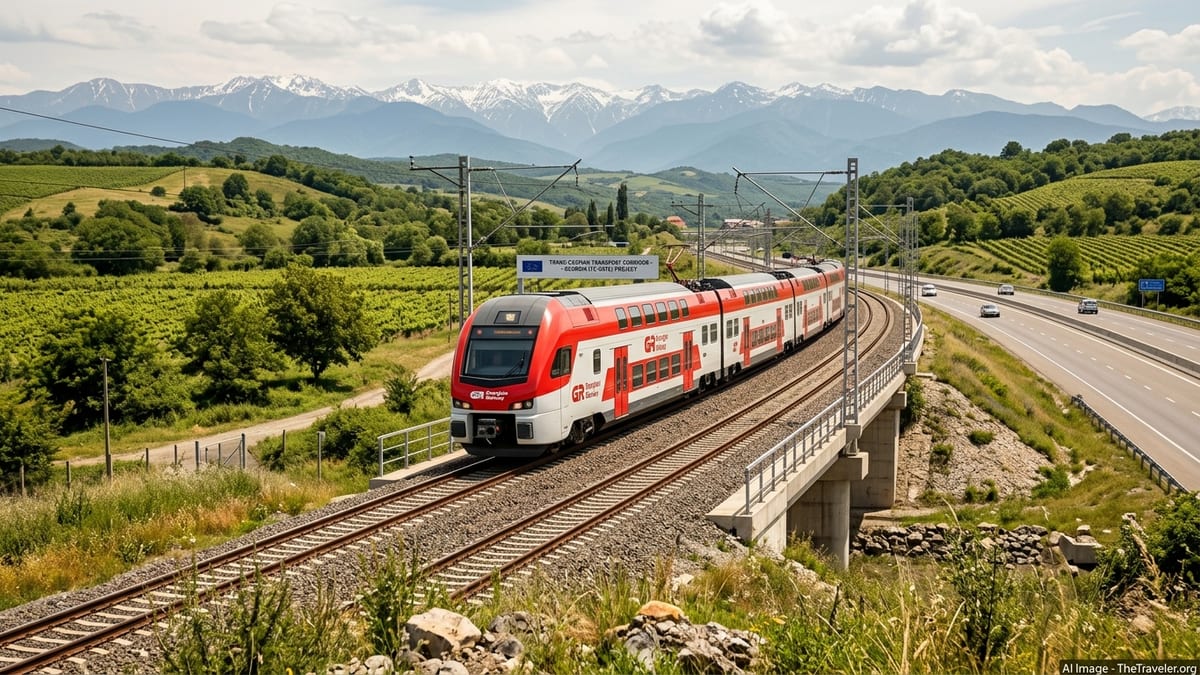
World Bank’s TC-GATE Project Targets Georgia’s Middle Corridor
The World Bank’s Board of Executive Directors approved the Trans-Caspian Transport Corridor – Georgia Accessibility and Transport Enhancement (TC-GATE) Project for Georgia on 2 June 2026, with total financing of 372 million dollars. Public World Bank financing data confirm the project and loan amount, listing it as focused on the Trans-Caspian Corridor segment in Georgia. Although a detailed project breakdown is technical, official environmental and social documents show that both the Roads Department and Georgian Railway are implementation agencies, indicating investment in selected road and rail links rather than a single line or station.
The TC-GATE project is at the loan approval and early implementation stage. World Bank documentation sets out obligations for Georgia on environmental and social management and confirms that works will be carried out over several years, not immediately transforming services for passengers. The government has framed the corridor investment as a way to strengthen freight flows between Europe and Asia while improving domestic accessibility, including safer and more reliable links between regions and major cities that also serve tourists.
Faster Tbilisi–Batumi Trains and Domestic Rail Rehabilitation
Separate from TC-GATE but closely related for travelers, Georgia has been upgrading its principal east–west railway. In an April 2026 statement, the Ministry of Economy said rehabilitation of the Tbilisi–Batumi and Tbilisi–Akhaltsikhe lines was scheduled for completion by August 2026, with a target Tbilisi–Batumi journey time of roughly four hours and significantly shorter times toward Akhaltsikhe. By early August, the Economy Ministry and Georgian Railway reported that travel time on the Tbilisi–Batumi route had in fact been reduced from about five and a half hours to around four hours following completion of major track works on the central corridor.
Recent government and company communications describe full rehabilitation of the Tbilisi–Batumi section, including removal of earlier speed restrictions and reconstruction at several stations. Local travel advisories and booking sites now quote train schedules of about four hours between the capital and Batumi, though some still show legacy times, so travelers should pay close attention to the specific departure they book. For the Tbilisi–Akhaltsikhe corridor, authorities have reiterated the goal of halving journey times, but as of November 2026 detailed new timings are less widely published and may vary by service as works are phased in.
New Intercity Trains and Formal Passenger-Rail Support
To match infrastructure upgrades, Georgia is preparing to renew its intercity rolling stock. In late 2026 the Asian Development Bank (ADB) published an Invitation for Bids for contract GEO/EMU/01 covering the procurement of electric multiple units with 10 years of technical maintenance for Georgian Railway, under an ADB-financed Georgian Railway Rolling Stock Project. Earlier official and business reports had described a plan to acquire 10 new electric passenger trains with backing from ADB, and the formal tender confirms that this procurement is now under way, rather than just an aspiration.
Government statements over 2025 and 2026 have linked these new trains to routes including Tbilisi–Batumi, Tbilisi–Poti, Tbilisi–Zugdidi and Tbilisi–Kutaisi, aiming to increase capacity and improve comfort on key intercity corridors. Delivery timelines referenced in planning documents and press briefings suggest a window of roughly 18 months from contract effectiveness, but the exact in-service date will depend on the outcome of the current tender. Travellers over the next two to three years may therefore see a gradual introduction of new trains alongside the existing Stadler units, rather than an overnight fleet change.
On the institutional side, Georgia has also formalised its approach to passenger rail. In June 2024 a direct public service contract between the Rail Transport Agency and Georgian Railway came into force for passenger services, effectively defining the state-backed public service obligations on key routes. This framework is important for tourists because it underpins the continued operation of socially important services, even where they are not commercially profitable, and provides a clearer basis for planning timetables and rolling stock investments.
Positioning Against Other Middle Corridor Upgrades
Georgia’s moves are unfolding alongside rail investment programs in neighboring corridor countries. Azerbaijan and Kazakhstan have each advanced capacity-boosting works on their Trans-Caspian segments, including track upgrades, additional passing loops and terminal improvements, according to recent government transport reports and project updates from international lenders. The European Union and the OECD have also published corridor studies over the past two years assessing bottlenecks on the so-called Middle Corridor and have earmarked funding for selected upgrades in the South Caucasus and Central Asia.
These parallel efforts do not amount to a uniform regional rail boom, but they do mean that Georgia’s TC-GATE project and associated national works are being planned within a broader, data-driven programme of corridor improvements. For overland travellers this matters less for any single new train and more for the medium-term prospect of more predictable freight and passenger flows, more interoperable border crossings and better-coordinated schedules between Georgia, Azerbaijan and onward links to Central Asia and Türkiye.
What Rail Travellers Can Expect in the Next Few Years
In the near term, the most tangible change for visitors is on the Tbilisi–Batumi route, where current official statements and timetable-based guides indicate a journey time of about four hours. This makes the train a faster and more comfortable option than in previous years, especially during the Black Sea summer season when road traffic can be heavy. As rehabilitation of the Tbilisi–Akhaltsikhe line progresses, travelers heading toward Akhaltsikhe and nearby heritage sites such as Rabati Fortress can expect shorter rail journeys, although exact timings will need to be confirmed at the time of booking.
Over the next two to four years, the combination of TC-GATE corridor works, the ADB-supported intercity train procurement and the public service contract framework is expected to support more frequent or more reliable services on core intercity routes including Tbilisi–Poti, Tbilisi–Zugdidi and Tbilisi–Kutaisi. However, these benefits will arrive gradually and may be uneven from year to year as construction and testing disrupt schedules. For now, most fares, booking channels and basic service patterns remain similar to recent years, and travellers still need to check train numbers, seasonal variations and any ongoing engineering works close to their travel dates.
Because TC-GATE is a long-term infrastructure and institutional project, its full impact on international overland journeys between Europe, the South Caucasus and Central Asia will only emerge over time. Those planning complex rail itineraries that cross from Georgia into Azerbaijan or Türkiye should continue to verify cross-border services, connection times and ticketing arrangements shortly before departure. As new procurement and construction milestones are reached, official railway and government channels are likely to provide the first reliable indication of additional trains, revised journey times or new booking options.