


More news on this day
A rare nationwide FAA ground stop on November 13, 2026, has intensified scrutiny of America’s aging air traffic control network just as tens of millions of travelers head into the Thanksgiving and Christmas rush, with operations largely back to normal but political fallout and lingering disruption risks shaping how airlines and passengers plan the holidays.
Get the latest news straight to your inbox!
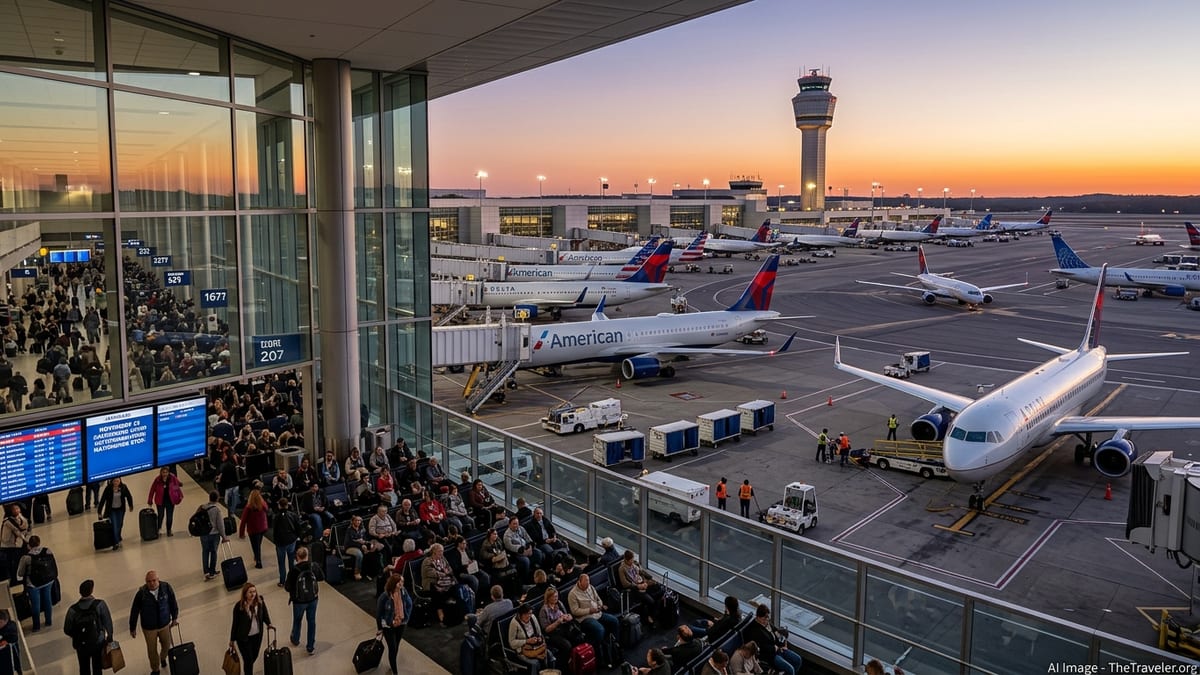
What Failed on November 13 and What We Know So Far
On Friday, November 13, the Federal Aviation Administration ordered a nationwide ground stop affecting all U.S. airports after its telecommunications network became unstable, interrupting some radar and radio services at multiple Air Route Traffic Control Centers and related facilities. The halt, which lasted roughly four hours and forty-five minutes before being lifted that evening, was described by the agency as a safety measure taken out of an abundance of caution while controllers worked with degraded but still partially functioning systems.
FAA statements and a subsequent Department of Transportation briefing attribute the disruption to problems within aging network infrastructure interacting with ongoing modernization work, not to a cyberattack. Early findings point to overloaded legacy switches and router hardware at several FAA sites that began generating unusually high volumes of network traffic, destabilizing communications and radar feeds at 17 of the nation’s 22 en route centers and several terminal radar facilities. Officials stress that these conclusions remain preliminary while contractors and federal investigators complete a technical root-cause analysis.
Transportation Secretary Sean Duffy and FAA Administrator Bryan Bedford have both emphasized that there is currently no evidence of a malicious intrusion, and federal summaries explicitly separate the November 13 failure from other recent IT incidents and from the FAA’s new SMART AI decision-support tools. Several congressional oversight letters, however, underline concern that decades-old copper networks and early-2000s-era hardware remain embedded in critical systems, raising questions about how quickly vulnerable components can be replaced without further disruption.
How Quickly the System Recovered
According to an FAA question-and-answer briefing on the incident, the airspace system returned to full operational status over the weekend following the Friday ground stop. Controllers kept existing flights moving during the outage using remaining radio channels and radar feeds, while newly departing flights were held on the ground until network stability was restored. Once the stop was lifted, priority was placed on clearing backlogs at major hubs and restarting normal traffic flows through the affected centers.
Even after the technical fix, knock-on effects continued through at least Sunday, November 15, and into Monday, November 16, as airlines repositioned aircraft and crews and worked through stranded passengers. The FAA reports that more than 12,000 flights were canceled on November 13 alone, the majority by major carriers, with additional delays and cancellations over the following two days as schedules were reset. Airport and FEMA situation reports describe the system as largely stabilized by early in the week of November 16, though some localized delays persisted where staffing and aircraft were out of position.
The rarity of such an event has drawn particular attention. Modern U.S. aviation has seen nationwide groundings only twice before: after the September 11, 2001 attacks and during the January 11, 2023 NOTAM system outage, both shorter than the 2026 stop. That history underscores both how unusual the November 13 decision was and why authorities were willing to accept major disruption rather than risk reduced safety margins while key communication links were unstable.
Airline Waivers and What Protection Travelers Have Now
Major U.S. airlines responded to the ground stop with nationwide travel alerts and fee waivers for affected customers, layered on top of standard federal passenger protections. American Airlines, for example, issued a travel alert covering trips scheduled between November 13 and 15, allowing customers to change their itineraries without change fees if they rebooked by November 15. In an operational update last revised at 11 p.m. on Sunday, November 15, the carrier said its travel alert remained in effect and confirmed that customers whose flights were canceled could request refunds.
Other large airlines issued similar, though not identical, policies, generally allowing fee-free rebooking within a defined date range and in the same cabin, subject to available seats. These measures were discretionary responses to an FAA-mandated safety action rather than obligations triggered by airline-controlled disruptions such as crew scheduling problems. As a result, specific rules varied by carrier, and travelers were required to use official airline channels or apps to confirm eligibility.
For passengers looking ahead to Thanksgiving and Christmas, the key practical point is that no blanket federal compensation scheme automatically applies if another ATC-related ground stop occurs. Airlines may again choose to extend change-fee waivers or offer refunds, but they are not required to provide compensation for delay-related costs in the way some foreign regimes mandate. Travelers should therefore review their carrier’s contract of carriage, check current travel alerts frequently, and consider trip insurance or premium credit card protections if they are concerned about cascading disruptions around holiday peak days.
Holiday Forecast: Busy but Not Broken
Despite the shock of the November 13 ground stop, the U.S. air travel system is currently operating normally at a national level heading into Thanksgiving week. FAA and DOT briefings describe the telecommunications problem as an acute event, with stability restored and targeted mitigation steps in place while the technical investigation continues. There is no forecast of another nationwide ground stop, although officials have acknowledged that additional problematic hardware may still be in service pending planned upgrades.
AAA’s latest Thanksgiving outlook, released on November 16, projects about 81.5 million Americans will travel at least 50 miles from home between Tuesday, November 24 and Monday, November 30, a slight decline from last year but still near record levels and above pre-pandemic volumes. Within that total, nearly 6 million travelers are expected to fly over the seven-day period. News coverage and interviews with passengers suggest that the ground stop has led some families to build in longer buffers at the start of trips or to consider driving instead of taking short-haul flights, though overall demand remains strong.
For travelers, the realistic expectation is heavy crowds, largely full flights and limited same-day alternatives if a flight is canceled, especially at already busy hubs. Airlines are still fine-tuning crew and aircraft positioning after the outage, and air traffic facilities are incorporating lessons learned into operating procedures and network monitoring, which could occasionally slow traffic flows in specific regions even without a headline-grabbing shutdown.
Practical Tips for Flying Through Thanksgiving and Christmas
Given the combination of a recent system shock and very high holiday demand, travelers with upcoming flights should take extra steps to protect their plans. Checking airline apps frequently in the 24 hours before departure can reveal early opportunities to move to less congested connections or to take advantage of any new waivers. Building longer connection times at major hubs, especially in the Northeast and Midwest where congestion is common, can reduce the risk of missed onward flights if there are minor ATC-related delays.
Passengers should also be prepared for limited rebooking options if a flight cancels on peak days, since most seats are already sold. Same-day standby may be constrained, and overnight stays can be required if crews or aircraft are out of position. Because ATC safety ground stops sit in a gray area between classic weather disruptions and airline-controlled problems, travelers should not assume automatic vouchers or hotel coverage and instead verify in real time what their particular carrier is offering in response to a given interruption.
Looking beyond Thanksgiving toward Christmas and New Year’s, the core unknowns are the final technical findings from the FAA’s investigation and how quickly Congress responds to Secretary Duffy’s request to boost dedicated air traffic control modernization funding from an already appropriated 12.5 billion dollars to roughly 50 billion dollars in additional support. For now, those debates will play out largely in Washington, while travelers’ most immediate tasks remain straightforward: monitor flights closely, allow more time than usual, and be ready to adjust plans quickly if localized ripples from November’s outage intersect with the busiest travel days of the year.