


Zadar is one of the most approachable places to start a Croatia trip. Compact yet historic, with a dramatic waterfront, inventive public art, and easy access to islands and national parks, it feels both relaxed and exciting at once. This guide focuses on what first-time visitors really need to know: how to get into town, where to stay and swim, what things cost in practice, and how to make the most of a few days in and around Zadar.
Get the latest updates straight to your inbox!
Where Zadar Is and Why It Works So Well as a First Stop
Zadar sits on Croatia’s central Dalmatian coast, roughly midway between Zagreb and Split. On a map, you will find it facing a dense archipelago of islands and looking out over the Adriatic Sea. This position makes it easy to combine Zadar with other Croatian highlights: by coach, it is usually about 3 hours to Zagreb and 2.5 to 3 hours to Split, and long-distance buses run several times a day in both directions. For many visitors flying in from elsewhere in Europe, it is an ideal starting point before continuing along the coast or inland to Plitvice Lakes National Park.
The city itself is split between the compact, historic Old Town on a small peninsula and the more modern districts on the mainland. First-time visitors usually stay in or around the peninsula, because most key sights, restaurants, and nightlife cluster there. Zadar is big enough to offer proper services, supermarkets, and accommodation choice, but still small enough that you can cross the Old Town on foot in 15 minutes. This balance tends to be less overwhelming than larger cities like Split or Dubrovnik, especially if it is your first trip to Croatia.
Another reason Zadar works well for first-timers is its rhythm. Cruise ships do call here, and it gets busy in July and August, yet outside peak season you will very likely see locals doing everyday errands alongside visitors on the main streets. Prices also reflect that everyday use: in many bakeries, a simple burek pastry might cost around 1.50 to 2.50 euros, and a coffee at a neighborhood café can be comparable. You will notice higher prices right on the waterfront promenade at sunset, but it is still very possible to eat and drink well on a mid-range budget.
Exploring Zadar’s Old Town: Roman Stones and Venetian Gates
The Old Town is where you will spend most of your time, especially if you only have a day or two. It is a pedestrian-friendly maze of pale stone streets, Roman ruins, and Venetian-era walls. One practical approach for first-time visitors is to enter through the Land Gate, a 16th-century triumphal arch set into the old city walls, and then work your way through a loose loop around the peninsula. From the Land Gate, you can quickly reach Five Wells Square, the city park on the old fortifications, and then drift downhill toward the Roman Forum.
At the Forum, you are standing on 2,000 years of history. Fragments of columns lie scattered on the ground, and steps form natural seating where people stop to rest with gelato. Right next to the Forum is the circular Church of St Donatus and the Cathedral of St Anastasia with its bell tower. Climbing the tower involves a series of narrow staircases, but on clear days you get a panoramic view across red-tiled roofs and the marina to the islands beyond. Many visitors time this for late afternoon to avoid the harshest sun and to catch the light softening over the sea.
Old Town Zadar is also where you will find everyday services that make travel easier. Supermarkets and small convenience stores are tucked into side streets. Local bakeries sell still-warm kifle and burek early in the morning. If you want a sit-down meal, traditional konobas just a few lanes away from the waterfront often feel more local and can be a few euros cheaper per main course than the prime-view terraces right on the promenade. For orientation, the main pedestrian street, Široka ulica (often just called Kalelarga), runs roughly east-west across the peninsula and is a useful reference point if you feel turned around.
The Sea Organ, Greeting to the Sun, and Zadar’s Famous Sunset
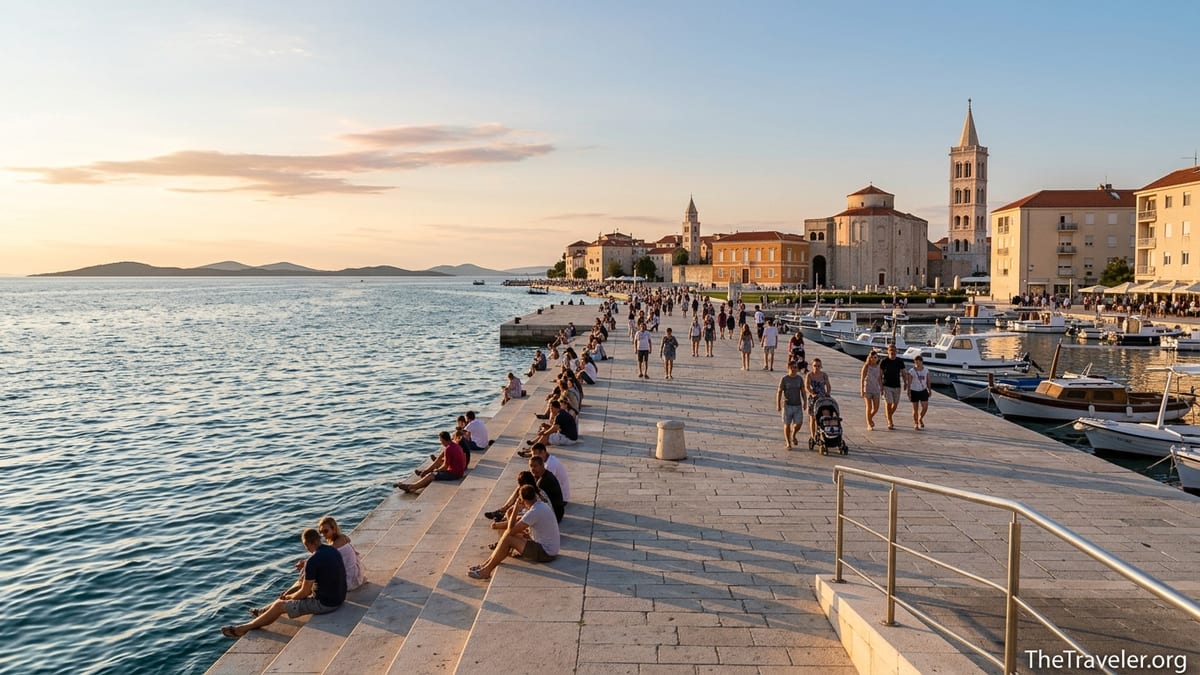
No first-time visit to Zadar is complete without spending time on the Riva, the seafront promenade on the western edge of the Old Town. Here you will find Zadar’s most distinctive modern landmark, the Sea Organ. Installed into a set of wide stone steps descending into the sea, the Sea Organ hides pipes and resonating chambers under the surface. As waves roll and boats pass, air is pushed through the pipes and creates soft, shifting chords. The sounds are never quite the same, and if you sit on the steps for 20 or 30 minutes you will notice the pitch change as the swell rises and falls.
Just a short walk from the Sea Organ is another open-air installation, the Greeting to the Sun. This is a large circular plate made of glass panels and solar cells embedded in the promenade. During the day, it simply looks like a bright disc set into the pavement. After sunset, the stored solar energy powers a dynamic light display that ripples across the surface in colored patterns. Families with children tend to linger here after dark, and visiting in the evening gives you a sense of how much Zadar’s public life revolves around the waterfront.
Travelers often hear that Zadar has one of the most beautiful sunsets on the Adriatic, and that reputation is not exaggerated on clear days. Practically speaking, this means the Riva can get crowded an hour before the sun goes down, especially in July and August. If you want a quieter spot, you can walk a little south along the promenade away from the Sea Organ, where there are still benches and sea views but fewer people taking photos. Alternatively, some visitors book short sunset boat trips that depart from near the footbridge connecting the Old Town to the mainland, giving you the same glowing sky from a different perspective.
Beaches and Swimming: Where to Get into the Adriatic
Although Zadar is primarily an urban destination, it offers several easy swimming spots. The closest proper beach to the Old Town is Kolovare, around a 10 to 15 minute walk along the waterfront heading southeast from the peninsula. The beach is a mix of pebbles and concrete platforms, with shade from pine trees in some sections. In summer you will usually find kiosks selling drinks and snacks, simple changing cabins, and showers. For a first-timer without a car, Kolovare is a straightforward place to take a morning or late-afternoon swim without needing to navigate buses or boat schedules.
To the northwest of town, the Borik area offers more resort-style options. Here you will find hotel complexes, beach bars, and sections of shoreline with loungers and umbrellas for rent. Prices vary by venue, but a couple can expect to pay a modest fee for two loungers and an umbrella for the day in high season. The water here is generally calm, and the atmosphere suits families who want facilities like playgrounds and cafés within a short walk of the sea. If you are staying in an apartment in one of Zadar’s northern neighborhoods, Borik may be more convenient than Kolovare.
As in much of Croatia, beaches around Zadar are predominantly pebbly or rocky rather than sandy, so water shoes can make getting in and out more comfortable, especially for children or anyone with balance issues. Many locals simply spread towels on the smooth rocks along the less developed stretches of coast, using metal ladders fixed into the concrete to climb in and out of the sea. This is very common on summer evenings when the heat eases and people come out to swim before dinner. First-time visitors sometimes expect large sandy expanses and are surprised; knowing the terrain in advance helps you pack the right footwear.
Food, Cafés, and How Much Things Tend to Cost
Zadar’s food scene combines classic Dalmatian seafood with more casual street options well suited to first-time visitors. On the seafood side, grilled fish such as sea bream or sea bass, black risotto made with cuttlefish ink, and octopus salad are staples on many menus. In a mid-range restaurant in the Old Town, a main seafood dish might typically run from the low to mid twenties in euros, depending on weight and type of fish. Meat dishes like ćevapi with onions and ajvar or slow-cooked pašticada with gnocchi usually cost a bit less. Portions can be generous, so sharing starters and a dessert can help manage both appetite and budget.
For quicker meals, bakeries, pizzerias, and simple grill stands are very useful. A large slice of pizza sold by weight in the Old Town might cost a few euros, and a takeaway sandwich from a bakery is generally in the same range. You will also see gelato counters on Kalelarga and near the Forum; a single scoop is typically just a couple of euros, and queues form in the evening as locals and visitors stroll together. It is entirely acceptable to eat ice cream while walking, and this is a common part of the evening promenade for families.
Café culture is strong, and coffee is an everyday ritual. Expect an espresso at a neighborhood bar to be cheaper than a cappuccino or latte at a prime seafront location, but even at the Riva many visitors find prices comparable to other European coastal cities. Sitting with a coffee for an hour is normal, and you are not usually rushed to give up your table. When it comes to tipping, rounding up the bill or leaving around 10 percent for good service in restaurants is customary but not mandatory. In very casual places, leaving the small coins from your change is appreciated.
Arriving in Zadar: Airport, Buses, and Getting Around
Zadar Airport sits roughly 10 kilometers southeast of the city. For first-time visitors, the two main ways into town are the airport shuttle bus and taxis or app-based rides. The shuttle bus typically runs in connection with flight arrivals and makes stops at the main bus station, the city ferry port, and near the Old Town. Recent guides indicate that tickets are usually in the range of 4 to 5 euros per person for a one-way journey, including luggage. The ride into town takes around 20 to 30 minutes depending on traffic, and tickets can often be purchased directly from the driver or the kiosk in the arrivals area.
Taxis and ride-hailing services such as Bolt also operate between the airport and city. A conventional taxi from the airport to the Old Town often costs somewhere around the mid-twenties to mid-thirties in euros, depending on time of day and traffic. Some travelers report that ride-hailing fares can be lower, especially outside peak hours, but you will need a data connection and the relevant app installed. It is wise to check the estimated fare in the app before confirming any ride and to be cautious about unlicensed drivers approaching you inside the terminal who quote vague or unusually low prices without using a meter.
Within Zadar, the Old Town is entirely walkable. For areas further out, local buses connect districts such as Borik and Diklo with the peninsula, and there is also a small rowing boat service called the barkajoli that ferries passengers across the short channel between the Old Town and the mainland near the market. Tickets for local buses are relatively inexpensive compared with taxis, but schedules may not appear reliably in mapping apps, so first-timers often ask at their accommodation or at the main bus station for up-to-date timetable information. If you are renting a car, be aware that parking on or very near the peninsula is limited and almost always paid, so many visitors choose to park slightly further away and walk in.
Islands and Day Trips: From Ugljan to Dugi Otok and Beyond
One of Zadar’s biggest advantages is its access to islands and national parks. Directly across the narrow channel lies Ugljan, often called the “green island” thanks to its pine forests and olive groves. Ferries from the city’s main port typically reach Ugljan in about 15 to 20 minutes, and recent price examples suggest that a one-way passenger ticket usually costs a few euros, varying slightly by season and departure time. Once on Ugljan, visitors can walk or cycle between small villages and swim from quiet coves that feel far removed from the bustle of the mainland, even on busy summer days.
Further out, Dugi Otok offers some of the region’s most striking coastal landscapes, including the white pebbles and turquoise shallows of Sakarun (often written Saharun) Beach and the cliffs of Telašćica Nature Park. Reaching Dugi Otok typically involves a ferry or fast catamaran from Zadar to ports such as Brbinj or Sali, with travel times of around 1.5 to 2 hours depending on the service. Organized day trips from Zadar, including boat excursions that stop at Sakarun, often cost in the range of several tens of euros per person and may include swimming stops, simple lunches, and basic snorkeling gear. For first-time visitors not comfortable planning ferry connections, these packaged day trips can remove much of the logistical stress.
Beyond the islands, Zadar also serves as a base for trips to national parks such as Kornati and Krka. Boat tours to the Kornati archipelago, a maze of uninhabited islands and cliffs, depart directly from Zadar or nearby marinas during the main season and usually last a full day. Excursions to Krka National Park often combine bus transfers with time to explore the park’s walking paths and viewpoints over its cascades. Prices for these tours vary with season, inclusions, and group size, so most travelers compare offers from several agencies in the Old Town before booking. When you speak with operators, asking clearly what is included in the advertised price, whether park entrance tickets are extra, and how long you actually spend at each stop can greatly reduce frustration later.
Practical Tips for First-Time Visitors to Croatia Using Zadar as a Base
For many travelers, Zadar is their first point of contact with Croatia, so a few practical notes help things go smoothly. Croatia’s currency is the euro, and while card payments are extremely common in hotels, supermarkets, and many restaurants, you will still find small kiosks, bakery windows, and market stalls that prefer cash. ATMs are widely available in Zadar, but using machines attached to major banks in the city center or at the airport is often a safer bet than standalone machines that may charge higher fees. When withdrawing, if the machine offers dynamic currency conversion into your home currency, declining that conversion and choosing to be charged in euros usually gives a more favorable rate.
English is widely spoken in Zadar’s tourism-facing businesses, and staff at hotels, restaurants, and tour agencies are used to dealing with visitors from across Europe and beyond. Learning a few basic Croatian words such as “hvala” for thank you and “molim” for please or you are welcome is still appreciated. When it comes to safety, Zadar generally feels calm, especially compared with larger European cities. Standard precautions apply: keep an eye on your belongings in crowded areas like the Riva at sunset and on packed buses, and store passports and surplus cash in your accommodation rather than carrying everything on you.
If you are planning to travel onwards in Croatia, Zadar’s main bus station connects you to most of the country. Long-distance coach operators such as FlixBus and national carriers run routes to Zagreb, Split, and other coastal towns. Booking tickets a day or two in advance during peak summer gives you more choice of departure times and avoids last-minute stress. On the day of travel, arrive at the station at least 20 to 30 minutes early to locate the correct bay, especially if you are unfamiliar with the layout or if announcements are made primarily in Croatian. For onward ferries to islands beyond Zadar’s immediate archipelago, checking potential summer schedule changes shortly before you travel is also wise.
Finally, pack with Zadar’s climate in mind. Summers can be hot and dry, with strong sun reflecting off pale stone in the Old Town and off the water along the Riva. A hat, high-factor sunscreen, and light clothing that covers shoulders are very useful, as are sandals that cope well with uneven cobbles and pebbly beaches. If you are visiting in shoulder seasons like May, June, September, or October, evenings can feel fresh by the sea, so a light jacket or sweater is worth the space in your luggage. This combination of sun, sea breeze, and old stone is part of Zadar’s charm, but it rewards travelers who arrive prepared.
FAQ
Q1. How many days should a first-time visitor spend in Zadar?
For a first visit, two full days in Zadar itself usually feels comfortable, letting you explore the Old Town, enjoy the Sea Organ and sunset, and fit in a relaxed beach session. Adding one or two extra days gives you enough time for at least one island or national park day trip without rushing.
Q2. Is Zadar a good base for exploring other parts of Croatia?
Yes, Zadar works well as a central base. From the main bus station you have regular coaches to Zagreb and Split, and from the port you can reach Ugljan, Dugi Otok, and other islands. Many travelers spend several nights in Zadar, take day trips to islands or nearby national parks, then continue down the coast.
Q3. How do I get from Zadar Airport to the Old Town?
The most common option is the airport shuttle bus, which normally meets incoming flights and stops at the main bus station, ferry port, and near the Old Town, with tickets typically a few euros per person. Taxis and ride-hailing services are faster and more flexible but usually cost several times more than the bus for the same journey.
Q4. Can I visit the Sea Organ and Greeting to the Sun at any time?
Both installations are free and open at all hours. The Sea Organ makes sound whenever there are waves or passing boats, while the Greeting to the Sun is most striking after sunset when its solar-powered lights come on. Visiting once by day and again after dark gives a very different feel.
Q5. Are there sandy beaches in or near Zadar?
Most beaches in and around Zadar are pebbly or rocky, including popular spots like Kolovare and Borik. If you strongly prefer sand underfoot, you may want to plan a day trip to certain bays on nearby islands, but even there many shorelines still mix fine pebbles with sand. Water shoes are a practical solution for most visitors.
Q6. Is Zadar suitable for families with children?
Yes, Zadar is generally family-friendly. The Old Town is mostly pedestrian, the waterfront has plenty of room for strollers, and children often enjoy the Sea Organ, evening light show at the Greeting to the Sun, and shallow sections of city beaches. Supermarkets and pharmacies are easy to find for everyday supplies.
Q7. Do I need to rent a car in Zadar?
You can comfortably explore the Old Town and nearby beaches without a car, using walking, local buses, and occasional taxis or ride-hailing. For more remote islands or inland areas, a rental car provides extra freedom, but many first-time visitors prefer organized day trips to avoid driving and parking in unfamiliar conditions.
Q8. Is Zadar expensive compared with other Croatian cities?
Overall, Zadar is often a little more affordable than very high-profile destinations like Dubrovnik, especially at peak times. Food, coffee, and accommodation prices do rise in July and August, and seafront locations charge a premium, but it is still possible to manage a mid-range budget by mixing restaurant meals with bakery lunches and avoiding the most touristy terraces.
Q9. When is the best time of year to visit Zadar?
The most comfortable times for many travelers are late spring and early autumn, when the weather is warm enough for swimming but the city is less crowded and prices can be slightly lower. July and August offer long, hot days and a lively atmosphere but also bring higher accommodation costs and more visitors at key sights and beaches.
Q10. Is Zadar safe for solo travelers?
Zadar generally feels safe for solo visitors, including those walking around the Old Town at night, which stays active around the waterfront during the summer season. Normal precautions are still important, such as watching your belongings in crowds and using reputable transport, but most solo travelers report feeling comfortable and welcome.