


Zadar is one of the Adriatic’s most atmospheric small cities, a compact peninsula where Roman ruins, Venetian walls and bold modern art installations all meet the sea. You can walk from 1st century forums to a 21st century sea organ in under ten minutes, then sit on warm stone steps as the sky turns orange over the islands offshore. This guide focuses on the essentials: the Sea Organ and Greeting to the Sun, the Roman Forum and Church of St Donatus, the city walls and Land Gate, the Riva promenade, the market, nearby beaches and the very best places to watch Zadar’s celebrated sunsets.
Get the latest updates straight to your inbox!
Sea Organ: Zadar’s Signature Soundscape
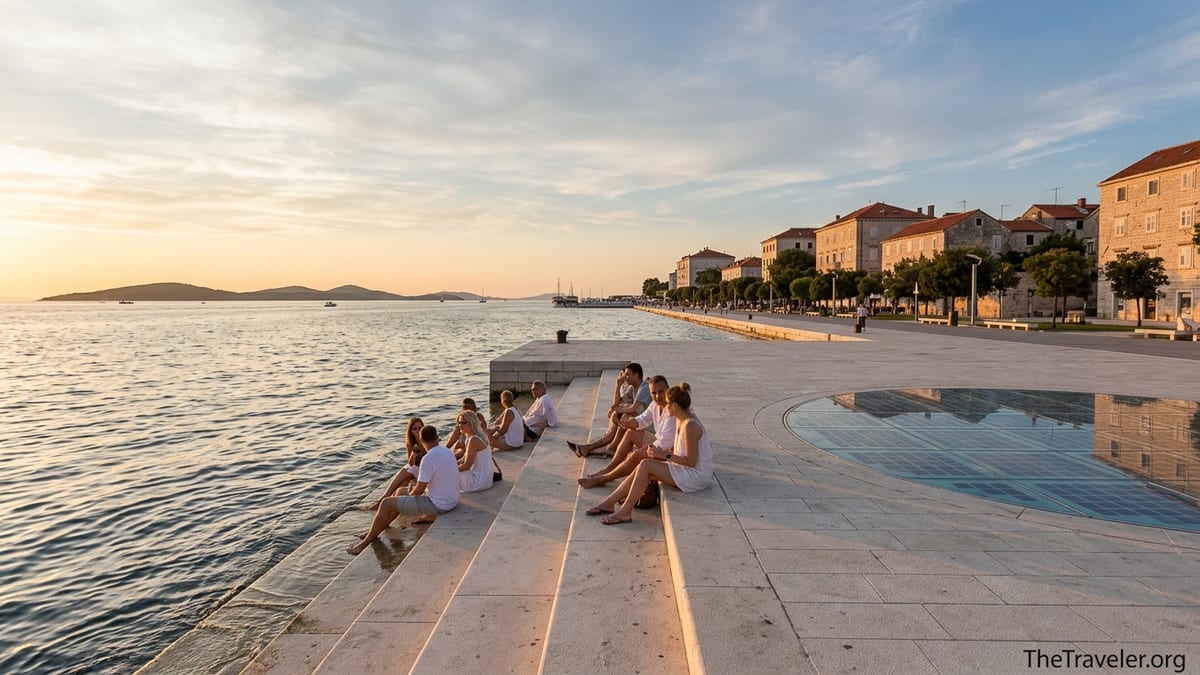
The Sea Organ sits at the western tip of Zadar’s Riva promenade and is the city’s most distinctive attraction. Built into broad marble steps that descend into the sea, it hides 35 pipes of different lengths and diameters that turn wave energy into a haunting, ever-changing melody. Sounds range from low sighs to bright whistles depending on the strength of the swell, so a breezy afternoon in June will sound quite different from a calm October evening.
In practice, visiting the Sea Organ is very simple: you come to sit. Locals in flip-flops, backpackers with gelato from a nearby kiosk and cruise passengers with lanyards all settle on the steps with their feet inches from the water. Many travelers aim for golden hour, about an hour before sunset in summer, when ferries cross the channel and the light catches the stone. If you are sensitive to crowds, come in the morning when the music is softer and there is more room to stretch out.
The Sea Organ is free, open at all hours and requires no reservation. You may see small signs asking people not to block the drainage grates, but otherwise you can sit almost anywhere. For photographs, stand slightly back on the higher steps so you can frame the people, stone and sea together; if you want to record the sound, move closer to the slots where the pipes release the air and keep wind noise in mind.
Families often bring children to watch the waves splash against the lower steps, but parents should keep a close eye when the sea is rough. There are no railings and the stone can get slippery in winter and on stormy days. Away from peak summer, you may have the place almost to yourself late at night, when the only sounds are the organ and distant church bells from the Old Town.
Greeting to the Sun: Light Show on the Riva
Just a few meters from the Sea Organ lies Zadar’s other contemporary icon, the Greeting to the Sun. This circular installation is set into the pavement of the promenade and consists of hundreds of glass plates with solar cells beneath. During the day it looks like a giant blue disc at the tip of the peninsula, but after sunset the surface slowly fills with moving patterns of colored light, synchronized loosely with the rhythm of the waves and the flow of people walking over it.
In high season, expect a lively scene from about 30 minutes after sunset onward. Children race through the lights, couples pose for silhouette photos and street performers sometimes play nearby. The experience is entirely free, so there is no ticket line, but if you want uncluttered photos arrive a little before official sunset and claim a spot at the edge of the circle, then wait as the sky darkens and the first lights appear.
Practical tips help here: wear non-reflective clothing if you plan to be in photos, since bright white can blow out in smartphone shots against the dark pavement. Photographers looking for the full effect often come with a tripod and shoot at wide angles to capture both the glowing circle and the horizon, but even handheld night-mode photos work surprisingly well. On windy evenings in spring and autumn, a light jacket is useful; you are fully exposed to sea breezes at this end of the peninsula.
Because the Greeting to the Sun is integrated into the public promenade, there are no opening hours in the formal sense. The installation is most impressive from late spring to early autumn when nights are warm and the waterfront is busy, but on clear winter evenings you can have an almost private light show with only a few locals passing by on their way home.
Roman Forum and Church of St Donatus: Layers of History
A five-minute walk inland from the Sea Organ brings you to the Roman Forum, the archaeological heart of Zadar. Laid out in the 1st century as the administrative and religious center of the Roman city, the space today is an open rectangle dotted with column bases, carved stones and fragments of ancient walls. Children balance on low pillars while walking tours pause in the shade to explain how the original temples were oriented, and local dogs nap on warm marble in the late afternoon.
Overlooking the Forum is the round Church of St Donatus, Zadar’s most recognizable building. Dating from the 9th century, it was constructed partly with reused stones from the Roman ruins beneath it, some of which you can still see in the lower walls and flooring. From the outside, its thick stone drum and simple windows feel almost fortress-like compared to the more ornate Baroque churches elsewhere in the city. Inside, the interior is usually bare, with occasional concerts taking advantage of the natural acoustics.
The area around the Forum is ideal for slow exploration. On one side stands the Cathedral of St Anastasia with its tall bell tower, which you can usually climb for a small fee, offering a textbook view over the red rooftops and out toward the islands. On another side you will find narrow alleys leading to cafés that serve espresso and simple pastries for a few euros, ideal for a mid-morning break between sights.
If you are visiting in peak summer, consider coming early, around 9 a.m., before heat builds on the stone. The Forum is mostly unshaded and can feel very hot by midday. Comfortable sandals or trainers are a better choice than thin flip-flops, as the ground is uneven and some stones are polished smooth from centuries of use.
City Walls, Land Gate and Old Town Streets
Zadar’s Old Town is still partly wrapped in imposing city walls, a reminder that this was once a key fortress of the Venetian Republic. Several stretches of wall are accessible on foot, with views toward the modern city and marina on one side and terracotta roofs on the other. Walking these sections at a leisurely pace gives context that is hard to grasp from ground level: you understand why the peninsula was so easily defended and how narrow the channel is to the mainland.
The most decorated entrance through these fortifications is the Land Gate, built in the 16th century. Carved with a lion of St Mark and flanked by ornamental columns, this gate once greeted merchants arriving by boat into the protected harbor. Today, many visitors first see it while crossing from the bus station area or parking at the edge of the Old Town. It is worth pausing here to look up at the carvings and imagine the traffic of soldiers, traders and pilgrims who once passed under the same stone arch.
From the Land Gate, you can wander into a maze of polished limestone streets that make up the Old Town. People’s Square is the everyday heart of the city, lined with cafés and often hosting small events in summer, from klapa (a cappella) singing evenings to local craft stalls. Prices at cafés here are typically a little higher than in the newer part of town, but still moderate by broader European standards, especially outside July and August.
Walking tours, many of them in English, often start either near the Land Gate or at the main square and trace a loop through the Old Town to the Forum, cathedral and waterfront. These can be a good value if you are short on time, packing centuries of history into a two-hour stroll, though independent travelers can also navigate easily with an offline map and a bit of curiosity.
Riva Promenade, Market and Everyday Zadar Life
The Riva, Zadar’s sea-facing promenade, is the city’s outdoor living room. It runs along the southern edge of the peninsula, shaded in parts by trees and backed by benches facing the channel. Locals come here to jog at sunrise, push strollers in the afternoon and meet friends for a pre-dinner drink in the early evening. Many visitors walk the full length at least once a day, often timing their stroll to end at the Sea Organ and Greeting to the Sun.
Just inland from the promenade, near the main bridge to the mainland, you will find Zadar’s central market. Mornings are the busiest, as vendors set up stalls piled with glossy tomatoes, local figs in late summer, greens from family gardens and fresh fish on ice in the covered hall. Even if you are staying in a hotel and not cooking, it is worth coming to see what is in season and to pick up picnic supplies such as cherries, olives or a wedge of Pag cheese. Small bunches of herbs and lavender sachets are popular low-cost souvenirs.
The market is one of the best places to observe everyday life beyond the tourist core. Older residents bargain over prices, restaurant buyers make quick bulk purchases and stallholders chat across aisles. Expect to pay in local currency or by card at better-equipped stands; cash still speeds up transactions. If you arrive after lunchtime many stalls will already be packing up, so aim for late morning rather than late afternoon.
Cafés and bakeries cluster around the market’s edges. A simple breakfast of a burek pastry filled with cheese or spinach and a strong coffee is inexpensive and filling, ideal before a day of sightseeing. From here, it is a short walk back to the Riva if you want to sit in the shade and watch ferries and small fishing boats move through the channel.
Beaches and Swimming Near the Old Town
Although Zadar is primarily a historic city break destination, it offers convenient places to swim within a short walk or bus ride from the Old Town. The closest option many travelers use is the stretch of concrete platforms and small pebble coves near the Kolovare area, about 15 to 20 minutes on foot from the Land Gate along the waterfront. Here you will find ladders into clear water, showers, and in summer simple beach bars selling drinks and snacks.
Further along the coast, family-friendly pebble beaches extend south, with sections offering shaded areas under pines and basic amenities like changing cabins. These spots do not have the dramatic cliffs or turquoise lagoons of more remote Croatian islands, but they are very practical if you have only an afternoon free. Water quality is usually good, though it is wise to avoid swimming immediately after very heavy rainfall when run-off can be higher.
Beach footwear is useful, as most of the shoreline is rocky or pebbled rather than sandy. Simple rubber or neoprene shoes, widely sold in local shops and kiosks, make it easier to enter and exit the water. Families with younger children often appreciate areas with gradual pebble entry instead of direct ladders from concrete, so it can be worth walking an extra five or ten minutes to find a suitable cove.
During July and August, expect beach areas closest to town to be crowded in the middle of the day. Early morning swims around 8 a.m. or late afternoon dips after 5 p.m. are calmer and more comfortable in the summer heat. Outside peak season, especially in May, June, September and early October, you may share stretches of shoreline with only a few locals.
Where to Watch Zadar’s Famous Sunsets
Zadar’s sunsets are part of local lore, often described as some of the most beautiful on the Adriatic, with the sun dropping behind a string of low islands on the horizon. The most popular vantage point is the Sea Organ area, where rows of people sit shoulder to shoulder facing west. On clear evenings in July, arrive at least 20 to 30 minutes before sunset if you want to sit on the lower steps closest to the sea.
For a slightly quieter experience, walk a few minutes north along the outer seawall beyond the Greeting to the Sun. Here, the crowds thin out, but you still hear the sea organ and see the same burning orange sky. Couples often bring a bottle of local wine and plastic cups to share as they watch, while solo travelers lean against the wall with a takeaway slice of pizza from one of the Old Town’s simple pizzerias.
Another perspective comes from the Riva on the southern side of the peninsula. You do not see the sun drop directly into the sea, but you watch the changing colors reflected on the water and on the facades of the Old Town. Some waterfront cafés and hotel terraces here advertise “sunset cocktails,” and while prices are higher than inland bars, they may still be reasonable for a one-off treat with a view.
If you prefer elevation, consider climbing the cathedral bell tower for the last entry time of the day if schedules allow. From the top, you can watch the shadows lengthen over the Forum and the Old Town while the sky over the islands shifts from yellow to pink. Always check locally for opening hours, as they can vary by season and weather conditions.
The Takeaway
What makes Zadar special is how compact and walkable its main sights are. You can move from Roman stones and medieval churches to a modern sound sculpture and a solar-powered light show in a single easy stroll along polished streets. The Sea Organ and Greeting to the Sun are must-sees, but they feel richer when framed by an understanding of the city’s deep history at the Roman Forum, St Donatus and along the UNESCO-listed walls and Land Gate.
Balancing your time between cultural landmarks, simple local experiences like the market and Riva, and a few hours at the beach will give you a rounded sense of the city. Build your days around the light: cool, quiet mornings for ruins and churches, late afternoons for markets and promenades, and every evening saved for the drama of sunset by the sea. With that rhythm, Zadar’s mix of old stones, contemporary art and everyday Dalmatian life reveals itself with very little effort.
FAQ
Q1. How much time do I need to see Zadar’s main sights?
Most travelers can see Zadar’s core highlights, including the Sea Organ, Greeting to the Sun, Roman Forum, St Donatus, Land Gate and Riva, in one full day, but two days allow a more relaxed pace with beach time and repeated sunset visits.
Q2. Is there an entrance fee for the Sea Organ or Greeting to the Sun?
No, both the Sea Organ and Greeting to the Sun are free public installations on the waterfront, open at all hours and accessible without tickets or reservations.
Q3. What is the best time of day to visit the Sea Organ?
The Sea Organ is atmospheric at any time, but early evening before sunset is especially popular as you can listen to the sounds while watching the sky change and boats pass by.
Q4. Can I go inside the Church of St Donatus?
Yes, the interior is usually open to visitors for a modest fee, and it occasionally hosts concerts; opening hours can vary by season, so check locally on the day you visit.
Q5. Are the Old Town streets and city walls suitable for people with limited mobility?
Zadar’s Old Town is mostly flat, but surfaces are polished stone and can be uneven or slippery, and access to some wall sections and towers involves stairs, so those with limited mobility should choose routes carefully and may wish to avoid climbs.
Q6. Where is the main market, and when is it open?
The central market sits just inland from the bridge connecting the peninsula to the mainland, and while exact hours vary, it is most active in the morning, with many stalls closing by early afternoon.
Q7. Are there sandy beaches in or near Zadar?
Most beaches close to Zadar are pebbly or built with concrete platforms and ladders; for softer or more natural shorelines, many travelers use buses or boats to reach nearby coastal villages and islands.
Q8. Is it safe to swim near the Old Town?
Yes, locals and visitors regularly swim from designated areas near Kolovare and similar spots, but it is important to enter the water at marked access points, follow any posted advice, and be cautious during rough seas or immediately after heavy rain.
Q9. When is the best season to visit Zadar for sunsets and comfortable weather?
Late spring and early autumn, roughly May to June and September to early October, often offer warm evenings, vivid sunsets and smaller crowds compared with the peak of July and August.
Q10. Do I need to join a guided tour to enjoy Zadar’s Old Town?
No, the Old Town is compact and easy to explore independently with a simple map, though guided walking tours can provide helpful historical context if you are interested in a deeper understanding of the sites.