


Few European sunsets feel as immersive as Zadar’s waterfront, where the sea quite literally sings and the pavement beneath your feet turns into a glowing galaxy of light. Greeting to the Sun and the Sea Organ sit side by side at the tip of Zadar’s old town peninsula, forming one of Croatia’s most memorable evening experiences. This guide shows you exactly how to time your visit, pair both attractions, avoid the worst crowds and capture striking photos, whether you are traveling solo, as a couple or with kids in tow.
Get the latest updates straight to your inbox!
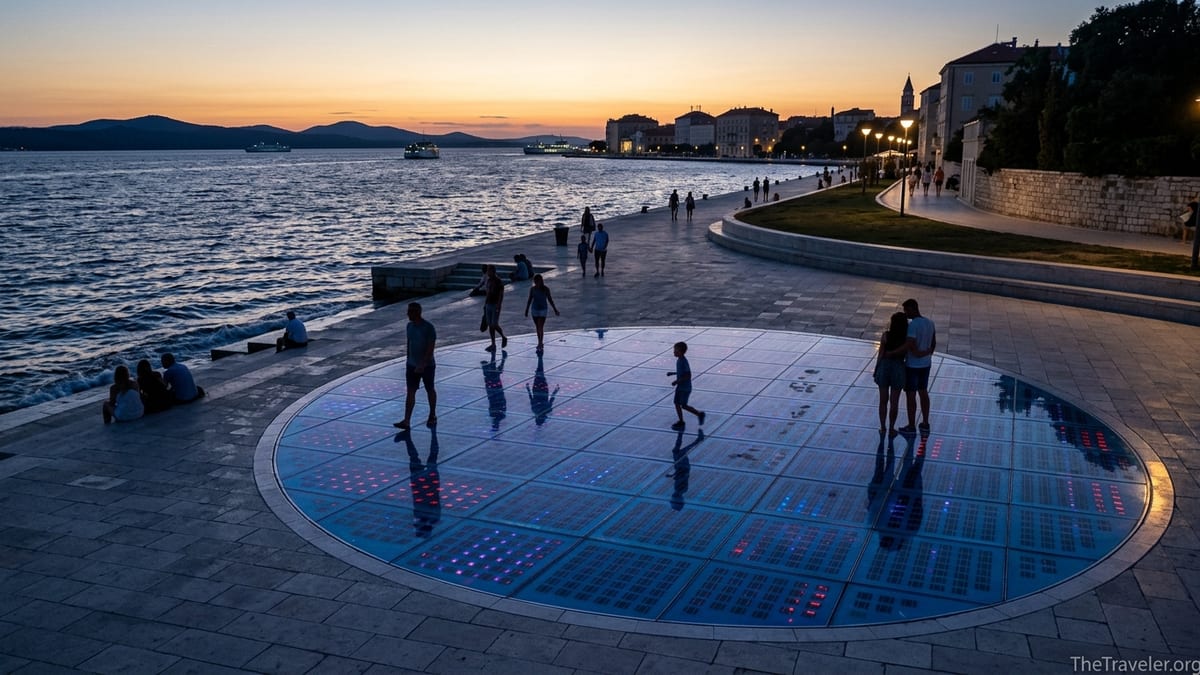
What Greeting to the Sun Actually Is
Greeting to the Sun, known locally as Pozdrav Suncu, is a circular solar installation set into the stone pavement on Zadar’s Riva waterfront promenade, at the northwestern tip of the old town peninsula. Designed by Croatian architect Nikola Bašić, it is made of around 300 multi layered glass panels arranged in a 22 meter wide disc that silently soaks up solar energy during the day and releases it as a vibrant light show after dark. In daytime it looks like a minimalist glass plaza, but once the sun sets the surface comes alive with shifting patterns of colored LEDs powered by the energy collected earlier.
The artwork also serves as a symbolic model of the solar system. The main circle represents the Sun, while smaller circles embedded in the nearby pavement trace out the other planets. During an early evening stroll you will see children hopping from one glowing “planet” to another while adults circle slowly around the main disc taking in the view of the islands on the horizon. The ring around the installation functions as a kind of calendar, with engraved names of local saints and details about the position of the sun on their feast days, adding an unexpected layer of astronomy and local culture beneath your feet.
Unlike a typical light show with fixed sequences, the visual rhythm here feels organic. The LEDs respond to the energy stored during the day and to programmed patterns that shift as night progresses, so no two evenings look exactly the same. On some nights the surface ripples in slow blues and purples, while on others sharp dots of red and green flash across the glass as though tracking an invisible constellation. For most visitors, the effect is less “spectacle” and more a slowly unfolding atmosphere that you experience while sitting, walking or playing on the disc rather than just watching from a distance.
Most importantly, Greeting to the Sun is fully public and free. There are no barriers, no tickets, and no fixed show times. You can walk straight across the surface at any hour, and in high season you will see everything from toddlers crawling along the illuminated segments to older locals using the circle simply as a place to sit, chat and look out over the Zadar Channel toward Ugljan Island.
Best Time of Day and Year for the Light Show
Because Greeting to the Sun runs on solar energy, timing is central to the experience. The installation begins to glow around sunset, but it only comes into its own once the sky is properly dark. In practice, this means planning to be on the waterfront from roughly 20 to 45 minutes before sunset until at least 30 to 60 minutes after. In June and early July, sunset in Zadar is typically around 8:45 to 9:00 pm, so the strongest colors appear closer to 9:30 pm and later. In April, May, September and October, sunset is earlier and the light show reaches full intensity by around 8:00 to 9:00 pm, which can be more practical for families with younger children.
The installation runs year round, but season shapes the mood. July and August are peak season: hot days, very busy evenings and a buzzing waterfront atmosphere. On a clear August night, the disc can be packed shoulder to shoulder just after sunset, with street musicians playing nearby and ice cream queues stretching back toward the old town. For a calmer experience with the same visual impact, consider late May, June or September, when evenings are warm but crowds are slightly thinner and accommodation prices are typically lower than high summer. Winter brings much shorter days and fewer visitors, yet on a crisp, clear January evening you might share the light show with only a handful of locals out walking their dogs.
Weather plays a role in the character of the show rather than its existence. The panels charge even on overcast days, though the colors can appear somewhat softer after very cloudy afternoons. Light rain does not stop the installation from operating and can actually create interesting reflections in the wet glass, but heavy rain or strong Bora winds sometimes thin out the crowds dramatically. On those blustery evenings you might get rare space to photograph the disc with very few people on it.
If photography is a priority, aim for the shoulder seasons of late spring or early autumn, and check the daily sunset time in advance. Arrive 45 to 60 minutes before the sun dips below the sea so that you can claim a vantage point for the sunset itself and then move gradually toward the disc as twilight deepens. Photographers often treat the evening in two phases: first shooting the golden and blue hour with the islands in silhouette, then focusing on the glowing surface and human silhouettes once the sky is dark enough for the LEDs to dominate.
Pairing Greeting to the Sun with the Sea Organ
One of the reasons this corner of Zadar works so well is that Greeting to the Sun sits just steps away from another contemporary landmark: the Sea Organ. Built into a set of broad stone steps that descend directly into the Adriatic, the Sea Organ hides a system of pipes and chambers beneath the promenade. As waves roll in, air is forced through the pipes, producing a continuous, gently shifting soundscape that ranges from low, meditative tones on calm days to a livelier, more playful melody when the sea is choppier. The two works were designed by the same architect and feel like counterparts, with the organ “playing” the sea in sound while Greeting to the Sun translates the sky into color and light.
For visitors, the smartest way to experience both in one evening is to plan a gradual progression rather than treating them as separate sights. A classic sequence looks like this: arrive at the Sea Organ 30 to 45 minutes before sunset, find a spot low on the steps or along the railing, and simply listen as the sound swells with the tide. As the sun nears the horizon, turn your attention westward to watch the sky behind the silhouettes of Ugljan and Dugi Otok islands. Once the sun has slipped below the sea and the sky moves from orange to deep blue, follow the flow of people a short distance north to the circular glass disc of Greeting to the Sun and watch as the first colors appear underfoot.
Because the attractions are only a short walk apart, you can easily move back and forth between them in a single evening. Many visitors, especially families, allow 20 to 30 minutes of quiet sitting time at the Sea Organ followed by another 30 to 45 minutes around the solar disc. A common real world pattern: an early dinner in the old town around 7:00 pm, strolling toward the waterfront by 8:00 pm, then lingering between the two installations until about 9:30 pm. Even in high season you rarely need transport; the entire route is walkable and flat, with plenty of benches along the promenade for pauses.
If you are visiting outside the main season, you can shift this timetable earlier. In October, for example, you might be at the Sea Organ by 6:00 pm, witness sunset around 6:30 pm, and then finish the evening at Greeting to the Sun by 7:30 or 8:00 pm. This flexibility makes the pairing suitable not only for summer holidaymakers but also for shoulder season city breakers using Zadar as a base for day trips to nearby islands or national parks.
How to Get There, Where to Stand and When Crowds Peak
Greeting to the Sun and the Sea Organ sit at the seaward end of Zadar’s old town, on the Riva promenade. If you are staying in the historic center, you can simply follow any narrow street west until you reach the sea, then turn right and walk along the waterfront for 5 to 10 minutes. From the Land Gate or the main square, the walk takes roughly 15 minutes at a relaxed pace. Travelers staying in modern districts across the harbor such as Borik or near the main bus station often take a local bus or a taxi to the old town and then continue on foot; rideshare prices from those neighborhoods usually range from the equivalent of a short city hop taxi fare in other mid sized European cities.
In terms of where to position yourself, adjust according to what you most want to capture. For the classic sunset view, sit on the Sea Organ steps facing out toward the open sea. This gives you an unobstructed horizon and full sound experience. For photos that include both attractions, look for a spot slightly elevated on the promenade behind the steps; from there you can often frame the Sea Organ in the foreground, Greeting to the Sun off to the right and the islands in the background. Later in the evening, move onto the disc itself to shoot close ups of patterns and reflections, or stand at the very edge of the circle and photograph people as silhouettes walking across the illuminated surface.
Crowds here follow a predictable pattern. In July and August, the walkway begins to fill from around 7:30 pm, with the half hour before sunset the busiest period on the Sea Organ steps. Immediately after sunset, many people drift toward Greeting to the Sun; this first 20 to 30 minutes of darkness is often when the disc is at its most packed. Families with younger children start to peel away around 10:00 pm, so if you prefer a more open disc for photography, coming back later in the evening can pay off even in high season. In May, June, September and October, the build up is gentler, and on weekdays you may find ample space even during the peak moments.
If your schedule allows, consider visiting twice: once on a clear evening for the “full show” and once between lunchtime and late afternoon. Daytime visits are vastly less crowded, and the disc itself becomes an appealing place to sit or lie down with a coffee to watch ferry traffic threading its way through the islands. Midday averages can be very hot from June through August, so early afternoon or late afternoon is often more comfortable, particularly for families or older travelers.
Photography Tips: Capturing Light, Color and Atmosphere
Photographing Greeting to the Sun and the Sea Organ is not only about the installations themselves but also about their context on the edge of the Adriatic. Start with the sunset. During golden hour, aim for wide shots that include the curve of the Riva promenade, anchored boats and the silhouettes of people sitting on the steps. A standard smartphone in landscape orientation can easily capture this, but if you have a mirrorless camera or DSLR, a 24 to 35 millimeter lens allows you to frame both the crowd and horizon without distortion. Shooting at a relatively narrow aperture such as f/8 keeps both foreground and distant islands acceptably sharp.
As twilight deepens and the Greeting to the Sun lights intensify, the challenge becomes balancing bright LEDs with the remaining ambient light. Smartphones handle this increasingly well, but you will get cleaner results if you tap to expose for the brightest part of the disc and let the surrounding sky fall a little darker. On a camera where you can adjust settings manually, consider starting with something like 1/60 second at f/2.8 to f/4 and raising ISO moderately. If you want light trails from people moving across the disc, experiment with slower shutter speeds like 1/4 or 1/2 second and brace your camera on the low surrounding wall rather than hand holding.
Perspective matters. Some of the most effective images of Greeting to the Sun use a high vantage point to emphasize its circular geometry. While you cannot climb any structure directly over the disc, you can walk a short distance back toward the old town and shoot from steps and slightly elevated platforms along the promenade. This allows you to catch the full circle, the curve of the Sea Organ and the dark strip of sea in one frame. Travelers with drones should be aware of local regulations and restricted zones around the peninsula; always check current guidance before launching, and keep in mind that the area is both busy and sensitive.
Do not forget detail shots. Once you have the postcard perspectives, move closer. Photograph reflections of children’s shoes or prams on the glowing panels, couples holding hands on the edge of the circle, or the engraved markings on the outer ring. On windy evenings, watch for spray from the waves reaching the lower Sea Organ steps, creating glistening surfaces that can mirror the lights from the disc in unexpected ways. Even a budget smartphone can capture these smaller vignettes if you get close enough and pay attention to where the strongest pools of light fall.
Experiencing the Installations With Children and Families
Greeting to the Sun is especially popular with families, and it is easy to see why. The huge glowing circle functions like an open air playground once the lights come on. Younger children run, dance and trace patterns, while older kids try to guess which smaller circles represent which planet. Parents and grandparents tend to linger on the low stone wall around the disc, where they can watch both the children and the sea at the same time. Because there are no moving parts, loud music or sudden flashes, the environment generally feels stimulating but not overwhelming for most children.
That said, the area gets crowded in peak season evenings, which can be tiring for very young kids. If you are traveling with a stroller, approach from the flat promenade side rather than trying to navigate down the Sea Organ steps. It is common for families to time a slow loop: ice creams or simple takeaway snacks from kiosks in the old town, a wander along the Riva as the heat of the day fades, then 15 to 20 minutes listening to the Sea Organ before letting the children loose on the illuminated disc after dark. Expect that many kids will want to stay far longer than adults planned, so factor an extra half hour into your evening schedule.
Safety considerations are straightforward but worth noting. The Sea Organ steps lead directly into the sea, so keep a close eye on children there, especially if the water is rough. Surfaces can be slippery when wet. Around Greeting to the Sun, the main hazard is simply tripping over other people during the busiest periods, as many visitors are focused on their screens or cameras while walking. If you prefer more space for little ones to explore, opt for a shoulder season visit or come slightly later in the evening after the first post dinner wave of visitors has thinned out.
For multi generational groups, the combination of flat promenade, benches, cafes nearby and the gentle sensory environment of sound and light make this corner of Zadar an ideal evening outing. On a typical summer night you might see teenagers filming short videos on the disc, parents chatting on the sidelines, and grandparents listening quietly to the Sea Organ while watching ferries glide past in the dark. The experience works without any need for tickets, queues or long explanations, which is a relief after more structured sightseeing earlier in the day.
Practical Tips: Food, Facilities and Respecting the Space
There are no formal ticket booths or controlled entry points for either Greeting to the Sun or the Sea Organ, which keeps the experience feeling relaxed and spontaneous. However, it also means there are no dedicated visitor facilities directly at the installations. The nearest public toilets are a short walk back toward the old town, and many travelers combine their visit with a drink or dessert at cafes along the waterfront where facilities are available for customers. In high summer, consider bringing a refillable water bottle; evenings are cooler than midday but can still be warm and humid.
Food options nearby range from casual pizzerias and konobas in the old town lanes to gelato stands and bakery counters. A common pattern is to have an early dinner around 7:00 pm, perhaps sharing a simple seafood risotto or grilled fish plate, then wandering out for ice creams to enjoy on the Sea Organ steps. Because both attractions are free, this can be one of the more budget friendly evenings of a Zadar stay: a family of four might spend only on meals and perhaps a few treats from promenade vendors rather than on entrance fees.
As the installations have grown in popularity, local authorities and residents have emphasized simple etiquette to keep the atmosphere enjoyable. Walking, sitting and gentle play on the disc are encouraged, but cycling or using scooters directly across the panels is discouraged, and you may see signs or staff reminding visitors of this during busy periods. Glass bottles on the illuminated surface can be a concern, both for safety and for the longevity of the panels, so it is wise to keep drinks in secure containers and use nearby bins. At the Sea Organ, many people like to sit quietly and listen; playing loud personal music over speakers or climbing over others to take photos rarely goes down well.
If you want to extend the evening, you can continue your walk south along the Riva, where the promenade remains lively well into the night in summer. Street performers sometimes set up further along, away from the immediate Sea Organ and Greeting to the Sun area, which helps preserve the more contemplative atmosphere right by the installations. Families often loop back into the old town via one of the side streets, emerging near the Roman Forum or the cathedral, turning the evening into an informal circuit that ties together ancient and modern Zadar.
The Takeaway
Greeting to the Sun and the Sea Organ are far more than quick photo stops. Together they form a living public space where Zadar’s famous sunset, the movement of the sea and the rhythm of city life all meet. By timing your visit around sunset and early nightfall, approaching first through sound at the Sea Organ and then through light at Greeting to the Sun, you give yourself the chance to experience them as locals often do: not as separate attractions, but as a single evening ritual on the edge of the Adriatic.
Whether you arrive with a camera bag, a stroller or just an ice cream in hand, the formula is simple. Check the sunset time, come a little early, stay a little later than you planned, and let the combination of waves, color and sky do the rest. On many trips through Croatia, travelers remember this hour on Zadar’s waterfront just as vividly as island boat days or national park hikes. It is a reminder that sometimes the most powerful travel moments are not the ones behind a ticket gate, but the ones freely shared in a public square as the light fades and the sea sings.
FAQ
Q1. Do I need a ticket for Greeting to the Sun or the Sea Organ?
Both Greeting to the Sun and the Sea Organ are completely free public installations, open at all hours, with no tickets or reservations required.
Q2. How much time should I plan for a visit?
Most visitors spend 20 to 30 minutes at the Sea Organ and another 30 to 45 minutes around Greeting to the Sun, though photographers and families often stay longer.
Q3. What is the best time of day to see the light show?
The light show is most impressive from about 20 minutes after sunset onward, once the sky is dark enough for the LEDs to stand out against the surroundings.
Q4. Is it suitable for young children and strollers?
Yes, the promenade is flat and stroller friendly, and most children love the glowing disc, though parents should watch little ones carefully around the Sea Organ steps by the water.
Q5. Can I swim near the Sea Organ or Greeting to the Sun?
The Sea Organ steps lead directly into the sea, and in calm weather some people do slip into the water, but this area is not a designated beach and conditions can change quickly.
Q6. Are there toilets or changing facilities nearby?
There are no dedicated facilities at the installations themselves; the nearest toilets are back toward the old town, and many visitors use cafe facilities when buying drinks or food.
Q7. What happens if it is cloudy or raining?
The installations still operate in cloudy or light rainy conditions, though colors can appear softer; heavy rain or strong wind mainly affects how many people are out on the promenade.
Q8. Is it safe to visit late at night?
The waterfront around Greeting to the Sun and the Sea Organ is typically busy and well frequented in the evening, and many families and couples stay until late in peak season.
Q9. Can I visit during the day, or is it only interesting at night?
Daytime visits are worthwhile for the sea views and to see the solar panels up close, but the full visual effect of Greeting to the Sun only appears after sunset when the lights turn on.
Q10. Are professional cameras and tripods allowed?
Personal cameras are welcome, but during busy summer evenings it is polite to avoid setting up large tripods where they might block the flow of people on the promenade or the disc.