


Travelers heading from Zurich to Interlaken face an enviable dilemma. Switzerland’s exceptional rail network offers both a fast, businesslike connection via Bern and a slower, gloriously scenic journey through Lucerne and over the Brünig Pass on the Luzern–Interlaken Express. This guide compares the main options using current schedules and fare structures to help you decide whether to prioritize speed, views, or a smart mix of both.
Get the latest updates straight to your inbox!
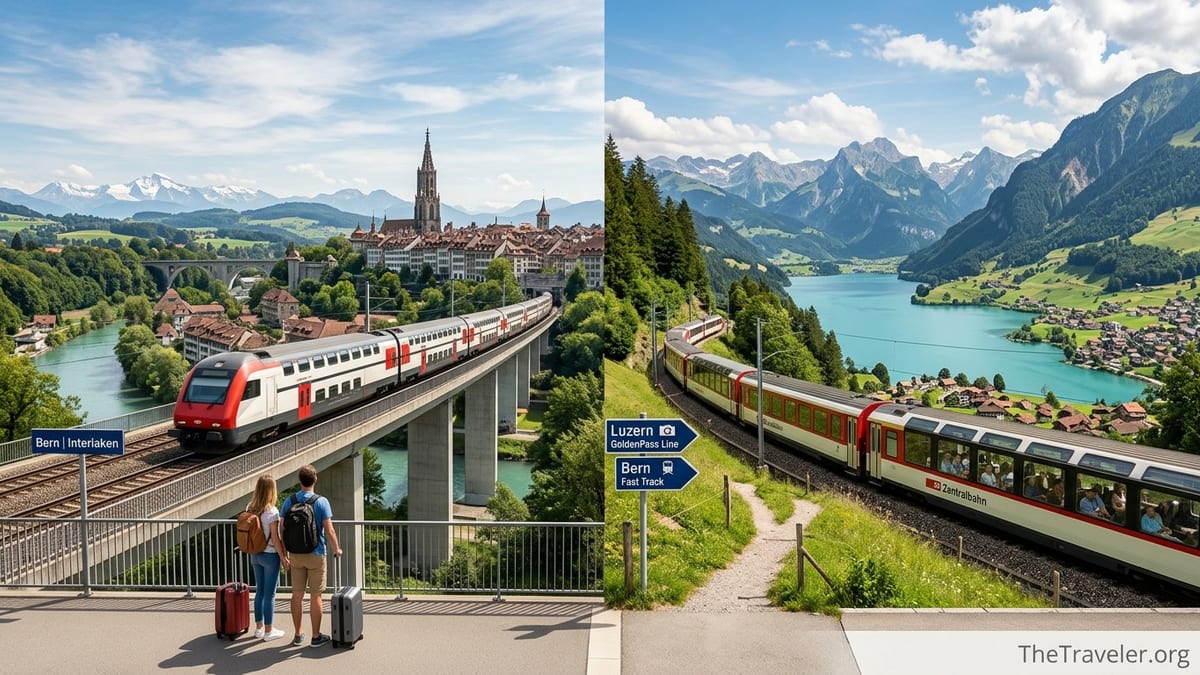
Fastest Standard Route: Zurich to Interlaken via Bern
The most practical way to reach Interlaken from Zurich is the standard connection via Bern. On a typical weekday, journeys from Zürich Hauptbahnhof to Interlaken Ost with one easy change in Bern usually take around 1 hour 55 minutes to 2 hours 10 minutes, depending on the specific InterCity or InterRegio connection. Trains on this route are frequent throughout the day, and connections in Bern are generally well-timed, with transfer times often around 8 to 15 minutes.
The core of the fast route is the InterCity service from Zürich HB to Bern, which usually takes about 56 to 60 minutes. From Bern, Interlaken Ost is served by InterCity and InterRegio trains that cover the final stretch in roughly 50 to 55 minutes. The line between Bern and Interlaken follows the Aare River and passes Lake Thun, offering some pleasant scenery even on the quickest option, although the focus here is efficiency rather than panoramic views.
For travelers arriving by long-distance train or flight and keen to reach hotel check-in in Interlaken by mid-afternoon, the Bern route is usually the clear winner. You roll your luggage directly onto large standard-gauge trains with level or near-level boarding in Zurich and Bern, plenty of overhead and end-of-car luggage racks, and no need to worry about special panoramic reservations. Even in high season, it is common to find a free seat without reserving in advance.
If your main goal is to connect quickly onward to Lauterbrunnen or Grindelwald on the Berner Oberland Bahn, arriving at Interlaken Ost in about two hours from Zurich also keeps the overall journey to the Jungfrau Region manageable in a single travel half-day. Many visitors who plan an afternoon cable car ride from Wengen or a stroll in Grindelwald therefore choose this faster connection, especially on arrival days when jet lag and luggage are factors.
Scenic Alternative: Zurich to Interlaken via Lucerne and the Brünig Pass
The longer scenic alternative runs from Zürich HB to Luzern, then on the narrow-gauge Zentralbahn line over the Brünig Pass to Interlaken Ost. In practice, this usually means a journey of around 3 hours to 3 hours 20 minutes in total, depending on your specific connection time in Lucerne. The first leg from Zurich to Lucerne typically takes about 45 to 55 minutes on frequent InterRegio or InterCity trains.
From Lucerne, the Luzern–Interlaken Express covers the picturesque 98-kilometer route in approximately 1 hour 50 minutes. This train is part of the GoldenPass line concept, with panoramic-style coaches, large windows, and commentary or information screens that highlight key points along the way. While the overall travel time is roughly an hour longer than going via Bern, the payoff comes in the variety of landscapes, from lakeside views to high passes and rivers slicing through deep valleys.
Travelers who enjoy leisurely journeys and want the train ride to be part of the holiday experience often find this route more satisfying. It suits those planning a relaxed start to a multi-day Swiss itinerary, photographers with time to spare, and visitors who may not otherwise cross the Brünig Pass during their trip. For many, the combination of Lucerne’s historic old town and the lake and mountain views on the onward journey makes the extra time feel like a highlight rather than a detour.
If you have at least four to five flexible hours between leaving Zurich and needing to be in Interlaken, this scenic route becomes a compelling option. You can easily build in a couple of hours in Lucerne for lakeside walks or a quick look at the Chapel Bridge before boarding the Luzern–Interlaken Express and treating the rest of the day as a rolling sightseeing tour.
Inside the Luzern–Interlaken Express: Route, Scenery and Seating
The Luzern–Interlaken Express runs roughly once per hour throughout the day, following a consistent pattern between Luzern and Interlaken Ost. Leaving Lucerne, the train initially follows the shorelines of Lake Lucerne’s outskirts before turning toward the smaller lakes of central Switzerland. After about 20 to 30 minutes, it reaches the shores of Lake Sarnen, where the scenery becomes noticeably more open and photogenic, with water views framed by hills and villages.
Further along, Lake Lungern offers one of the most striking stretches of the journey, with turquoise water and steep surrounding slopes. The climb to the Brünig Pass brings tighter curves, tunnels and glimpses of mountain peaks, particularly in clear weather. On the descent toward Meiringen, the line threads its way along steep valley sides, passing waterfalls and forests before following the Aare River as it approaches Lake Brienz. The final section along Lake Brienz into Interlaken Ost is among the most memorable, with dramatic, often emerald-colored water pressed beneath cliffs and wooded slopes.
Seat choice matters if you want to make the most of the views. For the direction from Lucerne to Interlaken Ost, many travelers find that the right-hand side offers the best continuous lake scenery, particularly along Lake Lungern and Lake Brienz. However, the line curves frequently, and scenery alternates sides, so there is no single perfect choice. If you are traveling in a small group, sitting in a bay of four around a table can allow everyone to move slightly and share both sides without much difficulty.
Onboard, the Luzern–Interlaken Express typically offers a mix of first and second class coaches with large panoramic windows. There is an onboard bistro or minibar service with light snacks, drinks and coffee, although the exact offer can vary by season and time of day. Luggage racks at the carriage ends and overhead shelves handle normal suitcases and backpacks well, and designated wheelchair spaces and accessible toilets are provided in specific coaches. Travelers with mobility needs should still allow extra time to board in Lucerne and Interlaken, as some platform and step heights differ from those on the larger InterCity trains.
New IR85 Services and How They Differ from the Panoramic Train
From May to October 2027, an additional layer of InterRegio 85 services is planned along the Luzern–Interlaken route. These IR85 trains are designed to supplement the existing Luzern–Interlaken Express and increase capacity during high tourist season without changing the basic hourly panoramic offer. The IR85 services are expected to use standard InterRegio rolling stock rather than the full panoramic-style coaches and branding that characterize the Luzern–Interlaken Express.
For travelers, the key distinction will be experience rather than ticket price. A regular second class ticket, Swiss Travel Pass, Saver Day Pass or Half Fare Card reduction should be valid equally on both the Luzern–Interlaken Express and the IR85 services, as they operate on the same line within the national timetable. However, the Express retains the more tourist-oriented layout, large panorama windows and stronger emphasis on commentary and scenic marketing, while the IR85 trains function more like standard long-distance services aimed at both tourists and local passengers.
If you are planning a trip for or after the 2027 summer season, it will be worth checking SBB’s published timetable closer to departure to see exactly how these services are integrated. In practice, you might have a choice between an IR85 train that fits your schedule slightly better and the classic Luzern–Interlaken Express that offers a more atmospheric ride. Those who are focused on scenery will likely still prefer to time their connection to catch the Express, while travelers simply needing to reach Interlaken by a certain hour may be happy to use whichever departure offers the most convenient timing.
Because these IR85 trains are additions rather than replacements, they effectively give passengers more flexibility. Families with children or travelers with tight onward connections may appreciate having several trains within a short window, while photographers and rail enthusiasts can target the panoramic service for the full visual experience.
Timetables, Reservations and Handling Crowds
Both the Zurich–Bern–Interlaken route and the Zurich–Lucerne–Interlaken route operate on a clockface timetable. In practical terms, this means that departure times repeat at the same minute past each hour, making planning straightforward. For example, on many days InterCity trains from Zürich HB to Bern leave at regular hourly intervals, as do the Luzern–Interlaken Express departures from Lucerne. This structure also makes it easier to build in a deliberate break in Lucerne or Bern without needing to memorize complex schedules.
Seat reservations inside Switzerland remain largely optional on these routes. Most passengers simply board with a valid ticket or pass and choose any free seat. However, optional reservations can be useful in peak summer months, on weekends during school holidays, and on especially popular panoramic trains such as the Luzern–Interlaken Express. If you are traveling with young children, carrying very large luggage, or prefer to sit together as a group of four or more, paying a modest reservation fee can remove uncertainty and stress.
Handling luggage is generally straightforward, but two factors deserve attention. First, avoid bringing oversized suitcases if possible, as storage areas on the narrow-gauge Zentralbahn trains are more limited than on standard InterCity coaches. Medium-sized rolling bags and backpacks fit much more easily above or at the ends of the carriage. Second, if you have multiple heavy bags, consider using station luggage trolleys, advance luggage forwarding services offered within Switzerland, or arranging your hotel to receive forwarded bags so you can enjoy the scenic ride with only a daypack.
For families, both main routes are manageable with strollers and young children. Many carriages have area near the doors that can accommodate a folded stroller, and toilets on long-distance trains often include changing tables. Because the Luzern–Interlaken Express is marketed as a scenic line, it tends to attract more tourists and can be lively with cameras and excited children, especially in summer. The faster Bern route may feel quieter and more businesslike, which some parents appreciate when aiming for nap time.
Fares, Passes and What Offers Best Value
Switzerland’s fares on these routes are distance-based, so the scenic detour via Lucerne is usually more expensive than the direct route via Bern when comparing full point-to-point fares. As of late 2026, a standard full-fare second class ticket from Zürich HB to Interlaken Ost via Bern costs in the region of several dozen Swiss francs, while traveling via Lucerne and the Luzern–Interlaken Express is somewhat higher because of the longer distance and extra segment. Exact prices depend on the day and whether you are using any discounts.
Supersaver tickets and the Saver Day Pass can significantly reduce costs for travelers with fixed travel times. Supersaver tickets usually apply to specific trains and routes and can offer substantial discounts compared with the standard flexible fare, particularly when booked well in advance for off-peak departures. A Saver Day Pass, bought early, can sometimes cover an entire day’s travel across the Swiss network, including Zurich to Interlaken, for a price similar to or below a regular one-way ticket. However, availability and pricing for these offers vary by date, so it is important to check current options while planning.
For visitors staying several days, the Swiss Travel Pass or a Swiss Half Fare Card often provides better overall value than individual tickets. The Swiss Travel Pass covers full travel on most SBB trains, including both the Bern route and the Luzern–Interlaken Express, making the choice of path more a matter of time and scenery than cost. In that case, you simply show your pass and board any permitted train, then pay only optional supplements for seat reservations if you choose to make them. The Swiss Half Fare Card, valid for a month, gives approximately 50 percent off most tickets across the network, making both Zurich–Interlaken routes more affordable while still requiring you to buy each ticket individually.
For a one-off journey with a fixed date, many travelers compare the standard point-to-point fare with any Supersaver fares available that day. For a longer multi-day itinerary that might include side trips to Jungfraujoch, Schynige Platte or boat rides on Lakes Thun and Brienz, a Swiss Travel Pass often represents good value, especially if you enjoy spontaneous detours and are likely to use trains, boats and mountain railways daily. The best approach is to price your likely journeys for the specific dates of travel and compare the sum of single tickets with the cost of the relevant pass, taking into account potential Supersaver availability.
Interlaken West vs Interlaken Ost: Where You Actually Arrive
The Zurich–Bern–Interlaken route and the Luzern–Interlaken Express both terminate at Interlaken Ost, which functions as the main rail hub for the region. Interlaken Ost is the starting point for trains up the Lütschine valleys toward Lauterbrunnen and Grindelwald, as well as for many local and regional services. It is also a short walk or local bus ride from the eastern boat pier for cruises on Lake Brienz, making it the best arrival point if your accommodation or onward plans focus on the lake, Lauterbrunnen, Wengen, Mürren or Grindelwald.
Interlaken West, located closer to the town center and many hotels, is served by trains arriving from Bern along the Lake Thun side. If you take the fast route from Zurich via Bern, some services will call at Interlaken West before reaching Interlaken Ost, allowing you to step off closer to central shops, restaurants and the western boat pier for Lake Thun. Visitors staying in hotels along Höheweg or close to the town center often find it more convenient to disembark at Interlaken West and walk or take a brief taxi ride to their accommodation.
Travelers coming via Lucerne and the Luzern–Interlaken Express always arrive at Interlaken Ost, so a short onward journey is needed if your hotel is near Interlaken West. This is straightforward: frequent local trains and buses shuttle between the two stations in only a few minutes, and taxis are readily available. If you are carrying large luggage, the short connection might be slightly less convenient than stepping off directly at Interlaken West, but in practice most visitors manage the transfer easily.
If your first activity after arrival is a lake cruise, your ideal station depends on the lake. For Lake Thun, Interlaken West is closer to the boat pier, while for Lake Brienz, Interlaken Ost is adjacent to the departure area. Those heading straight into the mountains toward Lauterbrunnen or Grindelwald should stay on until Interlaken Ost, where the narrow-gauge Berner Oberland Bahn departs from platforms within the same station complex.
Two Suggested Itineraries: One for Speed, One for Scenery
For travelers who value speed, a typical fast-day itinerary might look like this. After breakfast in Zurich, catch a mid-morning InterCity train from Zürich HB to Bern, taking around one hour. In Bern, follow the clear signage to your connecting platform and board the InterCity or InterRegio to Interlaken Ost, arriving roughly two hours after leaving Zurich. From Interlaken Ost, you could continue directly to Lauterbrunnen, reaching the village by early afternoon and leaving time to ride up to Wengen, stroll through the village and enjoy an early dinner with views of the Jungfrau massif.
A scenic-focused day uses the same starting point but a different rhythm. Depart Zürich HB for Lucerne mid-morning, either on an InterRegio or InterCity, arriving in about 50 minutes. Spend two to three hours exploring Lucerne: walk past the Chapel Bridge, visit the lakefront promenade, or enjoy lunch at one of the many cafes near the water. In mid-afternoon, board the Luzern–Interlaken Express for the one hour fifty minute journey over the Brünig Pass, taking in Lake Sarnen, Lake Lungern and the dramatic approach along Lake Brienz before rolling into Interlaken Ost early evening.
These two itineraries highlight the trade-off in a concrete way. The fast route lets you go from Zurich to a mountain village in the Jungfrau Region by mid-afternoon, using the efficient hub of Bern and Interlaken Ost. The scenic route turns your transfer day into an experience, combining Lucerne’s city charm with lakes and passes that many travelers cross only once in a lifetime. Either can work as a first day in Switzerland, depending on whether you prefer to unpack early or savor a longer, more varied approach.
In both cases, booking Supersaver or Saver Day offers in advance can reduce costs, and holding a Swiss Travel Pass removes most of the need to think about ticketing on the day. The main practical difference comes down to overnight timing: if you are arriving in Zurich earlier that same morning by flight, the flexible yet fast Bern route is usually safer, whereas if you have already spent a night in Zurich or Lucerne and can leave after breakfast, the scenic detour becomes much more feasible.
Is the Scenic Detour Worth the Extra Time?
Whether the scenic Luzern–Interlaken Express route is worth roughly an extra hour of travel compared with the fast Bern connection depends on your priorities, your itinerary length and your appetite for train time. For visitors on a tight schedule who want to maximize hours in the Jungfrau Region itself, the directness of Zurich–Bern–Interlaken often wins out. You still enjoy some lakeside views along Lake Thun near Interlaken, and you arrive fresh enough to explore the town or head straight up into the mountains.
For those with a bit more flexibility, the scenic detour can feel like an integrated part of the holiday rather than a delay. If you anticipate that this may be your only visit to central Switzerland, the chance to see Lucerne, Lake Sarnen, Lake Lungern, the Brünig Pass and Lake Brienz in one continuous arc is powerful. In this case, combining Zurich, Lucerne and Interlaken in a single day’s journey is a logical and memorable choice, especially for photographers, rail enthusiasts and families who enjoy varied scenery from the comfort of the train.
Cost differences between the two routes are real but, in the context of a typical multi-day Swiss trip, often modest when compared with overall accommodation and activities. If you are using a Swiss Travel Pass, the financial comparison largely disappears, and the choice becomes entirely experiential. With point-to-point tickets, checking exact fares and any Supersaver options for your specific date will clarify the additional expense for the scenic routing.
In the end, there is no single correct answer. If your priority is to arrive in Interlaken or the Jungfrau villages as quickly as possible, choose Zurich–Bern–Interlaken and enjoy a concise, comfortable ride. If you have the time and want the journey to be a highlight filled with lakes and passes, opt for Zurich–Lucerne–Interlaken on the Luzern–Interlaken Express, ideally combined with a relaxed stop in Lucerne. Either way, Switzerland’s meticulous timetables, modern rolling stock and integrated passes ensure that getting from Zurich to Interlaken is as smooth as it is memorable.