


More news on this day
For travelers facing 20-hour itineraries and outlet-free layovers, portable chargers have shifted from nice-to-have accessories to essential survival tools, with newer models packing faster USB-C speeds, smarter displays and flight-friendly batteries.
Get the latest news straight to your inbox!
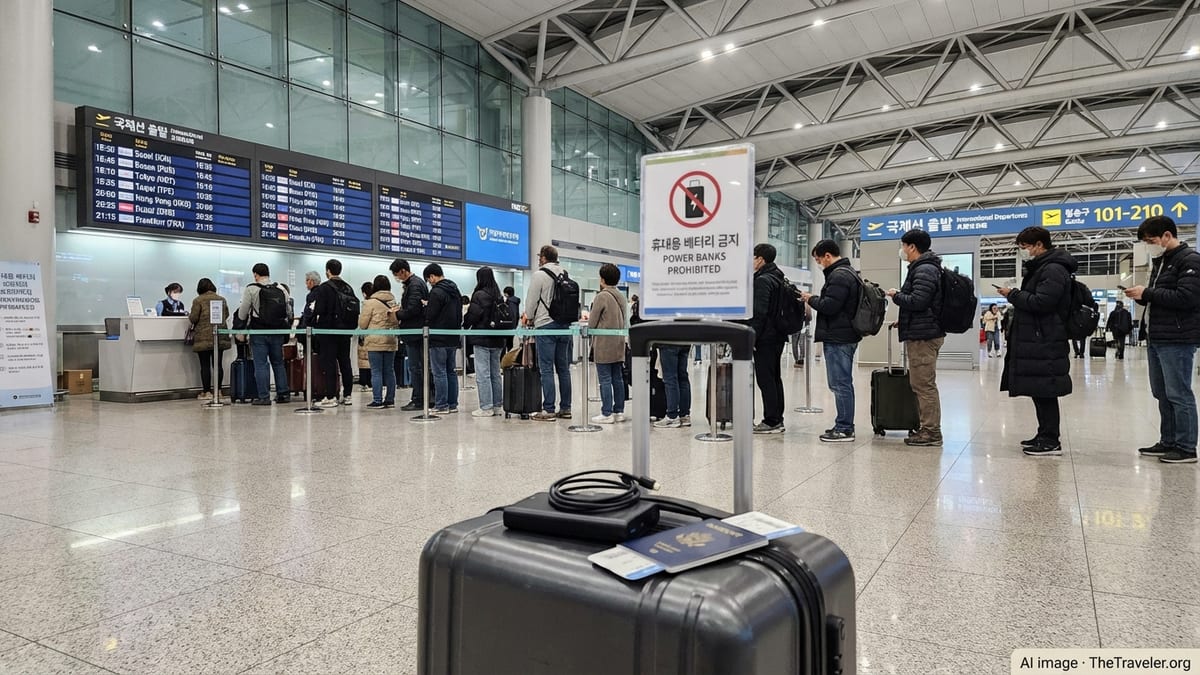
Why Power Banks Matter More On Long Travel Days
Long-haul itineraries increasingly combine early departures, overnight flights and tight connections, leaving little time to hunt for power outlets in crowded terminals. Recent buyer guides show that 10,000 to 20,000 mAh has become the practical sweet spot for travelers, offering multiple phone charges in bodies that still fit a jacket pocket or tech pouch. At the same time, USB-C Power Delivery has replaced older standards, allowing phones to reach roughly 50 percent charge in about half an hour on a 20 W or higher output.
Regulators have also shaped how these batteries are built and carried. Federal Aviation Administration materials state that lithium-ion power banks must travel in carry-on baggage, not checked luggage, and are generally limited to 100 watt hours per battery, a threshold that covers most products aimed at consumers. Travel-focused roundups now routinely flag watt-hour ratings and emphasize whether a pack stays within airline guidelines, reflecting growing awareness among frequent flyers.
Within those constraints, manufacturers have pushed slim designs, integrated cables and higher-wattage USB-C ports that can support tablets and lightweight laptops. The result is a 2026 travel power bank market where one device can keep a phone, wireless earbuds and even an ultraportable computer running across a full day of flights and transfers.
Compact Everyday Chargers For Phones And Earbuds
At the small end of the range, 5,000 to 10,000 mAh chargers are positioned as everyday carry items that disappear into a sling or seat-back pocket while still covering one to two full phone charges. Recent testing by gadget publications highlights slim 10,000 mAh USB-C models as the most versatile choice for most travelers, balancing roughly 37 watt hours of capacity with pocketable weight and size.
Several 10,000 mAh units stand out for long travel days that are still light on gear. Travel-oriented buyer guides in 2026 frequently point to compact USB-C packs with 20 W or 30 W Power Delivery that can quickly top up modern phones and small tablets. One widely recommended pick combines a slim profile with 20 W USB-C, while others emphasize rounded corners and textured shells that slide easily in and out of cramped airplane seat pockets.
Wireless charging has also become more relevant to travelers juggling boarding passes and snacks. Magnetic packs designed to snap to newer phones provide cable-free charging at around 7.5 to 15 W, enough to keep navigation and streaming apps running through a layover. Although their capacities are typically lower than wired-only counterparts, they reduce cable clutter and are popular among travelers who want to keep using their phones while charging one-handed in tight spaces.
High-Capacity Bricks For Laptops And Multi-Device Loads
For travelers who rely on laptops for work during long flights, 20,000 to 25,000 mAh chargers have become a distinct category. Several recent rankings of best travel power banks spotlight models in this range with 60 W to 140 W USB-C outputs capable of sustaining fast charging for larger devices. One frequently cited high-end pack around 24,000 mAh offers 140 W Power Delivery and multiple USB-C ports, giving enough headroom to run a notebook and recharge a phone at the same time during a transoceanic flight.
Other large-capacity chargers focus on value and packability rather than maximum wattage. Some 20,000 mAh travel-oriented models deliver around 100 W over USB-C, enough for many thin-and-light laptops, while keeping weight and price below premium competitors. These power banks often include small status screens, displaying charge percentage and output power to help travelers ration remaining capacity through delays and diversions.
Despite their size, many of these high-capacity units remain under the 100 watt-hour threshold cited in airline and safety guidance, and several travel buying guides explicitly note their watt-hour ratings to reassure passengers. For long itineraries that involve working on presentations or editing media midair, carrying one of these larger bricks can effectively double the usable time of a laptop away from an outlet.
Built-In Cables, Stands And Other Travel-Friendly Features
Beyond raw capacity, convenience features can determine whether a portable charger truly earns a place in a carry-on. Reviews in late 2025 and 2026 consistently praise 10,000 mAh USB-C models with built-in or retractable cables, which remove the risk of discovering at boarding that the correct cord is packed in checked baggage. One widely covered compact power bank, for example, pairs a 10,000 mAh battery with a retractable USB-C cable and up to 45 W output, allowing fast top-ups without carrying extra wires.
Stands and pass-through capabilities are also becoming more visible on traveler shortlists. Some magnetic wireless packs double as kickstands, propping a phone in landscape orientation for watching movies in a cramped economy seat. Others support pass-through charging, allowing the power bank to act like an in-line adapter when plugged into scarce airport outlets so that both the device and the battery charge at once.
Displays and smart power management play a role on long travel days as well. Midrange and premium power banks increasingly feature digital readouts for remaining percentage and, in some cases, live wattage. Reports on newer 20,000 mAh and 25,000 mAh models note that these displays help travelers decide whether to prioritize topping up a phone, tablet or laptop before the next boarding call, instead of relying on a simple four-LED indicator.
Ultra-Slim And Magnetic Options For Minimalist Flyers
An emerging segment in 2026 focuses on ultra-slim chargers for travelers who value minimal bulk above all. A recently launched 10,000 mAh magnetic power bank from a major smartphone brand, measuring close to one centimeter thick, illustrates how manufacturers are compressing batteries into flatter shapes. Coverage of this and competing products highlights that such designs can slide alongside a laptop in a sleeve, reducing the chance a charger is left behind in a seat-back pocket or security bin.
At the smaller end, 5,000 mAh magnetic packs targeting recent flagship phones offer just enough capacity to bridge a heavy travel day, while maintaining extremely low weight. Early impressions and user reports suggest these tiny chargers are gaining traction among frequent flyers who already carry a second, larger power bank in a backpack but want a lightweight "walking around" option for airport terminals and city transfers.
Magnetic and ultra-slim designs inevitably involve trade-offs in output and port selection. Many of these chargers prioritize a single USB-C port and moderate wireless speeds over multiple connections, making them better suited as companions to a primary wired power bank rather than standalone solutions. Still, for travelers aiming to keep pockets light while navigating security lines, these compact chargers can be an important part of a broader charging strategy.
Staying Within Airline Rules While Maximizing Power
As portable chargers grow more capable, airline and safety rules remain a constant backdrop. Guidance published by aviation authorities emphasizes that power banks count as spare lithium-ion batteries, must travel in carry-on bags and typically may not exceed 100 watt hours per unit without special approval. Many travel gear guides now translate milliamp-hour ratings into watt hours and flag when a model sits just below that cutoff, helping buyers avoid surprises at the gate.
Some resources also note that while there is usually no strict numerical limit on how many sub-100 watt-hour batteries a passenger can carry, individual airlines can impose their own caps. That has prompted reviewers to recommend fewer, more capable power banks instead of several small units, particularly for international itineraries where rules can vary by carrier.
For travelers planning their next long-haul trip, the current market offers portable chargers that match almost any use case, from slim phone savers to laptop-grade bricks. Focusing on clear watt-hour ratings, USB-C Power Delivery support and practical features such as built-in cables or magnetic attachment can make the difference between scrambling for outlets and sailing through the longest travel days with charged devices.