


I arrived in Sweden expecting a polished, efficient version of what I had already seen in Denmark and Norway: tidy cities, expensive meals, and scenery you mostly admire from a distance. After a week weaving from Stockholm’s waterfront to Gothenburg’s café districts and up to the Arctic circle by night train, I left with a completely different picture. Sweden turned out to be less about curated Scandinavian perfection and more about everyday rituals, long train journeys, and a surprising number of affordable, deeply local experiences hiding in plain sight.
Get the latest updates straight to your inbox!
Why Sweden Felt Different From the Rest of Scandinavia
On paper, Sweden fits neatly into the Scandinavian stereotype: high prices, high standards of living, and highly efficient public services. I landed in Stockholm assuming it would feel like a larger version of Copenhagen, another waterfront capital framed by bike lanes and designer boutiques. Instead, what changed my view almost immediately was how quietly informal everyday life felt. People in sneakers and worn Fjällräven jackets shared tables in small cafés, pushing strollers and chatting in a mix of Swedish and flawless English, and no one seemed in any particular hurry.
That sense of unhurried normalcy is what sets Sweden apart as a travel experience. In central Stockholm I stayed in a midrange hotel near T-Centralen, paying roughly what I would in a US city of similar size, but what made the stay memorable was not the design or the breakfast buffet. It was the fact that within ten minutes on foot I could go from a busy commuter hub to Gamla Stan’s medieval alleys, and then continue down to Södermalm, where locals in wool beanies leaned against railings overlooking the water at sunset. Sweden rewards slow walking and casual detours rather than a checklist of must-see monuments.
I had imagined Scandinavia as expensive to the point of being inaccessible for many travelers. Sweden challenged that idea. Yes, a sit-down dinner with wine in Stockholm’s trendier neighborhoods can easily rival prices in London or New York, but I also found that a filling lunch at a simple neighborhood spot near Odenplan could still come in around the equivalent of a modest US fast-casual meal if I chose the dagens lunch, the daily special that Swedes rely on to eat out affordably.
Stockholm: From Grand Boulevards to Everyday Rituals
My first full day in Stockholm began like a typical city-break itinerary. I walked past the Royal Palace and the Parliament, admired the gilded details, and joined a few tour groups shuffling through Gamla Stan’s narrow streets. The surprise came later that morning when I stepped onto the ferry that crosses to Djurgården. The short public boat ride felt more like a commuter shuttle than a tourist sightseeing cruise, but for just a few dollars’ equivalent on my transit card, I found myself gliding between islands past pastel-colored stone buildings, with locals commuting to work alongside families pushing prams.
On Djurgården, it was tempting to spend the whole day hopping between major attractions like the Vasa Museum and Skansen. Instead, I walked a few minutes away from the crowds, found a bench facing the water, and bought a simple takeaway coffee and kanelbulle from a kiosk. That modest fika set me back less than a specialty coffee and pastry in many US cities, and it came with something harder to buy: time. Watching joggers and dog walkers pass by made it clear that for Swedes, the island was not just a museum district but an outdoor living room.
Eating in Stockholm further shifted my expectations about Scandinavian travel. I had braced myself for uniformly high restaurant prices, but supermarket culture filled many gaps. At a large Coop and a Hemköp near my hotel, I picked up hearty rye crispbread, Västerbottensost cheese, and gravad lax from the refrigerated counter, assembling picnic-style dinners along the waterfront for a fraction of restaurant prices. In a city where a sit-down main course in a central neighborhood can easily approach the cost of a midrange US restaurant, this kind of self-catering makes Stockholm not only manageable but surprisingly relaxed.
What also stood out was the city’s commitment to public transport as a core part of the travel experience. The same SL card that paid for my ferry covered metro rides out to leafy suburbs, and a single day’s transport cap meant I never had to second-guess hopping onto a tram or bus. Instead of feeling like I needed to see “everything,” I let myself ride out beyond the traditional tourist orbit, stepping off in residential neighborhoods and discovering pocket parks and small cafés that never appear on top-ten lists.
Gothenburg: Where Fika Redefined My Idea of Luxury
Midway through the week, I boarded a train to Gothenburg, Sweden’s second-largest city and one of Europe’s greenest urban centers. Unlike some Scandinavian capitals that can feel museum-like in their perfection, Gothenburg felt immediately approachable. The tram from the central station rolled past brick warehouses, canals, and clusters of bikes leaning against railings, and within a few stops I was walking into the Haga district, a neighborhood famous for its preserved wooden houses and café culture.
Haga is often described as Gothenburg’s fika central, and it lived up to the reputation the moment I stepped onto its cobbled main street. Low wooden buildings painted in muted greens and reds housed independent shops and cafés, some with handwritten signs advertising “världens största kanelbulle,” the world’s biggest cinnamon bun. At Café Husaren, one of the classics, I watched locals and visitors share tables under old chandeliers, a plate-sized cinnamon bun big enough for two or three people placed between them. Sharing one of those buns with a coffee cost noticeably less than an elaborate dessert and drink in many Western European capitals, and it lingered in my memory as more luxurious than any tasting menu.
Further down Haga Nygata, I ducked into a small vegetarian café that had been operating since the early 1980s. The interior felt like a friend’s living room, with worn wooden tables, mismatched chairs, and walls lined with framed posters. A hearty lentil stew served with fresh bread and a small salad cost roughly what you might pay for a fast-casual bowl in an American city. Yet it came with unlimited tap water, no rush to leave, and an unspoken invitation to occupy the table as long as I liked. That, I realized, was the Swedish twist on value: not piling a plate high, but offering time and space.
Gothenburg also complicated the idea that Scandinavian travel is all about dramatic fjords and mountain vistas. The city’s beauty revealed itself in details: tramlines curving over bridges, small pocket parks tucked between buildings, and locals pausing mid-afternoon for fika even on a workday. My most memorable moment was not at a designated viewpoint but sitting on a bench up near Skansen Kronan, the old hilltop fortification, looking down over the terracotta rooftops and listening to church bells echo with the clanging of passing trams.
Heading North by Night Train: The Journey Becomes the Destination
The real turning point in my view of Scandinavian travel came when I boarded an overnight train bound for Swedish Lapland. Instead of flying north, I chose the classic route from Stockholm toward Abisko, one of the country’s northernmost settlements and a renowned base for aurora watching and mountain hiking. The system for these Arctic night trains has evolved in recent years, with Sweden’s national rail company selling tickets while a separate operator runs many of the services, so schedules can appear and disappear in batches. Booking a few months in advance, I secured a bunk in a shared sleeper compartment for a price comparable to a midrange hotel night in Stockholm, with the added benefit of covering more than a thousand kilometers while I slept.
Boarding the train at Stockholm Central in the early evening felt more like stepping into a small traveling village than catching a standard intercity service. Families spread out picnics on their couchette tables, hikers in technical jackets compared route plans for the Kungsleden trail, and older couples quietly read paperbacks. My compartment had three bunks on either side, with clean sheets and a narrow ladder. It was compact, but no more cramped than many overnight trains in continental Europe, and the ritual of making up the bed as city lights flickered past the window turned the journey itself into part of the adventure.
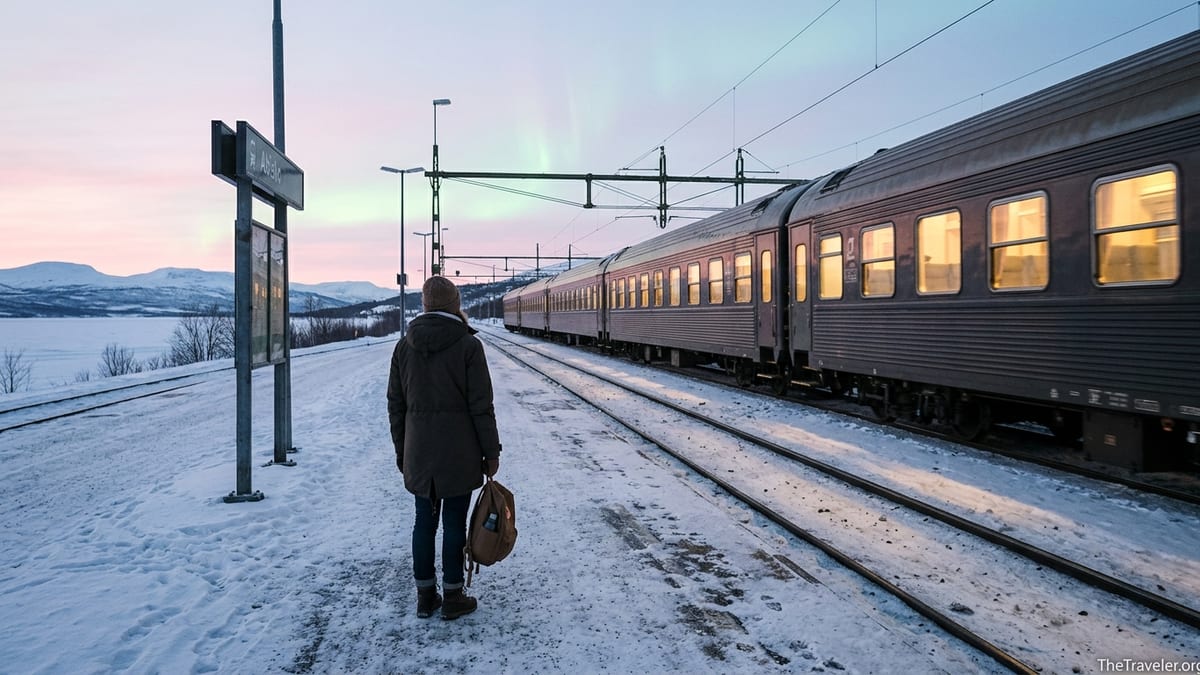
During the night, the train crossed central Sweden and rolled steadily north. By early morning, when I slid up the blind, the scenery outside had swapped city suburbs for vast swathes of forest broken by lakes and occasional red wooden houses. Later in the year, these same trains continue onward into the Arctic Circle, past Kiruna and on toward Narvik in Norway, a route that has become one of Europe’s great winter rail journeys. Onboard announcements switched between Swedish and English, and the café car sold simple breakfasts, coffee, and snacks at prices that felt reasonable given the remote terrain we were entering.
What struck me most was how accessible this kind of ambitious overland journey felt once I understood the system. Third-party websites and forums can make the booking process sound mysterious, full of seasonal variations and partner operators, but on the ground the experience was straightforward. Pay attention to release windows for tickets, expect that exact departure times and services might vary by season, and be prepared for occasional disruptions in extreme winter weather. With those caveats in mind, traversing almost the entire length of Sweden overnight was not a luxury reserved for the few, but a very Swedish kind of long-distance commuting.
Abisko and the Arctic: Rethinking “Remote” Travel
Arriving near Abisko, the sense of distance from Stockholm finally hit me. The small stations serving Abisko Östra and Abisko Turiststation sit between mountains and the shores of Lake Torneträsk, and in winter this region’s clear skies create some of Europe’s best odds for seeing the northern lights. The town itself is tiny, with little more than a handful of guesthouses, a hostel, and the mountain station that serves hikers and aurora chasers. Yet regular passenger trains connect it to Stockholm and even to Norway, proving that “remote” in Sweden often still means reachable by scheduled rail.
In many parts of the world, hunting the aurora has become synonymous with expensive multi-day tour packages and helicopter flights. In Abisko, I was reminded that you can still experience serious wilderness with relatively low-key infrastructure. The Swedish Tourist Association runs mountain stations and huts that cater to hikers in season, offering simple dorm beds, hearty communal meals, and gear rentals. Guided activities from local operators range from snowshoe walks to evening aurora tours, but it is also entirely possible to head out on marked trails independently if you are prepared, always checking weather conditions and heeding local advice.
The costs here did challenge my assumptions in a different way. Groceries in the north can be pricier than in Stockholm due to transport, and restaurant-style meals at small lodges naturally reflect the logistics of operating in a sparsely populated region. At the same time, once you are in Abisko, most of the main attractions are free: the open sky, miles of hiking trails in Abisko National Park, and the quiet of a subarctic landscape where the loudest sound at night might be crunching snow under your boots.
What transformed my view of Scandinavian travel was the realization that you do not have to choose between polished city breaks and hardcore expeditions. In one week, I went from sipping coffee beside 19th-century façades in Stockholm to standing under a sky streaked with faint green arcs of aurora, all without charter flights or private transfers. Sweden’s combination of robust public transport, protected natural areas, and a culture that values time outdoors makes this kind of gradient of experiences uniquely accessible.
Costs, Surprises, and Smart Ways to Stretch a Budget
Before this trip, my mental image of Scandinavia was of uniformly high prices that meant most travelers could only afford a brief visit. Sweden did challenge my budget at times, especially when I forgot to plan ahead. An unplanned dinner in central Stockholm with a main course and a drink can quickly climb toward what a nicer restaurant in a major US city might charge. A round of cocktails in a waterfront bar in Gothenburg or Malmö rarely qualifies as a bargain, and specialty coffee drinks can match prices in trendsetting cities elsewhere in Europe.
Yet the week also showed me how much control travelers have over their daily costs in Sweden. Transit passes in cities like Stockholm and Gothenburg offer good value if you use them frequently, effectively capping your transportation spending for the day. Supermarkets stock plenty of ready-to-eat options, from salads to hot meatballs and potatoes in deli counters, and many Swedish hotels and hostels include generous breakfast buffets in the room rate. Building your day around one restaurant meal and one supermarket picnic can make a noticeable difference over the course of a week.
Another surprise was how many experiences that felt “premium” elsewhere were simply part of life here. In Malmö’s modern food halls, for example, I noticed that a freshly prepared salad bowl or poke-style dish from a popular vendor cost around what you might pay in a midrange US food court, but the ingredients skewed toward whole grains, roasted vegetables, and fresh fish. In Gothenburg, a tram ride out to the archipelago and a simple plate of shrimp at a local restaurant felt like the sort of outing that would be labeled and priced as a gourmet experience overseas.
I also learned that in Sweden, time and flexibility are forms of currency. Accept that long-distance trains in the far north may face schedule changes, particularly in winter, and build in a buffer day before any non-movable commitments like international flights. By doing so, you gain the freedom to embrace delays as part of the journey instead of a crisis. Over a week, that calm attitude made a tangible difference, turning potential stress points into extra coffee breaks in station cafés watching daily Swedish life unfold.
The Takeaway
Seven days in Sweden were enough to overturn several firmly held ideas I had about Scandinavian travel. I arrived expecting pristine cities and high prices that kept authentic experiences at arm’s length. I left with a sense of a country where everyday routines, from fika in Gothenburg’s Haga district to overnight train journeys through the north, are not only accessible to visitors but form the backbone of a deeply satisfying trip.
Sweden taught me that in this part of the world, luxury is less about star ratings and more about how you spend your hours. It is lingering over a shared cinnamon bun instead of rushing to the next museum, choosing a night train cabin over a short flight so you can wake up to snow-covered forests outside your window, and trusting that even in a place frequently labeled expensive, there are always quieter, more local ways to experience it. For travelers willing to slow down and look beyond the postcard views, a week in Sweden can quietly, and quite completely, reshape how you think about Scandinavia.
FAQ
Q1. Is Sweden really as expensive as people say for travelers?
Sweden can be pricey, especially for restaurant meals and alcohol, but costs vary widely. Using supermarket picnics, daily lunch specials, and transit passes, many travelers find that overall expenses can be managed to levels similar to other popular Western European destinations.
Q2. How many days do I need to combine Stockholm with a trip to the Arctic?
A week is usually the minimum to do both without feeling rushed. Many travelers spend three days in Stockholm and then two to three days in the north, plus overnight train travel in each direction if they choose not to fly.
Q3. Are the night trains in Sweden comfortable enough for light sleepers?
Night train comfort depends on the type of accommodation you book and your expectations. Sleeper cabins with fewer bunks are quieter and more private, while shared couchettes are more budget friendly but can be noisier. Earplugs, an eye mask, and a flexible mindset usually go a long way.
Q4. Do I need to book the Stockholm to Abisko night train far in advance?
Tickets for popular dates, especially in aurora season and during school holidays, often sell out weeks or months ahead. It is wise to monitor release dates on rail booking platforms, book as soon as your plans are firm, and have backup dates or routes in mind in case your first choice is unavailable.
Q5. Is it possible to see the northern lights in Sweden without booking a tour?
Yes, if you travel to a place with dark, clear skies like Abisko and stay several nights during aurora season, you can simply walk to viewpoints or follow marked trails. Tours add guidance, transport, and photography help, but the sky itself is free.
Q6. What is fika, and how much should I budget for it each day?
Fika is a Swedish coffee break built around slowing down, usually with a pastry like a cinnamon bun. In cities, a coffee and pastry in a cozy café can roughly match prices in other European capitals, so budgeting for one fika stop a day is a realistic and rewarding way to experience Swedish culture.
Q7. Can I rely on card payments everywhere in Sweden?
In practice, yes. Sweden is one of the most cash-light countries in the world, and most cafés, shops, public transport systems, and even small businesses accept major credit and debit cards. Carrying a small amount of cash is helpful but rarely essential.
Q8. Is English widely spoken outside the major cities?
English is widely understood across Sweden, including in smaller towns and many rural tourism hubs. You may meet some people who are less comfortable speaking it, but for most travel situations, from ordering food to asking for directions, English is usually enough.
Q9. What is the best season for a first trip to Sweden?
For a mix of city life and nature without temperature extremes, late spring and early autumn are appealing. Those interested in midnight sun and hiking often choose summer, while travelers focused on the northern lights and winter activities aim for the colder, darker months.
Q10. How does Sweden compare with Norway and Denmark for a first Scandinavian trip?
Norway is often chosen for dramatic mountains and fjords, Denmark for compact cities and cycling culture, and Sweden for a blend of large but livable cities, extensive forests and lakes, and relatively easy access to the Arctic. For many travelers, Sweden offers the most varied experiences in a single trip.