


The first time the sky exploded over Rovaniemi, it felt as if someone had quietly dimmed the world and then painted a slow-motion river of light above the dark spruce forest. My eyelashes were crusted with frost, my fingers were going numb inside borrowed mittens, and the only sound was the squeak of packed snow under a dozen boots. Then the greens brightened, a hint of violet edged in from the north, and the low murmur of the group turned into a chorus of gasps. In that moment, the long flights, the jet lag and the layers of wool were all paid back in full. Seeing the Northern Lights in Rovaniemi was not just a highlight of my Finland trip. It rearranged the entire journey around a single, shimmering memory.
Get the latest updates straight to your inbox!
Why Rovaniemi Is Such a Powerful First Aurora Destination
Rovaniemi sits right on the Arctic Circle in Finnish Lapland, which puts it directly under the auroral oval, the ring around the poles where Northern Lights most commonly appear. For a first-time aurora hunter, that geography matters. You are not chasing rare events on the horizon. On a reasonably active night with clear skies, the lights can hang overhead, arch from one side of the sky to the other, or ripple above the tree line right outside town. Local guides point out that the lights are possible roughly from late August until mid April, whenever the nights are dark enough, but the core tourism period in Rovaniemi runs from about October to March, when snow, cold and Christmas magic all collide.
Equally important is the infrastructure that has sprung up around this natural phenomenon. Rovaniemi is the busiest gateway to Finnish Lapland, with frequent winter flights from Helsinki and major European hubs, a night train from the capital, and a dense cluster of hotels, glass igloos and cabins designed explicitly for Northern Lights viewing. On my first afternoon in town, at least half the flyers in the lobby advertised aurora chases: in minibuses, on snowmobiles, by reindeer sleigh and even from an outdoor ice pool, watching the sky while floating in a survival suit. The city feels built for people who come here with one hope in mind.
Rovaniemi also offers a gentle learning curve. English is widely spoken, credit cards are accepted almost everywhere, and the town is compact enough that you can walk from the central hotels to the riverfront or to pick-up points for evening tours. For many visitors this is their first time so far north, and the mix of easy logistics and wild Arctic landscapes makes the leap into sub-zero temperatures and polar night feel less intimidating and more like an adventure you can actually manage.
That combination of high aurora potential, clear practical systems and a festive winter atmosphere is why Rovaniemi has become one of Finland’s most visited Northern Lights bases. It is not the remotest or darkest place in Lapland, but for a first brush with the aurora, it is hard to beat the balance between comfort and cosmic spectacle.
Choosing When to Go: My February Window and What I Learned
I chose mid February for my trip, aiming for a week-long stay. The logic was simple. By then the December peak in Christmas crowds had ebbed, daylight hours were returning, and local statistics suggest that February and March often bring a slightly higher chance of clear skies compared with the cloudier heart of winter. On my first morning in town, the hotel receptionist nodded at my dates and said, with Finn-like understatement, that this was "not a bad time" for the lights.
Across seven nights I had three that were fully overcast, two with partial breaks and two that were mostly clear by late evening. The two best displays came on nights that started unpromisingly, with low cloud at 7 pm and light snow. In both cases, local guides watched the forecasts and satellite images, then drove the group 30 to 40 minutes outside Rovaniemi toward patches of forecasted clear sky. Had I gone for a shorter three-night stay, I might easily have missed both shows. In other words, the strongest lesson from my week was simple: if the lights are a priority, think in terms of nights, not days. Giving yourself at least four or five nights in Rovaniemi significantly improves your odds of catching a break in the clouds.
Timing within each night also mattered. The brightest activity I saw happened between about 10 pm and 1 am, though tours typically leave town around 8 pm. Several nights, a faint green arc appeared low on the northern horizon early in the evening, barely visible to the naked eye but obvious on camera. Only later did it intensify and climb higher. That pattern matched what many local operators describe as normal: patience and willingness to stay out are rewarded more often than dramatic, quick shows at a convenient hour.
If your schedule is flexible, consider what you want besides the aurora. October and November bring darker, moodier nights with a real chance of snow but less predictable conditions on the ground. December and early January mean deep winter, heavy tourism and the full Christmas spectacle at nearby Santa Claus Village. February and March keep the frozen landscapes and strong aurora potential but add more sunshine and slightly more stable weather. In every case, remember that no month can guarantee the lights, but some balance the odds more gently than others.
How I Actually Saw the Lights: Tours, Apps and Old-Fashioned Luck
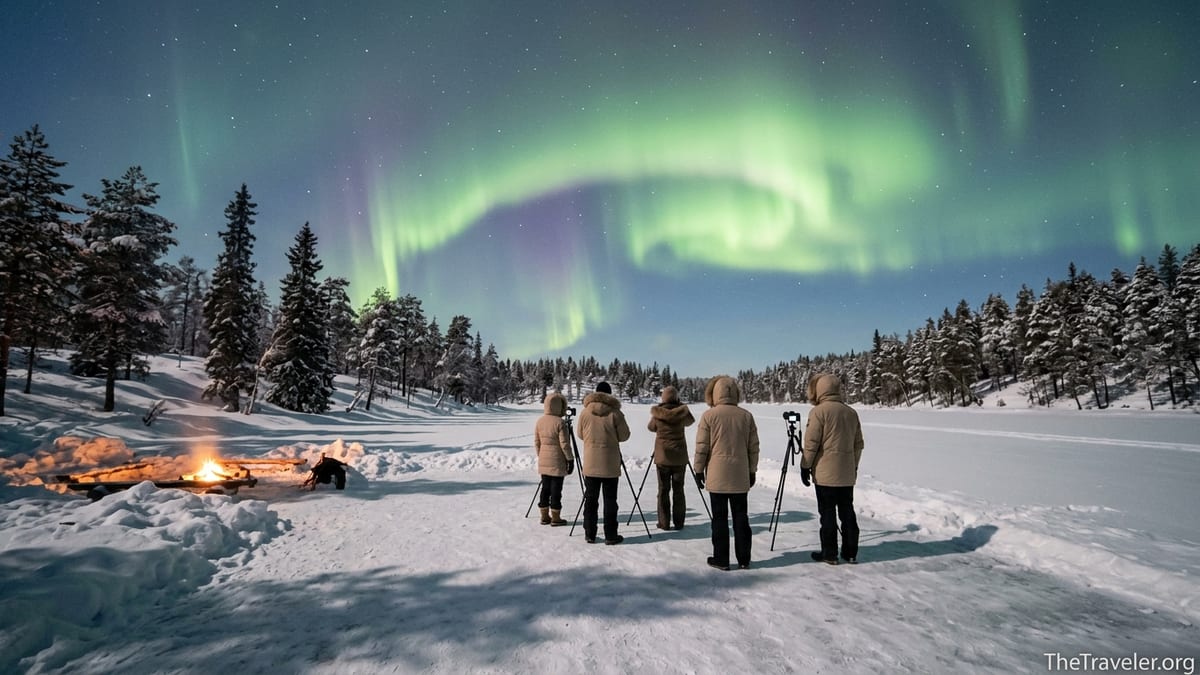
On my first night in Rovaniemi, I booked a dedicated Northern Lights minibus tour with a small local operator that kept groups to about a dozen people. The price was just under 130 euros per person, including hotel pickup, winter overalls, a simple campfire snack and tripod rental. Our guide checked both the space weather data and multiple cloud models in the late afternoon before deciding which direction to drive. That night we headed north-east, away from town lights, then turned down an unplowed forest road to a frozen lake that served as our viewing base.
At first the sky was a uniform gray. The guide lit a fire, handed out sausages and hot berry juice, and talked about solar wind and Finnish folklore while we stamped our feet to keep warm. Twenty minutes later the first star appeared overhead. Ten minutes after that, a band of milky green shimmered into view, stretching low across the northern horizon like a faint, glowing cloud. Cameras picked it up easily as vibrant color before many of us could see more than a ghostly arc. Slowly, it strengthened, split, and then climbed higher, until ribbons and curtains of light danced above the treeline. The guide moved from tripod to tripod, adjusting settings and snapping portraits for anyone who wanted proof we had not simply dreamed it.
Later in the week, I tried a different approach. Armed with an aurora forecast app and a rough understanding of the KP index, I walked away from the town center on a cold, clear night, following the unlit path along the frozen Kemi River. Around midnight, a pale glow bloomed above the opposite bank, then sharpened into a clear band of light. I ended up watching the show from a snow-covered parking area behind an unassuming riverside apartment block, alongside a pair of local students who had taken their own advice that you can sometimes see the aurora from a quiet corner without paying for a tour. It was less dramatic than the lake display, but perhaps more satisfying because it felt earned.
Those two nights taught me that there is no single right way to see the Northern Lights in Rovaniemi. Guided tours are valuable for their local weather knowledge, access to darker locations and photographic help, which is reassuring if you have only a couple of nights to spare. Independent watching, on the other hand, costs nothing beyond warm clothing and rewards those willing to study a few maps, walk a little further from the city and simply look up. In both cases, luck is the final ingredient. You can stack the deck with good planning, but you cannot script the sky.
Where to Stay: From Glass Igloos to City Hotels
Accommodation choices in and around Rovaniemi strongly shape how you experience the aurora. For one night I checked into a glass-roofed cabin at a resort outside town, where the ceiling over the bed tilted north and the room came with a silent aurora alarm that buzzed if activity rose above a certain threshold. In February high season, double-occupancy glass igloos near Rovaniemi typically run from around 350 euros per night in simpler resorts on the outskirts to more than 700 euros in premium locations attached to Santa-themed complexes. That is a steep price for the possibility of lying in comfort while the sky puts on a show, but for some travelers it is the dream scenario.
Most of my stay, however, was in a mid-range hotel in central Rovaniemi, a few minutes walk from the main pedestrian street and bus stops for Santa Claus Village. My room faced the wrong direction for aurora viewing and the city lights would have washed out all but the strongest displays anyway, but I valued the convenience: easy access to restaurants, supermarkets for picnic supplies, and pick-up right at the door for evening tours. Nightly rates in winter for this kind of hotel often sit in the 140 to 220 euro range for a standard double, with occasional sales on shoulder-season dates.
For those prioritizing both budget and dark skies, cabins and guesthouses on the fringes of town are an appealing compromise. A small cottage with basic kitchen facilities, a short drive or even a bus ride from the center, can cost less than a mid-range hotel room while offering direct access to quiet snowy fields or forest edges where you can watch the sky without much light pollution. Several resorts clustered around local lakes and forest roads offer simple rooms alongside more expensive igloos, giving you flexibility to spend on one splurge night under glass and sleep in more modest lodgings the rest of the time.
Whichever option you choose, check practical details that affect aurora watching. Does the property face open northern sky or sit in a hollow surrounded by tall trees? Are there outdoor spaces where you can safely stand and watch at midnight without needing to wander onto a busy road? Do they dim exterior lighting at night or keep bright floodlights on until morning? These small, real-world considerations can make the difference between seeing a delicate auroral arc from your front steps and having to jump in a taxi every evening in search of darker ground.
Weather, Cold and the Reality of Standing Still at Minus 20
Photographs of the Northern Lights rarely show what it feels like to wait for them. On my coldest night in Rovaniemi, the temperature dropped below minus 20 degrees Celsius, and simply standing on a frozen lake for more than an hour tested every piece of clothing I owned. The tour company provided an insulated overall, thick boots and mittens, but the biggest difference came from small extras: a thin balaclava under my hat to protect my cheeks from the wind, hand warmers in glove liners, and a thermos of hot tea tucked into my backpack.
Local advice is unromantic but accurate. Dress as if you were planning to stand at a bus stop for two hours in a commercial freezer. Several light layers under a windproof outer shell help trap warm air. Cotton performs poorly in these conditions because it holds moisture, so most Finns recommend wool or synthetic base layers, wool socks, and a down or synthetic insulated jacket. Good winter boots that are one size up from your usual allow room for thick socks without cutting off circulation. On nights when we walked only short distances from the bus to a viewing spot, everyone who had prioritized fashion over warmth looked increasingly miserable as the minutes ticked by.
Weather also shapes expectations. Rovaniemi can experience heavy cloud cover in mid-winter, and local guides are upfront that even strong aurora activity overhead is invisible behind a solid blanket of gray. Tours sometimes cancel if the cloud models give no hope of clear patches within a reasonable driving radius, while other nights they will go ahead but warn that chances are low. During my stay, one group arrived back at the hotel around midnight, grinning despite not seeing the lights, simply because the guide had taken them to an empty, snow-silent forest and cooked sausages over a fire. That kind of reframing helps. If you treat every outing as a full Arctic experience, with the aurora as a spectacular bonus rather than a guarantee, disappointment becomes easier to absorb.
Finally, understand that the cold can intensify both discomfort and magic. On my clearest night, when the air felt almost brittle and every breath crystallized, sound seemed to drop away until only the crackle of the fire and the occasional whisper of other watchers remained. When the sky brightened, reflected light from the snow made the entire landscape glow faintly green. The cold was sharp, but it was inseparable from the memory. It is part of what makes seeing the Northern Lights in Rovaniemi feel so distinctly Arctic.
Beyond the Aurora: How Rovaniemi Filled the Daylight Hours
As astonishing as the lights were, what surprised me most was how much of the trip I now associate with daylight. Because the main aurora hours fall late at night, days in Rovaniemi are largely free for other experiences. I visited Santa Claus Village once, expecting kitsch and crowds, and found both, but also a certain earnest charm. Families queued to meet a very patient Santa, children tried reindeer sleighs on short loops through the snowy trees, and somewhere in the middle of it all I crossed an officially marked line of the Arctic Circle, watched by a dozen cameras and a group of schoolchildren cheering for reasons known only to them.
Other days focused more on nature. A half-day husky safari took me about an hour beyond town, where we sledded through frozen marshes and sparse forest in a band of blue twilight, dogs throwing up plumes of powdery snow as they ran. On another morning, I joined a small-group snowshoe outing into hilly woodland, where the guide pointed out tracks of arctic hare and willow grouse while explaining how the region balances rising winter tourism with fragile boreal ecosystems. None of these activities mentioned the Northern Lights in their descriptions, yet every guide ended up sharing their own favorite viewing spots or stories of particularly intense displays during coffee breaks.
Rovaniemi itself is compact but not insubstantial. The town center offers a few low-key museums, including an excellent science center that explains Arctic phenomena and climate through interactive exhibits, and a provincial museum that traces Lapland’s wartime history and post-war reconstruction. Supermarkets stock familiar international brands alongside rye breads, smoked fish and Finnish pastries, which makes self-catering easy if restaurant prices start to mount. Cafes provide warm refuges during the short afternoon daylight, serving cinnamon buns and strong coffee to a clientele that mixes tourists in snow pants with local students hunched over laptops.
Filling the day in this way sharpened the contrast with the night. By the time 8 pm rolled around and people started gathering in hotel lobbies in bulky overalls or layering up in their rooms for a lone walk down to the river, the city felt as though it were shifting into a different mode. The same streets that held buses and families earlier now became corridors leading to darkened edges and open sky. That rhythm of day and night, of human-scale activities and cosmic patience, became the quiet structure of the entire trip.
The Takeaway
Looking back, the Northern Lights over Rovaniemi were a single bright thread through a week of deeper, more textured experiences. The most vivid moment came on that frozen lake, when the aurora intensified suddenly, green curtains twisting overhead while the entire group fell silent. A few minutes later it faded back to a pale arc, as if nothing unusual had happened. The snow under our boots, the scent of woodsmoke and the faint sting of the cold on exposed skin are as much a part of that memory as the sky itself.
If you are considering a trip to Rovaniemi for the aurora, go in with realistic expectations and generous time. Give yourself several nights, accept that clouds are part of the story, and frame each evening as an Arctic outing rather than a guaranteed show. Use tours wisely for their local knowledge and equipment, but do not neglect the quiet possibilities of simply walking away from the city lights on a clear night and waiting to see what appears. Choose accommodation that suits your budget and comfort, but pay attention to access to dark sky and safe outdoor spaces as much as to themed decor.
Perhaps most importantly, let the rest of Rovaniemi matter too. Ride a husky sled, visit a museum, drink coffee in a warm cafe while snow drifts past outside, or watch families spill out of buses at Santa Claus Village, flushed with cold and excitement. The Northern Lights will remain the headline memory if you are fortunate enough to see them, but they will be held in place by everything else you did, felt and learned along the way. For me, that is why this corner of Finnish Lapland turned a simple hope of seeing green in the sky into the genuine highlight of an entire trip.
FAQ
Q1. What is the best month to see the Northern Lights in Rovaniemi?
Many travelers find February and March offer a good balance of long dark nights, slightly higher chances of clear skies and less intense Christmas crowds, though the aurora season generally runs from late August to mid April.
Q2. How many nights should I stay in Rovaniemi to have a good chance of seeing the lights?
While it is possible to see the aurora on a one or two night visit, staying at least four or five nights increases your chances of getting at least one clear, active night.
Q3. Do I need to book a Northern Lights tour, or can I go on my own?
You can do either. Tours offer local weather expertise, transport to darker locations and photography help, while independent watching works if you are comfortable using forecasts, walking away from city lights and dressing for long periods in the cold.
Q4. Are glass igloos in Rovaniemi worth the cost for aurora viewing?
Glass igloos offer the comfort of watching the sky from a warm bed and sometimes include aurora alarms, but they are expensive and cannot guarantee activity. Many travelers choose one splurge night in an igloo and spend the rest of their stay in more affordable accommodation.
Q5. How cold does it get during Northern Lights season, and what should I wear?
Winter temperatures in Rovaniemi often drop well below freezing and can reach minus 20 degrees Celsius or lower, so bring layered clothing, insulated boots, a windproof outer shell, warm gloves or mittens, and cover exposed skin for long periods outdoors.
Q6. Can I see the Northern Lights from Rovaniemi town center?
Very strong displays can sometimes be visible even with city lights, but for most aurora activity you will see far more detail and color by going to darker areas along the river, in nearby forests or on dedicated tours away from the urban glow.
Q7. What time of night are the Northern Lights most likely to appear?
Activity can occur at any time when it is dark, but in Rovaniemi many of the best displays happen between roughly 10 pm and 1 am, which is why tours often run late into the night.
Q8. Is Rovaniemi a good destination for families who want to see the Northern Lights?
Yes. Rovaniemi combines aurora opportunities with family-friendly attractions such as Santa Claus Village, short reindeer rides, husky visits and accessible museums, which helps keep children engaged even if the lights do not appear every night.
Q9. Do I need special camera equipment to photograph the Northern Lights?
A camera that allows manual control of settings, a sturdy tripod and a relatively fast wide-angle lens make a big difference, though modern smartphones can capture basic aurora images in night mode. Many tours provide tripods and help with settings.
Q10. Are Northern Lights tours in Rovaniemi crowded, and how far in advance should I book?
During peak winter months tours can be busy and may sell out, especially around Christmas and school holidays, so booking at least a few weeks ahead is sensible. If you prefer smaller groups, look for operators who limit group size and confirm details before you travel.