


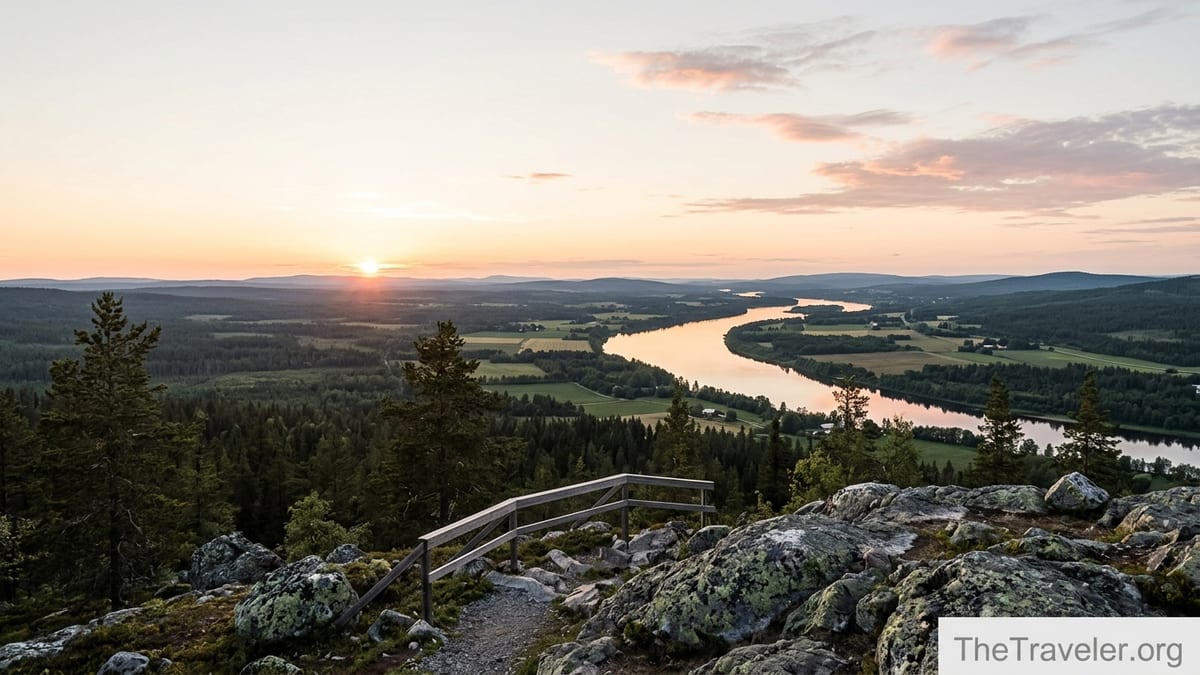
Somewhere around half past eleven at night, the forest on Aavasaksa fell quiet. Cars stopped arriving, conversations dropped to whispers, and everyone on the hill seemed to turn in unison toward the northwest horizon. A pale gold sun hovered just above the line of dark spruce and the broad Tornio River Valley. It inched downward, paused in a band of apricot haze, then began to rise again without ever dipping below the horizon. That short hour on Aavasaksa, watching the midnight sun circle over Finnish Lapland, became the quiet, shimmering highlight of my entire trip.
Get the latest updates straight to your inbox!
Discovering Aavasaksa, Lapland’s Classic Midnight Sun Hill
I had come to Lapland expecting Santa motifs in Rovaniemi and perhaps a reindeer safari, but it was a throwaway line in a local brochure that changed my plans. It mentioned Aavasaksa, a 242 meter hill in the municipality of Ylitornio, almost on the Arctic Circle, described as one of the oldest tourist destinations in Lapland and traditionally celebrated as the southernmost place in Finland where the midnight sun is visible for several days around midsummer. That combination of history and sky made it impossible to resist.
Aavasaksa rises above the Tornio River Valley, facing Sweden on the opposite bank. The hill is sharp edged rather than a broad fell, which gives the summit a feeling of standing on a balcony suspended above the landscape. Even on the drive up you sense its importance. The road climbs through pine and birch forest, passing cabins and old park buildings, before emerging at a plateau crowned with viewing decks, a small observation tower, and walking paths that fan out through a conservation area.
Long before I joined the small crowd that June night, travelers had been making the same pilgrimage. Eighteenth century French scientists came here to measure the shape of the Earth, and by the nineteenth century Aavasaksa had a reputation across Europe as a grandstand for the midnight sun. Today the scene is humbler and more personal. Instead of grand expeditions, it is rental cars with Helsinki plates, a campervan from Germany, a couple arriving on bicycles from the village below, all converging on the same ridge of bedrock to watch the sun refuse to set.
Knowing that history added an unexpected intimacy to my own visit. Standing beside a wooden rail, I had the strong sense of stepping into a very old ritual. The details had changed: phones instead of field notebooks, thermoses of supermarket coffee instead of silver picnic sets. Yet the essence was the same. People had been coming to Aavasaksa for nearly three centuries to watch a sun that simply keeps shining.
Getting to Aavasaksa: From Rovaniemi and Beyond
Reaching Aavasaksa is simpler than it looks on the map. Many visitors approach from Rovaniemi, the region’s main gateway, with regular flights and trains from Helsinki and other European hubs. From Rovaniemi, Ylitornio lies roughly 110 to 120 kilometers to the southwest by road. I rented a compact car at the airport and drove via the regional road that threads through forests and small villages, an easy journey of about ninety minutes in good summer conditions.
The closer alternative is the Tornio and Kemi area on the northwestern coast of the Gulf of Bothnia. From Tornio, which sits directly on the Finnish Swedish border, the drive north along the Tornio River to Ylitornio takes about 45 minutes to an hour on a well maintained highway. Long distance buses link Tornio and Ylitornio a few times a day in summer, and trains run as far as nearby stations like Kemi and further inland, allowing a combination of rail and bus for those who prefer not to drive.
Once in Ylitornio, Aavasaksa itself is just a short detour. The hill rises a few kilometers south of the town center, signposted clearly. A paved road winds all the way to the main parking area near the summit, which means you do not need to be a hiker to experience the midnight sun here. I saw older couples step out of their car in polished shoes and young families unloading folding chairs, all of them just a minute’s gentle walk from the viewpoint. For those without a car, local accommodation providers sometimes arrange transfers up the hill in the evening, especially around the Midsummer weekend.
If you are arriving from farther afield, it is worth building in some buffer time. In Lapland, timetables can be sparse and distances deceptive. During my stay, a traveler I met at a café in Rovaniemi missed the day’s only direct bus west and ended up sharing a taxi with two others to Kemi to connect onward to Tornio. It worked out and the cost split three ways was manageable, but it was a reminder that this is a region where planning around limited departures matters, especially if your entire goal is to be on that hill precisely when the sun skims the horizon.
Choosing Where to Stay Around Aavasaksa
The charm of an Aavasaksa midnight sun trip is how quickly it takes you from transit hubs into deep quiet. Instead of basing myself in a city and tackling the hill as a long evening excursion, I chose to stay close. The Ylitornio area offers a scattering of small, independent accommodations: riverside guesthouses in the village, simple motels along the highway, and, on the hill itself, a cluster of wooden cabins and villas designed to put the view at the center of your stay.
On the southern flank of Aavasaksa I visited a set of forest cabins where guests step directly from their veranda onto a network of trails. Another option, a little higher up, offered log chalets with big picture windows facing the Tornio River Valley, advertised specifically for the nightless night in mid summer. Prices in early June were generally lower than the peak Midsummer holiday, with basic studio cabins in the wider Ylitornio area starting somewhere around what you might pay for a mid range hotel room in Helsinki, and more secluded premium chalets costing considerably more. Booking a few months in advance for the key weeks around the solstice is wise.
Staying in or near Ylitornio also lets you experience the quieter side of Lapland tourism. Unlike the large winter resorts farther north, the summer scene here is dominated by Finnish families, Swedish day trippers crossing the border, and a handful of international visitors who have done their research. One evening, I walked from my guesthouse to a small grill kiosk on the main road for a late burger and fries. The owner asked why I had come so far north in June. When I mentioned Aavasaksa, he nodded in approval and began sharing his own childhood memories of watching the sun roll along the horizon with his parents on Midsummer’s Eve.
For those who prefer a more urban base, Rovaniemi or even Kemi and Tornio remain viable. You could stay in a modern riverside hotel in Rovaniemi, spend your days visiting the Arktikum museum or strolling the Ounasvaara hill trails, then pick a clear evening and drive to Aavasaksa for the show. It makes for a late return, but in the middle of the white night season you will spend the entire trip there and back in full daylight, which feels more like a long afternoon than an after dark journey.
Walking, Waiting and Watching on the Hill
Aavasaksa is not just a single viewpoint. When I arrived a little after 9 pm, the top of the hill felt like a small park in the sky. A wooden observation tower rises above the trees, echoing the scientific history of the site. Around it, a web of paths leads to different lookouts facing north and west, each pocket with its own mood. One led to a rocky outcrop where a couple sat quietly with a thermos. Another skirted the edge of a low cliff with a sweeping view over the river and a church spire glinting in the distance.
The practical rhythm of a midnight sun visit is simple. People come early to stake out a favorite spot, then drift slowly, adjusting their vantage point as the light changes. Below us, fields and villages on both the Finnish and Swedish sides of the valley softened from green to a muted silver, while the river turned to a ribbon of molten metal. Camp chairs appeared. Someone unpacked a small barbecue in the parking lot. Children ran along the wooden walkway under the glow of a sun that refused to dim.
For all its social hum, the atmosphere remained gentle. Around half past eleven the chatter faded almost automatically as phones came out and everyone focused on the sun’s slow descent. The science is straightforward. Because of the Earth’s tilt and the hill’s position just south of the Arctic Circle, the upper edge of the sun remains visible for a few nights around the summer solstice, helped by the way the atmosphere bends light. In practice, from the hill you see the sun sliding diagonally, pausing above the horizon in a band of color that shifts from pale yellow to almost copper, then climbing back up on a slightly different track.
Even outside the narrow window of true midnight sun, the light here in early and late summer is extraordinary. In late May and early July the sun might dip a little below the horizon, but the nights are still bright, with long twilight instead of darkness. A local photographer I met on the hill told me he prefers those nights, when thin clouds catch slow moving color and the landscape glows in layers of pastel. He showed me a photo he had taken the previous week: the Tornio River valley drenched in pale pink and the sun peeking out just above a low bank of cloud at half past midnight.
The Feel of the Midnight Sun: More Than a Photo Opportunity
Experiencing the midnight sun from Aavasaksa is as much emotional as visual. The first surprise is how functional everything still feels. Your phone shows a time that belongs to deep night, but your body never receives the usual cues of darkness. Birds continue their subdued dusk song. The wind, if it comes, is gentle and cool rather than biting. The air carries scents of resin and damp earth, exactly as it would in late evening much farther south.
That dislocation emerged clearly in small moments. Around midnight, a parent near me reminded their child to brush their teeth when they got back to the cabin, as if it were any other bedtime. The child objected, pointing at the bright sun and insisting it was still afternoon. Nearby, an older couple from southern Finland, who had driven up specifically for the weekend, confessed they were on their third cup of coffee of the day because going to sleep in full daylight still felt fundamentally wrong.
The second surprise is how quiet the experience can be, even among others. Unlike scripted excursions where a guide narrates every phase of the evening, Aavasaksa leaves room for private reactions. Some people filmed continuously. Others, like me, took one or two photos and then slipped the phone back into a pocket just to stand still. I watched a group of cyclists, who had pushed their bikes up the final incline, sit almost silently for the full hour around midnight, sharing chocolate from a bag that passed hand to hand without a word.
Later, back at my guesthouse, the owner mentioned that the hill’s long history as a viewing point shapes that mood. Generations of visitors have come with a sense of occasion, and there is a shared understanding that this is not just another scenic overlook. The sun, as she put it, is the main character, and everyone else is there as a respectful audience. That resonated with my own memory of the moment when the sun reached its lowest point, hovering just above the dark line of the horizon, and an unspoken pause seemed to ripple through the crowd.
Practical Tips for Planning Your Midnight Sun Visit
Planning a trip built around one natural phenomenon involves a little strategy. The first piece is timing. In northernmost Finland the midnight sun lasts for weeks, but at Aavasaksa the window is tighter. Aim for the days around the summer solstice in late June if you want the classic experience of the sun remaining visible at true midnight. In the weeks just before and after, you will still get luminous nights and very late sunsets, which can be just as beautiful and more flexible if your dates are limited.
Weather is the second variable. On my first planned night a bank of low cloud rolled in around 10 pm, flattening the light and hiding the horizon entirely. Rather than waiting stubbornly, I drove back down and tried again the next evening, which turned crystal clear. If your schedule allows, give yourself at least two nights in the area to improve your odds. Local accommodation owners and café staff are usually happy to share their sense of the forecast and whether the evening looks promising.
Comfort matters more than gear. In June, temperatures on the hill can hover in the single digits Celsius even when the afternoon has been warm, especially if there is a breeze. I was grateful for a fleece, a windproof shell, and a thin wool hat. Others around me had blankets pulled from their car trunks. A thermos of hot tea or coffee, simple snacks, and perhaps a small camp chair will make the long wait feel more like a picnic than a vigil. Sturdy shoes help on the rocky outcrops and wooden walkways, which can become slick if there has been rain.
Finally, consider your impact. Aavasaksa’s growing popularity has prompted the local municipality to invest in infrastructure, but it remains a fragile hilltop environment. Stay on marked paths, use designated fire pits and grills rather than improvising, and carry your rubbish back down with you. As tourism spreads along the Tornio River Valley, there is a clear effort to keep Aavasaksa’s experience low key and sustainable, and visitors play an important role in preserving that balance.
Beyond the Hill: Life Along the Tornio River Valley
While the midnight sun viewing was the peak of my trip, the days around it were just as memorable. Ylitornio and the broader Tornio River Valley offer an easygoing slice of Lapland that is very different from the busy winter resorts farther north. Fishing boats drift along the broad river, and in summer local companies run excursions for salmon anglers who time their casts to the slow northern evenings. Cycling is popular too. I met a pair of Dutch travelers who had brought folding bikes by train and were spending a week riding from village to village on both the Finnish and Swedish sides of the border.
On one afternoon I followed a short marked trail from Aavasaksa’s summit into a small nature reserve. The path wound through old pine forest and patches of bilberry, over exposed bedrock scoured by ice. Wooden signboards described the hill’s geological history and its role in the 18th century scientific expeditions. Elsewhere around Ylitornio, other trails lead to nearby hills such as Ainiovaara, or down to small lakes popular with locals for swimming and berry picking later in the season.
Culture and history surface in quieter ways. On the top of Aavasaksa stands a statue of Lapland author Annikki Kariniemi, whose novels captured the region’s landscape and life. In town, small museums and local exhibitions explore cross border life along the Tornio River and the blend of Finnish and Swedish influences. Summer festivals, often timed around Midsummer, bring music and dance to village greens, with visitors from both sides of the border.
The food scene is low key but satisfying. Cafés and restaurants in Ylitornio serve Lapland staples like salmon soup, sautéed reindeer with mashed potatoes and lingonberries, and simple grilled dishes. Supermarkets stock everything you might want for a hilltop picnic: rye bread, local cheeses, smoked fish, fresh berries when in season. On the evening of my perfect midnight sun, I ate a supper of cold smoked salmon and cucumber on bread in the parking area, then carried a square of cloudberry cake in a napkin up to the viewpoint as dessert with a view.
The Takeaway
In the weeks since I left Lapland, it is not the high adrenaline activities or the glossy attractions that have stayed with me most vividly. It is that quiet hour on Aavasaksa, standing among strangers on a hill that has drawn travelers for centuries, watching a sun that simply refused to set. The experience felt both intimate and expansive, tied to a precise point on the map yet connected to the slow turning of the Earth itself.
Practically, Aavasaksa is accessible, inexpensive to visit, and easy to fold into a wider Lapland itinerary built around Rovaniemi, Kemi, or Tornio. Emotionally, it offers something harder to quantify: a sense of participating in an old northern ritual where time bends and familiar routines fall away. Whether you choose to stay in a hilltop cabin, a village guesthouse, or a city hotel two hours’ drive away, making the effort to be on that ridge at midnight around the solstice can reframe your entire journey.
If your image of Lapland is defined by winter snow and Christmas lights, an early summer visit to Aavasaksa will gently overturn it. Here, the defining element is light itself, soft yet insistent, drawing you out of bed and up a forested hill to watch the world glow long after the clock says you should be asleep. For me, that luminous night above the Tornio River became the quiet heart of my Lapland trip, a memory I suspect will surface every time the late evening sun lingers on my own horizon at home.
FAQ
Q1. When is the best time to see the midnight sun from Aavasaksa?
The most reliable period is around the summer solstice in late June, when the sun typically remains visible at or near local midnight on clear nights.
Q2. Do I need to be very fit to reach the viewpoint on Aavasaksa?
No. A paved road leads almost to the top, with parking close to the main viewpoints. Short, gently graded paths and boardwalks make the area accessible for most visitors.
Q3. Is it possible to visit Aavasaksa as a day trip from Rovaniemi?
Yes. The drive from Rovaniemi to Ylitornio takes roughly one and a half to two hours each way in summer, so many travelers visit in the evening and return late at night.
Q4. What should I wear for a midnight sun visit in June?
Even if the day has been warm, bring layers. A light insulated jacket, windproof shell, long trousers and sturdy shoes are recommended, plus a hat and gloves if you feel the cold.
Q5. Are there facilities at the top of Aavasaksa?
There is a parking area, marked paths, viewing platforms and some picnic spots. Services can vary by season, so it is wise to bring your own snacks, water and warm drinks.
Q6. Can I rely on public transport to reach Aavasaksa?
Public transport will get you close, to Ylitornio or nearby towns, but services are limited, especially in the evening. Renting a car or arranging a local transfer offers more flexibility.
Q7. Is Aavasaksa suitable for families with children?
Yes. The short walks, open viewpoints and novelty of being outdoors at midnight in full daylight make it an engaging experience for children, as long as they are dressed warmly.
Q8. What if the weather is cloudy during my planned visit?
If possible, allow at least two nights in the area so you can adapt to changing weather. Even on partly cloudy evenings the light can be beautiful, but thick low cloud can hide the horizon entirely.
Q9. Are there other activities near Aavasaksa to fill the daytime?
Yes. You can hike local trails, explore Ylitornio and nearby villages, take scenic drives along the Tornio River Valley, go fishing or simply enjoy slow summer days by the water.
Q10. Do I need to book accommodation far in advance for midsummer?
For the peak period around the summer solstice and the Midsummer holiday weekend, it is sensible to reserve accommodation several months ahead, especially if you want a cabin or hilltop chalet.