


The Acropolis Museum café and restaurant offer some of the most memorable Acropolis views in Athens, whether you are starting the day with Greek coffee or toasting the Parthenon at sunset. Yet many visitors arrive unsure how to access these spaces, what they can order, and when the light is best for photographs. This guide walks you through the experience step by step so you can plan your own Acropolis moments with confidence.
Get the latest updates straight to your inbox!
Understanding the Acropolis Museum Café and Restaurant
The Acropolis Museum has two distinct food spaces that many visitors unknowingly blur together: a ground-floor café with a terrace overlooking the archaeological excavation, and a full restaurant on the second floor with a wide terrace facing the Acropolis. Both feel stylish yet relaxed rather than formal, and both are designed to be part of the museum experience, not just add-on concessions.
The ground-floor café is the easier of the two to duck into. It sits just off the main lobby and opens over the glass floor that reveals the excavated ancient neighborhood beneath the museum. It is a natural stop for a quick break between galleries, a coffee while waiting for friends, or a low-key snack if you are traveling with children who need a pause away from the main exhibits.
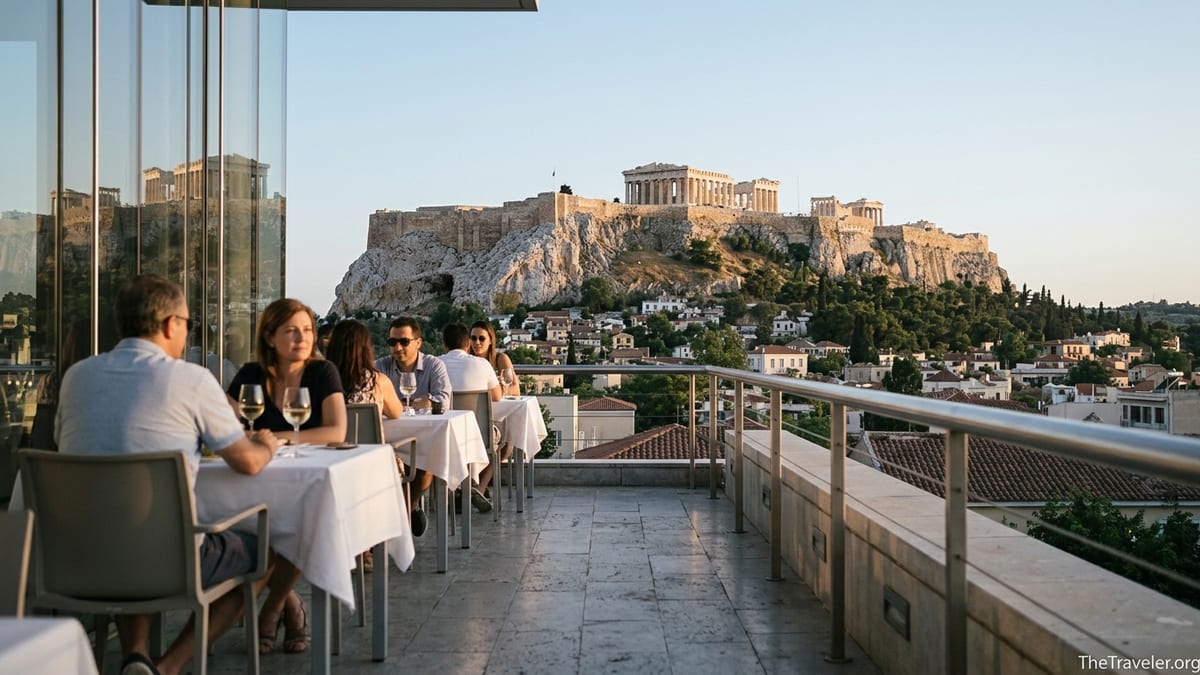
The second-floor restaurant is where the famous view lives. The dining room stretches along floor-to-ceiling glass with a direct line of sight to the Parthenon and the surrounding hills. A large open-air terrace extends the space in warmer months, so you can sit outside with the Acropolis almost level with your eyeline, especially striking at sunset when the marble turns golden.
Both spaces are casual enough for sightseeing clothes, yet the architecture and views create a sense of occasion. You might see families in shorts at one table and Athenians meeting for a business lunch or birthday celebration at another, all sharing the same panorama of temples and rooftops.
Access Rules: Do You Need a Museum Ticket?
One of the most common questions is whether you can visit the café or restaurant without touring the museum galleries. Officially, the second-floor restaurant requires a free admission ticket that you collect from the main ticket counters. That means you pass through the security and ticket area, but you do not have to buy a full museum ticket if you are going only for food and the view. The restaurant itself confirms that access is through a free admission ticket for the second floor rather than a paid exhibition ticket.
In practice, travelers regularly report using this option to meet local friends for a meal or to catch the night view on Fridays and Saturdays when the restaurant stays open until midnight in both summer and winter seasons. For example, an Athens-based reviewer described visiting purely for a cool drink on the terrace on a hot afternoon, using the free restaurant access without entering the galleries. This makes the restaurant a smart choice if you have already visited the museum on a previous trip but still want a fresh Acropolis perspective.
The ground-floor café is even more flexible. Because it sits within the public area of the museum building, access can be possible without a full exhibition ticket, especially outside the busiest hours. However, security practices can change with crowd levels, and during peak summer weekends staff may steer all visitors through the same ticket flow to manage numbers. It is wise to arrive with the expectation that you may need at least a basic museum entrance ticket to reach any internal space, then consider café or restaurant access as an added perk rather than a stand-alone right.
Whichever route you take, budget a few extra minutes for airport-style security screening at the main entrance. Trip reports highlight that queues for museum tickets can build in mid-morning and on rainy days when cruise groups flock indoors, so if you plan a time-sensitive breakfast or sunset drink on the terrace, aim to arrive at least 20 to 30 minutes before your hoped-for sitting.
What to Eat and Drink: Menus, Prices and Local Flavors
The Acropolis Museum food offerings are designed to feel recognizably Greek without being intimidating for first-time visitors. The restaurant on the second floor focuses on seasonal dishes built around traditional recipes. The hot-food kitchen typically starts serving around midday, in line with the museum’s own description that hot dishes are available from 12 noon. You can expect plates such as slow-cooked lamb with herbs, baked eggplant with feta, and seafood options in summer, alongside lighter salads and vegetarian choices.
Independent visitors commonly describe prices as reasonable for the setting. Recent reviews mention main dishes in the mid-teens to low twenties in euros, salads and lighter dishes a bit lower, and desserts such as walnut cake with ice cream or traditional semolina halva in the single-digit euros range. It is not a budget canteen, but compared with rooftop hotel bars or high-end restaurants in Plaka and Thissio with similar views, the museum restaurant typically feels better value for money.
The café menu changes more often, but you can reliably expect Greek coffee, espresso, cappuccino, soft drinks, bottled water, and simple pastries such as spanakopita (spinach pie) or cheese pies. A coffee and a pastry together might come to roughly the cost of a specialty drink at an international chain, but here you are paying for a seat overlooking an actual archaeological dig. If you are traveling with children, the café’s straightforward sandwiches and juices make it a low-stress refueling stop between exhibits.
For drinks with a view, the restaurant terrace is the place to linger. Greek white wines from regions like Santorini or Nemea, local beers, and classic cocktails such as an Aperol spritz or a simple gin and tonic all appear on recent wine lists and traveler photos. Visitors often comment that sipping a glass of chilled assyrtiko on the terrace while the Acropolis lights slowly switch on feels like a highlight of their Athens stay, especially on Friday and Saturday nights when the restaurant remains open until midnight and the city hums below.
Best Times to Visit: Breakfast Mornings vs Sunset Nights
The best time for your Acropolis Museum food stop depends on what you value most: calm and cool temperatures, or dramatic golden light and city energy. In the summer season from 1 April to 31 October, the museum opens at 8 am Monday to Thursday and at 9 am on weekends, while on Fridays it stays open until 10 pm. The restaurant follows similar hours and on Fridays and Saturdays extends to midnight, as confirmed in the museum’s official schedule. This creates very different moods across the day.
For travelers planning a full Acropolis morning, a common pattern is to climb the Acropolis itself early, then come down to the museum for a late breakfast or coffee once the sun becomes intense. For example, a suggested Athens itinerary from a local tourism guide recommends an 8 am Acropolis visit followed by a mid-morning coffee in the neighborhood, then the museum from around 10:30 am. In practice, you can adapt this to include the museum café instead of a street café: walk straight down the pedestrian Dionysiou Areopagitou walkway, enter the museum, and reward yourself with coffee and something sweet overlooking the excavation.
Sunset and night visits are when the second-floor terrace shines. In summer, sunset in Athens falls between roughly 8 pm in April and 9 pm in June and July, sliding earlier again toward autumn. On Friday and Saturday nights, you can time a reservation around golden hour and stay as the Parthenon spotlights flicker on. The marble turns from honey gold to cool white, and you can watch the last light drain behind Philopappos Hill while the restaurant’s glass walls reflect the city’s twinkling lights.
In the winter season from 1 November to 31 March, museum opening hours shift, and the restaurant still offers late nights on Fridays and Saturdays, but with an earlier sunset and a more intimate atmosphere. Locals sometimes treat it as a cozy spot to meet friends out of the rain, sharing a hearty stew or pasta while the Acropolis looms against a chill blue sky. If you are visiting in the off season, it is worth checking the seasonal hours carefully the week you travel, as adjustments sometimes occur for holidays and special events.
Reservations, Dress Code and Practical Tips
The restaurant on the second floor accepts reservations by phone or email, and the museum’s official information encourages booking, especially on busy evenings and during high summer. On the restaurant page, the museum lists a direct reservation phone line and email address, indicating that no reservations are scheduled on Sundays. In practice, travelers report that walking in for lunch on weekdays is often possible, but that Fridays and Saturdays after 7:30 pm can fill up, particularly when large groups or events are booked.
If you have only one evening in Athens and dream of a sunset drink in front of the Parthenon, consider reserving a table a week or two in advance. When you arrive, you will still need to pass through the main museum entrance and pick up your free restaurant admission ticket from the counters. Give your name at the restaurant host stand upstairs, and they will seat you on the terrace or inside the glass-walled dining room depending on your preference and the weather.
There is no strict dress code beyond what you would wear comfortably to a museum. Travelers in sandals and shorts sit alongside others in casual dresses or button-down shirts. The atmosphere is smart-casual rather than formal. One practical point is footwear: the museum floors are polished and the terrace is smooth stone, so comfortable shoes with some grip make it easier to wander between your table and the terrace rail for photos without worrying about slipping after a summer rain shower.
Payment is straightforward, with major credit and debit cards widely accepted. Some visitors note that service charges are not automatically included, though a small tip is appreciated for attentive service. One diner recounted checking the bottom of the printed menu, which explicitly stated that a customer should be presented with a bill before paying, something worth remembering anywhere in the city: always ask for the itemized bill and review it calmly before settling up.
Capturing the View: Best Photo Spots and Moments
Photographers will find the Acropolis Museum food spaces surprisingly rich in angles. On the ground floor, the café terrace looks out over the excavation through layers of glass and steel. You can frame shots that contrast steaming coffee cups on your table with the ancient stones below the glass floor, a way to show the layering of modern Athens over classical ruins. For a less reflective shot, step to the edge of the terrace and angle your camera slightly downward to minimize glare on the glass.
Upstairs, the restaurant terrace is the headline act. The best wide view of the Acropolis typically comes from tables toward the far edge of the terrace, where you can see the Parthenon centered on the hill with fewer nearby buildings in the frame. If you do not secure one of these tables, do not worry: you can usually stand by the terrace railing for a moment to take a photo between courses. Many visitors also enjoy capturing candids of their companions in profile with the Acropolis behind them, using a smartphone in portrait mode to keep their face sharp while softly blurring the temple.
Light changes quickly in Athens, and the most flattering times for photos are the hour after doors open in the morning and the hour before sunset in the evening. In the harsh midday sun, the white marble can blow out in images, appearing as bright patches with little detail. To manage this, tap to expose on the Acropolis in your smartphone camera and slightly lower the exposure slider, or if you are using a dedicated camera, stop down the aperture and shorten your shutter speed. Shooting from inside the glass-walled dining room can also help soften midday light with a subtle filter effect.
Inside the museum galleries themselves, photography rules can be stricter, and flash is often prohibited. The restaurant and café, by contrast, encourage a more relaxed attitude to phones and cameras, provided you are considerate of other diners’ privacy. One useful habit is to take your wide shots quickly just after sitting down, then put away your camera for most of the meal, bringing it out again at the moment the Acropolis lights appear or the sky shifts color. That way, your experience remains both photogenic and present.
Combining Food, Museum Visit and Neighborhood Wandering
Thoughtful timing can turn a simple coffee break into a centerpiece of your Athens day. One popular sequence for first-time visitors is to start early at the Acropolis site, descend by late morning, and then walk directly into the museum for a few hours of air-conditioned exploration. After absorbing the Parthenon marbles and the top-floor gallery that mirrors the temple’s layout, retreat to the second-floor restaurant for a lingering lunch. From there, you can move down to the ground-floor café for a final espresso before leaving, or step straight out into the pedestrian street to wander Plaka and Koukaki.
Another scenario suits travelers who are short on time or revisiting Athens. If you have already toured the Acropolis on a previous trip, you might skip the full museum visit and focus purely on the view. Arrive in the late afternoon, collect your free restaurant admission from the ticket desk, and ride the elevator up to claim a spot on the terrace. Spend an hour or two with a glass of wine and a small selection of meze plates, such as dolmades and grilled vegetables, watching daylight slide into evening. Once you are done, you can stroll along Dionysiou Areopagitou, where street performers and buskers often play with the illuminated Acropolis hovering above.
Families may find that splitting the day helps children stay engaged. For instance, you could visit only the museum’s ground floor and Archaic Gallery in the morning, break for an early lunch at the restaurant with its kid-friendly menu items, then leave for a nap or playground time in nearby Koukaki before returning to the neighborhood in the evening for ice cream and a second look at the Acropolis from a different vantage point, such as Philopappos Hill or a nearby rooftop café.
However you structure your day, remember that the museum, the café, and the restaurant are all part of the same cultural experience. The architecture was designed so that as you move between food and galleries, your eye is constantly pulled back to the Sacred Rock. In that sense, every coffee, lunch, or sunset drink in the building is another way of looking at the Acropolis, from yet another angle and moment in time.
The Takeaway
The Acropolis Museum café and restaurant offer more than a convenient meal stop. They are among the very few places in Athens where you can sit with a proper plate of food or a thoughtfully poured glass of wine while the Parthenon fills your field of vision. With flexible access via a free admission ticket to the second-floor restaurant, late hours on key evenings, and menus that balance Greek character with visitor-friendly options, they reward a bit of advance planning.
Choose morning if you crave quiet light and a gentle start to the day, or target sunset if you want drama and city energy as the Acropolis lights up. Allow time for security and potential queues at the entrance, consider a reservation for peak evenings, and think of the café terrace and restaurant balcony as photo stages as much as dining rooms. In doing so, you will turn a simple coffee or meal into a lasting memory: the moment when your fork paused mid-air because the marble on the hill suddenly flared gold against the Athens sky.
FAQ
Q1. Can I visit the Acropolis Museum restaurant without buying a museum ticket?
Yes. The second-floor restaurant uses a free admission ticket that you collect from the main ticket counters, so you can access it without paying for the main museum galleries.
Q2. Do I need a reservation for the Acropolis Museum restaurant terrace?
Reservations are strongly recommended for sunset and evening visits on Fridays and Saturdays, and during peak summer months, while weekday lunches are more often available for walk-ins.
Q3. What time does the Acropolis Museum restaurant serve hot meals?
The museum states that the hot-food kitchen opens from midday, so you can expect hot dishes such as mains and cooked plates to be available from around 12 noon.
Q4. Are prices at the café and restaurant expensive compared to other Athens spots?
Prices are higher than a basic neighborhood taverna but generally lower than many rooftop hotel bars with similar views, and most travelers describe them as reasonable for the setting.
Q5. Is there a dress code for dining at the Acropolis Museum restaurant?
No formal dress code is enforced. Smart-casual sightseeing clothes such as neat shorts, summer dresses, and sandals are typical and perfectly acceptable.
Q6. Can I just get a coffee or drink on the terrace without a full meal?
Yes. Many visitors stop at the restaurant terrace or ground-floor café for coffee, soft drinks, or wine only, using the opportunity to enjoy the view without sitting for a full multi-course meal.
Q7. When is the best time to photograph the Acropolis from the restaurant?
The best light is usually in the first hour after opening in the morning and during the hour before sunset, when the marble glows and city lights start to appear.
Q8. Are vegetarian or lighter options available on the menu?
Yes. Menus typically include salads, vegetable-based dishes, and cheese-focused plates, and the café often offers simple vegetarian snacks such as cheese pies and sandwiches.
Q9. Can children dine comfortably at the Acropolis Museum restaurant?
Families are very common, and the restaurant is used to hosting children. High chairs and simpler dishes are usually available, and the spacious terrace allows room to move around between courses.
Q10. Is the terrace open in winter or in bad weather?
The terrace operates mainly in fair weather, but even in colder months you can still enjoy the Acropolis view from inside the glass-walled dining room, which offers nearly the same panorama in climate-controlled comfort.