


Standing at the foot of the Acropolis in Athens, most visitors face a practical question long before they pass the ticket gates: do you really need a tour, and if so, what kind? Between group tours sold on booking platforms, freelance guides offering last-minute deals, downloadable audio tours and the temptation to simply wander on your own, it can be hard to know which option fits both your budget and travel style. This guide breaks down the main ways to visit the Acropolis today, what they cost in real terms, and how much extra history and context you actually gain.
Get the latest updates straight to your inbox!
What Your Acropolis Ticket Actually Includes (and What It Does Not)
First, it helps to separate your entrance ticket from any kind of tour. As of mid‑2026, the standard Acropolis ticket for adults is around 30 euros in high season. This covers the archaeological site on the hill itself, including the Parthenon and surrounding monuments, but it does not include a guided tour or an audio guide. The Acropolis Museum is a separate institution with its own ticket, typically around 15 to 20 euros depending on season and special exhibitions. There is currently no official combo ticket that automatically includes both a guided tour and both entrances, so what you see packaged online is usually a reseller bundling official tickets with guiding services.
Most group and private tours you find on major platforms will specify whether Acropolis entry tickets are included, but the wording can be confusing. Some offer “guided tour only,” meaning you pay the guide’s fee but must still buy your own entrance at the official gate or online through the Hellenic heritage ticketing system. Others sell “skip‑the‑line” products where a local agency pre‑purchases the official tickets, then adds a margin for the convenience and the logistics. When comparing prices, always check if the tour price is “with ticket” or “without ticket” so you can accurately judge the real value.
The Acropolis Museum, located just below the hill, operates separately with timed entries and its own ticket control. You can visit the hill and skip the museum, or vice versa, but many travelers find that the museum’s sculptures and models explain what the ruins on the hill once looked like. Several tour companies therefore sell combined products like “Acropolis & Museum with licensed guide,” which bundle both tickets plus a 3 to 4 hour guided visit split between the hill and the museum. These combos tend to be among the most expensive options, but they also deliver the deepest historical context in a short time.
Guided Group Tours: Social, Structured and Good Value
Guided group tours are the most common way visitors experience the Acropolis. On big booking platforms, a standard 2 to 3 hour small‑group tour of the Acropolis, often capped at 20 people, typically runs around 40 to 60 euros per person without entrance tickets, or 70 to 90 euros including the official Acropolis ticket. Morning departures between 8:00 and 9:00 are popular because they avoid some of the midday heat and crowds, particularly from April through October when cruise groups are at their peak.
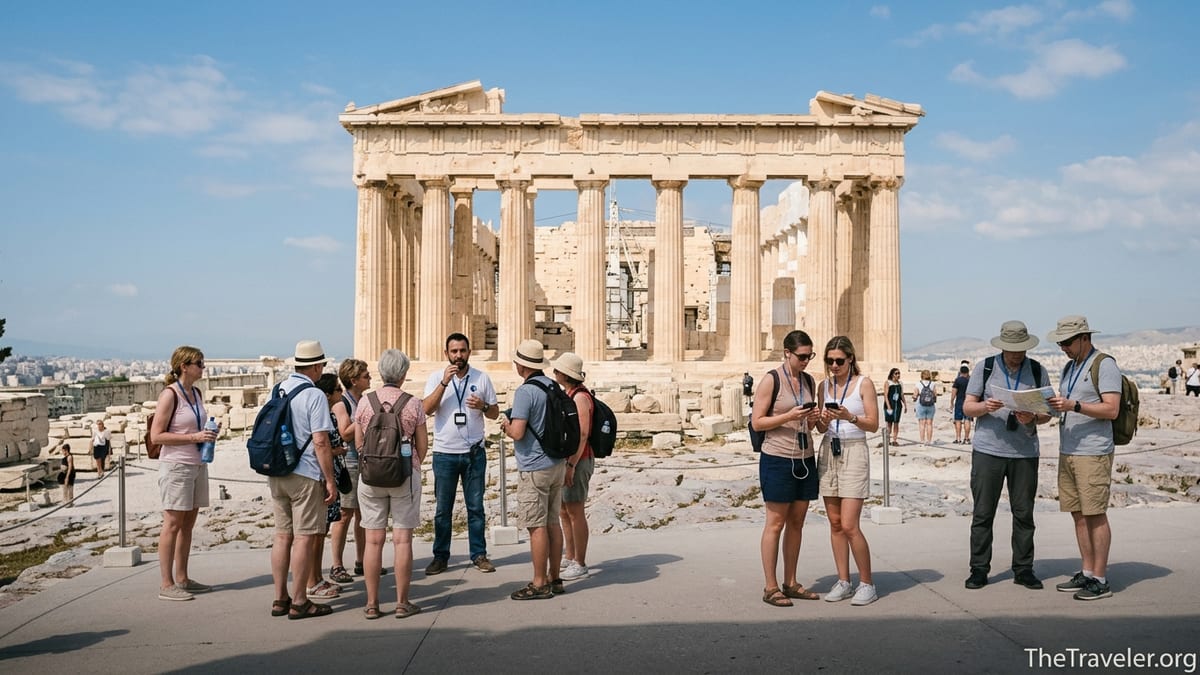
In practice, a group tour might gather at a landmark such as the Acropolis metro station or the Dionysiou Areopagitou pedestrian street, walk up together past the Theater of Dionysus, then pause at key points while the licensed guide explains the history of the Propylaea gate, the Parthenon, the Erechtheion and its Caryatid porch. You will often see guides using wireless audio systems, speaking into a microphone while guests listen on small receivers with earphones. This allows you to hear reasonably well even when the group spreads out or the hill is noisy with other tours.
Group tours suit travelers who like structure and social contact and do not mind a set pace. A classic example: a couple visiting Athens for two days books a 9:00 Acropolis group tour with tickets included for about 80 euros per person. They learn the basics of Athenian democracy, the Persian Wars and the building program of Pericles, then have free time afterward to revisit viewpoints for photos. The main trade‑off is less flexibility. If you prefer to linger at the Parthenon for 20 minutes taking pictures from every angle or you walk more slowly on uneven ground, you might occasionally feel rushed or pressured to keep up with the group.
Private Guides: Maximum Flexibility and Depth at a Higher Price
Hiring a private licensed guide is the premium option for visiting the Acropolis. For a 2 to 3 hour private tour, expect to pay somewhere in the range of 120 to 200 euros for the guiding fee alone, not including entrance tickets. Prices vary based on the length of tour, language requested and how early you book. Split between four friends, however, a private guide at 180 euros plus tickets comes out to a similar per‑person cost as a mid‑range group tour, while giving you far more control over pacing and focus.
With a private guide, you can tailor the visit to your specific interests. Families with children often ask guides to weave in myths of Athena and Poseidon, stories of Theseus and the Minotaur or simple explanations of why the Parthenon looks slightly “curved” due to optical refinements. History enthusiasts might want a heavier emphasis on archaeological debates, such as the reconstruction of the temple of Athena Nike or the discussions surrounding the Parthenon sculptures in London. A good private guide will also adjust to mobility or hearing needs, picking quieter spots to talk, suggesting handrails and choosing routes with fewer stairs where possible.
Private guiding really shines when you link the Acropolis with the Acropolis Museum in a single half‑day. A common private itinerary begins with a 90 minute walk on the hill, then descends to the museum for another 90 minutes focusing on the original Caryatids, the Parthenon frieze and a scale model of the Acropolis plateau. Many visitors who have done both group and private options say the private tour felt like “paying for a college seminar” condensed into a morning. If your time in Athens is short or the Acropolis is a dream‑of‑a‑lifetime visit, this level of personalization can be worth the extra cost.
Audio Guides and Apps: Cheap, Flexible and Surprisingly Good
For visitors who prefer to explore independently but still want structured commentary, audio guides and apps bridge the gap between guided and self‑guided visits. One of the most widely used examples is the Rick Steves Audio Europe app, which offers a free Acropolis walking tour in English. Many travelers report spending about 90 minutes to 2 hours following this tour on the hill, listening through headphones while pausing and replaying sections as needed. There are also audio tours available for the Ancient Agora and an Athens city walk, which can help you place the Acropolis within the broader city context.
Beyond free options, several commercial audio apps sell Acropolis tours for a modest fee, often between 5 and 15 euros per download. These typically include offline maps marking each stop, short audio segments triggered by GPS or QR codes and sometimes bonus content about nearby attractions such as the Odeon of Herodes Atticus or Filopappou Hill. When these are bundled with skip‑the‑line entrance tickets by third‑party resellers, you might see packages advertised as “Acropolis entry with audio guide” for 40 to 50 euros, essentially combining the 30 euro ticket with a premium app and small booking fee.
Audio guides are especially practical if you travel with people who like different paces. For instance, one person might listen carefully to each track in front of the Erechtheion while another skips ahead to the viewpoints over the city, catching up later by listening to missed segments on the steps below the Parthenon. They are also helpful for hearing‑impaired travelers who use Bluetooth hearing aids, since they can route the audio directly from their phone. The main limitation is that audio tours cannot answer follow‑up questions. If you want to engage in discussion, challenge interpretations or dive deep into specific architectural details, a human guide remains more satisfying.
True Self‑Guided Visits: Going It Alone With Maps and Minimal Context
The most economical way to see the Acropolis is to simply buy your ticket and walk the site on your own. This is what many backpackers, independent travelers and Athens residents do, especially on days when entrance is free or discounted for certain categories. At the gates you will find basic site maps and scattered information panels in Greek and English. These explain the names and dates of major structures and provide simple diagrams of reconstructions, but they are intentionally concise to keep foot traffic flowing in tight spaces.
A purely self‑guided visit tends to be shorter, often 60 to 90 minutes on the hill for first‑time visitors. You might linger on the south slope at the Theater of Dionysus, take photographs at the main viewing platform in front of the Parthenon and then circle the summit once to appreciate the skyline of modern Athens. Travelers who already know the history from previous reading, documentaries or university study often find this enough. It can also be the sanest option if you happen to arrive in peak heat in July or August and want to minimize time under the sun rather than stand still listening to commentary.
The trade‑off is that subtle aspects of the site can go unnoticed. Without a guide or audio commentary, many people miss details such as the engineering of the ancient cisterns, the political symbolism of building temples in marble instead of limestone or the way the Acropolis aligns with other sacred sites in Attica. If your schedule allows, one strategy is to do a short self‑guided walk first, then later in your trip join a thematic tour, such as a democracy‑focused walk in the Ancient Agora, to deepen your understanding of classical Athens as a whole.
The Value of a Licensed Guide: What You Really Gain
In Greece, guiding at archaeological sites like the Acropolis is regulated. Only licensed guides, who have completed specialized training and hold a professional license, are allowed to lead tours inside the official boundary and receive payment for it. This is why many general walking tour guides in Athens will walk you around the perimeter streets and viewpoints but hand you over to a licensed colleague when it is time to enter the Acropolis itself. This system aims to maintain a certain standard of accuracy and protect heritage sites from overcrowding and careless handling.
From a visitor’s perspective, a licensed guide typically brings three advantages. First, they condense a complex chronology into a coherent story: how the Mycenaean fortification evolved into the classical sanctuary, what changed during Roman and Byzantine times and how the monuments were damaged in later centuries. Second, they can interpret current conservation work you see on the hill, explaining why cranes and scaffolding surround parts of the Parthenon and what restoration techniques are used. Third, they can answer practical questions in real time, from where to find drinking water fountains to the best route down if you have knee issues.
Real‑world experiences shared by recent visitors often emphasize how a guide helped “bring stones to life.” For example, a group tour might pause in front of the west frieze of the Parthenon, with the guide pointing out specific scenes in the Panathenaic procession that relate to civic identity, something most visitors would not decode from the reliefs on their own. In the Acropolis Museum, a licensed guide can walk you along the glass gallery displaying the Parthenon marbles, indicating which pieces are original, which are casts and where removed sculptures currently are, helping you understand a major international debate without oversimplifying it.
Is a Tour Actually Worth It? Matching Options to Traveler Types
Whether a tour is “worth it” at the Acropolis depends on your budget, time and interest in history. A budget traveler visiting Athens for several days, comfortable reading on their own, might choose self‑guided visits supplemented by a free audio tour and a mid‑priced guidebook. Their costs could be limited to the official entrance tickets plus perhaps 10 euros for a premium app, leaving more money for meals, island ferries or other experiences. In contrast, a family on a once‑in‑a‑lifetime Mediterranean cruise stop might view a 300 euro private Acropolis and museum tour for five people as excellent value, since it guarantees a well‑paced, kid‑friendly experience in just half a day.
A reasonable rule of thumb is that if you have a strong interest in history or archaeology but only one half‑day to devote to the Acropolis area, a guided experience of some kind is usually worth the money. A good group tour can frame the site in its ancient context, then you can stay on afterward to wander or take photographs at your leisure. If you are more interested in atmosphere and views than detailed explanations, you may be happier visiting early in the morning alone, climbing to the summit before most groups arrive, and then later reading about what you saw from a comfortable café terrace nearby.
Do not underestimate your own energy and comfort. The Acropolis involves uphill walking on uneven stone, often in strong sun and heat, with limited shade on the summit. Standing still for long periods while listening to a guide can feel more tiring than strolling at your own pace with an audio tour you can pause. For some travelers, that alone tips the balance toward audio or self‑guided options, even if they appreciate the depth an in‑person guide could offer.
Practical Booking Tips and Realistic Budgeting
When planning the financial side of your Acropolis visit, think in layers: first the official tickets, then your preferred style of guidance. At current prices, a realistic per‑person budget for a high‑season visit might look like this. For a fully self‑guided hill visit with a free audio tour, count on around 30 euros for the Acropolis ticket and nothing extra. Add the Acropolis Museum at around 15 to 20 euros if you are a history enthusiast, bringing your total to roughly 45 to 50 euros without any paid guiding.
If you choose a standard small‑group Acropolis tour including tickets, expect to pay between 70 and 90 euros per adult. A combined Acropolis and museum group tour with both tickets often falls into the 100 to 130 euro range, reflecting 3 to 4 hours of guiding and two official entrances. Private tours commonly start around 120 euros per group for the Acropolis only and climb to 200 euros or more for longer, combined experiences. Spreading these costs across your travel party can make private guiding surprisingly competitive compared with signing up four people for a premium group tour.
In terms of booking strategy, high‑season mornings from May through September often sell out for the most reputable guides and small‑group tours. Booking at least a week or two ahead is wise if you want a specific time slot or language. In shoulder season months like April and October you may find more last‑minute availability and occasional discounts. Same‑day deals sometimes appear on the street near the Acropolis metro station, but these are best approached with caution: always verify that the guide is licensed, clarify whether tickets are included and ask about group size before paying.
FAQ
Q1. Do I need to book an Acropolis tour in advance, or can I decide on the day?
For basic entry tickets, you can usually buy on the day, though lines can be long in high season. For popular small‑group and private tours, it is safer to book at least several days ahead in summer to secure a morning slot and your preferred language.
Q2. Is a private Acropolis guide worth the extra cost compared with a group tour?
A private guide is generally worth it if you are traveling as a family or small group, have specific interests or accessibility needs, or want to combine the hill and museum in one deep‑dive visit. For solo travelers and couples on a strict budget, a well‑reviewed small‑group tour usually offers enough depth at a lower per‑person price.
Q3. Are audio guides a good substitute for a live guide at the Acropolis?
For many visitors, a high‑quality audio tour is an excellent substitute, especially when paired with a good map or guidebook. You get structure, stories and directions at a fraction of the price, plus the freedom to pause and rewind. The main thing you miss is the ability to ask follow‑up questions or have explanations customized to your background knowledge.
Q4. Can I visit the Acropolis Museum and the Acropolis hill on the same ticket?
No. The Acropolis hill and the Acropolis Museum use separate tickets and entrance systems. Some tour operators or agencies bundle both tickets with a guided tour, but these are commercial packages layered on top of the official tickets rather than a single combined state ticket.
Q5. How long should I plan for an Acropolis visit with or without a tour?
A typical guided visit to the hill alone takes about 2 to 3 hours. If you add the Acropolis Museum, expect a total of 4 to 5 hours including walking between the two. Self‑guided visitors who mainly want the views often spend about 60 to 90 minutes on the hill and another 1.5 to 2 hours in the museum.
Q6. Are there English tours available every day at the Acropolis?
Yes. In high season there are numerous English‑language tours every day, both morning and afternoon, offered by different companies and independent licensed guides. Outside peak months, there may be fewer departure times, so checking schedules and booking ahead is more important.
Q7. Is a tour recommended if I am traveling with children?
A family‑focused group or private tour can be very helpful with children, as a good guide will adapt stories to their age level, include myths and interactive questions, and pace breaks for shade and water. Very young children may still do better with a flexible audio or self‑guided visit so you can leave whenever they get tired.
Q8. What is the best time of day for an Acropolis tour?
Morning tours, starting between 8:00 and 9:00, are generally best to avoid the worst heat and crowds, especially from late spring through early autumn. Late afternoon can also be pleasant with softer light, though some areas may feel busier as day tours and cruise passengers converge.
Q9. If I am on a tight budget, what is the smartest way to see the Acropolis?
On a tight budget, buy the official Acropolis ticket only, then use a free or low‑cost audio tour to guide you around the site. Visit early or late in the day to avoid heat, read the on‑site panels, and save guided experiences for one or two other sites that interest you most.
Q10. Do Acropolis tours include transportation from my hotel?
Most Acropolis tours do not include hotel pickup and instead meet at a central point near the site, such as the Acropolis metro station or a nearby square. A few higher‑priced options offer transfers, but in central Athens it is usually easy and inexpensive to reach the meeting point by metro, tram or a short taxi ride.