


Arriving at the Acropolis can be confusing. Your ticket does not tell you which gate to use, signs on the streets are minimal, and by peak season the wrong choice can mean standing in line for an hour under a blazing Athenian sun. This guide breaks down the two key Acropolis entrances, how to reach each one, and which gate works best for different types of travelers, from first-time visitors to families with strollers or travelers with limited mobility.
Get the latest updates straight to your inbox!
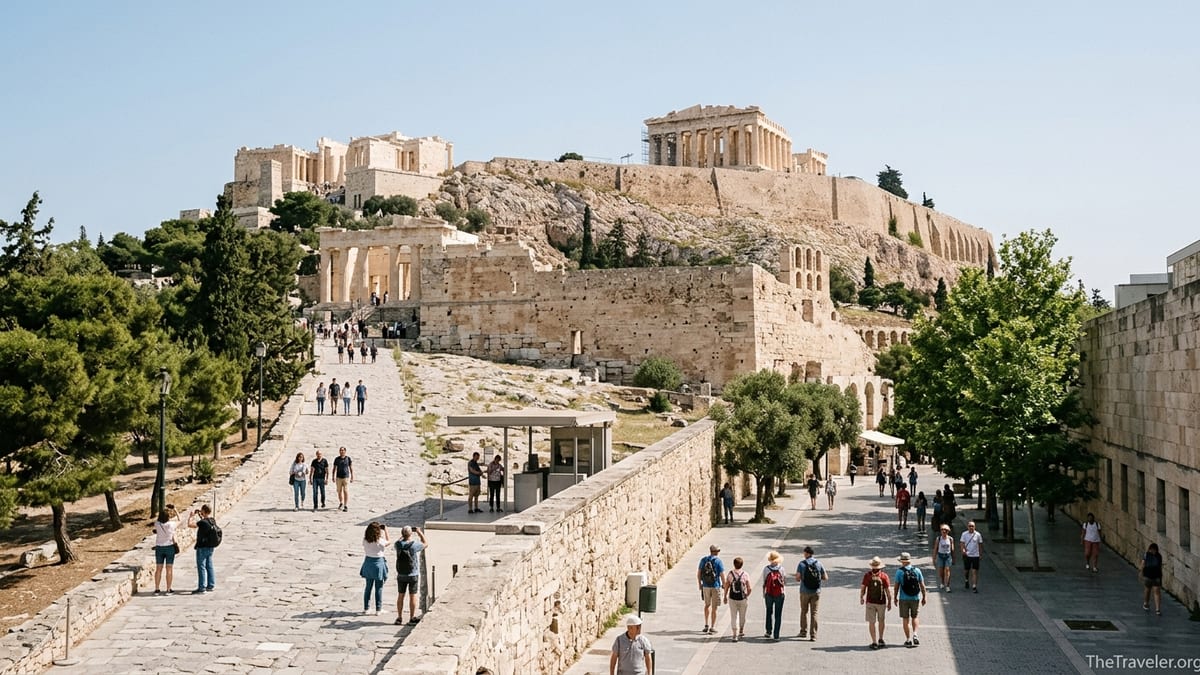
Understanding the Two Main Acropolis Entrances
For most visitors there are effectively two working entrances to the Acropolis and its slopes. The first is the main entrance on the western side, near the Propylaea, reached from the area around the Areopagus Hill and the end of Apostolou Pavlou Street. This is the historical approach: you enter, climb through the monumental Propylaea gateway and emerge directly in front of the Parthenon. It feels theatrical and grand, and nearly all coach groups and many guided tours default to this gate.
The second is the side or south-slope entrance along Dionysiou Areopagitou Street, near the Acropolis Museum and the Acropolis (M2) metro station. This gate brings you in via the Theatre of Dionysus and the southern slopes, then curves up to join the same main path near the top. Many independent travelers now use this side entrance because it is closer to the metro and, outside the very peak hours, often has noticeably shorter lines than the west gate.
In practice both entrances give access to the same archaeological site, share the same ticketing system and security checks, and converge on the same uphill marble walkway. The differences are about how you reach them, the queues you are likely to face, and how steep or long your walk will feel, especially in summer heat when every extra 10 minutes in the sun matters.
It is worth noting that there is also a separate accessible lift entrance on the northwest side for visitors with valid disability documentation and their companions. This is signposted as the elevator entrance rather than a general gate, and it is managed under different rules than the two standard entrances described in this article.
Metro Access and How to Reach Each Gate
If you are arriving by metro, the Acropolis station on Line 2 (the red line) is your natural starting point. The station sits just south of Dionysiou Areopagitou Street, a short walk from both the Acropolis Museum and the south-slope entrance. When you exit the metro, follow signs for the museum, walk up to the wide pedestrian street and you will see clear flow toward the Acropolis and museum area. From the station exit, most travelers reach the side entrance in roughly 3 to 5 minutes at a relaxed pace, simply by following the stone-paved street uphill.
Reaching the main west entrance from the same metro stop takes longer. You walk along Dionysiou Areopagitou toward the Acropolis, then continue around the base of the hill past the Odeon of Herodes Atticus until signs point you uphill to the ticket area. This walk usually takes 10 to 15 minutes from the metro for an average adult, longer if you are with young children or stopping for photos. The payoff is that you approach the Acropolis in a more traditional arc, seeing the massive walls and Odeon as you curve around the rock.
Travelers staying near Syntagma or Monastiraki sometimes choose to walk instead of using the metro, following Ermou Street to the Thissio area and continuing along the pedestrianized route that loops around the Acropolis. This walk is scenic but can add 20 to 30 minutes on warm days. If your goal is simply to minimize effort and arrive quickly, taking Line 2 to Acropolis station and using the south entrance is usually the most straightforward option, especially if you are visiting with older relatives or anyone sensitive to heat.
Taxis and rideshares can drop you near both gates, but vehicles cannot drive directly up to the site itself. In practice drivers often stop near the main entrance side, at the junction close to the parking area and the start of the short climb to the ticket booths. If you have limited walking capacity, it helps to show the driver a map or specify that you need the closest drop-off point to either the “main Acropolis entrance” or “Dionysou Areopagitou near the Acropolis Museum,” depending on your plan.
Queues, Crowd Patterns, and Timing Strategies
Crowds at the Acropolis fluctuate sharply by time of day and season. In July and August, cruise ship groups and tour buses start arriving by about 8:30 in the morning. By 10:00 many visitors report lines at the main west entrance that can stretch 30 to 60 minutes, even when you already hold a timed ticket. In contrast, local reports and recent visitor accounts consistently mention that the side entrance near the Theatre of Dionysus often has much shorter queues, especially before 9:00 and again later in the afternoon.
One common pattern is that independent travelers with pre-booked tickets gravitate toward the south entrance in the early morning, while large guided groups still favor the main gate. For example, a family visiting in late May might arrive at the side entrance at 8:00 and be inside within 10 minutes, whereas friends arriving at the west gate at 10:30 in mid-June might queue half an hour behind multiple coach groups. The difference can be the entire length of your visit if you are traveling with young children who tire easily.
Timed-entry tickets have become increasingly important as the authorities manage daily visitor numbers. In high season, you select a one-hour entry window, such as 8:00 to 9:00 or 10:00 to 11:00. The staff at both gates generally enforce these windows, meaning that if you show up more than a short time after your slot, you may be asked to buy a new ticket for a later hour. Some travelers report being turned away at the south gate when late for a morning slot and then walking around to the main gate to negotiate entry, which wastes time in the heat. Building in a 15 to 20 minute buffer for finding your entrance and clearing security is a practical way to avoid this situation.
For most visitors who want to avoid the worst crowds without waking up at dawn, two strategies work well. First, book the 8:00 to 9:00 slot and use the side entrance, going straight up to the summit while the light is still soft and temperatures are lower. Second, in very hot months, consider a late afternoon slot, arriving at the side gate two to three hours before closing time when many day-tour visitors have already left. In both cases, plan time at the end for a slow descent via the slopes rather than rushing down the same way you came.
Walking Difficulty, Slopes, and Surface Conditions
However you enter, a visit to the Acropolis involves real uphill walking. The site rises around 150 meters above sea level and the paths, while well-maintained, include stone ramps, steps and sections of worn marble that can be slippery even when dry. The walk from the south entrance is more gradual, weaving up past the Theatre of Dionysus, but it still climbs steadily. From the main entrance, you gain elevation more quickly, especially as you approach the Propylaea, where you navigate a combination of steps and sloping marble.
For relatively fit travelers in comfortable shoes, the overall climb from either gate to the Parthenon plateau usually takes 15 to 25 minutes, including photo stops. The paths are not technically difficult, but they do require attention. In practice, the most challenging part for many is the compressed section just below the Propylaea near the top, where people funnel through a narrow historic gateway. This area can become crowded and slow going by mid-morning, regardless of which entrance you used to reach it.
If you are visiting with a stroller, the south entrance is generally more manageable. You can follow the wider paths past the Theatre of Dionysus and use ramps where available, though you will still meet some uneven surfaces. Many families opt to park or fold the stroller at the base of the steeper sections near the top and carry younger children for the last few minutes. Lightweight travel strollers with good brakes and larger wheels handle the cobblestones and stone paths better than narrow-wheeled city models.
Visitors with limited mobility should review recent information on the dedicated elevator near the northwest side of the hill, which is accessed from close to the main entrance side rather than the south gate. Local advice suggests that travelers with mobility concerns check ahead to confirm operating status and eligibility, as access is typically reserved for those with demonstrable disability documentation and, in many cases, a companion. Even with the lift, navigating the hilltop still involves some walking on uneven surfaces, so supportive footwear and realistic expectations are important.
Main Entrance vs Side Entrance: Which Gate to Start From?
If it is your first time at the Acropolis and you are reasonably fit, the main west entrance offers the most classically dramatic arrival. You walk through pine-shaded areas, see the massive fortification walls up close and finally climb into the citadel through the Propylaea, much as ancient visitors would have done. For travelers who are particularly interested in history and architecture, this ceremonial approach can make the whole experience feel more coherent, with the Parthenon reveal acting as a highlight.
On the other hand, for many modern travelers practical considerations trump ceremony. The side entrance is closer to the Acropolis metro station, sits almost adjacent to the Acropolis Museum and often has shorter lines, especially before 9:30. Solo travelers and couples staying in central Athens frequently choose this gate because it fits neatly into a day where you visit the Acropolis first, descend via the south slopes and then head directly into the museum or nearby cafes without backtracking around the hill.
Families with small children, travelers visiting in peak summer heat, and anyone who is anxious about long queues often find the side entrance a better starting point. A realistic example: a couple with a four-year-old arriving in late July can ride the metro to Acropolis station, walk three minutes to the south gate, and be on their way up to the Parthenon before the day’s first tour buses fully unload at the main gate. They may sacrifice the grand westward approach through the Propylaea, but they gain energy and patience for exploring the summit.
For photographers, the choice is more nuanced. Using the main entrance first thing in the morning gives you front-on views of the Propylaea and earlier chances for wide shots along the central axis of the Parthenon before the summit fills. Starting at the side gate lets you photograph the Theatre of Dionysus and southern slopes while light is still gentle, then circle onto the plateau. In many cases, a balanced strategy is to enter via one gate and exit via the other, designing a one-way walking route rather than retracing your steps.
Route Planning for First-Timers: Sample Itineraries
For a classic first visit with an emphasis on atmosphere, consider starting at the main west entrance on the earliest slot available. From the metro, you can either walk around the base of the Acropolis or take a short taxi ride that will drop you near the car access point below the main gate. Once you clear tickets and security, move steadily upward toward the Propylaea, pausing on the terraces to look back across Athens. On the summit, circle the Parthenon clockwise, then continue toward the Erechtheion and viewing points over the city before beginning your descent via the south path toward the Theatre of Dionysus. You will exit near Dionysiou Areopagitou, within a few minutes’ walk of the metro and the museum.
Alternatively, if you are more concerned about minimizing walking and queues, a side-entrance loop works well. Take the metro to Acropolis station, walk up to the south gate, and enter directly onto the slopes. Spend a few minutes at the Theatre of Dionysus, then follow the broad path as it climbs and curves around the hill. When you reach the upper junction near the Propylaea, choose the gentler ramps where possible and allow for short rests. After exploring the summit, you can retrace your path to exit again via the south gate, which keeps your total elevation gain and descent relatively consistent and avoids the steeper stair sections on the western flank.
Visitors combining the Acropolis with the Acropolis Museum in a single day often find it efficient to use the south gate both ways. A typical plan in spring might involve an 8:00 ticket, entering via the side entrance, spending 90 minutes on the hilltop and slopes, then descending for a late-morning coffee on Dionysiou Areopagitou before heading into the museum for a few hours of cooler, indoor exploration. This structure allows you to experience the outdoor site in the relative cool of the morning and shift your afternoon into air-conditioned spaces while still staying within a compact area.
If you are carrying heavy camera equipment or have travelers in your group with differing energy levels, consider splitting your visit. One approach is to visit the Acropolis itself early one morning using whichever gate fits your accommodation and mobility needs, and then, on another day, walk the pedestrian loop around the base of the hill at an easier pace, visiting lower-lying sites like the Agora and the Temple of Olympian Zeus. This keeps the most demanding walking focused into a short, well-planned window.
Common Problems at Each Gate and How to Avoid Them
At the main west entrance, the biggest issues are congestion and heat. Lines for ticket checks, security scans and the narrow approach to the Propylaea can stack up quickly once coach groups arrive. To reduce frustration, pre-purchase your ticket for the earliest suitable slot, arrive at the main gate at least 20 minutes before your window opens, and carry water, sun protection and a hat. If you find yourself arriving late in the morning with a flexible plan, it may be worth checking line length at the side gate before committing to the main gate queue.
Another common challenge at the main entrance is confusion over the accessible elevator and who can use it. Travelers sometimes assume that limited fitness alone qualifies them for the lift, only to be turned back for lack of appropriate documentation. If anyone in your group has a permanent disability, research the current policy in advance, bring relevant documents in a physical or digital form, and allow extra time for checking in at the specific entrance designated for elevator use.
At the side entrance, the key pitfalls tend to involve ticket timing and expectations. Because this gate is so close to the metro and the museum, some visitors arrive casually, expecting to purchase a ticket at the booth and enter immediately, only to discover that the next available time slot is hours away or that their pre-booked slot has just expired. To avoid this, aim to be in the vicinity of your chosen gate 15 to 30 minutes before your time window, and treat the time printed on your ticket as a firm commitment rather than a suggestion.
Finally, both gates share a simple but important risk: underestimating how much energy the visit will require. Travelers arriving after a long-haul flight sometimes plan the Acropolis for their first afternoon in Athens, climb in intense sun after a poor night’s sleep, and leave exhausted. Whenever possible, schedule your visit for a morning after you have had one night to recover, drink more water than you think you need before you begin the climb, and budget time at the end of your visit to sit in the shade along Dionysiou Areopagitou or at a nearby cafe to recover.
The Takeaway
Choosing between the Acropolis main entrance and the side entrance is less about right and wrong and more about matching the gate to your priorities. The main west entrance offers the classic ceremonial approach, a sense of following in the steps of ancient processions and a direct line to the Parthenon through the Propylaea. The side entrance along Dionysiou Areopagitou, close to the Acropolis metro station and museum, often provides shorter lines, a gentler climb and a smoother transition into the rest of your day in central Athens.
For first-time visitors who are reasonably fit and particularly interested in atmosphere, starting at the main entrance and exiting via the south slopes provides a satisfying narrative arc. For families, summer travelers and those who prioritize convenience, entering and exiting via the side gate typically creates a calmer, less tiring experience. In both cases, arriving early, pre-booking your timed ticket and wearing supportive footwear will do more to shape your day than any single choice of gate.
Whatever route you choose, remember that the real goal is not simply to reach the top but to give yourself enough space and energy to appreciate what you find there: the delicate fluting of Parthenon columns, the caryatids of the Erechtheion, and the wide view over modern Athens stretching to the Saronic Gulf. With a bit of planning around entrances, queues and walking difficulty, the climb up the Sacred Rock can become a highlight of your time in Greece rather than a logistical ordeal.
FAQ
Q1. Which Acropolis entrance is better for first-time visitors?
For most first-time visitors who are comfortable with some uphill walking, the main west entrance is the most atmospheric, because you enter through the Propylaea and see the Parthenon dramatically revealed ahead of you. However, if you are visiting in peak summer heat, traveling with young children or especially worried about queues, the side entrance near the Acropolis metro station is often easier and less stressful.
Q2. How far is the side entrance from the Acropolis metro station?
From the Acropolis station on Line 2, walking to the side entrance along Dionysiou Areopagitou typically takes about 3 to 5 minutes at a normal pace. You exit the station, follow signs to the Acropolis Museum and then continue slightly uphill along the pedestrian street until you see the ticket booths and security area on your left.
Q3. Can I enter through one gate and exit through the other?
Yes, most visitors can enter through one gate and exit through the other without any problem, as both lead into the same archaeological site. A common strategy is to start at the main west entrance for the classic approach to the summit and then descend via the south slopes, exiting near the Acropolis Museum and metro. This turns your visit into a one-way walk instead of retracing your steps.
Q4. Which entrance usually has shorter lines?
Queue length varies by season and time of day, but many recent visitors report that the side entrance along Dionysiou Areopagitou usually has shorter lines than the main gate, especially before about 9:30 in the morning and again later in the afternoon. The main west entrance tends to attract more large tour groups and cruise excursions, which can quickly build long lines after 10:00.
Q5. Is the walk from the side entrance easier than from the main entrance?
The side entrance offers a more gradual climb, starting near the Theatre of Dionysus and winding up the south slope, which many people find slightly easier. The main entrance involves a steeper final section as you approach and pass through the Propylaea. From either gate you will encounter uneven stone, steps and worn marble, so supportive footwear and a reasonable fitness level are important.
Q6. Which gate should I use if I have a stroller or small children?
Families with strollers and young children usually find the side entrance more practical. The approach from the Acropolis metro station is short, and the paths on the south slope are generally wider and more gradual than the steeper steps near the main gate. Many parents still choose to fold the stroller or leave it at the base of the last climb to the summit to avoid struggling on the most crowded and uneven sections.
Q7. How do timed tickets work with the two entrances?
Timed-entry tickets list a specific one-hour window for entering the site, and you can use either entrance during that window. Staff at both gates typically enforce the times, so if you arrive significantly late you may be asked to purchase a new slot. To account for walking time from your hotel or the metro, aim to be near your chosen gate 15 to 30 minutes before the start of your time window.
Q8. Which entrance should I choose if I also want to visit the Acropolis Museum?
If the museum is part of your day, the side entrance is usually more convenient. You can take the metro to Acropolis station, enter the site via the south gate, explore the summit and slopes, and then exit back near the museum for a late-morning or afternoon visit. This keeps your walking route compact and avoids having to circle the hill again after you finish at the Acropolis.
Q9. Where is the accessible elevator, and can I use it from any gate?
The accessible elevator is located on the northwest side of the hill, reached from near the main entrance area rather than the south gate. Access is typically reserved for visitors with documented disabilities and their companions, not for general visitors who simply wish to avoid climbing. If you may be eligible, check the latest official information before your visit and bring any relevant documentation with you.
Q10. What is the best entrance if I am short on time?
If time is tight and you are arriving by metro, the side entrance is often the most efficient choice because it is very close to Acropolis station and commonly has shorter lines outside the very busiest hours. You can enter quickly, walk directly up to the Parthenon, spend focused time on the summit and then descend via the same route to return to the metro or head straight to the nearby museum or cafes.