


More news on this day
Europe’s airport hierarchy has shifted again, with new 2024 and 2025 traffic data confirming Istanbul Airport as Europe’s busiest hub by passenger volume and Madrid Barajas consolidating fifth position, underscoring how Turkey and Spain are driving the continent’s post pandemic aviation recovery and altering where and how travelers connect across the region.
Get the latest news straight to your inbox!
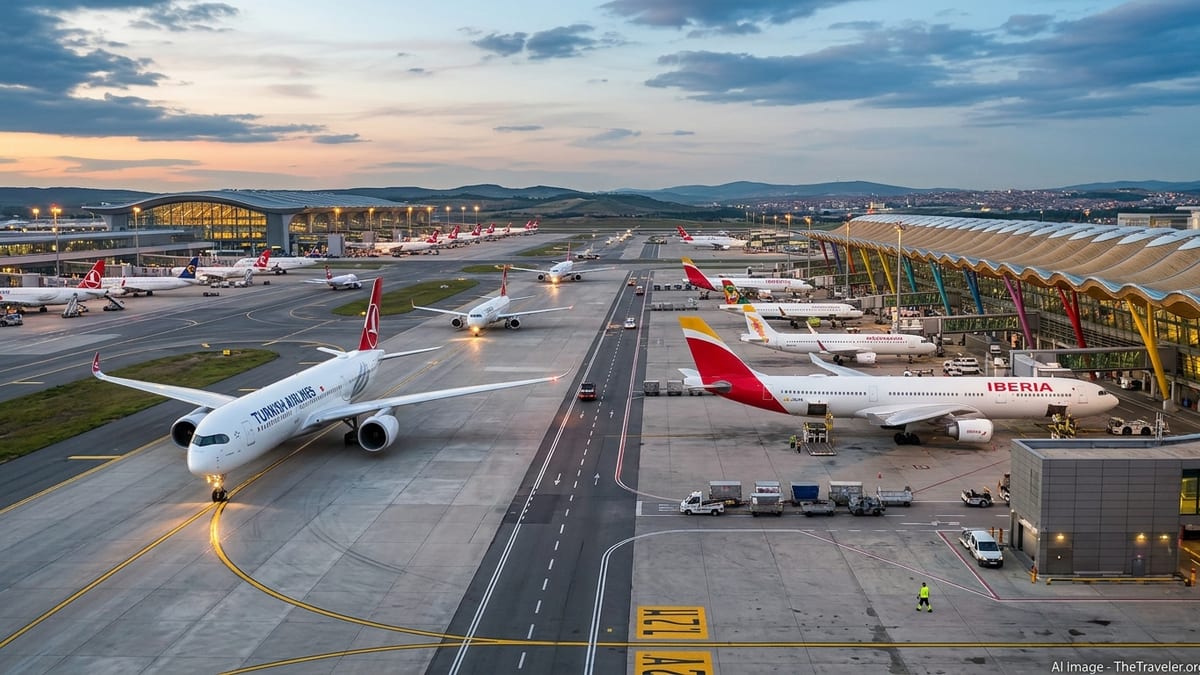
Istanbul confirmed as Europe’s busiest airport by passengers
The most consequential development in Europe’s airport rankings is that Istanbul Airport has been confirmed as the continent’s busiest airport by total passengers, based on the latest full year datasets derived from Airports Council International and national operators for 2024 and 2025. Publicly available compilations of ACI based figures for 2024 show Istanbul handling a little over 80 million passengers, placing it ahead of London Heathrow, Paris Charles de Gaulle and Amsterdam Schiphol in total throughput. For travelers, that means more itineraries now route via Istanbul when flying between Europe, the Middle East, Africa and Asia.
Separate statistics on international passengers only show a different picture, with Heathrow still ahead on purely international flows, but the combined domestic and international count is what determines the overall ranking where Istanbul now leads in Europe. This distinction matters for travelers comparing connectivity, as Istanbul’s rise reflects both strong transfer traffic and Turkey’s large domestic market feeding into the hub.
Operational data on air traffic movements also reinforces Istanbul’s new status. A Europe wide performance review for 2024 reports that Istanbul handled the highest number of aircraft movements among major European airports for the third consecutive year, underlining that the passenger ranking is supported by intensive flight activity rather than a one off spike. For passengers, that translates into dense banked schedules and multiple daily frequencies on key routes, particularly to Gulf states, Central Asia and secondary European cities.
Madrid secures fifth place and builds on record Spanish traffic
Madrid’s Adolfo Suárez Madrid Barajas Airport has simultaneously consolidated its position around fifth place in Europe by passengers, supported by record volumes across the wider Spanish airport network. Spain’s airport operator Aena reported that its national network surpassed 320 million passengers in 2025, with Madrid Barajas accounting for just over 68 million travelers and recording growth of about 3 percent compared with 2024. These figures place Madrid clearly behind the largest hubs such as Istanbul and Heathrow but ahead of many competitors jostling in the second tier.
Cross checked datasets that aggregate ACI and national authority statistics also place Madrid in fifth position in Europe for passenger traffic in 2024 and 2025, with total volumes a little above 68 million and modest year on year growth. That compares with roughly 60 million passengers in 2023, confirming a sustained upward trajectory rather than a single rebound year. For travelers, the ranking reflects a broadening range of long haul options from Madrid, particularly to Latin America, North America and the Middle East, alongside dense domestic and intra European networks.
The latest figures mean that Spain’s capital has tightened its grip on the top spot within the Aena network and within the Iberian Peninsula, outpacing Barcelona and Lisbon by a significant margin. However, airport capacity is becoming a constraint. Spanish media report that Aena plans to limit declared capacity at Madrid Barajas and Barcelona El Prat from 2027 because current terminals and runway systems are approaching saturation, a move that could temper growth in flight numbers even as passenger demand remains robust.
What the new rankings mean for travelers using Istanbul and Madrid
For passengers, Istanbul’s emergence as Europe’s busiest airport primarily translates into more one stop connectivity options rather than a direct change in fares. Turkish Airlines and its partners now operate expansive banks of flights through Istanbul to destinations across Europe, Asia and Africa, and the increased traffic volumes have been accompanied by a steady rise in frequencies on many routes. That means travelers flying from medium sized European cities often find Istanbul among the most frequent and time flexible connection points to destinations such as Central Asia, the Indian subcontinent or East Africa.
Madrid’s position as Europe’s fifth busiest hub strengthens its role as a primary gateway between Europe and Latin America. Airlines based in Spain and Latin America have added capacity over the last several seasons, helped by recovering business and leisure demand. As passenger numbers through Barajas climb into the high 60 million range, more city pairs between Spain and countries such as Mexico, Colombia and Brazil now have nonstop options, which can reduce total journey times for travelers who might previously have needed to connect via northern European hubs.
The flip side of this growth is that both airports are experiencing pressure on infrastructure and service quality, particularly at peak times. While Istanbul’s newer facilities were designed with large flows in mind, passengers may still encounter long walking distances and busy security queues during heavy bank periods. In Madrid, reports of congested terminals and runway saturation have prompted the capacity limit plan discussed by Aena and the Spanish government for implementation from 2027, which could curb the number of additional flights that airlines may add in coming seasons.
A Europe wide aviation rebound provides the backdrop
The reshuffling of Europe’s airport rankings is taking place against a continent wide recovery in passenger traffic. ACI Europe’s full year 2024 traffic review reported that passenger volumes across the European airport network exceeded 2019 levels for the first time since the pandemic, with overall growth of around 7 percent compared with 2023. That recovery has continued into 2025, helping large hubs like Istanbul and Madrid to consolidate their positions and drawing more routes and frequencies back to secondary airports.
Within this broader rebound, growth patterns are uneven. Istanbul benefits from Turkey’s role as a bridge between regions and from a strong national flag carrier strategy that channels connecting traffic through a single mega hub. Madrid’s gains are closely tied to the performance of Spanish tourism and to the country’s extensive domestic and inter island networks, which pump feeder traffic into Barajas. By contrast, some northern European hubs have grown more slowly, affected by capacity constraints, environmental regulations and shifting airline strategies.
These dynamics mean that travelers planning multi leg trips through Europe may find that itineraries which previously routed almost automatically via airports such as Frankfurt or Amsterdam now more often propose connections in Istanbul or Madrid. That shift is driven by airline scheduling and capacity decisions rather than by a single ranking table, but the latest passenger figures confirm that the center of gravity for certain flows, particularly between Europe and destinations to the south and east, is edging toward Turkey and Spain.
What to watch next: capacity limits and future data releases
Looking ahead, the key factors that could alter Europe’s airport rankings again are infrastructure decisions and future demand patterns. The announced plan by Aena to limit capacity at Madrid Barajas and Barcelona El Prat from 2027, motivated by concerns over congestion and operational resilience, may moderate Madrid’s growth in aircraft movements even if passenger demand keeps rising. Travelers using Madrid from the late 2020s could therefore see fuller flights rather than many new frequencies, especially at peak times.
For Istanbul, attention will focus on how close the airport comes to its long term design capacity as Turkish Airlines and other carriers add routes. While publicly available data confirm that Istanbul currently leads Europe in total passengers, future ACI datasets for 2026 and beyond will show whether that lead widens or narrows compared with Heathrow, Paris and other large hubs. Travelers should remember that rankings based on different metrics, such as international passengers only or freight volumes, can yield different leaders, so context will remain important when new figures are released.
In practical terms, the latest confirmed rankings do not require immediate action from travelers, but they are a useful signal of where route choice and connection options are expanding. Passengers booking complex itineraries over the next few seasons may wish to compare schedules via Istanbul and Madrid alongside more traditional northern European hubs, particularly for trips linking Europe with Latin America, Africa or Asia. As new ACI and operator statistics appear for 2026 and 2027, they will clarify whether the current Istanbul first, Madrid fifth configuration is a temporary post pandemic adjustment or a more durable feature of Europe’s aviation landscape.