


More news on this day
Overnight delays on multiple Air India Express services departing Chennai left hundreds of passengers stranded at the domestic terminal, highlighting ongoing concerns about communication and disruption management at one of India’s busiest airports.
Get the latest news straight to your inbox!
Multiple evening departures hit by long delays
According to local coverage from Chennai on June 9, 2026, several Air India Express flights scheduled to depart on Monday night experienced extensive delays, affecting routes to Kolkata, Bengaluru and Pune. Passengers reported waiting for hours beyond their original departure times as revised schedules shifted repeatedly through the night.
Reports indicate that the service to Kolkata was among the worst affected, with the late evening departure pushed back by roughly eight hours. More than 140 passengers had already completed check in when information screens began to show a rolling series of revised timings, leaving many unsure of when they would actually board.
Other domestic routes were also disrupted. Coverage from the scene notes that the Chennai to Pune service, scheduled just after 10 p.m., departed nearly two hours behind schedule, while a flight to Bengaluru was similarly delayed. For many travellers, the late-night timings meant they had limited options to leave the airport or find alternative transport once the disruptions became clear.
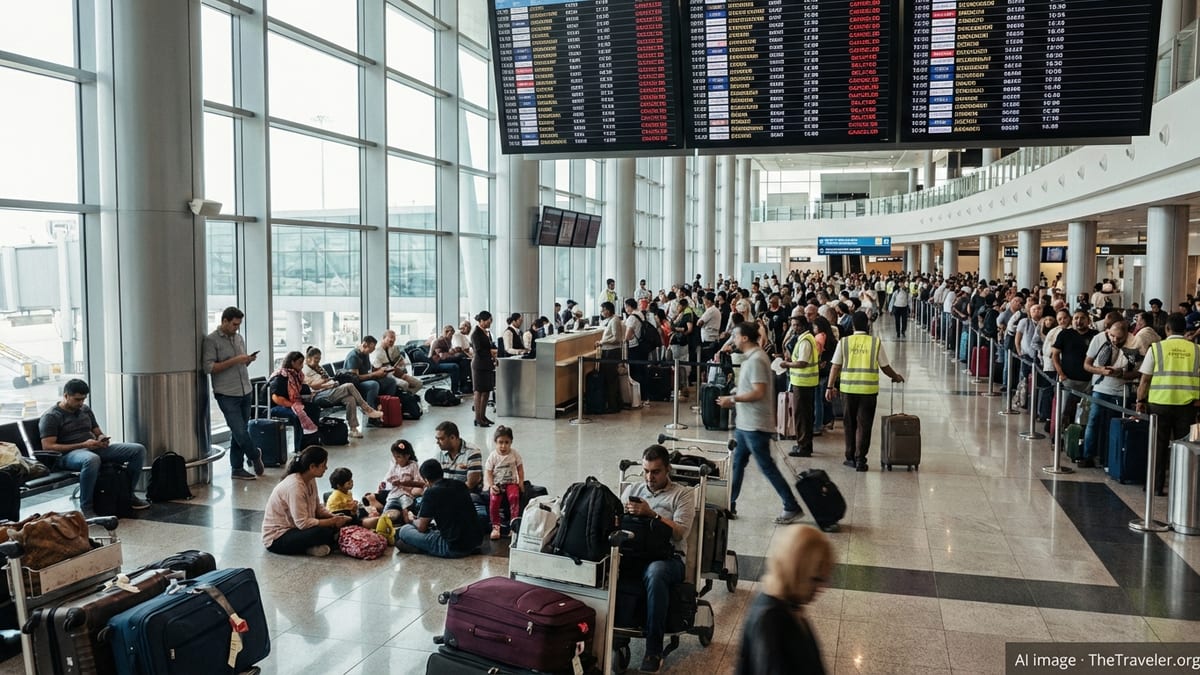
By the early hours of Tuesday, weary passengers were still scattered across the terminal, some having spent most of the night in the seating areas with their luggage and families. Social media posts from affected travellers described children sleeping on chairs and elderly passengers struggling to rest as they waited for updates.
Confusion at the terminal and scant communication
One of the main complaints emerging from the incident concerns communication within the terminal. Passengers quoted in local news reports said that announcements about revised departure times were infrequent and often lacked detail about the reasons for the disruption. Several accounts describe long stretches with no audible updates, pushing travellers to rely on app notifications, flight information displays or informal word of mouth.
Publicly available information from the airline’s digital channels did indicate schedule changes overnight, but the timing of updates did not always align with what passengers were experiencing at the gate. Some travellers reported that online status boards continued to list flights as “on time” or only “slightly delayed” even as hours passed at the terminal.
The situation at Chennai follows a pattern of recent incidents in which Air India Express passengers have described long waits, limited on-ground support and uncertainty about options when serious delays occur. Previous cases reported from the same airport this year have involved travellers stranded for more than 12 hours after technical issues forced repeated rescheduling of a domestic departure.
Across online forums and consumer platforms, feedback from travellers has increasingly focused less on the fact of operational disruptions and more on how information is shared and basic needs are handled while passengers are stuck at airports. The Chennai episode has quickly become another example cited in these discussions.
Airline obligations and what passengers can seek
Publicly available guidance on Air India Express policies indicates that the carrier offers certain forms of assistance when long delays occur, particularly during overnight hours. The airline’s customer information states that if a flight scheduled between 8 p.m. and 3 a.m. is delayed by more than six hours, affected passengers may be entitled to hotel accommodation and airport transfers, subject to specific conditions.
Indian civil aviation regulations also set out minimum standards for care and compensation in cases of prolonged delays or cancellations, including the provision of meals or refreshments, hotel stays when necessary and options for rebooking or refunds. Consumer-advocacy resources note that documentation such as boarding passes, delay notifications and receipts can be important if travellers later pursue reimbursement or statutory compensation.
In the Chennai overnight delays, early accounts suggest that many passengers remained in the terminal without organized accommodation, raising questions about how consistently support policies were applied on the ground. Some travellers reported buying their own food and arranging private transport after finally disembarking or abandoning their trips, adding to out-of-pocket costs.
Travel advisers often recommend that passengers facing extended disruptions document timing changes, retain any written communication from the airline and, where possible, file feedback or claims through official channels rather than relying solely on telephone interactions. For those with onward connections on separate tickets, experts point out that early contact with other carriers or rail operators can sometimes reduce the impact of missed links.
Growing scrutiny of disruption handling across the network
The Chennai incident arrives at a time when Air India Express and its parent group are under heightened scrutiny for how they manage irregular operations across a rapidly expanding network. The low cost carrier, which now runs more than 500 daily flights across domestic and international routes, has been central to the group’s strategy of capturing price-sensitive traffic through tier one and tier two Indian cities.
In recent months, however, passengers across several routes have described a series of lengthy delays and overnight disruptions, sometimes linked to technical snags or air traffic constraints. Accounts published from other Indian airports detail experiences of travellers waiting 12 to 25 hours for replacement flights, often citing inadequate communication and limited assistance with food or lodging.
Industry analysts note that fast growth in flight frequencies and fleet size can strain operational resilience, especially when airlines are simultaneously managing pilot availability, maintenance cycles and airport congestion. When problems cascade during peak travel periods, airports such as Chennai, which already contend with busy domestic and regional schedules, can quickly see knock-on effects across multiple departures.
Observers say the latest episode at Chennai reinforces the importance of robust disruption-management systems, including proactive messaging to passengers, clear information at gates and well-drilled protocols for arranging hotels and rebooking. With social media amplifying individual accounts of poor treatment, repeated scenes of stranded travellers at Indian airports risk eroding trust in carriers that are otherwise investing heavily in new aircraft and upgraded cabins.
Calls for clearer standards as travel demand climbs
Domestic air travel in India continues to rebound, and routes serving Chennai, Kolkata, Bengaluru and other major cities remain intensely competitive. As airlines chase traffic with aggressive pricing and dense schedules, passenger-rights advocates argue that reliable handling of delays is becoming a key differentiator in travellers’ choice of carrier.
Legal commentators point out that while existing regulations outline baseline obligations for airlines, enforcement can be uneven and many passengers are not fully aware of what they are entitled to receive in cases of long delays. Incidents such as the overnight disruption at Chennai often prompt fresh debate over whether compensation levels and service standards should be strengthened or more clearly communicated.
For now, those affected by the latest Air India Express delays are left to navigate the aftermath on their own, from missed work and family commitments to out-of-pocket expenses on food, transport and alternative bookings. As their accounts circulate through local media and online platforms, pressure is likely to increase on carriers and regulators alike to ensure that overnight disruptions do not routinely result in passengers sleeping in terminals without clear information or support.
With the summer travel season under way and further schedule changes already in place across parts of the wider Air India network, the handling of this latest episode at Chennai may serve as an early test of whether recently announced measures to improve disruption response are being felt where they matter most, at the departure gates and check in counters where passengers spend long hours waiting for their flights to finally depart.