


More news on this day
Air India is accelerating its long haul comeback, restoring and expanding key routes to Europe, North America and Asia as India’s outbound travel market returns to growth and the flag carrier’s widebody fleet ramps up under Tata Group ownership.
Get the latest news straight to your inbox!
Widebody Expansion Underpins International Rebound
Publicly available fleet and order data indicate that Air India has moved from survival mode to strategic expansion on long haul sectors. The airline has begun taking delivery of Airbus A350 aircraft and additional Boeing 777s and 787s, supported by a headline order for hundreds of new jets that positions the carrier for sustained growth across continents. This build up of widebody capacity has been central to restoring key intercontinental links that were pared back during the pandemic and early restructuring period.
The introduction of the A350 into commercial service from 2024, initially on domestic routes before long haul deployment, has allowed Air India to add fuel efficient, long range aircraft well suited to nonstop services between India and major cities in Europe and North America. At the same time, leased 777-200LR and 777-300ER aircraft and incremental 787s have expanded the pool of widebodies available for trunk routes to London, New York, San Francisco and other high demand destinations.
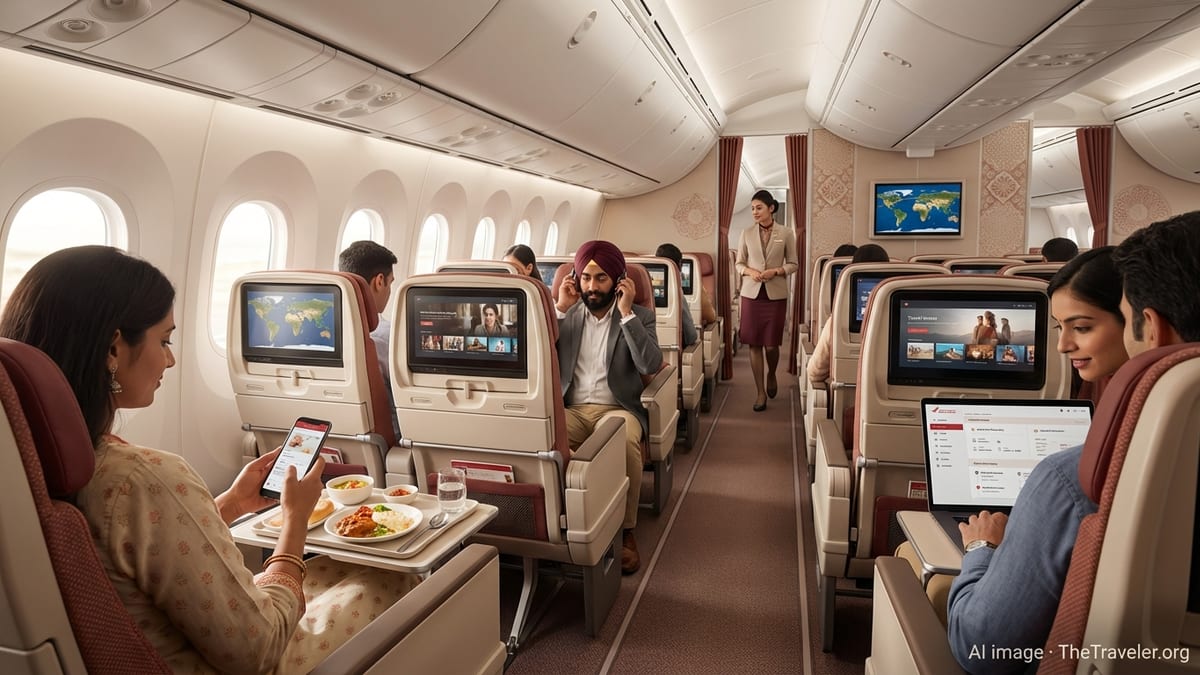
Industry coverage of Air India’s multi year transformation program, branded Vihaan.AI, notes that widebody renewal and network growth have been treated as parallel priorities. The airline has begun a multibillion dollar retrofit program for older 777 and 787 jets, replacing seats and inflight entertainment while the first A350s take over key international rotations. That combination of new aircraft and refurbished cabins is giving the carrier more competitive products on critical long haul sectors.
Available traffic data for India’s international market show that demand has rebounded strongly since late 2023, with outbound leisure and visiting friends and relatives segments leading the recovery. Air India’s fleet growth has therefore arrived as the market shifts from pent up demand to structural expansion driven by a growing middle class and a larger Indian diaspora in Europe, North America and the Gulf.
North America Links Regain Strategic Weight
On India United States routes, which are among the world’s longest regularly scheduled services, Air India has steadily rebuilt frequencies that were disrupted by the pandemic. The carrier now operates nonstop flights from Delhi, Mumbai and Bengaluru to major US gateways including New York, Newark, Chicago, Washington and San Francisco, supported by a mix of 777-200LR, 777-300ER and, increasingly, A350 aircraft.
Earlier expansions saw the airline add more weekly services to San Francisco and London, lifting the number of India US flights and adding thousands of seats per week on nonstop routes. Schedules data for the 2024 and 2025 winter seasons show periodic frequency adjustments as aircraft are rotated for retrofit, but the overall seat offering between India and North America remains meaningfully higher than before Air India changed ownership.
The reintroduction of upgraded widebodies on New York area routes has been a particular focus. Publicly available announcements describe plans for A350-900 aircraft to operate Delhi New York John F. Kennedy and Delhi Newark services, replacing older 777s and providing a new three class product on some of the carrier’s most visible flights. For US based travelers, that shift is expected to improve consistency of cabin quality on routes that compete directly with Gulf and European carriers.
Partnerships have added to this rebuilding of capacity. An interline arrangement with Alaska Airlines, for example, extends Air India’s reach beyond its US gateways to dozens of domestic points, making nonstop India US flights more attractive to travelers headed to secondary American cities. As schedules normalize across the Atlantic and Pacific, the combination of greater nonstop capacity and improved connectivity is reestablishing India US links as a growth pillar for the airline.
Europe Sees Denser Schedules and More Hubs
Across Europe, Air India has revived and expanded service to a cluster of key hubs, reflecting the importance of both point to point traffic and onward connections to the rest of the continent. London Heathrow remains the primary European gateway, with multiple daily services from Delhi and Mumbai and additional capacity layered in during peak travel periods. The United Kingdom is one of Air India’s largest foreign markets, and enhanced frequencies there have been central to the broader international recovery.
Beyond London, Air India has rebuilt links to major continental hubs such as Frankfurt, Paris, Amsterdam and Zurich. Recent schedule filings and airline statements show patterns of additional rotations being added on select days during high demand windows, providing flexibility for India based travelers connecting to wider Europe through alliance and codeshare partners. In some cases, temporary additional flights have been mounted for specific travel peaks, such as school holidays and festival periods.
Fleet renewal is beginning to influence these European routes as well. As A350s and reconfigured 777s enter service, they are gradually being assigned to high profile sectors to improve the passenger experience and increase premium seating capacity. The refit of older widebodies, which began in the second half of 2024, is expected to progressively bring lie flat business class seats and modern inflight entertainment to more Europe India flights over the next several years.
For European airports, Air India’s expansion is part of a wider realignment of long haul traffic as carriers from India and the Gulf compete to capture flows between the continent and South Asia. As India’s outbound tourism and student populations grow, the carrier’s ability to offer more direct or one stop options is becoming a factor in how passengers choose between traditional European network airlines and newer Asian competitors.
Regional Asia and Island Destinations Gain Capacity
While much attention has focused on long haul flights to Europe and the United States, Air India has also been adding short and medium haul capacity across Asia as part of a broader international restoration. Schedules and press materials indicate that the airline has operated additional flights from Delhi to popular leisure destinations such as the Maldives and Sri Lanka during peak holiday periods, as well as reinforcing services on important business and diaspora routes within South and Southeast Asia.
These regional increases serve several purposes. They help Air India defend share against low cost rivals on high volume leisure corridors, while also feeding long haul flights from Delhi and Mumbai by improving connectivity from secondary Indian cities and neighboring countries. Additional services on Delhi Colombo and Delhi Maldives sectors, for example, allow travelers from those markets to connect more easily to Europe or North America over India rather than routing through Gulf hubs.
Within Asia, the airline’s growing narrowbody fleet complements widebody deployment by allowing more frequencies on routes where demand is strong but stage lengths are shorter. The addition of new A320neo and A321neo aircraft provides lower fuel burn and better economics, freeing up larger widebodies for long haul routes while maintaining or increasing capacity on intra Asian sectors.
The combination of regional growth and long haul restoration is gradually restoring Air India’s pre pandemic geographic reach. Network maps published in recent months show an expanding list of international destinations across Asia, including in the Gulf, Southeast Asia and East Asia, with India once again positioned as a hub for two way travel between these markets and Europe or North America.
India Reclaims Its Role in Global Travel Flows
The acceleration of Air India’s international operations comes as India’s broader aviation market matures and shifts toward higher value long haul traffic. Government statistics and industry analysis point to sustained growth in international passenger numbers, with India emerging as one of the world’s fastest growing large air travel markets by 2024 and 2025. This has created both an opportunity and a necessity for the country’s flagship carrier to rebuild and modernize its global network.
Under private ownership, the airline’s strategy has emphasized reclaiming nonstop links on historically important routes, especially to Europe and North America, while positioning Delhi and Mumbai as viable alternatives to Gulf and European hubs for connecting traffic. The ramp up of widebody deliveries, the refurbishment of existing aircraft and targeted frequency increases to major cities all reflect that ambition.
For travelers, the visible outcomes are more nonstop options between India and cities such as London, Frankfurt, New York, Chicago and San Francisco, alongside improved schedules to regional Asian and island destinations. For India’s aviation sector, Air India’s resurgence on international routes marks a shift from a fragmented market heavily reliant on foreign carriers toward a more balanced landscape in which a reinvigorated national airline plays a larger role in global travel flows.
As additional A350s and other widebodies join the fleet over the next few years, industry observers expect further growth in Air India’s long haul network across Europe, North America and Asia. That trajectory suggests that the current surge in international flights is not simply a short term response to post pandemic demand, but part of a longer term effort to reestablish India as a central node in global air travel.