


More news on this day
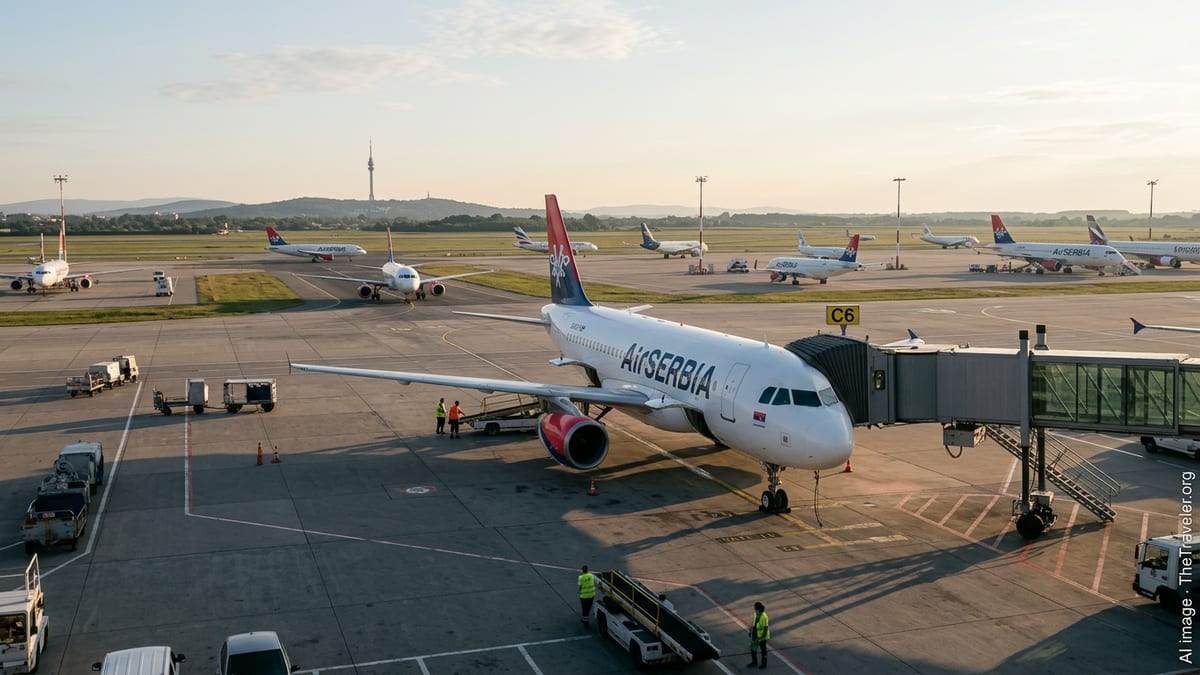
Serbia’s flag carrier Air Serbia is sharpening its focus on Central Europe, with higher Prague frequencies and an expanded Belgrade hub positioning the airline for another step-change in travel growth ahead of winter 2026.
Get the latest news straight to your inbox!
Prague Gains Prominence in Air Serbia’s Network
Publicly available schedule data show that Air Serbia already operates multiple weekly flights between Belgrade’s Nikola Tesla Airport and Prague’s Václav Havel Airport, with around ten departures per week in the current timetable. This places Prague among the more frequently served Central European capitals in the airline’s regional network and provides year-round connectivity for both business and leisure travelers.
The route has been part of Air Serbia’s core European portfolio for more than a decade, having first appeared in the carrier’s post-rebranding network in 2013. Over time it has evolved from a smaller-capacity link into a higher-frequency service, mirroring broader growth at the Belgrade hub and the airline’s efforts to capture transit traffic moving between Central Europe, the Balkans, and long-haul destinations.
As Prague consolidates its role as a key airport in Central and Eastern Europe, the strengthening Belgrade connection plays into wider network goals on both sides. Václav Havel Airport has been rebuilding its long-term strategy after the restructuring of Czech Airlines, with published information from the airport operator pointing to more than 120 destinations in the winter 2025/2026 schedule and a broad mix of full-service and low-cost carriers.
For travelers, the Prague–Belgrade link provides access to onward connections across Southeast Europe, the Eastern Mediterranean, and transatlantic gateways, turning what was once primarily a point-to-point route into an important feed channel for Air Serbia’s long-haul ambitions.
Belgrade Hub Grows as Passenger Numbers Reach Record Highs
Belgrade Nikola Tesla Airport has become the centerpiece of Serbia’s aviation expansion, and Air Serbia’s traffic figures underscore how quickly the hub has scaled. Company data for 2025 indicate that the airline carried around 4.57 million passengers on nearly 49,000 flights, surpassing a long-standing record set in the late 1980s and lifting average load factors compared with the previous year.
Network statistics for 2025 point to a portfolio of more than 100 routes, including roughly 90 scheduled and a double-digit number of charter destinations across Europe, North America, Asia, and parts of Africa. The fleet, close to 30 aircraft and still growing, has been configured to manage both dense regional shuttle operations and longer sectors to markets such as North America and China.
The growth has continued into 2026, with the airline publicly reporting its highest revenue and passenger numbers in company history for the previous year and signaling further network expansion. The strategy relies heavily on tightening frequencies to important European capitals, which in turn support long-haul connectivity and smooth out seasonal swings in demand across the network.
Prague’s enhanced role fits this pattern. Higher weekly flights from the Czech capital provide additional feed for services to New York, Chicago, Toronto, Shanghai, Guangzhou, and other intercontinental routes, while also widening options for travelers heading to popular holiday destinations in Greece, Spain, Italy, and the Balkans via Belgrade.
Winter 2026 Expansion Builds on Frequency Gains
While detailed flight-by-flight timetables for winter 2026 are still being finalized, Air Serbia has begun outlining its broader seasonal approach. The airline’s in-house publications and recent announcements describe a strategy of unveiling summer and winter schedules together, allowing passengers and partners to plan well ahead and giving the carrier room to fine-tune capacity on routes such as Prague as demand develops.
Upcoming winter seasons are set to feature a larger mix of destinations than before, with recent additions like Baku, new Adriatic links, and expanded Spanish services pointing to a more geographically diverse network. Company communications also underline a priority to increase frequencies to key European capitals, specifically naming cities such as Athens, Brussels, Milan, Madrid, Lisbon, Prague, and Vienna as beneficiaries of extra flights.
In this context, Prague is positioned to benefit from what amounts to a multi-year ramp-up rather than a single-season adjustment. Higher winter frequencies smooth traffic flows outside the traditional summer peak and help Air Serbia reduce seasonality, a long-running challenge for airlines in Southern and Eastern Europe.
For travelers in the Czech Republic and neighboring countries, the expected winter 2026 build-up should translate into more choices for weekend city breaks in the Balkans, easier access to winter sun destinations via Belgrade, and better-aligned connections to North American and Asian gateways.
Central Europe Connectivity and Competitive Dynamics
Prague’s wider winter 2025/2026 schedule illustrates how competitive the Central European market has become. Information published by Václav Havel Airport points to a line-up of more than 120 destinations operated by a mix of full-service carriers and low-cost airlines, including recent or upcoming entries from carriers such as Air Arabia, AJet, Animawings, Asiana Airlines, Condor, and Etihad Airways.
This expanding roster increases pressure on individual airlines to differentiate and to offer reliable hub connectivity. Air Serbia’s response has focused on building a resilient Belgrade hub that can attract connecting traffic from medium-sized cities like Prague, while simultaneously adding long-haul destinations that smaller Central European airports might not be able to sustain directly.
Belgrade’s location between Central Europe and the Eastern Mediterranean gives Air Serbia an opportunity to serve as a bridge for flows that might otherwise funnel through larger Western European hubs. Rising Prague frequencies, alongside similar increases to other regional capitals, strengthen that proposition, particularly for travelers who value shorter total travel times and streamlined transfers.
The Prague–Belgrade corridor also supports tourism in both directions. Czech visitors gain easier access to Serbia’s city-break and cultural tourism market, while Serbian travelers can tap into Prague’s position as one of Europe’s most visited historic capitals, further reinforcing demand for a robust year-round schedule.
Strategic Outlook for Serbia’s Flag Carrier
Air Serbia’s published plans point toward continued measured expansion through 2026, with six new routes announced for the year and intentions to keep strengthening the carrier’s presence in strategically important markets. The airline highlights a combination of tourism, business, and VFR (visiting friends and relatives) traffic as key pillars of its network design.
The focus on Prague fits neatly within this broader roadmap. The Czech capital generates a blend of business, leisure, and connecting demand, making it well suited to a hub-and-spoke model centered on Belgrade. As frequencies rise and winter capacity grows, the route is likely to become even more integral to how Air Serbia balances its European network with its intercontinental ambitions.
For Serbia, the strategy contributes to a wider push to position Belgrade as a competitive regional hub in Southeast and Central Europe. For travelers in both countries, the practical result is a denser schedule, more one-stop options to distant markets, and a clearer role for Prague as one of the key gateways feeding Air Serbia’s expanding global network heading into the winter 2026 season.
Air Serbia summer 2026 network overview
Air Serbia 2025 performance results
Air Serbia record revenue and passengers report 2026