


More news on this day
AirAsia X’s consolidated airline group has entered 2026 with strong momentum, carrying about 18.9 million passengers in the first quarter and signaling a near full recovery driven by a fast-expanding network across China, Malaysia, Thailand, the Philippines, Cambodia, India and now Indonesia.
Get the latest news straight to your inbox!
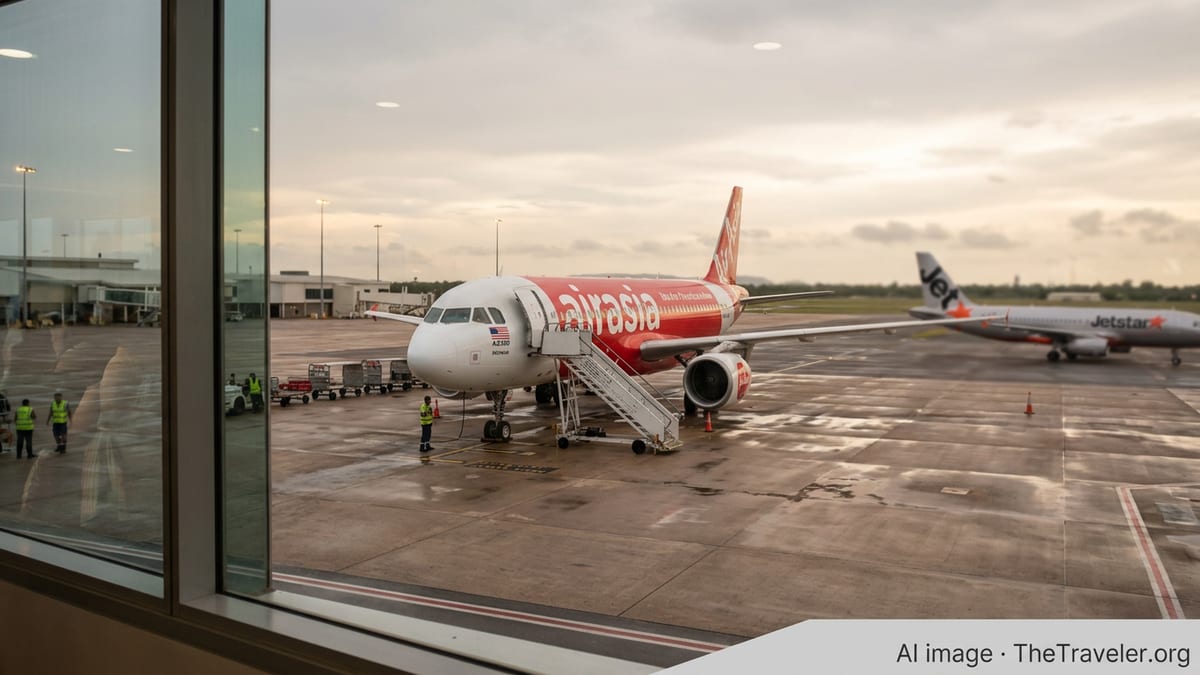
Passenger Surge Marks Turning Point for AirAsia X Group
Publicly available data for the first quarter of 2026 indicates that the wider AirAsia-branded network under AirAsia X and Capital A carried roughly 18.9 million passengers, a year-on-year increase of about 9 percent. Industry coverage describes the performance as one of the clearest signs that the group’s multi-year restructuring and fleet reactivation program is translating into traffic growth.
Analysts following the region’s low-cost sector note that this volume puts the group close to its pre-pandemic trajectory, especially when combined with the high load factors reported through 2025. Capacity growth, measured in seats and flights operated, has largely kept pace with demand, suggesting that the surge is not simply the result of discounting but of a sustained recovery in regional and medium-haul travel.
Recent financial disclosures for full-year 2025 show that AirAsia X’s long-haul and mid-haul operations have returned to consistent profitability, while short-haul affiliates across Southeast Asia and India are again operating at scale. Together, these developments have positioned the group to use its enlarged traffic base as a springboard for further network expansion throughout 2026.
Indonesia Joins a Rebounding Seven-Market Network
The latest phase of recovery has been underpinned by a more geographically balanced network spanning China, Malaysia, Thailand, the Philippines, Cambodia and India, with Indonesia now added as a key pillar. Expansion moves during 2024 and 2025, including new routes linking secondary cities and tourist destinations, have laid the groundwork for Indonesia’s integration into the consolidated AirAsia X structure.
Indonesia AirAsia’s recent route launches to destinations such as Adelaide and increased connectivity from Indonesian gateways to Malaysia and beyond are part of this strategy. Airport operator releases and airline announcements highlight how new international services from Indonesian hubs are being used to funnel more travelers into the broader AirAsia system, reinforcing Kuala Lumpur, Bangkok and other regional hubs.
The inclusion of Indonesia gives the group a stronger presence across the world’s fourth-most-populous country and one of Asia’s fastest-growing domestic aviation markets. By linking major Indonesian cities with China, India and intra-ASEAN destinations, the carrier aims to capture both leisure demand and an expanding base of small-business and migrant-worker traffic.
China Reopening and ASEAN Tourism Drive Demand
China’s reopening has been a central driver of AirAsia X’s rebound. Company traffic updates for 2025 point to double-digit growth on China routes and load factors that frequently approach or exceed 90 percent on key city pairs. This rebound has allowed the group to redeploy widebody and narrowbody capacity toward high-yield markets just as outbound Chinese tourism regains pace.
At the same time, ASEAN tourism flows have strengthened, with Malaysia, Thailand, Indonesia and the Philippines benefitting from a return of international visitors and rising intra-regional travel. Tourism authorities across these countries report steady growth in arrivals, and low-cost carriers such as AirAsia X have been prominent in restoring connectivity to island and secondary-city destinations that rely heavily on affordable air links.
The Philippines, Cambodia and India have also played supporting roles in the group’s recovery. Additional capacity from Manila and Cebu, new and relaunched routes into Cambodia, and deeper coverage of Indian metros and tier-two cities have diversified revenue sources beyond the traditional Malaysia-Thailand core. This mix has helped cushion the network against isolated demand shocks or regulatory changes in any single country.
Near Full Recovery Strengthens Capital and Fleet Plans
The latest passenger figures arrive as the group advances a detailed restructuring and recapitalization roadmap. Capital A, the parent company overseeing AirAsia-branded airlines, has stated in public filings that it is working to complete a regularization plan and fully consolidate its aviation businesses under AirAsia X, with regulatory and shareholder milestones largely mapped out for completion around 2025 and 2026.
As part of that process, AirAsia X has been progressively reactivating its fleet and upgrading its mix of aircraft. Company statements and investor presentations point to plans for a full return of parked aircraft, targeted exits for older Airbus A330s over the next decade, and potential deliveries of new-technology jets to lower unit costs. The strong start to 2026, in terms of both passenger volume and load factor, provides an important commercial foundation for those capital-intensive decisions.
Equity market reaction to the restructuring has been mixed over the past year, reflecting lingering concerns about leverage and competitive pressures in Asia’s low-cost space. However, the reorganization has also enabled clearer reporting of performance across the combined airline portfolio, allowing investors and analysts to track whether traffic growth, such as the 18.9 million passengers carried in the latest quarter, is translating into sustainable earnings.
Competitive Pressures and Service Expectations Remain High
Despite the improving numbers, AirAsia X faces an intensely competitive environment. Full-service and low-cost rivals across the region are also scaling up capacity on key trunk routes linking China, Southeast Asia and India. Some have launched refreshed cabin products and loyalty offers, while others are pursuing aggressive pricing strategies to regain market share.
Customer feedback shared in public forums in early 2026 suggests that while many travelers are attracted by AirAsia’s low fares and dense network, there is continued scrutiny on reliability, schedule changes and digital customer service tools. Instances of cancellations, reschedulings and frustrations with online support illustrate the operational pressures that come with ramping up quickly after a prolonged downturn.
Industry observers note that maintaining on-time performance and improving disruption handling will be critical as the group chases further growth from Indonesia and other emerging markets. With load factors already high on many routes, incremental gains may increasingly depend on service consistency and ancillary revenue development rather than simple seat additions.
For now, the combination of a double-digit traffic rebound, nearly 19 million passengers carried in a single quarter and the integration of Indonesia into a seven-market network places AirAsia X among the most closely watched recovery stories in global aviation as 2026 unfolds.