


More news on this day
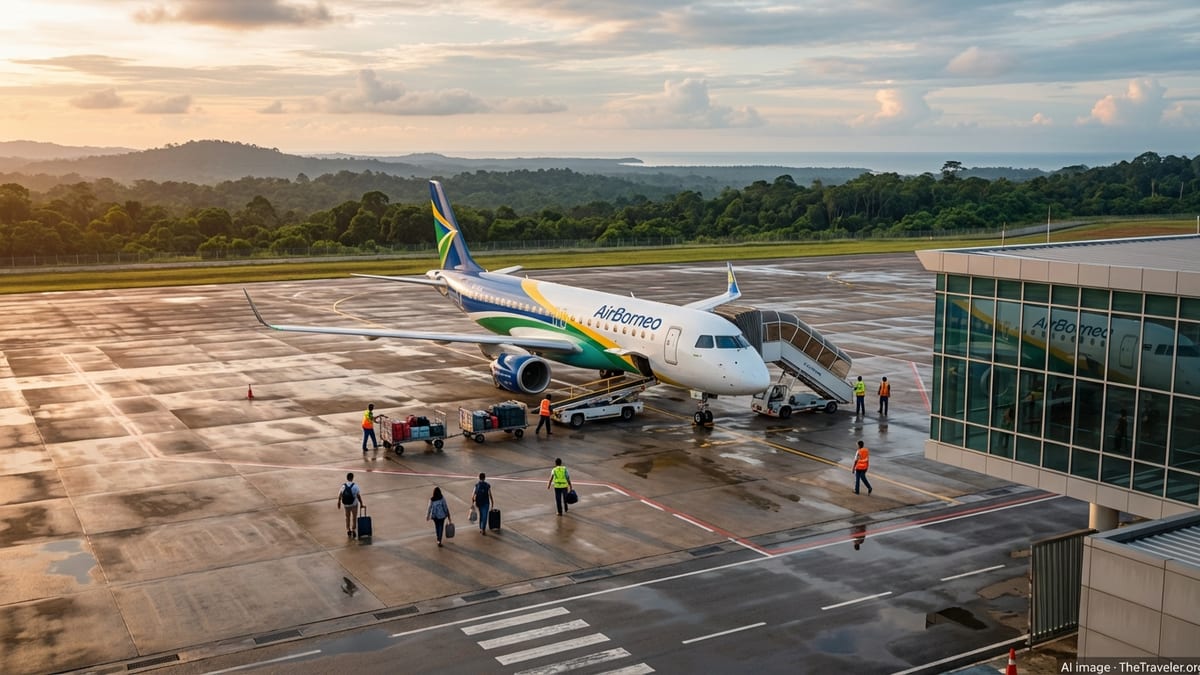
AirBorneo’s chief executive has issued a public apology after days of widespread flight disruptions across Sabah and Sarawak, acknowledging the impact on rural communities and pledging a refreshed ATR turboprop fleet to stabilise the airline’s operations.
Get the latest news straight to your inbox!
Maintenance bottlenecks trigger cancellations across Borneo
Publicly available information indicates that AirBorneo has faced a wave of delays and cancellations since early June, with multiple turboprop aircraft taken out of service at the same time for scheduled checks and technical rectification. The resulting capacity crunch has disrupted links on core Rural Air Services routes, where the airline provides essential connectivity between smaller communities and regional centres.
Reports describe an operational bottleneck driven by the late delivery of key replacement components, which left the carrier unable to return aircraft to service as quickly as planned. With several ATR turboprops grounded simultaneously, the schedule across parts of Sabah and Sarawak became increasingly fragile, leading to rolling knock-on effects for passengers.
The airline only began flying under the AirBorneo brand in January 2026 after the Sarawak government acquired and restructured former commuter operator MASwings. Industry coverage notes that the new carrier inherited a heavily worked regional fleet that must serve both commercial routes and subsidised public service obligations in East Malaysia, leaving limited room for error when aircraft are unavailable.
In recent days, AirBorneo has issued travel advisories urging passengers to verify flight status before heading to airports, signalling that irregular operations are expected to continue while maintenance work is completed. Passenger accounts shared on social platforms highlight missed connections, overnight delays and challenges rebooking on alternative services in remote areas with few competing airlines.
CEO issues apology and outlines recovery measures
According to Malaysian business media, chief executive Megat Ardian Wira has now publicly apologised to affected travellers, acknowledging frustration and uncertainty caused by the disruptions. In his statement, he emphasised that safety standards and regulatory requirements guided the decision to keep aircraft on the ground while technical issues were resolved.
The airline has indicated that additional operational and maintenance measures have been introduced to strengthen fleet resilience. These include adjustments to aircraft allocation, tighter coordination between engineering and scheduling teams, and efforts to speed up the sourcing of spare parts. The goal is to restore a more predictable timetable while maintaining what the carrier describes as high safety and airworthiness standards.
Available statements from the company also stress its role in serving communities that depend on small-aircraft links for access to healthcare, education and government services. The CEO framed the current turbulence as a setback rather than a shift in strategy, saying the airline remains focused on providing reliable, full-service connectivity across Borneo.
Regional aviation observers note that the episode is an early test of public confidence in the state-owned airline. Launched with strong political backing and expectations of improved connectivity, AirBorneo is now under pressure to show it can quickly stabilise operations and avoid prolonged disruption on lifeline routes.
New ATR 72-600s and 42-600s at the centre of fleet renewal
The apology coincides with renewed attention on AirBorneo’s fleet plans. Earlier this year the carrier placed a firm order for eight new ATR turboprops, comprising five ATR 72-600 and three smaller ATR 42-600 aircraft, as part of a programme to modernise its rural air service fleet. Industry briefings indicate the aircraft are intended to replace older turboprops and provide extra capacity on busy short-haul sectors.
ATR’s own communications describe the new generation aircraft as offering lower fuel burn and improved reliability compared with earlier models, an important factor for airlines operating short hops between secondary airports. For AirBorneo, the arrival of newer airframes is expected to ease maintenance pressure, reduce unplanned downtime and support more resilient scheduling in challenging operating conditions.
The ATR 42-600s are expected to be deployed on thinner or more constrained routes where shorter runways and lower demand make smaller aircraft a better fit. The ATR 72-600s, by contrast, are likely to focus on higher-density sectors linking cities such as Kuching and Kota Kinabalu with interior towns and island communities that rely on frequent services.
While specific delivery timelines have not been publicly detailed in full, the carrier has framed the new turboprops as central to its medium-term turnaround from the current disruption. Aviation analysts caution, however, that new aircraft alone will not resolve reliability issues unless accompanied by investment in engineering facilities, spare-parts inventories and crew training.
Balancing public-service obligations with commercial ambitions
Background coverage shows that AirBorneo was created with a dual mandate: to maintain subsidised rural air services across East Malaysia and to evolve into a competitive regional carrier serving larger domestic and eventually international routes. The airline operates under public service obligation frameworks for many of its shortest sectors, connecting remote communities that would otherwise be unprofitable to serve.
This model means that flight disruptions can have outsized effects compared with larger urban markets. Cancellations on small-community routes may leave passengers with no same-day alternatives, while weather, terrain and limited airport infrastructure can further complicate recovery options. The recent technical issues have underlined how dependent rural passengers are on a small fleet of turboprops that must remain available and well maintained.
At the same time, the Sarawak-owned airline has announced plans to grow beyond its inherited network. Reports indicate that AirBorneo has secured narrowbody jets and is preparing to launch services linking Borneo with major cities in Peninsular Malaysia and, later, regional destinations in Southeast Asia. Managing this expansion while safeguarding the reliability of rural services remains a central challenge.
Industry commentators suggest that the current disruption could prompt a reassessment of how capacity is allocated between commercially attractive routes and those operated primarily for social connectivity. Ensuring sufficient spare aircraft and engineering resources for the turboprop operation may become a higher priority as the airline moves deeper into its growth phase.
Passengers seek clarity as airline works to rebuild trust
In the short term, passengers have been calling for clearer communication about schedule changes, rebooking options and compensation policies. Online discussions point to confusion at some airports as travellers attempt to navigate revised timetables and wait for updates on aircraft rectification progress.
AirBorneo has been urging customers to monitor flight status via official channels and has pledged to re-accommodate affected travellers on the earliest available alternatives. However, the limited number of daily services on many routes means that even small schedule changes can trigger extended delays for some passengers, particularly in the most remote parts of Sabah and Sarawak.
Aviation analysts note that transparent communication and proactive customer care will be critical as the airline works to restore confidence. For a state-owned carrier positioned as a symbol of regional pride and connectivity, early operational stumbles carry reputational risks that may take time to overcome.
With new ATR aircraft on order and a renewed focus on maintenance planning, AirBorneo is attempting to turn the current crisis into an inflection point for its young operation. How quickly it can translate fleet investment and procedural changes into consistently reliable service will likely shape public sentiment toward the airline in the months ahead.