


Singapore Changi Airport is one of the world’s great aviation hubs, connecting Southeast Asia to every corner of the globe. More than 100 airlines operate from its four passenger terminals, linking Singapore to hundreds of cities across Asia, Europe, the Middle East, Oceania and North America. For travelers, that huge choice can feel both exciting and overwhelming. This guide explains how airlines are organized at Changi, which carriers use which terminals, and how to navigate the airport efficiently when you fly in or out in 2026.
Get the latest updates straight to your inbox!
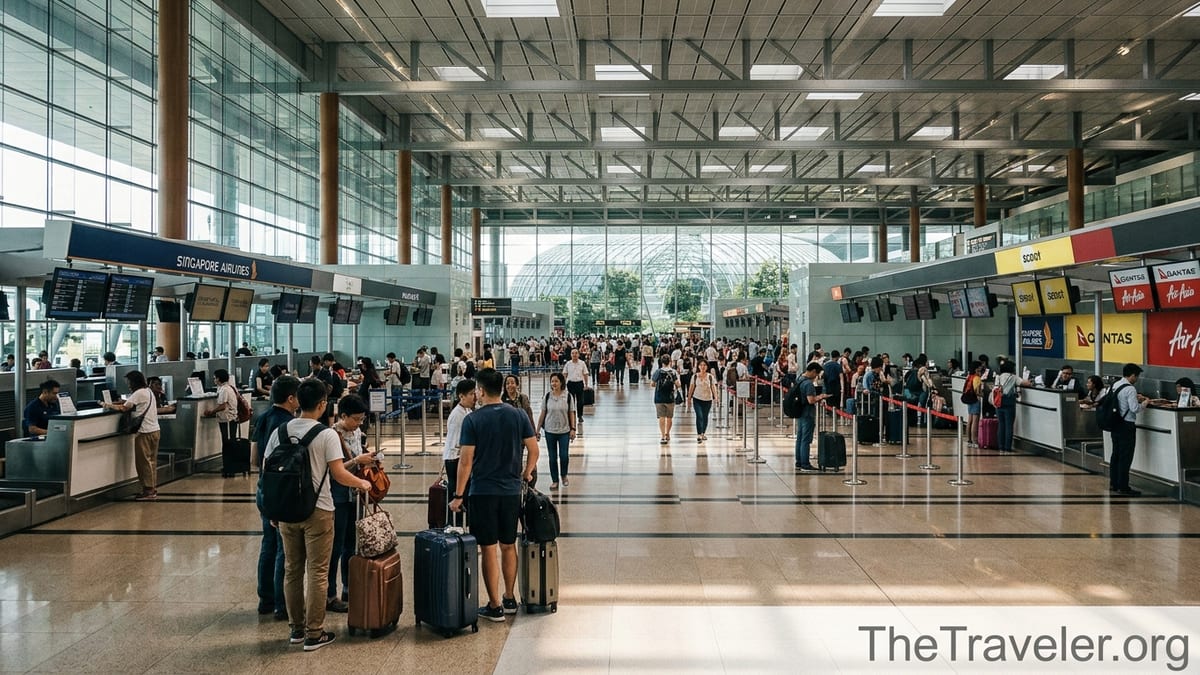
How Changi Airport’s Airline Network Is Structured
Changi Airport handles only international flights and functions as a pure global hub rather than a domestic gateway. In practical terms, this means almost every passenger is either starting or ending an international journey, or connecting between two international flights. Over 100 scheduled carriers serve Changi and collectively operate flights to more than 170 cities worldwide, with particularly dense coverage across Southeast Asia, North Asia, and Australia. In a typical week, there are hundreds of departures to nearby regional centers such as Kuala Lumpur, Jakarta and Bangkok, alongside long haul services to major cities like London, New York, Paris, Dubai, Sydney and Vancouver.
Singapore Airlines is the dominant carrier at Changi, operating roughly a third or more of all departures and using the airport as its primary global hub. Its low cost sister airline Scoot, also based in Singapore, adds large volumes of intra-Asia and medium haul traffic to destinations such as Bangkok, Taipei and Melbourne. Alongside these home carriers, travelers will find a full line up of familiar global brands. European airlines like British Airways, Lufthansa, Air France and KLM; Gulf carriers such as Emirates, Qatar Airways and Etihad Airways; and major Asian airlines including Cathay Pacific, Japan Airlines, All Nippon Airways, Korean Air and China Airlines all operate regular services to and from Changi.
For passengers, the scale of this network translates into extensive one stop connectivity. A traveler from a secondary European city can, for example, fly to Frankfurt on Lufthansa and then connect to Singapore before continuing on Singapore Airlines or Scoot to Bali, Phuket or Cebu. Similarly, an Australian traveler from Adelaide can connect via Melbourne or Sydney to Changi and then transfer to flights bound for Tokyo, Seoul, or key business destinations in India and China. This web of alliances and codeshares is central to how airlines use Changi as a bridge between continents.
Changi also ranks as a significant cargo and logistics hub, with carriers like FedEx Express and UPS using the airport for regional distribution. While cargo flights are not directly visible to most passengers, their presence contributes to the airport’s overall traffic levels and helps sustain frequency on many passenger routes because bellyhold freight is an important part of the economics of long haul flights.
Terminals and How Airlines Are Distributed in 2026
Changi currently operates four passenger terminals: T1, T2, T3 and T4. Terminals 1, 2 and 3 form a connected horseshoe around the central Jewel complex and are linked by an automated Skytrain system. Terminal 4 sits slightly apart on the south side of the airfield and is connected by dedicated shuttle buses. All four terminals handle both arrivals and departures, and each is configured for international traffic with full immigration and customs facilities.
Terminal 1 is home to a broad mix of full service international airlines. Travelers will commonly find carriers such as Qantas, British Airways, Qatar Airways, Emirates and Thai Airways using this terminal, along with a variety of regional airlines from Southeast Asia and beyond. If you are flying from Singapore to London on British Airways, or to Sydney on Qantas, you are likely to check in and depart from T1. The terminal is directly connected to Jewel, which can be convenient if you have time before your flight to visit the indoor waterfall or dine in one of the many restaurants.
Terminal 2, which has undergone significant renovation in recent years, functions as a primary base for several SkyTeam and partner airlines as well as part of Singapore Airlines’ operation. Carriers such as Air France, KLM, Korean Air, China Eastern and Vietnam Airlines often use T2, making it a common terminal for passengers flying to or from Europe via Amsterdam or Paris, or to key cities in Northeast Asia. From January 2026, Jetstar Asia has consolidated its Singapore operations in Terminal 2 as well, which means that many low cost flights around Southeast Asia on Jetstar now check in at the same terminal that handles connecting long haul flights on partner airlines.
Terminal 3 is the flagship home of Singapore Airlines and handles a majority of the carrier’s long haul services to Europe, North America and Oceania, along with some regional flights. Passengers boarding Singapore Airlines flights to cities like New York, San Francisco, London, Frankfurt or Sydney will usually do so through T3. Star Alliance partners, including All Nippon Airways, United Airlines and Air New Zealand, also operate here. For example, a passenger flying from Singapore to Tokyo on ANA or to Auckland on Air New Zealand is typically processed at T3, making connections with Singapore Airlines relatively straightforward.
Terminal 4, the newest of the four, was designed with a strong emphasis on automation and efficiency and has a distinct low cost and regional profile. Airlines such as AirAsia group carriers, Cebu Pacific, Vietjet and some services by Korean Air and other regional operators use this terminal. A traveler bound for Kuala Lumpur on AirAsia or Manila on Cebu Pacific will usually depart from T4. Although T4 is physically separate, regular shuttle buses provide transfer links to the main terminal complex and the MRT station, and airside transit buses connect T4 passengers who are transferring to flights in T1, T2 or T3 on through-ticketed itineraries.
Major Home Carriers: Singapore Airlines, Scoot and Jetstar Asia
As Singapore’s flag carrier, Singapore Airlines is central to understanding how airlines operate at Changi. It offers an extensive network of destinations that, as of early 2026, spans well over 130 cities across close to 40 countries and territories. From Changi, Singapore Airlines operates multiple daily flights to key regional destinations such as Kuala Lumpur, Jakarta, Bangkok and Manila, as well as long haul services to Europe, North America, Australia and the Middle East. Typical long haul examples include twice daily or more to London, daily flights to New York via intermediate points, and multiple daily flights to major Australian cities like Sydney and Melbourne.
Scoot, a wholly owned low cost subsidiary of Singapore Airlines, complements this network by focusing on leisure and price sensitive routes. Operating primarily from Terminals 1 and 2 depending on scheduling and gate allocation, Scoot connects Singapore to popular holiday destinations such as Bali, Phuket and Krabi, as well as secondary cities in countries like China, India and Japan. For instance, a traveler might book a Singapore Airlines long haul flight from Frankfurt to Singapore and then connect onto a Scoot service to a beach destination in Thailand, all while remaining within the same airport complex and often with coordinated schedules.
Jetstar Asia, a low cost carrier based in Singapore, is another significant player in the short haul segment. With its operations consolidated in Terminal 2 from January 2026, Jetstar Asia offers budget friendly flights from Changi to cities such as Bangkok, Phuket, Manila, Yangon and various Indonesian destinations. A backpacker planning a Southeast Asia circuit might arrive in Singapore on a major international airline and then use Jetstar Asia from T2 to reach places like Phuket or Bali at relatively low fares, sometimes under a few hundred Singapore dollars return when booked well in advance.
These three carriers together create a layered ecosystem: Singapore Airlines offers full service connectivity and premium cabins on long haul and key regional routes, Scoot provides low cost options and additional frequency on leisure and secondary markets, and Jetstar Asia adds competition and capacity on many of the busiest short haul routes. For travelers, this means real choice between premium products, hybrid services and bare bones low cost fares, all within the same airport.
International Airlines by Region: Who Flies to Singapore
From Europe, travelers can choose between both home carriers and foreign airlines. Singapore Airlines operates its own flights from Changi to major European hubs including London Heathrow, Manchester, Frankfurt, Zurich, Paris and Amsterdam, among others. Alongside these, European airlines like British Airways, Lufthansa, Air France, KLM and Swiss connect Changi to their respective hubs. For example, a traveler from Barcelona might fly Iberia to Madrid, connect to British Airways or Singapore Airlines to reach Singapore, and then continue on to Bali, all via different alliances but using Changi as the midway point.
The Middle East is strongly represented through the major Gulf carriers. Emirates operates services between Singapore and Dubai, Qatar Airways connects Changi to Doha, and Etihad Airways flies to Abu Dhabi. These routes are heavily used by passengers traveling between Europe or Africa and Asia-Pacific, as well as by Singapore residents heading to the Middle East. A traveler flying from Nairobi to Sydney might, for instance, fly from Nairobi to Doha on Qatar Airways, connect to Singapore, then transfer to a codeshare flight onward to Australia, combining Middle Eastern and Asia-Pacific networks.
North Asia and Greater China form one of Changi’s densest regional markets. Airlines such as Cathay Pacific, Japan Airlines, All Nippon Airways, Korean Air, Asiana Airlines, China Eastern, China Southern, XiamenAir and others serve Singapore alongside services by Singapore Airlines and Scoot. These routes are popular both for business travel, such as between Singapore and Tokyo or Seoul, and for tourism, such as winter trips from Singapore to Hokkaido or spring visits from Chinese cities to Singapore and Bali. Frequencies on some trunk routes, like Singapore to Tokyo or Shanghai, can reach multiple daily departures across several airlines.
Within Southeast Asia and the broader Asia-Pacific region, Changi is effectively a super hub. Low cost carriers such as AirAsia, Cebu Pacific, Vietjet and Indonesia AirAsia, together with full service airlines like Thai Airways, Garuda Indonesia, Philippine Airlines and Vietnam Airlines, connect Singapore to almost every major city in the region. For example, there are usually multiple daily flights to Kuala Lumpur, Jakarta, Bangkok and Manila operated by a mix of low cost and full service airlines. Further afield, airlines from Australia and New Zealand, including Qantas, Jetstar Airways, Virgin Australia and Air New Zealand, operate regular flights to Singapore, providing convenient links for both holidaymakers heading to Southeast Asia and business travelers connecting via Changi to Europe and North America.
Understanding Terminals, Transfers and Airline Choices
One of Changi’s biggest advantages is how easy it is to move between terminals, which is crucial when you are connecting between different airlines. Terminals 1, 2 and 3 are connected airside by the free Skytrain system, which typically operates from early morning until late at night. Transferring from a Singapore Airlines flight that arrives in Terminal 3 to a Qatar Airways departure in Terminal 1, for instance, usually involves a short walk to the Skytrain station, a ride of only a few minutes, and then a short walk to the new boarding gate.
Terminal 4 is separate and not served by the Skytrain, but Changi provides dedicated shuttle buses to link it with the main terminal cluster. For passengers on through tickets, airside buses transfer travelers between T4 and the other terminals without the need to clear immigration. A practical example is a traveler arriving from Kuala Lumpur on AirAsia into T4, connecting to a long haul code share operated by a partner airline in T1 or T3. With bags checked through, the passenger can stay within the secure area and use the transit bus to reach the connecting gate. For passengers on separate tickets, however, a transfer between T4 and another terminal usually requires clearing immigration, collecting baggage, and checking in again.
Minimum connection times at Changi differ depending on whether you are staying within the same terminal or moving between terminals and whether your flights are on a single booking. For most mainstream itineraries booked on one ticket, airlines and alliances design their schedules around realistic transfer windows, often in the range of 60 to 90 minutes for international to international connections. For example, a passenger might land from Sydney at 18:00 and be able to board a 19:30 departure to Frankfurt, both on Singapore Airlines in Terminal 3, with a comfortable margin for security checks and a brief visit to a lounge.
When choosing airlines, travelers should consider not only price and schedule but also terminal convenience and alliance relationships. Flying with a single alliance, such as Star Alliance or on a single ticket across multiple partners, reduces the risk associated with tight connections and misconnections. A business traveler flying from Jakarta to New York might prefer an itinerary entirely on Singapore Airlines and other Star Alliance carriers, ensuring that if a delay occurs on the Jakarta to Singapore leg, the onward long haul segment can be rebooked more easily. Conversely, a budget conscious traveler might mix low cost and full service airlines on separate tickets, but should then allow extra buffer time at Changi for re-checking bags and possible delays.
Practical Tips for Flying Specific Airlines From Changi
Travelers departing on Singapore Airlines should check their terminal and gate allocation on their e-ticket or the airport’s flight information displays, as some Singapore Airlines services can operate from different terminals depending on gate availability. Most long haul flights are processed in Terminal 3, where the airline’s main check in zone and flagship lounges are located, but some regional flights and overflow services use Terminal 2. For example, a short haul service to a nearby city like Penang or Phuket might depart from T2 even if your previous experience of Singapore Airlines was entirely in T3.
If you are traveling on Scoot, expect a more stripped back, low cost experience compared to Singapore Airlines, with optional extras for baggage, seat selection and meals. Scoot typically operates from the main terminals and uses standard boarding gates without the premium lounges associated with full service airlines. It is common, for instance, for a Scoot flight to Bangkok to board from a gate area adjacent to those used by full service carriers, but with passengers queuing in a more casual style and announcements focused on boarding groups rather than premium status. Planning ahead by buying baggage and meals during booking rather than at the airport can significantly reduce the total cost of your trip.
For low cost carriers based in Terminal 4, such as AirAsia and Cebu Pacific, passengers should factor in a little extra travel time to reach the terminal. If you are coming from downtown Singapore by MRT, you will arrive at the station serving Terminals 2 and 3 and then transfer to the T4 shuttle bus, which adds an additional transfer step compared with departing from T1 to T3. A traveler with an early morning AirAsia flight to Kuala Lumpur might choose to stay at an airport hotel attached to the main terminal complex or overnight in the city and allow sufficient time to catch the first shuttle of the day to T4.
For those using full service international airlines such as Emirates, Qatar Airways, Qantas or British Airways, the experience at Changi is generally aligned with what you would expect from a major global hub. Dedicated premium check in counters, branded lounges and priority security lanes are common. For example, a passenger flying business class from Singapore to London on British Airways will check in at Terminal 1, use a partner lounge before departure and then board directly through an aerobridge. Similarly, a Qantas passenger heading to Sydney will find the airline’s own lounge facilities in T1, while codeshare passengers booked via Emirates or another partner can still access these services according to their ticket and frequent flyer status.
The Takeaway
For travelers, the breadth of airlines flying from Singapore Changi Airport is both a convenience and a responsibility. The convenience lies in the enormous choice of routes, carriers and price points, from premium long haul cabins on Singapore Airlines and its global partners to low cost options on Scoot, Jetstar Asia and AirAsia that make quick regional getaways affordable. The responsibility comes in understanding how Changi’s four terminals are organized and how your choice of airline affects where you check in, how you transfer, and how much time you should allow between flights.
By paying attention to terminals, alliances and ticketing arrangements, you can turn Changi from a simple transit point into a smooth part of your journey. Whether you are a business traveler connecting between New York and Jakarta, a family on holiday flying from London to Bali, or a backpacker piecing together a multi stop Southeast Asia adventure, knowing which airlines use which terminals and how transfers work will help you choose the best itinerary. In 2026, Changi remains one of the most efficient and traveler friendly megahubs in the world, and understanding its airline landscape is the key to taking full advantage of what it offers.
FAQ
Q1. How many airlines currently operate from Singapore Changi Airport?
More than 100 scheduled passenger airlines operate from Changi, serving over 170 cities worldwide. The exact number can vary slightly as carriers enter or leave the market.
Q2. Which terminal does Singapore Airlines use at Changi?
Singapore Airlines mainly uses Terminal 3 for its long haul and many regional flights, but some services also operate from Terminal 2 depending on scheduling and gate availability.
Q3. Which airlines typically use Terminal 1?
Terminal 1 hosts a mix of full service international airlines, including carriers such as Qantas, British Airways, Qatar Airways, Emirates, Thai Airways and several regional airlines.
Q4. What kind of airlines use Terminal 4?
Terminal 4 is largely used by low cost and regional carriers such as AirAsia group airlines, Cebu Pacific, Vietjet and some services by other Asian carriers, with a strong focus on automation and quick turnaround.
Q5. Is it easy to transfer between terminals at Changi?
Yes. Terminals 1, 2 and 3 are linked airside by a free Skytrain, while Terminal 4 is connected by dedicated shuttle buses. Transfers are generally efficient, especially on through tickets.
Q6. How much time should I allow for a connection between flights?
For itineraries booked on a single ticket, most airlines design connections of around 60 to 90 minutes. If you hold separate tickets, it is safer to allow several hours to clear immigration, collect bags and recheck.
Q7. Which low cost carriers fly from Singapore Changi Airport?
Low cost airlines at Changi include Scoot and Jetstar Asia based in Singapore, as well as AirAsia, Cebu Pacific, Vietjet and others operating mainly regional routes around Asia.
Q8. Can I connect airside if I arrive at Terminal 4 and depart from another terminal?
If your flights are on a through ticket with bags checked through, you can usually transfer airside using the dedicated transit bus between T4 and the other terminals. On separate tickets, you may need to clear immigration.
Q9. Which airlines fly non stop from Singapore to Europe?
Singapore Airlines operates non stop flights from Changi to several European cities such as London, Frankfurt, Zurich, Paris and Amsterdam, while airlines like British Airways, Lufthansa, Air France, KLM and Swiss also connect Singapore to their European hubs.
Q10. Where can I check which terminal my airline uses on my travel date?
The most reliable sources are your e-ticket and the airport’s real time flight information, which show the confirmed terminal and gate for your departure. Because allocations can change, always recheck close to departure.