


Flytoget, Oslo’s dedicated airport express train, is often the first piece of Norway that visitors experience. It is fast, frequent and easy to use, but it is also one of the more expensive ways to travel between Oslo Airport Gardermoen and the city. Before you tap your card at the barrier or buy a ticket in the app, it is worth understanding what you get for the premium price, how it compares with the regular Vy trains, and which ticket choices make sense for your specific trip.
Get the latest updates straight to your inbox!
Understand What Flytoget Actually Is
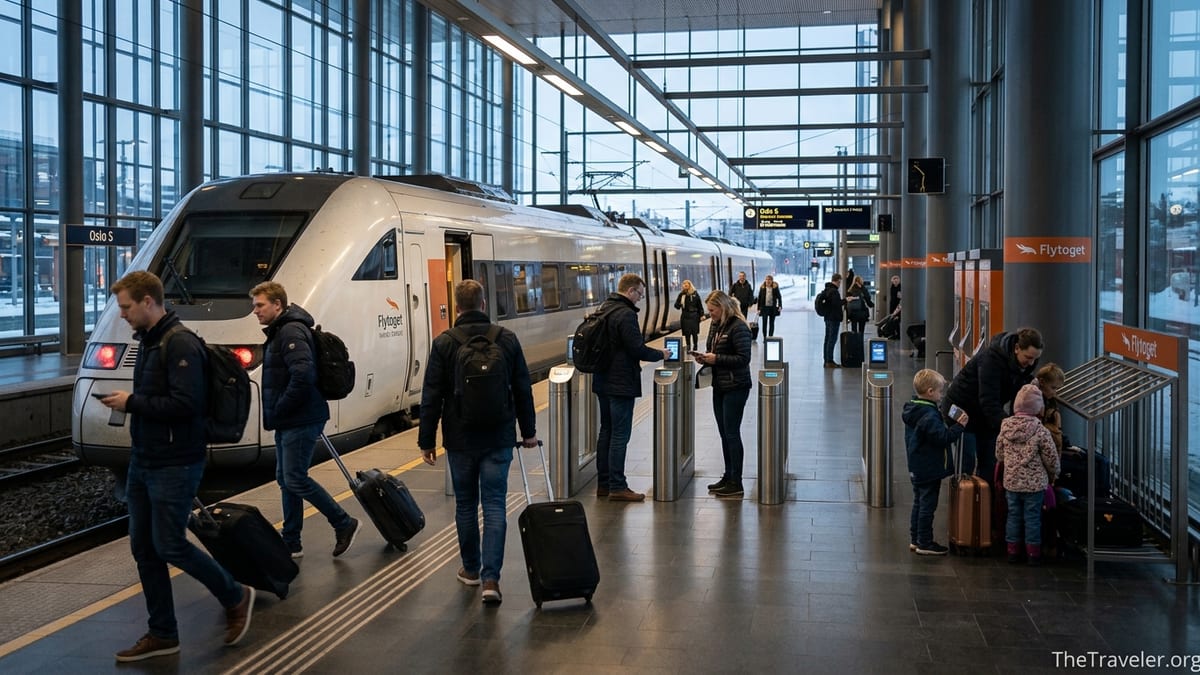
Flytoget is a high-speed airport express service that runs on the Gardermoen Line between Oslo Airport Gardermoen and central Oslo. Trains typically take about 19 minutes from the airport to Oslo Central Station, using dedicated Class 71 units designed for quick acceleration and comfortable seating. Services run roughly every 10 minutes for most of the day, so even if you just miss one, the next train usually appears within a short wait on the same platform.
The key thing to know is that Flytoget is a separate company and product from Norway’s main rail operator Vy. Both use the same tracks between the airport and Oslo, but Flytoget is marketed as a premium airport link with its own fares, branding and ticketing. When you arrive at Oslo Airport, clear customs and walk straight ahead, you will see clear signs pointing to the Flytoget platform, complete with orange branding, ticket machines and simple gates where you can tap a bank card or scan a ticket.
On board, you can expect free Wi-Fi, power outlets at most seats and dedicated luggage racks near the doors. Coaches are laid out with a mix of airline-style pairs of seats and open areas for suitcases. For a solo business traveler landing on a Monday morning with only a cabin bag, it feels very close to a moving business lounge: you sit down, connect to the Wi-Fi, and you are at Oslo Central Station before many passengers have even left the baggage hall.
Flytoget’s reliability and clarity are a big part of the appeal. Because the trains are dedicated to the airport route, they are less affected by delays elsewhere in the rail network. For travelers who are tired, jet-lagged, or anxious about making a flight connection later, that sense of a simple, predictable option can be worth paying extra for.
Compare Flytoget With Vy Trains Before You Buy
The most important decision travelers face is whether to use Flytoget at all. Vy’s regional and commuter trains also serve Oslo Airport, often on the same platforms and tracks, but at roughly half the price. Recent price guides for 2026 show Flytoget tickets between the airport and Oslo Central Station in the range of about 230 to 250 Norwegian kroner for a standard adult single, while Vy regional trains on the same stretch are commonly quoted around 115 to 135 kroner per adult for a similar journey time of about 23 to 30 minutes.
In practice, this means a couple arriving in Oslo can expect to pay something like 460 to 500 kroner in total on Flytoget, versus about 230 to 270 kroner on a Vy regional train, with only a few extra minutes of travel time. For a family of four, the gap grows even more noticeable, especially if children are old enough to require their own tickets. Several recent travel guides point out that for leisure travelers without rigid schedules, the Vy train usually wins on overall value while being only a little slower.
The trade-off is comfort and predictability. Flytoget typically runs every 10 minutes almost throughout the day, while Vy services are frequent but less strictly timed, and some trains make extra stops that stretch the journey closer to 30 or even 35 minutes. During busy commuter peaks, Vy trains can feel more crowded, particularly near Lillestrøm and into Oslo Central Station, whereas Flytoget’s trains are optimized for airport passengers with luggage and often feel more spacious.
Before you automatically head for the first illuminated Flytoget sign, check the departure board above the platforms. It will usually list both Flytoget departures and Vy trains. If you arrive mid-morning with no urgent connection and see that a Vy L12 or another regional service is due in five minutes, it may make sense to use that and save a meaningful amount on your airport transfer. If you land late at night or very early in the morning, when services are thinner and you want the certainty of a 10-minute pattern, Flytoget can be the better choice.
Know Your Ticket Options and How to Pay
Flytoget is designed for ticketless, friction-free payments, which is ideal for visitors who have just landed. The simplest option is to tap a contactless bank card directly at the barriers at the airport station and then again when you exit at Oslo Central Station or any other Flytoget stop. The system automatically calculates and charges the correct fare to the card. For many travelers, this means no need to handle ticket machines or worry about having local cash.
Alternatively, you can buy tickets in the official Flytoget app or at orange ticket machines near the platforms. The app is useful if you want a clear record of expenses for reimbursement or if you are buying for multiple people traveling together on one device. Some passengers also buy tickets at staffed desks in the arrivals hall, which can be reassuring if you prefer to ask questions in person after a long flight.
Vy tickets are purchased separately through the Vy app, through Oslo’s public transport app for zone-based tickets, or from green-and-white ticket machines at the station. A Vy ticket from Gardermoen to Oslo Central Station usually covers onward travel on local public transport within Oslo for a limited period, which can be valuable if you need to transfer to a tram, bus or metro. In contrast, a Flytoget ticket covers only the airport express route itself, so you may need to purchase an additional local ticket once you arrive.
For example, a traveler staying near the Majorstuen area might choose a Vy ticket that includes both the airport–Oslo Central rail segment and the onward metro ride, combining the journey into a single, integrated fare. Another traveler whose company reimburses Flytoget specifically may still opt for the airport express, then tap a separate local card or mobile ticket for the short tram ride to the hotel. Thinking through your door-to-door route before you buy can reveal which option is genuinely simpler and cheaper for your circumstances.
Timing, First and Last Trains, and Connection Risks
Flytoget’s headline advantage is speed and frequency. Typical journey times are about 19 minutes between Oslo Airport and Oslo Central Station, with trains departing every 10 minutes during most of the day. Services begin in the early morning and continue until shortly after midnight, so for most common flight arrival and departure times you will not wait long. For red-eye arrivals that land just after 05:00 or evening flights that arrive late, this reliability can make a noticeably smoother start or finish to your trip.
Vy regional and commuter trains on the same route can be nearly as fast, sometimes just 5 to 10 minutes slower depending on the stopping pattern. However, the timetable is more variable. During peak times and midday, it is common to find a Vy train every 10 to 20 minutes, but late at night or very early in the morning the gaps can be larger. If you have a tight onward connection, such as a reserved long-distance train onward to Bergen or Trondheim, the margin of error shrinks, and many travelers prefer Flytoget’s tighter timetable and dedicated fleet for that reason.
When flying out of Oslo, a typical recommendation is to plan to reach the airport two hours before a short-haul European flight and around three hours before a long-haul flight, then work backward to choose a departure from the city. For instance, if you have a midweek 08:00 flight to London, arriving at the airport around 06:00 is sensible. That usually means catching a Flytoget around 05:30 or a Vy regional train that arrives by about 05:40. On winter mornings with potential snow or ice, the extra buffer and slightly higher reliability of the airport express can feel more reassuring.
Travelers should also consider how they personally handle risk. Some are comfortable arriving at the airport with only a small margin, prioritizing the cheaper Vy fare. Others prefer to book a Flytoget train that reaches Gardermoen with an extra 30 or 40 minutes in hand, especially when flying long haul or when rebooking would be expensive. Checking real-time departures on the airport screens or in the relevant apps on your phone as soon as you land can help you make the right call for that particular day.
Comfort, Luggage, and Onboard Experience
For many travelers, the decision between Flytoget and Vy is less about exact minutes and more about how the journey feels. Flytoget trains are designed for passengers carrying suitcases, sports gear, or duty-free bags. They offer wide doorways, ample luggage racks and clear floors around entrances, which helps when you are shepherding children or trying not to block the aisle with a large suitcase. Seating is typically generous, with good legroom and a modern, bright interior.
On a busy Friday afternoon, a family of four with two rolling suitcases and a stroller may find Flytoget’s layout more forgiving. Parents can park baggage in the racks near the doors and sit within sight of it, rather than trying to squeeze everything into overhead shelves on a crowded regional train. The free Wi-Fi and power sockets also make it easy to let children wind down with a tablet or to quickly download maps and check-in emails during the short ride.
Vy trains on the same route vary more in layout, because they serve both airport passengers and regular commuters. Some services have good luggage space and modern interiors; others can feel more like standard regional trains, with narrower aisles and passengers standing in the vestibules during peak times. Many visitors report that at mid-morning and mid-afternoon, Vy trains are comfortable and quiet, but at early rush hours around 07:00 to 09:00 and 15:00 to 17:00 they can become crowded, particularly between Lillestrøm and Oslo.
If comfort is your top priority, consider your arrival time and the type of trip. A solo backpacker landing at 14:00 on a Wednesday may find a Vy train perfectly relaxing and enjoy saving the fare difference. A business traveler with a laptop, hand luggage and a suit carrier arriving at 07:30 on a Monday may appreciate Flytoget’s more predictable seat availability and the quieter atmosphere to catch up on emails before a meeting in the city.
Discounts, Groups, and When Flytoget Makes Financial Sense
Although Flytoget has a reputation as the expensive option, there are situations where the price gap narrows or where the overall value works out in its favor. Children, youth and some concession holders often qualify for reduced fares, so a family might pay less per person than the headline adult rate suggests. Business travelers whose employers specifically approve Flytoget as an expense may find that the additional cost is effectively invisible in their personal budget.
For example, imagine two colleagues flying in from Frankfurt on the same morning flight. One is on a tight schedule with a meeting near Nationaltheatret station at 10:00 and has their ticket reimbursed by a company policy that explicitly allows Flytoget. The other is adding a few days of vacation and paying out of pocket. The first might reasonably head straight to the Flytoget platform, valuing the extra reliability and the speed to central Oslo. The second might walk the same way but then choose the Vy train on the adjacent platform, spending roughly half as much for a journey that takes a few minutes longer.
Group dynamics can also shift the calculation. A group of four friends arriving late on a Friday night might compare Flytoget’s combined cost to splitting a licensed airport taxi or a pre-booked ride-share. At night, when local buses are less frequent and the city is quiet, the certainty of a 19-minute ride into Oslo Central Station and a short walk to a hotel can be preferable to navigating unfamiliar streets or waiting outside for a car in cold weather.
Travelers on multi-city rail itineraries should consider how Flytoget interacts with other tickets. In some cases, using Vy and zone-based public transport tickets from the airport all the way to a suburban address or a connecting station reduces the need for separate purchases and keeps costs consistent. In others, Flytoget to Oslo Central followed by a reserved long-distance train onward to Bergen or Trondheim can feel like one seamless rail journey, especially if you plan sufficient transfer time and prefer moving through train stations to taking buses or taxis.
The Takeaway
For visitors to Norway, Flytoget offers a fast, polished and reassuring way to move between Oslo Airport Gardermoen and the heart of the city. Trains every 10 minutes, clear signage and a simple tap-in, tap-out system make it one of the easiest airport rail links in Europe to use, especially after long flights. The experience on board is comfortable, with space for luggage, good connectivity and a quiet, modern environment.
At the same time, the competing Vy trains on the same tracks are often nearly as quick for roughly half the price, and they integrate more tightly with the wider public transport system in and around Oslo. For solo leisure travelers and cost-conscious visitors with flexible schedules, these Vy services are usually the better value. For business travelers, families with heavy luggage, or anyone catching a critical onward flight or train, Flytoget’s frequency and dedicated focus on the airport route can justify the premium.
The best strategy is to think about your complete journey before you buy a ticket. Consider what time you land or depart, whether you need onward buses or trams, how much luggage you are carrying and how you personally balance cost against convenience. Check live departure boards and apps once you reach the arrivals hall, and be ready to choose whichever option matches the realities of that particular day.
With a bit of planning, Flytoget can be a comfortable, near-effortless welcome to Norway. Even if you decide that a Vy train suits your needs better, understanding how Flytoget fits into the broader transport picture around Oslo will help you start and end your trip on the right track.
FAQ
Q1. Do I need to buy a Flytoget ticket in advance?
You do not need to buy Flytoget tickets in advance. Most travelers simply tap a contactless bank card at the barrier or use the app when they arrive, as trains run frequently.
Q2. How much faster is Flytoget compared with Vy trains?
Flytoget usually takes about 19 minutes between Oslo Airport and Oslo Central, while Vy services on the same route are often around 23 to 30 minutes, depending on stops and timetable.
Q3. Is Flytoget worth the extra cost for a short city break?
For a relaxed city break without tight connections, many visitors find Vy trains better value. Flytoget can still be worth it if you prioritize maximum comfort or arrive very early or late.
Q4. Can I use an Oslo public transport ticket on Flytoget?
No. Regular Oslo public transport and zone tickets are valid on Vy and local trains, buses, trams and metro, but Flytoget is a separate service with its own fares and tickets.
Q5. What is the best option if I am traveling with a lot of luggage?
Flytoget is designed with airport passengers in mind, so it usually offers more convenient luggage racks and space near the doors. It is often the easier choice with large suitcases.
Q6. Are there discounts for children or students on Flytoget?
Flytoget typically offers reduced fares for children and some concession categories such as students or seniors. The exact discounts can change, so check the latest information in the app or at the station.
Q7. What happens if my train is delayed and I miss my flight?
If a significant delay affects your journey, Flytoget and Vy have their own customer service and compensation rules. Policies can include assistance or partial refunds, but outcomes depend on the exact circumstances.
Q8. Is Wi-Fi available on Flytoget and Vy trains?
Yes. Flytoget trains offer free Wi-Fi and power outlets at most seats. Many Vy regional trains on the airport route also provide Wi-Fi, though quality and availability can vary more between services.
Q9. How early should I leave Oslo for a flight from Gardermoen?
As a general rule, aim to reach the airport about two hours before European flights and three hours before long-haul departures. Choose a Flytoget or Vy departure that arrives with a comfortable buffer.
Q10. Which train should I take if I am connecting to a long-distance route like Bergen or Trondheim?
If you have a tight connection to a reserved long-distance train, Flytoget’s slightly higher reliability and 10-minute frequency can reduce stress. With a generous buffer, a Vy train is usually sufficient and more economical.