


More news on this day
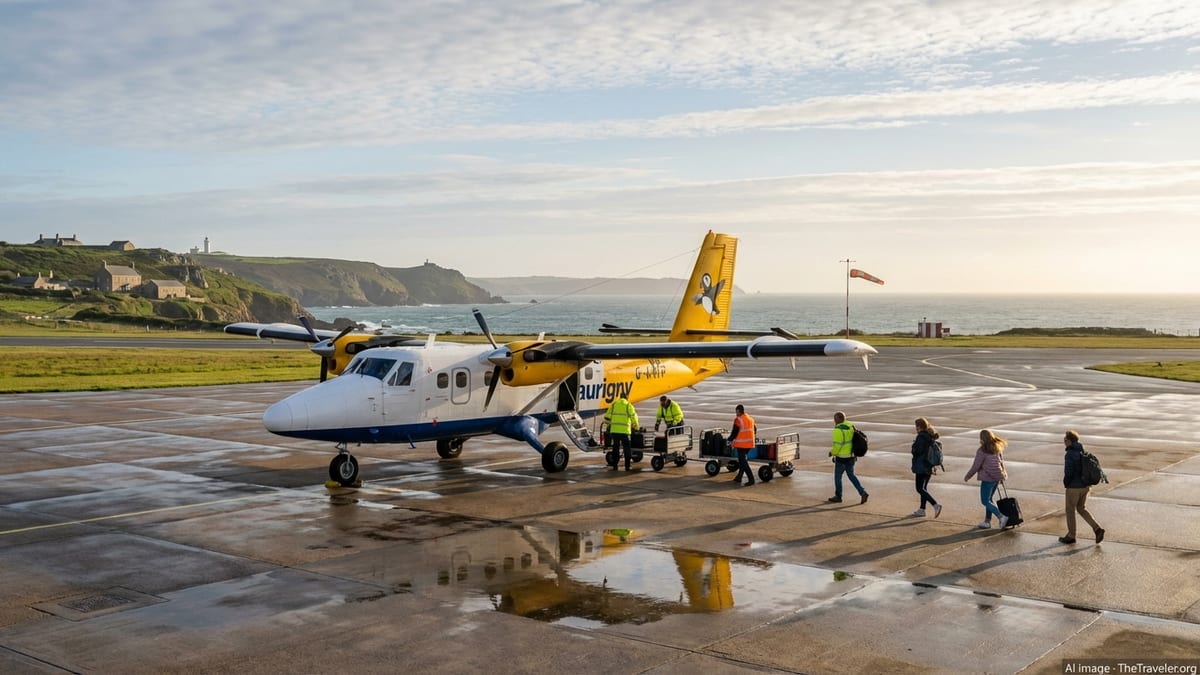
A major project to rebuild Alderney Airport’s ageing runway has been pushed back by at least a year, with construction now expected to start in 2028 instead of 2027, according to recent reports, prompting renewed concern on the Channel Island over reliability of air links and the risk of future airport closures.
Get the latest news straight to your inbox!
Rebuild timetable slips despite funding approval
Publicly available information indicates that up to £24 million has been approved for the Alderney Airport runway rehabilitation, including resurfacing and realignment of the main asphalt runway, taxiway and apron, after extended political debate in Guernsey earlier this year. When the package was agreed, States members were told that work could begin in 2027, subject to final business case approval and detailed design.
Updated coverage of the scheme now suggests that the earliest realistic construction start has shifted to 2028, effectively adding at least a year to the timetable. The delay is linked to the need to refine the project scope to fit within the agreed budget envelope and to complete further technical work before tendering can proceed.
Guernsey policy papers previously highlighted that parts of the reconstruction may require Alderney Airport to close entirely for around five months to allow the contractor to work in the quickest and most cost effective way. Any slippage in preparatory stages therefore carries knock-on uncertainty for operators and residents who are trying to plan around a significant period of disruption.
Reports describe the revised timeframe as very concerning for the island, which depends heavily on its small airport for passenger travel, freight and emergency medical evacuations to Guernsey and the UK mainland.
Safety restrictions and risk of unplanned closures
The runway project has been under discussion for several years, driven by concerns about the condition of the current asphalt surface and the need to meet modern aerodrome design standards. The main runway is short and narrow by contemporary regional aviation benchmarks and has undergone repeated patch repairs rather than comprehensive renewal.
Official documentation from Guernsey’s parliament has already warned that any further delay to rehabilitation increases the risk of unplanned closures. Restrictions introduced by the Director of Civil Aviation on account of surface and safety considerations have added to the sense that the airport is operating with limited resilience.
One recent report cited an instance where the runway had to close at short notice to address subsidence after heavy rain, illustrating how fragile the infrastructure has become. While contingency plans exist for short term closures, including arrangements for medical evacuations, the prospect of more frequent or longer shutdowns before rebuilding begins is seen locally as a serious vulnerability.
In that context, pushing the project back to 2028 is viewed by many on the island as creating a longer window of exposure, during which further restrictions or emergency works could again interrupt vital air services.
Concerns over connectivity, medevac and the local economy
Alderney’s geographic isolation means it relies almost entirely on its airport for regular links with Guernsey, Jersey and the United Kingdom. Ferry options are limited and weather dependent, so even relatively short interruptions at the airport can have outsized effects on residents, visitors and businesses.
Statements from the States of Alderney in recent months have underlined particular unease about medical evacuation resilience, given the reliance on timely transfers to Guernsey’s hospital and onward to specialist care in the UK. Any combination of deteriorating runway condition, tighter operational limits or extended construction closure could complicate those time critical journeys.
The tourism sector is also sensitive to uncertainty around transport. Travel industry observers note that airlines and tour operators typically plan schedules many seasons in advance, and the lack of a firm construction window risks deterring new services or investment until there is clarity on when and how the runway work will be delivered.
Local business groups have previously argued that a modernised, more reliable runway could support economic diversification and higher visitor numbers, while a prolonged period of uncertainty and ad hoc closures may have the opposite effect, discouraging longer term commitments from both residents and investors.
Project scope, design standards and cost pressures
According to available project summaries, the Alderney scheme aims to widen the main asphalt runway to meet minimum international design standards for the types of turboprop aircraft commonly used on Channel Islands routes. Existing plans also include strengthening and realigning the runway and taxiway system, along with works to the apron and associated safety areas.
Earlier technical work has involved surveying the airfield’s height profile and drainage, tasks that are necessary to finalise construction methods and mitigate long term settlement and surface wear. These preparations were presented as essential steps towards issuing tenders and securing a contractor.
However, cost pressures have remained a central challenge. Inflation in construction materials, specialist aviation standards and the logistical complexity of major works on a small island have all pushed up estimates. Political papers acknowledge that further value engineering is needed to keep the project within the £24 million budget without undermining safety or future capacity.
This rebalancing of scope, standards and cost appears to be one of the key factors behind the revised 2028 start date, as authorities work to present an affordable but durable solution that can win final sign off.
Community pressure for clarity and shorter disruption
Statements from Alderney’s elected representatives over the past year indicate persistent pressure for greater clarity on both timing and phasing of the runway rebuild. Local leaders have asked for reassurance that the airport will not be left in a prolonged state of limbo and that disruption to scheduled flights will be kept as short as possible.
Publicly available updates show that Alderney has pressed for detailed contingency planning to cover very short term, short term, medium term and long term closure scenarios, highlighting the importance of transport continuity for residents, businesses and essential services. There is also interest in making greater use of the island’s grass runways for certain operations once the main asphalt work is complete, subject to regulatory approval.
Ahead of construction, small improvements and safety investments have continued at the airport, but these are widely seen as stopgap measures rather than a substitute for the full rehabilitation. Community commentary on the latest delay reflects concern that incremental fixes may not be enough to avoid further restrictions while the island waits for a comprehensive rebuild.
For now, the focus among islanders and travel industry stakeholders is likely to be on how quickly the final business case can be agreed, how robust the 2028 start date proves to be, and whether the eventual construction schedule can balance the need for swift delivery with the imperative to keep Alderney connected to the wider region.