


George Town may be compact, but working out the best way to move between its UNESCO lanes, beach resorts and hilltop temples can save you both money and time. From quick Grab rides to Batu Ferringhi’s main beach to inexpensive Rapid Penang buses and full‑day private island tours, Penang’s transport network gives visitors plenty of choice if you understand how it works in practice.
Get the latest updates straight to your inbox!
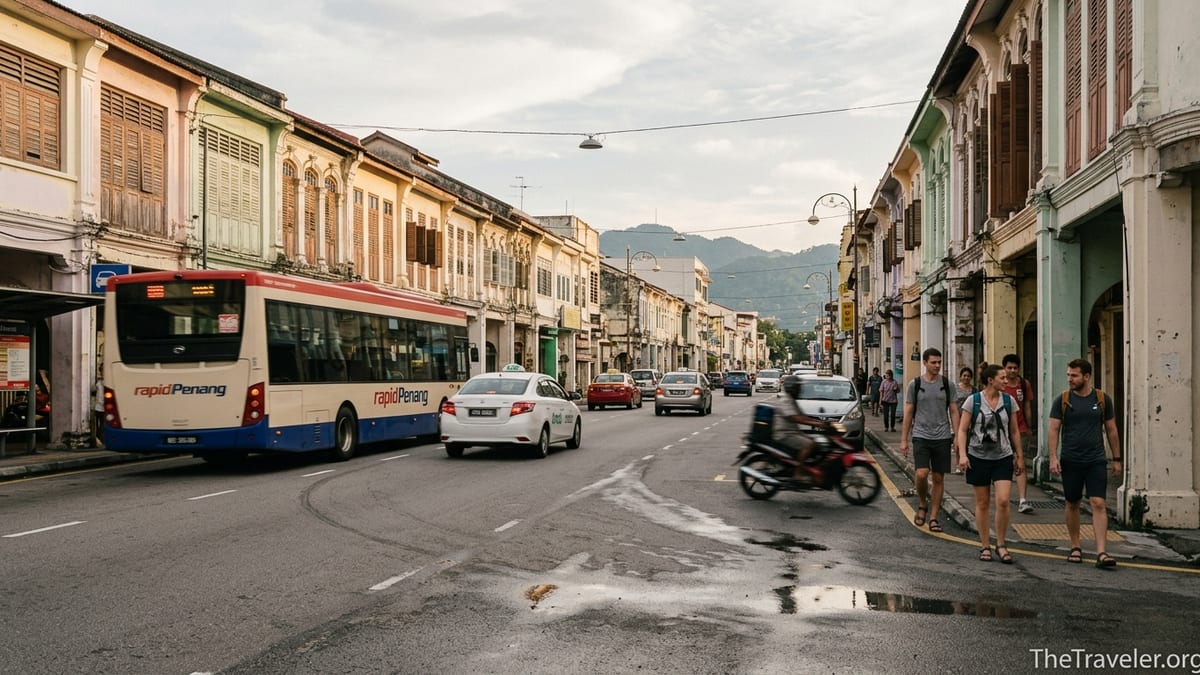
How George Town Is Laid Out – And Why It Matters For Transport
George Town sits on the northeast corner of Penang Island, with most heritage sights clustered within a walkable grid around Armenian Street, Chulia Street and the Esplanade. Just west of the old town is Komtar, the main high‑rise landmark and the hub where most Rapid Penang buses converge. Knowing this layout helps you decide whether to walk, ride Grab or catch a bus for each leg of your trip.
Penang’s main beach strip at Batu Ferringhi runs along the north coast, roughly 12 to 17 kilometers from central George Town depending on your starting point. In normal traffic the drive takes around 30 to 45 minutes by car or Grab, and a little longer by bus. Farther afield, the national park at Teluk Bahang, Balik Pulau on the island’s rural west side and the airport in Bayan Lepas all radiate out from George Town like spokes on a wheel.
This geography means you can comfortably explore George Town itself on foot and with the occasional short ride, but you will almost certainly need motorised transport to reach beaches, hill temples and nature spots. The good news is that for most visitors the key decision is simply when to pay for convenience, and when to trade time for savings.
Taxis, Grab And Ride‑Hailing: Door‑To‑Door Convenience
Traditional taxis still operate around George Town, particularly at fixed stands such as Penang International Airport and outside major malls and hotels. At the airport, for example, you can buy a coupon at the official taxi desk and a standard car into George Town typically costs more than a comparable Grab ride. Many visitors now use these taxis mainly as a backup if ride‑hailing is unavailable or heavily surging.
In everyday use, Grab is the dominant option for point‑to‑point travel. As of 2026, a standard Grab car from the airport to a hotel near Komtar or the Esplanade tends to cost roughly RM 26 to RM 35 depending on time of day and traffic, with a journey time of 25 to 35 minutes. Within George Town itself, short hops of 3 to 5 kilometres, such as from Armenian Street to Gurney Plaza for dinner, often come in around RM 8 to RM 15 in normal conditions.
For beach runs, expect to pay more simply because of the distance. A typical daytime Grab from central George Town to a Batu Ferringhi beachfront hotel such as the Hard Rock or Shangri‑La Rasa Sayang can fall in the region of RM 20 to RM 30 each way when traffic is light, with prices rising at peak times or on holiday weekends. Longer island trips, such as to Entopia Butterfly Farm and Tropical Spice Garden near Teluk Bahang, usually sit a little higher again but still represent good value for small groups compared with private tours.
Grab accepts both card and cash, which is convenient if you have not yet visited an ATM. The most practical approach is to add a card before you arrive so you are not dependent on finding small change for each ride. In busy periods, such as public holidays, you may see higher prices or longer waiting times; in those cases, walking to a main road or transport hub like Komtar can sometimes produce more driver matches than calling a car from a quiet side street.
Public Buses: Rapid Penang For Budget Island Travel
Rapid Penang is the state‑run bus network and forms the backbone of public transport across George Town and Penang Island. As of 2025 the company operates dozens of routes and several hundred buses that fan out from hubs at Komtar, Weld Quay and Penang Sentral on the mainland. The system is basic but extensive, making it particularly attractive for budget‑conscious visitors who do not mind slower journeys.
Fares on Rapid Penang are distance‑based, with shorter rides inside George Town costing only a few ringgit and longer cross‑island journeys typically capped at around RM 4 per person. For example, the popular 101 route runs from the city towards Batu Ferringhi and Teluk Bahang, taking roughly 45 minutes to an hour to reach the beach strip depending on traffic. For many travellers this is a comfortable way to save money if they are not in a rush and enjoy seeing more of local life from the bus window.
Services link most major sights tourists are likely to visit. Buses connect George Town to the airport in Bayan Lepas, Komtar to Balik Pulau on the rural west side, and city stops to attractions such as Kek Lok Si Temple or Penang Hill via interchange points. In addition, free city shuttles branded as CAT buses circulate around central George Town, making it possible to hop between heritage streets, the ferry terminal and key museums without paying a fare.
Payment is straightforward. Many visitors still pay the driver in cash, and it is useful to carry small notes, as change is not always available. Contactless cards and transport passes are used by residents, but foreign tourists are not always eligible for the monthly discounts. At busy times buses can be crowded and may run behind schedule, so allow extra time if you are heading to the airport or catching an onward ferry.
Rental Cars, Scooters And Walking In George Town
Hiring a car can make sense if you want complete freedom to criss‑cross the island, especially as a family or group of friends. Daily rates for small cars in Penang often start around RM 120 to RM 150 when booked locally, with pickup possible at the airport, in George Town or at beach resorts. This can be cost‑effective if you are planning several longer day trips, such as a loop from George Town to Balik Pulau, the south coast, then back via Penang Bridge.
That said, driving in George Town’s compact heritage core can be slow and stressful for newcomers. Streets are narrow, one‑way systems are common, parking can be limited and enforcement officers are active in tourist‑heavy areas. Outside the centre, roads to Batu Ferringhi and Teluk Bahang are winding and often busy on weekends. If you do rent a car, it is sensible to book a hotel with on‑site parking and use the vehicle mainly for leaving town rather than shuttling around the old streets.
Motorbike and scooter rentals are widely available and are popular with some independent travellers for quick runs to Batu Ferringhi or Teluk Bahang. Daily prices can be relatively low, but helmets are mandatory, tropical downpours are common and traffic standards vary. Visitors without experience riding in Southeast Asian cities may be more comfortable relying on Grab and buses instead of navigating Penang’s hills and urban traffic on two wheels.
Inside George Town itself, walking is often the best way to move between sights. Many of the murals, clan jetties, temples and cafes lie within a 10 to 20 minute stroll of one another. Pavements can be uneven in places and afternoons are hot and humid, but if you start early or walk in the evening you can cover a lot without spending anything on transport. A realistic pattern for many visitors is to explore on foot in the morning, then use Grab or a bus for a single longer trip later in the day.
Beaches, Island Tours And How To Reach Them
Most beach‑focused visitors pair a stay in George Town with day trips or overnights at Batu Ferringhi. Getting there is straightforward: you can take the Rapid Penang 101 bus from Weld Quay or Komtar for a very low fare and a 45 to 60 minute ride, or you can book a Grab for a faster 30 to 45 minute journey at several times the cost but with door‑to‑door convenience. Some resorts offer their own scheduled shuttles into town, particularly in the evening for guests heading to hawker centres and night markets.
Beyond Batu Ferringhi, Teluk Bahang at the northwest corner of the island serves as the gateway to Penang National Park. From here, jungle trails lead to beaches such as Monkey Beach and Kerachut Beach, while small boats can be hired from the park entrance or local operators for coastal trips. Visitors commonly arrange a Grab from George Town to the park entrance in the morning, hike or take a boat between beaches, then return by Grab or bus in the late afternoon.
Full‑day private tours with a vehicle and driver are another way to combine multiple island highlights in a single day without worrying about bus timetables. Local operators based in George Town and Batu Ferringhi offer custom itineraries that might include Kek Lok Si Temple, Penang Hill, Balik Pulau countryside, Tropical Spice Garden and sunset at Batu Ferringhi in one loop. In these cases, pricing is usually per vehicle for 6 to 8 hours, often starting in the low hundreds of ringgit depending on group size and inclusions.
If you have limited time, consider mixing transport modes. For example, you could take a Grab to Batu Ferringhi in the morning for a beach walk and lunch, then continue by bus to Teluk Bahang for an afternoon in the national park, returning by Grab after dark when buses thin out. On another day, you might book a private driver to handle a more ambitious circuit that would require several bus changes if done independently.
Paying For Transport: Cash, Cards And Practical Tips
Cash still plays a big role in Penang’s transport system, particularly for buses, small boats and older taxis. While Grab and some tour operators accept card payments, it is wise to keep a mix of notes and coins on hand for drivers who only accept cash or for moments when mobile coverage falters. ATMs are readily available around George Town, especially near Komtar, Gurney Plaza and major banks in the heritage area.
For Rapid Penang buses, paying in cash is the simplest option for short stays. Fares are low and drivers are accustomed to taking small notes. Some locals use stored‑value cards or monthly passes that cap costs, but these products are primarily targeted at residents and may not be worth the admin for a short visit. Free city routes, where available, require no payment at all: you simply hop on and off at marked stops.
Ride‑hailing apps like Grab bridge the gap between card and cash. You can link an international credit or debit card to your account before departure, then choose to pay either cash or card for each ride. This flexibility can be useful if you are running short on cash at the end of a day trip to Batu Ferringhi, or if you want to keep small notes for hawker food instead of taxis. Just remember that the app relies on mobile data, so ensure your SIM or roaming plan is active.
For private tours, airport transfers arranged through hotels and chartered vehicles with drivers, payment terms vary. Some small operators prefer cash in ringgit at the end of the day, while larger agencies or online platforms may accept card prepayment. When booking through your hotel concierge in George Town or Batu Ferringhi, ask clearly whether the quoted price includes tolls, parking and fuel so there are no surprises later.
Choosing The Best Option For Your Itinerary
The most efficient way to move around George Town and Penang depends heavily on your priorities. If cost is the main concern, pairing Rapid Penang buses and walking will take you surprisingly far. You might walk between street art, clan houses and Little India in the morning, grab a cheap bus to Batu Ferringhi for a sunset stroll along the sand, then return by a later bus or shared Grab if one is available.
If convenience ranks above budget, a combination of Grab and occasional private tours fits most visitors well. For instance, you could use Grab for evening runs to hawker centres like Gurney Drive, then book a private driver on another day to handle a more scattered route that might include Penang Hill, Kek Lok Si, Balik Pulau and a seaside dinner at Batu Ferringhi before returning to your George Town hotel.
Families with young children often appreciate the predictability and air‑conditioning of ride‑hailing or hotel shuttles, especially in the hottest hours of the afternoon. Meanwhile, more independent travellers may prefer the flexibility of a rental car or scooter, particularly if they want to explore quieter corners of the island at off‑peak times. In every case, it is usually sensible to avoid tight back‑to‑back commitments; tropical downpours and peak‑hour congestion can easily add 15 to 20 minutes to cross‑island travel.
Whichever mix you choose, planning your day around natural clusters of sights reduces the need for multiple long journeys. One day might focus on the UNESCO core and nearby food streets within George Town, mostly on foot. Another could be your “north coast” day, covering Batu Ferringhi, Teluk Bahang and the national park by bus, Grab or car. A third could explore the central spine of the island, linking Air Itam, Penang Hill and Balik Pulau, again with the transport mode that best suits your budget and comfort level.
The Takeaway
Penang’s capital rewards visitors who understand that not all journeys are equal. Inside George Town’s heritage zone, your feet and free city shuttles are often all you need. For the beaches and hills, inexpensive Rapid Penang buses and reasonably priced Grab rides open up most of the island without the hassle of full‑time car rental.
Deciding when to pay extra for a private driver or taxi is largely a question of time and energy. A single well‑planned tour day can cover the far corners of the island while leaving you relaxed rather than juggling connections. At the same time, even modest use of buses and walking can keep daily transport costs pleasantly low.
By pairing real‑world options like a RM 4 bus to Batu Ferringhi with an occasional door‑to‑door Grab from the airport or national park, most travellers find George Town and its surrounding beaches easy to navigate. With a rough sense of prices, routes and payment options in mind, you can focus less on logistics and more on Penang’s food, heritage and sunsets.
FAQ
Q1. Is it better to use Grab or taxis in George Town?
For most visitors, Grab is more convenient and often cheaper than traditional taxis, especially for trips like airport to George Town or George Town to Batu Ferringhi.
Q2. How much should I budget for a ride from Penang Airport to George Town?
A standard Grab from Penang International Airport to a central George Town hotel usually costs roughly RM 26 to RM 35, depending on traffic and time of day.
Q3. Are Rapid Penang buses reliable for tourists?
Yes, Rapid Penang buses cover most key areas and are very affordable, though they can be slow and crowded at peak times, so allow extra time for longer journeys.
Q4. What is the easiest way to reach Batu Ferringhi beach from George Town?
The easiest options are a Grab ride, which takes about 30 to 45 minutes, or the Rapid Penang 101 bus from Weld Quay or Komtar, which is cheaper but slower.
Q5. Do I need a rental car to explore Penang Island?
No, you can see most sights using a mix of walking, buses, Grab and the occasional private tour, though a rental car can be useful for families or complex itineraries.
Q6. Can I pay for buses and taxis with a credit card?
Rapid Penang buses are easiest to pay in cash, while Grab allows you to use cards or cash; traditional taxis and small boat operators usually prefer cash.
Q7. Is it safe to use public transport at night in George Town?
Bus services thin out later in the evening, so most visitors rely on Grab at night; using well‑lit stops and official ride‑hailing apps adds an extra layer of safety.
Q8. How walkable is George Town for sightseeing?
Central George Town is very walkable, with many murals, temples and cafes within a 10 to 20 minute stroll, though heat and uneven pavements can slow you down.
Q9. Are there shuttles between George Town hotels and Batu Ferringhi resorts?
Some larger resorts and hotels operate scheduled shuttles, especially in the evening, but availability varies, so check directly with your accommodation.
Q10. What is the best transport option for a full‑day island tour?
A private driver or organised tour is usually best for full‑day circuits that include several scattered sights, as it saves time and simplifies planning compared with buses.