


More news on this day
A widespread technology outage at American Airlines triggered a nationwide ground stop on Tuesday, stranding passengers across the United States and causing cascading delays and cancellations at San Francisco International Airport and other major hubs.
Get the latest news straight to your inbox!
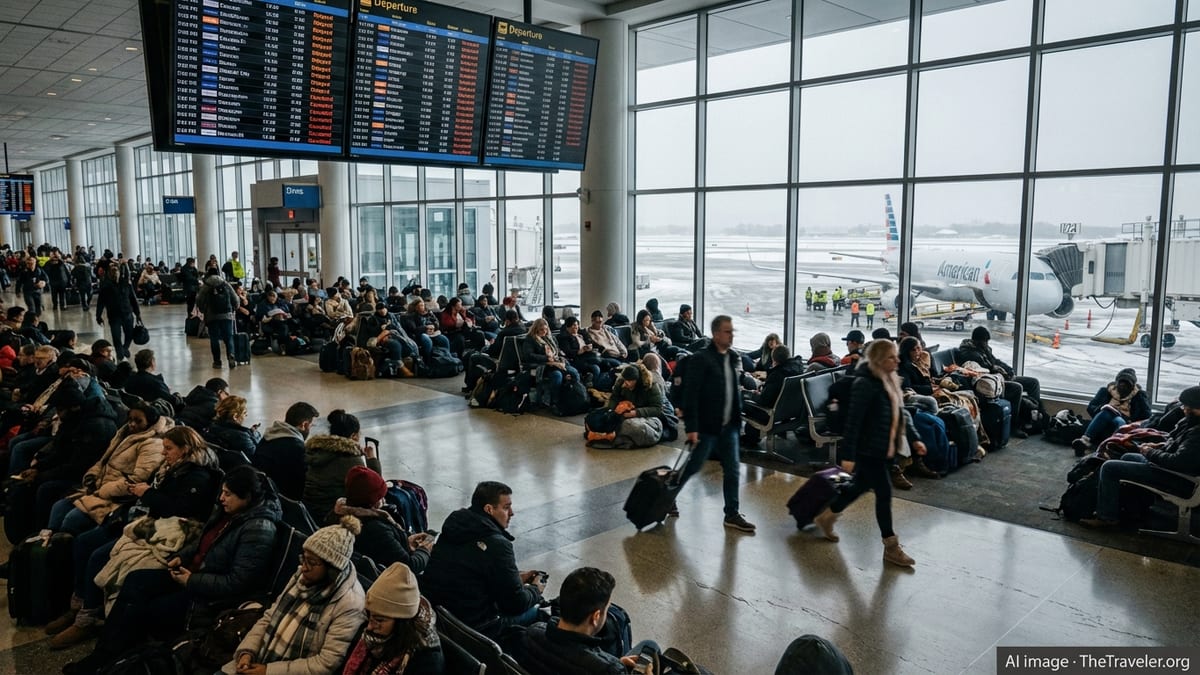
Nationwide outage halts departures across American’s network
Publicly available flight tracking data and passenger accounts indicate that American Airlines experienced a large-scale systems failure affecting core operational tools used for check-in, boarding and flight dispatch. The disruption led to a temporary halt on departures for American and its regional affiliates, with aircraft already airborne allowed to continue to their destinations.
Reports from multiple airports describe departure boards freezing, boarding passes failing to scan and gate agents unable to access reservations. Passengers referenced a “system wide outage” in social media posts, noting that flights that were boarded and ready to push back were ordered to remain at the gate while the airline worked to restore its platforms.
Operational data reviewed by news outlets show a sharp spike in delays and cancellations across American’s domestic network during the outage window, consistent with a coordinated ground stop affecting mainline and regional operations. While some flights resumed after systems were partially restored, schedules remained disrupted for hours as aircraft and crews fell out of position.
A travel advisory on American’s website referenced ongoing “technical issues” impacting select flights and encouraged customers to monitor their flight status and explore rebooking options if their travel was time sensitive.
Significant disruption for travelers at San Francisco International Airport
At San Francisco International Airport, where American operates a mix of mainline and regional flights primarily through domestic terminals, passengers reported being held onboard aircraft and in crowded gate areas as the outage unfolded. Several travelers at SFO described sitting on planes that had completed boarding only to be informed that departures were paused nationwide for American flights.
Real-time airport status information for San Francisco showed elevated delays for certain departures, and independent flight trackers indicated irregular operations on American routes from SFO to major hubs, including Dallas–Fort Worth, Charlotte and Phoenix. Some flights appeared to depart significantly behind schedule, while others were cancelled outright as the disruption lengthened.
Passengers described long lines at customer service counters as they sought new itineraries, hotel vouchers or meal assistance. With peak summer travel demand already straining airport infrastructure, the outage added pressure to security checkpoints, baggage claim areas and terminal seating as travelers waited for updates.
Observers at SFO noted that carriers not affected by the systems problem, including other major U.S. airlines, continued operating relatively normally, creating a sharp contrast between functional and disrupted gate areas within the same terminals.
Technical failure adds to a year of operational strain for airlines
The American Airlines outage arrives in a year marked by a series of technology-related disruptions across the aviation and broader transportation sectors. Industry analysts have highlighted how modern airline operations rely heavily on integrated software systems for everything from crew scheduling to weight-and-balance calculations, leaving carriers vulnerable when critical applications fail.
Recent global outages tied to third-party IT providers have demonstrated how a single software issue can ripple through airlines, airports and air traffic control systems. While details on the precise cause of American’s latest disruption were not immediately clear from public reporting, aviation experts have previously warned that aging infrastructure, complex vendor chains and tight operating margins can complicate efforts to build more resilient systems.
Published research on airline network resilience suggests that large carriers with extensive domestic and international routes can recover more quickly from isolated weather or airport shutdowns than from broad-based technology failures. When core systems go offline, airlines often face simultaneous challenges in rebooking passengers, repositioning aircraft and reassigning crew, extending the impact beyond the initial outage window.
Travel advocacy groups have renewed calls for clearer communication standards during technology incidents, urging carriers to provide timely, transparent updates on the nature of disruptions and travelers’ options for refunds or alternative transportation.
Passengers face missed connections, overnight stays and uncertain plans
For travelers caught in the outage, the operational complexities translated into missed connections, unplanned overnight stays and uncertainty about when they would reach their destinations. Passengers bound for international flights from American’s hubs reported concern about tight transfer windows, while others shared experiences of being rebooked on multi-stop itineraries or on partner carriers where seats were available.
Families traveling during the busy summer season described the added stress of managing children in crowded terminals while waiting for information. Business travelers, meanwhile, cited lost meeting time and added accommodation costs as they scrambled to adjust their schedules.
According to publicly available information from consumer advocates, travelers affected by significant delays or cancellations tied to airline-controlled issues, such as many forms of technical failures, may be eligible for meal vouchers, hotel stays or rebooking at no additional cost. However, specific remedies can vary by carrier, ticket type and the circumstances of each disruption, leaving many passengers reliant on airline agents or customer service channels to clarify their options.
Travel forums and social media posts suggested that some American customers were able to secure same-day rebookings or alternative routings, while others faced waits stretching into the next day, particularly from heavily impacted hubs and popular leisure destinations.
What travelers should do if flying American in the coming days
Given the scale of the disruption and the knock-on effects that often linger after a nationwide ground stop, aviation observers expect American’s operations to remain somewhat unsettled as aircraft and crews gradually return to normal rotations. Even after systems are restored, it can take multiple days for a carrier’s schedule to fully stabilize, particularly during peak travel periods.
Travel experts recommend that passengers scheduled to fly American in the near term closely monitor their flight status using multiple sources, including airline apps and third-party trackers, and arrive at airports earlier than usual in case of long lines at check-in or rebooking counters. Those with critical connections or time-sensitive travel plans may wish to explore alternative routing options or flexible change policies where available.
Industry analysis indicates that travelers can improve their chances of securing workable alternatives by proactively contacting the airline’s customer service channels as soon as a delay or cancellation appears likely, rather than waiting until long queues build at the airport. Some passengers report better results using digital channels, such as messaging within airline apps, during periods when phone lines and service desks are overwhelmed.
As American Airlines continues working to stabilize its systems and schedules following the outage, attention within the industry is likely to focus on the root cause of the failure, the robustness of backup systems and the broader question of how carriers can modernize technology infrastructure to reduce the risk of similar widespread disruptions in the future.