


More news on this day
An overnight American Airlines flight from San Diego to Chicago diverted to Phoenix Sky Harbor International Airport early Wednesday, November 26, after police say a passenger left his seat, moved to the front of the aircraft, refused crew instructions and attempted to manipulate an exit door, prompting fellow travelers and crew members to restrain him until the plane could land safely.
Get the latest news straight to your inbox!
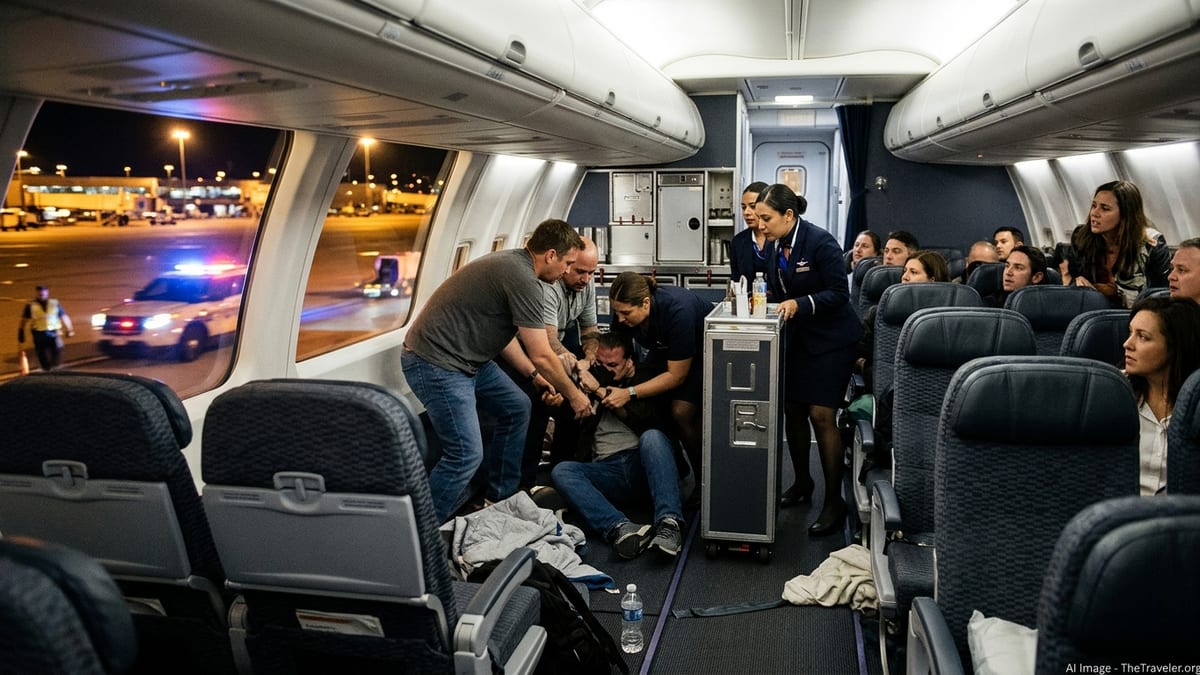
Incident on AA1494 en route from San Diego to Chicago
American Airlines Flight 1494, a regularly scheduled late-night service from San Diego International Airport to Chicago O’Hare International Airport, departed California shortly before 11 p.m. local time on Tuesday, November 25, according to flight-tracking data cited by multiple local outlets. Roughly an hour into the red-eye, while the aircraft was flying near the Arizona–California border south of Needles, California, a male passenger reportedly left his assigned seat and walked toward the front of the cabin.
Phoenix police said the man repeatedly ignored crew instructions to return to his seat and “attempted to tamper with” or manipulate an aircraft exit door. Witnesses quoted in several local reports described a tense but brief struggle in the forward cabin as flight attendants shouted for other passengers to move away from the door area. Video filmed on board, shared with local television stations and on social media, appears to show several passengers and crew members holding the man on the floor in the aisle near the front galley.
The captain diverted the flight to Phoenix Sky Harbor International Airport, where the aircraft landed without incident at about 1 a.m. local time on Wednesday, November 26. American Airlines and federal authorities have not reported any damage to the aircraft, and no operational emergency such as rapid depressurization occurred during the event.
Passenger restrained, removed in Phoenix; investigation under way
According to Phoenix police, crew members and several passengers restrained the man on the cabin floor and held him there until the aircraft reached Phoenix. Police said the passenger continued to resist while being restrained but that nobody else on board reported injuries. The man sustained what authorities described as a minor injury and was transported to a local hospital for evaluation after the plane reached the gate.
Law enforcement officers met Flight 1494 on arrival and assisted airline staff in removing the passenger from the aircraft. Phoenix police said the man was detained and interviewed, and that information from the crew and witnesses was being passed to federal authorities for review. As the flight was operating between two U.S. cities, any potential criminal charges related to interference with a flight crew or threats to aircraft safety would typically fall under federal jurisdiction.
The Federal Aviation Administration confirmed that the aircraft landed safely in Phoenix and said it is reviewing the incident as part of its standard process for reported in-flight disruptions and possible interference with crew duties. The FBI was notified by local police, in line with long-standing protocols for serious in-flight incidents on domestic U.S. routes. As of publication time, authorities have not publicly announced specific charges or named the passenger, and no federal complaint or court filing related to this case has yet appeared in accessible public records.
Airline response and impact on travelers
American Airlines described the diversion as a response to “a disruptive customer” and emphasized in statements to multiple local outlets that the safety and security of customers and crew are the carrier’s top priority. The airline said law enforcement met the aircraft on arrival in Phoenix and that the passenger involved did not continue onward to Chicago.
After the man was removed and the aircraft was cleared to continue operating, Flight 1494 eventually departed Phoenix for Chicago O’Hare around 5:50 a.m. local time, arriving several hours behind its original schedule. American Airlines has not released detailed information on any compensation or rebooking options provided, but standard practice in such diversions is for the airline to work with affected customers to complete their journeys, either on the same aircraft once cleared or on alternative flights as needed.
Passengers interviewed by local media described the response in the cabin as quick and relatively orderly, despite the obvious alarm among some travelers who awoke to raised voices and the sight of people grappling on the floor. One passenger who said he was seated nearby wrote on social media that “several strong heroes” helped subdue the man and later told reporters he felt the crew maintained control of the situation. Others reported that a flight attendant moved a beverage cart toward the front of the aircraft during the struggle, apparently as an additional barrier between the restrained passenger and the cabin door area.
Door-tampering incidents and what they mean for flight safety
Although witnesses said the passenger attempted to manipulate an exit door and some early social media posts characterized the episode as an attempt to “take over the plane,” aviation authorities and safety experts routinely stress that it is effectively impossible for a passenger to open a standard plug-type aircraft door at normal cruising altitude. The very high pressure differential between the cabin and the outside atmosphere forces the door tight against its frame, requiring far greater force than a person can exert from inside the cabin.
Nevertheless, any action that involves an exit door or interferes with the duties of flight attendants and pilots is treated as a serious matter because it distracts crew members from safety tasks and can escalate quickly. Federal rules prohibit passengers from assaulting, threatening, intimidating or interfering with crew in the performance of their duties, and violations can lead to substantial civil penalties and possible criminal charges. Even when an exit door cannot physically be opened in flight, attempting to handle door mechanisms or refusing repeated crew instructions is likely to trigger a diversion and referral to law enforcement.
The diversion of Flight 1494 follows a series of high-profile unruly passenger incidents in recent years, some involving attempts to open doors or emergency exits during taxi, climb or cruise. While the circumstances differ from case to case, the procedures used on AA1494 are consistent with industry practice: crews instruct the passenger to stop the behavior, request assistance from able-bodied travelers only if necessary, secure the cabin, coordinate with company dispatch and air traffic control, and divert to the nearest suitable airport where law enforcement can meet the aircraft.
Timing during a peak holiday travel period
The incident occurred during the busy Thanksgiving travel period in the United States, when domestic passenger volumes are among the highest of the year and overnight transcontinental flights are often full. Flight 1494’s scheduled route from Southern California to Chicago O’Hare is a key west–to–midwest corridor for both business and leisure travelers, including those making onward connections to the U.S. East Coast and international destinations.
Although the diversion caused a significant delay for passengers continuing on to Chicago, there were no broader knock-on disruptions to Phoenix Sky Harbor’s operations reported as a result of this single event. The airport, a major hub for American Airlines, handles diversions on a routine basis, particularly for transcontinental and regional flights crossing the Southwest, and has established procedures to bring in law enforcement and medical support quickly when an aircraft arrives with a disruptive passenger on board.
The timing of the diversion, around 1 a.m. local time, also meant that while passengers faced a lengthy overnight disruption and lost sleep before the rescheduled departure, gate congestion and airfield delays were less severe than they might have been during peak daytime hours. Travelers on later connecting flights from Chicago were advised to check updated itineraries and, where necessary, rebook onward journeys through American’s website, mobile app or customer service channels.
What travelers should know after the AA1494 diversion
For travelers, the diversion of Flight 1494 is a reminder that disruptive behavior in the cabin can lead to major schedule changes, even when there is no technical issue with the aircraft itself. While incidents involving alleged tampering with aircraft doors are still relatively rare compared with the overall volume of flights, they typically result in diversions, missed connections and overnight delays for everyone on board, not only for the person causing the disturbance.
Passengers scheduled to travel on American Airlines routes to or from Phoenix, San Diego or Chicago in the coming days do not currently face any special operational restrictions or schedule changes directly tied to this incident. The airline has not announced new policies as a result of the AA1494 diversion, but enforcement of existing rules on interfering with crew duties and complying with safety instructions remains strict across U.S. carriers. Travelers who witness concerning behavior in the cabin are generally encouraged to alert flight attendants promptly rather than intervene on their own, unless crew specifically request assistance, as reportedly occurred in this case.
Looking ahead, the FAA’s review and any subsequent law-enforcement action could clarify exactly what occurred in the minutes before Flight 1494 turned toward Phoenix, including how close the passenger came to affecting the exit door mechanism and what motivated his behavior. Until investigators release more detail or file formal charges, the episode remains classified as a serious unruly passenger event that prompted a precautionary diversion. Anyone booked on overnight transcontinental flights during the ongoing Thanksgiving and winter holiday periods may wish to allow extra time for connections and monitor flight-status notifications closely, in case of diversions or other unforeseen disruptions unrelated to weather or aircraft maintenance.