


More news on this day
Americans heading to the airport for Thanksgiving are confronting the highest rate of long tarmac delays since federal passenger-protection rules took effect in 2010, with a nationwide ground stop on November 13 and record holiday airfares compounding pressure on an already strained aviation system.
Get the latest news straight to your inbox!
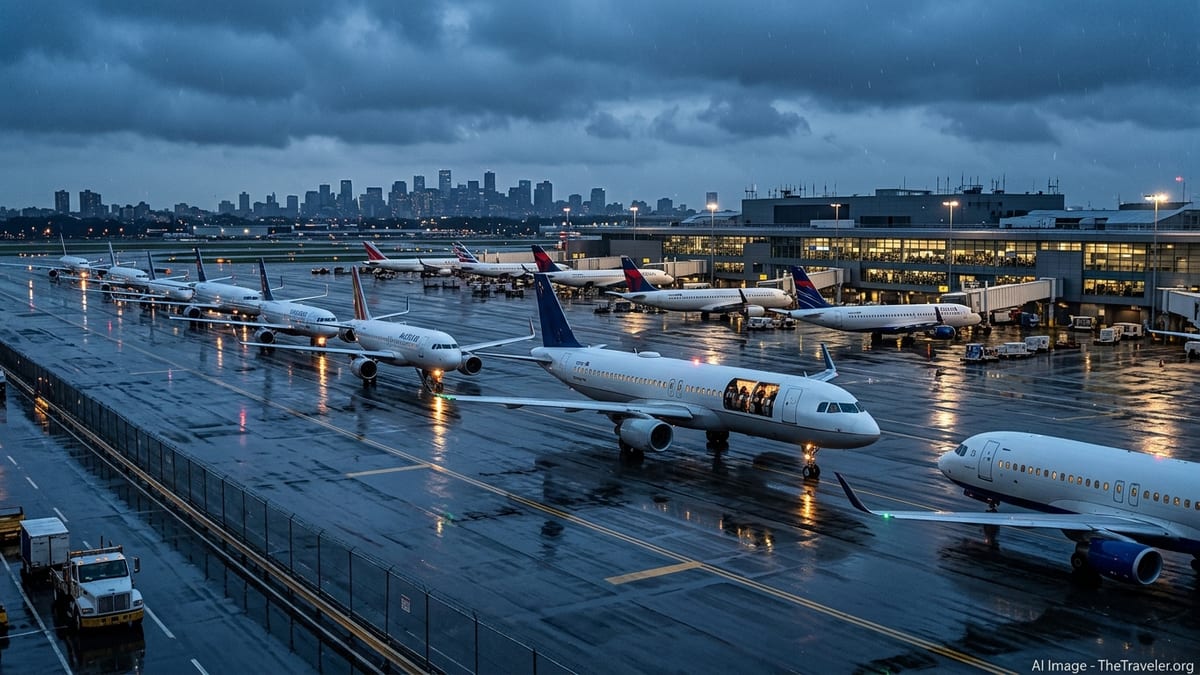
Data show extended tarmac delays climbing in 2026
Federal statistics indicate that 2026 is shaping up to be the worst year for extended tarmac delays since the U.S. Department of Transportation began enforcing strict limits on how long airlines can keep passengers on board without an opportunity to deplane. Monthly tarmac delay tables from the Bureau of Transportation Statistics, which list domestic flights held on the ground for more than three hours, show a clear uptick through September 2026 compared with the same period in 2024 and 2025, even as overall flight volumes remain similar.
While the detailed numbers for October and November are not yet published, partial-year data through September confirm that both the number of long delays and the share of flights affected are higher than at any point since the early years of the tarmac rule. Officials and independent analysts note that the vast majority of U.S. flights still operate without such extreme waits, but the recent increase has revived questions about how consistently the rule is being enforced and whether airlines and airports are doing enough to avoid preventable gridlock.
The rise in extended delays is especially pronounced at large, congested hubs in the Northeast, including airports serving the New York City region. These fields already operate near capacity during peak hours, and even modest disruptions can quickly cascade into long queues for departure and lengthy waits for gates on arrival, particularly when bad weather reduces the number of available runways or slows the rate at which air traffic control can safely handle flights.
How the tarmac delay rule works and what has changed on enforcement
The federal tarmac delay rule, introduced in 2010, requires most U.S. airlines to give domestic passengers the option to deplane after three hours on the tarmac and international passengers after four hours, with limited safety and security exceptions. Carriers must also provide food, drinking water, working lavatories and medical attention, as needed, after two hours of delay. Violations can trigger civil penalties running into tens of thousands of dollars per passenger on an affected aircraft, which prompted a sharp drop in lengthy delays soon after the rule came into force.
For much of the past decade, the Department of Transportation regularly opened investigations and levied fines when airlines allowed ground delays to run past the three or four hour limits without a valid exemption. The agency’s monthly Air Travel Consumer Reports still list every flight that crosses those thresholds, providing a public record of potential violations. Recent reports for 2026 continue to identify individual flights with tarmac times exceeding three hours, but so far there have been no corresponding public enforcement orders imposing penalties on U.S. airlines for these incidents.
In public statements following this month’s travel disruptions, Transportation Secretary Sean Duffy has argued that his department’s focus is on encouraging airlines and their contractors to address underlying causes of delays, including outdated technology and staffing constraints, rather than emphasizing fines. The department says it is continuing to investigate specific tarmac events and will take enforcement action where warranted by the facts and applicable law, but travelers currently have limited visibility into how those investigations are progressing or why some apparent violations do not lead to public penalties.
Inside the November 13 nationwide ground stop
The worst single disruption for U.S. air travel this year came on Friday, November 13, when the Federal Aviation Administration ordered a nationwide ground stop that halted departures at airports across the country. According to the agency’s question-and-answer summary and subsequent briefings from the Department of Transportation, a telecommunications failure linked to work on the FAA’s communications network destabilized systems that air traffic controllers use to communicate with pilots and monitor radar feeds.
The FAA says contractor L3Harris was carrying out a copper-to-fiber upgrade at a remote radio site in El Dorado, Arkansas, when a newly installed router began flooding the agency’s aging network with connection attempts. As the fault spread, communications and radar data at 17 of the nation’s 22 en route control centers became unreliable, prompting officials to impose a nationwide halt to departures “out of an abundance of caution” while they worked to isolate the problem and restore stable service. The ground stop lasted about four hours and 45 minutes before being gradually lifted that evening.
Federal summaries and airline filings indicate that roughly 12,000 flights were canceled on November 13, with thousands more delayed. Some reporting earlier suggested that more than 18,000 flights and around one million passengers were directly affected, but the FAA’s own tally of confirmed cancellations is lower, and the precise number of travelers caught up in the disruption remains an estimate. What is clear is that the outage created severe knock-on effects that extended into the weekend as airlines repositioned aircraft and crews, leaving some passengers facing multi-hour tarmac waits while operations were paused or slowly restarted.
Transportation Secretary Duffy has said publicly that investigators are still determining whether the root cause was a faulty piece of equipment or an installation error by the contractor. He has also stressed that there is no evidence of a cyberattack and that the incident highlights the vulnerability of older telecommunications infrastructure that the FAA is in the process of replacing. A Congressional research brief released on November 18 similarly concluded that the router failure during the upgrade exposed the risks of relying on legacy time-division multiplexing systems while transitioning to newer internet protocol-based networks.
System outages, airline tech failures and record holiday airfares
The November 13 ground stop has not been the only technology failure to hit air travelers this month. Within days of the FAA outage, United Airlines reported a widespread technology problem that disrupted its ability to dispatch aircraft and process passengers, and Delta Air Lines experienced an issue with its automated weight-and-balance system that led to delays across its domestic network. Those airline-specific events were shorter and more contained than the nationwide ground stop but added to a perception of fragility in the travel system at the outset of the holiday rush.
At the same time, travelers are paying more to fly. Data from airfare tracking services cited by U.S. media show that ticket prices for Thanksgiving and Christmas 2026 have reached their highest levels in about a decade, reflecting persistently elevated jet fuel costs and robust demand. One widely followed booking platform reported in late October that available flights over the Thanksgiving period were pricing about 39 percent higher than a year earlier, while searches for Christmas itineraries suggested a roughly 40 percent increase, with average advertised round-trip fares approaching the mid-$400 range for domestic routes.
Those pricing pressures appear to be tempering demand at the margins. The industry association Airlines for America has forecast that U.S. carriers will carry just under 29 million passengers over the 11-day Thanksgiving travel window this year, slightly below last year’s projection of about 31 million. By contrast, auto clubs expect continued strength in road travel, as some households opt to drive rather than shoulder higher airfares or risk becoming entangled in major airline or FAA system outages.
What this means for travelers over Thanksgiving and beyond
The convergence of higher long-tarmac-delay rates, infrastructure-related ground stops and record holiday ticket prices leaves U.S. air travelers with a more complicated risk calculus as they head into the busiest period of the year. Forecasts from the National Weather Service for the current Thanksgiving week highlight additional headwinds: low clouds, fog and rain along both coasts are expected to prompt intermittent ground stops and flow-control programs at major hubs, while a strengthening nor’easter could further disrupt operations at airports from Washington to Boston on Thanksgiving Day and into Friday.
Travelers have limited tools to completely avoid potential tarmac delays triggered by weather or rare nationwide outages, but there are steps that can reduce exposure. Flights early in the day are typically less vulnerable to knock-on disruptions, and nonstop itineraries avoid the risk of missed connections if the first leg is held on the ground. Passengers can also monitor the FAA’s real-time traffic management advisories and their airline’s mobile app for signs of emerging system problems, and should be prepared with basic supplies such as water, snacks and essential medications in their carry-on luggage in case they spend longer than planned on board.
Looking beyond the holiday period, multiple reviews and Congressional letters following the November 13 ground stop suggest that lawmakers will press the FAA and the Department of Transportation for detailed timelines and funding plans to modernize air traffic communications systems and reduce the chance of another nationwide halt. The department has pledged to complete a full investigation into the outage and to publish recommendations for infrastructure and procedural changes. For travelers, the key questions in the months ahead will be whether those reforms translate into fewer extreme tarmac delays and more resilience when technical problems occur, and whether regulators resume using their enforcement powers in visible ways when airlines fall short of existing passenger-protection rules.