


More news on this day
Thanksgiving week air travel is ramping up at Harrisburg International Airport, where officials are preparing for some of the busiest days of the year even as federal data show that roughly one in four flights to several Pennsylvania airports arrived late in 2026 through August.
Get the latest news straight to your inbox!
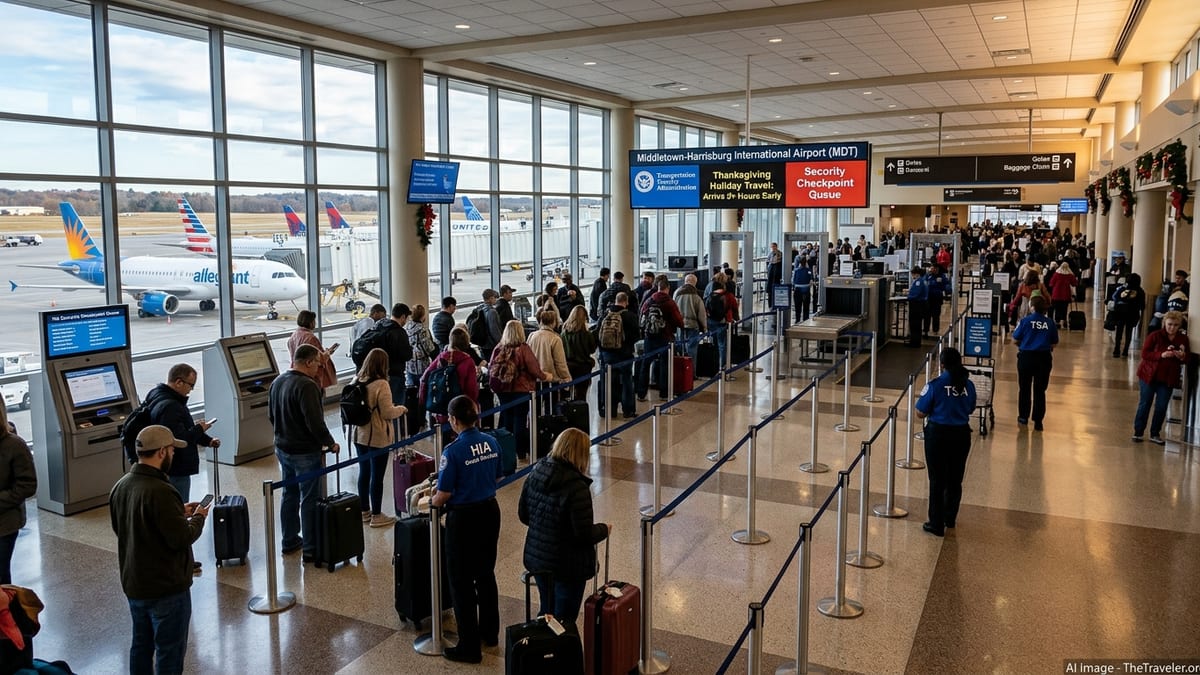
Harrisburg braces for one of its busiest Thanksgiving periods
On the day before Thanksgiving, Harrisburg International Airport in Middletown was already seeing traffic build in waves as early-morning departures gave way to steady mid-day crowds and a busy evening bank of flights. Airport spokesperson Scott Miller has said this could be the busiest Thanksgiving period HIA has seen, with passenger counts projected to edge a few percent above last year’s record levels as airlines add staff locally to handle the demand.
Harrisburg, served by Allegiant, American, Delta and United, is the primary commercial airport for south-central Pennsylvania and typically sees a spike in infrequent flyers around major holidays. Many of those travelers drive from across the Harrisburg–Lancaster–York region, using HIA specifically to avoid the longer drives and heavier crowds at Philadelphia and Baltimore/Washington. The increase in once- or twice-a-year flyers tends to put additional pressure on check-in, security and boarding processes, which the airport is trying to anticipate.
To manage the peak, HIA has scheduled additional staff throughout the Thanksgiving travel window, which broadly runs from Tuesday, November 24, through Monday, November 30, 2026, in line with the national Thanksgiving travel period defined by AAA. Extra personnel are positioned at airline check-in counters, security queue entrances and information points to help guide passengers unfamiliar with the layout or current security rules, with the aim of preventing bottlenecks before they form.
How Pennsylvania’s airports compare on 2026 delay rates
While the holiday period itself will not be fully reflected in federal statistics until later, data reported to the Bureau of Transportation Statistics for the first eight months of 2026 provide a snapshot of how reliably flights have been operating into Pennsylvania airports so far this year. An analysis of that BTS data, focused on airports with at least 1,000 arriving flights between January and August, shows that several of the state’s commercial airports have seen roughly one quarter of inbound flights arrive at least 15 minutes behind schedule.
Lehigh Valley International Airport posted the highest share of delayed arrivals among the Pennsylvania airports examined in the analysis, with about 26.7 percent of flights arriving late through August. Harrisburg International followed with a delay rate of about 24.4 percent of arrivals, narrowly ahead of Pittsburgh International at 24 percent, Wilkes-Barre/Scranton at 23.9 percent, and State College Regional at 23.5 percent. Philadelphia International, by far the state’s largest airport by passenger volume, recorded a lower share of delayed arrivals in the same period, at roughly 22.2 percent.
Because these figures aggregate thousands of individual flights across multiple airlines and months, they provide a broad look at performance rather than a day-by-day forecast. The same BTS datasets show variation from month to month depending on weather, air traffic control constraints and airline scheduling practices, and smaller airports can see percentage swings when a relatively small number of flights are hit by storms or operational disruptions. Nonetheless, the year-to-date ranking underscores that travelers using mid-sized Pennsylvania airports like Harrisburg and Lehigh Valley have encountered meaningful levels of delay in 2026 even before the late-November surge.
Thanksgiving 2026 travel outlook for Pennsylvania flyers
Nationwide, AAA projects that 81.5 million Americans will travel at least 50 miles from home between Tuesday, November 24 and Monday, November 30, 2026, a slight decrease from an estimated 81.6 million during Thanksgiving week in 2025. Of those, just under 6 million travelers are expected to fly on domestic routes, representing a small 0.2 percent dip compared with last year but still near record Thanksgiving air volumes. Federal Aviation Administration data seen this week also point to one of the busiest holiday air schedules in more than a decade, with more than 400,000 flights forecast nationwide over the broader Thanksgiving period.
In Pennsylvania, travel patterns generally track those national projections. Regional outlets citing AAA expect tens of thousands of residents from metropolitan areas such as Harrisburg, Scranton/Wilkes-Barre and the Lehigh Valley to travel for the holiday, with the vast majority going by car and a smaller but significant share flying. Local forecasts suggest that road traffic will be heaviest on the Tuesday and Wednesday before Thanksgiving, and again on the Sunday return, while airports anticipate their peak passenger numbers on the Wednesday before the holiday and the Sunday afterward.
Weather is an additional variable that can influence delay rates. Forecasts for Pennsylvania during the 2026 Thanksgiving period call for unsettled conditions, with rain and gusty winds expected on Thanksgiving Day itself in parts of the state, but comparatively calmer and seasonable weather on the busier departure and return days. Nationally, forecasters have warned that storms affecting the East Coast, Midwest and parts of the West could produce localized air traffic disruptions, although the impact on specific flights will depend on how conditions evolve during the week and how airlines adjust their schedules.
How Harrisburg and nearby hubs are preparing travelers
At Harrisburg International, officials are applying lessons from previous holiday peaks to try to keep passengers and flights moving. The airport has coordinated with its resident airlines and the Transportation Security Administration to staff more lanes during morning and late afternoon surges and to adjust shift patterns so that help is available at the times of day when lines typically grow longest. In addition to its own staff, HIA depends on airline contractors and federal security officers, which means planning begins weeks ahead of the Thanksgiving period.
Because a large share of holiday travelers are less familiar with current air travel procedures, staff at Harrisburg are emphasizing wayfinding and basic pre-trip preparation. Digital and in-terminal signage is being used to remind passengers about identification requirements, liquid and electronics screening rules and cut-off times for checked baggage. The airport and airlines are also encouraging travelers to arrive at least two hours before domestic departures during peak days, giving extra time for parking, shuttle transfers, bag drop and security screening.
Nearby hub airports that serve many central Pennsylvania residents, such as Philadelphia International and Baltimore/Washington International Thurgood Marshall, have put similar measures in place. BWI, for example, has reported that about 21.1 percent of arriving flights in the 2026 year-to-date period through August were delayed, slightly below the delay share at Harrisburg and Lehigh Valley but still affecting roughly one in five arrivals. For travelers driving from the Harrisburg region to use those larger hubs, the trade-off typically involves a wider choice of nonstop routes and potentially lower fares in exchange for longer ground travel times and heavier crowds at security.
What Pennsylvania travelers should do before heading to the airport
With delay rates across Pennsylvania’s commercial airports hovering around one in four arrivals so far this year and national forecasts pointing to very busy skies, travelers using Harrisburg and other regional airports over Thanksgiving are being urged to build flexibility into their plans. Airports, airlines and travel organizations are largely aligned in advising passengers to rely on their airline’s mobile app for the most current information on check-in times, gate changes, delays and rebooking options. Those apps draw directly from airline operations systems and can often alert passengers to changes before they appear on terminal flight information displays.
Passengers are also being encouraged to double-check reservation details, baggage allowances and identification requirements at least a day before travel, and to monitor weather along their routing, particularly if they are connecting through major hubs where storms can have cascading effects. For early-morning departures from Harrisburg and other regional airports, arriving well before sunrise has become a common recommendation, as security lines can form quickly when several flights are scheduled to leave within a tight window.
Looking beyond the Thanksgiving period, the on-time performance statistics for the first eight months of 2026 provide a baseline that travelers and airport managers alike will be watching as the year’s final data become available. If fall and early winter continue to bring heavy travel volumes and periodic weather disruptions, the year-end picture for Pennsylvania’s airports could show delay rates holding near current levels or shifting depending on how airlines and regulators manage capacity and staffing. For now, the practical guidance remains the same for Thanksgiving week flyers out of Harrisburg and other Pennsylvania airports: check flight status frequently, use airline and airport tools, allow extra time at each step of the journey and be prepared for conditions that are busier, but not dramatically different, from last year.