


More news on this day
Delta Air Lines says it has restored the automated system used to calculate aircraft weight and balance after an outage on Sunday, November 22, 2026, forced a brief FAA ground stop into Atlanta and delayed thousands of flights across the carrier’s U.S. network at the start of the busy Thanksgiving travel period.
Get the latest news straight to your inbox!
What happened to Delta’s weight and balance system
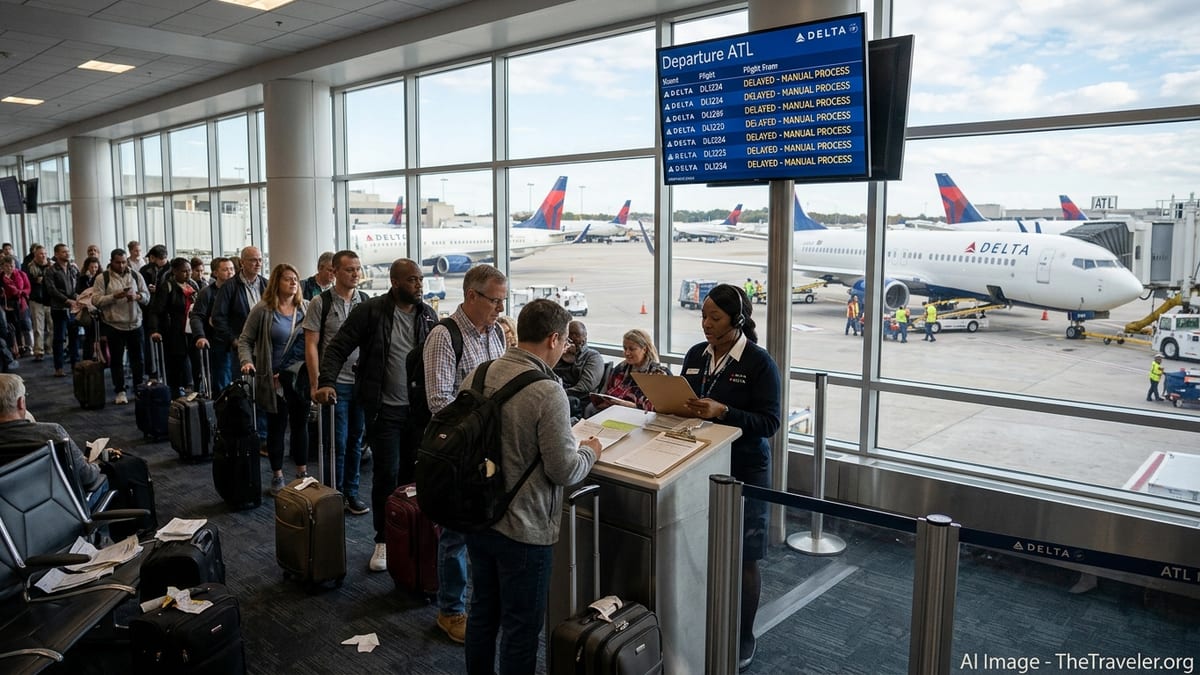
Delta’s disruption began early on Sunday, November 22, when the airline’s automated system for calculating aircraft weight and balance stopped working properly. The tool, sometimes described as a load or weight‑and‑balance automation system, generates key figures that pilots and dispatchers use before every departure, including how passengers, baggage and cargo are distributed on board. When the system went offline, Delta was unable to automatically produce these calculations for many flights and had to fall back on manual processes.
In a statement issued later on Sunday, the airline said it was “working to resolve issues with the airline’s weight and balance automation system” and confirmed that the outage affected operations across its network, not only at its Atlanta hub. By the afternoon, Delta reported that the automation system had been restored and stressed that the issue was not related to any Federal Aviation Administration air traffic control systems. The carrier also said there was no indication of a cyberattack.
Because weight‑and‑balance compliance is a core safety requirement, aircraft cannot depart until correct figures are confirmed. With automation unavailable, Delta teams at multiple airports had to verify individual loads by hand, sometimes counting bags and re‑issuing documentation before each take‑off. That process significantly slowed departures even after the underlying technology problem was fixed, as crews worked through a backlog of flights and repositioned aircraft and staff around the network.
Impact on Atlanta, the FAA and nationwide operations
The outage was most visible at Hartsfield‑Jackson Atlanta International Airport, Delta’s main hub and one of the world’s busiest airports. On Sunday morning, at Delta’s request, the FAA briefly halted Delta flights bound for Atlanta while the airline assessed the problem with its weight‑and‑balance automation. The nationwide ground stop for Delta’s Atlanta‑bound traffic lasted for roughly an hour before being replaced by a ground delay program that allowed flights to depart at controlled intervals, typically with average delays of around an hour.
Flight‑tracking data indicated that the knock‑on effects were substantial. By Sunday afternoon, thousands of Delta and Delta Connection flights had been delayed across the United States, with Atlanta, New York LaGuardia and other Delta hubs particularly affected. Some accounts put the number of delayed flights at more than 3,000 across the day, with several hundred cancellations as aircraft and crews ended up out of position. Delta later estimated that around 70 percent of its Sunday delays and cancellations were directly linked to the automation outage, with the remainder caused by existing weather issues and air traffic control constraints, particularly in the Northeast.
Although the FAA’s initial advisory applied to flights headed to Atlanta, the operational impact spread well beyond that airport. Long lines formed at check‑in and security at several Delta stations as passengers tried to rebook or obtain information, and aircraft arriving at outstations sometimes could not depart again until revised load paperwork was available. Even after the FAA lifted the Delta‑specific restrictions into Atlanta late on Sunday morning, the cumulative effect of earlier ground stops, manual calculations and crew duty time limits continued to disrupt schedules throughout the afternoon and evening.
How the disruption affected travelers
For passengers, the timing could hardly have been worse. The outage struck at the start of the Thanksgiving travel rush, traditionally one of the busiest periods of the year for U.S. airlines. Many travelers reported being held on board aircraft awaiting final weight‑and‑balance figures, while others faced long waits at gates as departure times repeatedly slipped. In some cases, flights already boarded were eventually cancelled when delays pushed crews beyond their regulated duty limits or when connecting aircraft and pilots could not reach their next assignments.
Delta said it was working with affected customers to provide rebooking options and that it would offer meal vouchers and hotel accommodations where required by the length and timing of delays. The airline also confirmed that passengers whose flights were cancelled or significantly changed could request refunds if they chose not to travel. Travelers whose trips involved tight connections, especially through Atlanta, were urged to monitor their itineraries closely and make use of self‑service tools in the airline’s app and on its website to secure alternative routes.
Operationally, the disruption extended beyond Sunday. Travel on Monday, November 23, was described as “mostly back on track” by some aviation outlets, but residual delays and aircraft rotations were still being cleared. Some passengers reported ongoing hold‑ups on Monday as dispatchers continued to handle weight‑and‑balance tasks more manually on certain flights and as airports handled the backlog of aircraft awaiting gates, catering and baggage handling after the concentrated delays the previous day.
Recent pattern of U.S. aviation tech outages
The Delta incident came in the middle of a difficult fortnight for U.S. aviation technology systems. On Friday, November 13, a malfunction in the FAA’s own network infrastructure prompted a rare nationwide ground stop affecting all carriers. While flights gradually resumed later that day, the agency’s halt to departures produced thousands of cancellations and delays, and airlines spent much of the following weekend repositioning aircraft and crews. U.S. officials later said that the November 13 failure involved FAA equipment and that there was no evidence of a cyberattack.
Just three days after the FAA event, on Monday, November 16, United Airlines experienced a separate system outage that disrupted its operations. According to communications from the union representing United pilots and subsequent airline statements, that incident interfered with crew messaging and the flow of final aircraft weight and balance information to flight decks. Departures were paused while the company restored its systems, leading to hundreds of delayed flights before operations normalized later the same day. Regulators emphasized that the United outage, like Delta’s later problem, was tied to airline technology rather than federal air traffic control systems.
Together, these events have raised questions among regulators and airline executives about the resilience of critical aviation IT infrastructure. Airlines, the FAA and other stakeholders are already engaged in multi‑year modernization programs, but the recent sequence of failures has underscored how dependent day‑to‑day operations have become on complex, interconnected software platforms. For travelers, the main consequence is increased uncertainty: while such outages remain infrequent compared with the overall volume of flights, a single failure in a key system can now disrupt thousands of journeys within hours.
What travelers should do next and how long effects may linger
By Monday, November 23, Delta and the FAA both described operations as stabilized, with no ongoing ground stop or special delay program in place for Atlanta‑bound Delta flights. Flight‑tracking data showed that while some residual delays persisted into Monday, they were gradually diminishing as aircraft and crew rotations returned to normal. For most travelers booked on Delta or its regional partners later in the Thanksgiving week, the airline now expects to operate its regular schedule, subject to usual weather and air traffic constraints.
Passengers travelling in the days immediately following the outage should nevertheless take some precautions. Anyone scheduled to connect through Atlanta or other Delta hubs is advised to check their flight status frequently, paying particular attention to aircraft type or flight number changes that might indicate rerouted equipment or crew. Travelers with flexible plans may want to allow extra connection time or choose earlier departures where available, in case lingering schedule adjustments or adverse weather add new delays on top of an already busy holiday timetable.
Those who were directly affected on November 22 and 23 and who have not yet rebooked or requested compensation should review Delta’s current policies for irregular operations. In previous disruptions, the airline has typically allowed fee‑free changes within a defined travel window for itineraries touching affected airports, as well as refund options where flights were cancelled. Because policies can vary by fare type and route and may be updated as recovery progresses, travelers should verify the latest rules directly with the airline or through official booking channels rather than relying on outdated information. For now, Delta’s weight and balance automation has been restored, but the episode is a reminder that even routine pre‑flight calculations can become a critical vulnerability when the systems that support them fail.