


More news on this day
An Amtrak passenger stranded after a train lost power in a tunnel during a heatwave has criticized the company for failing to provide clear answers about what went wrong or when travelers would be able to leave, adding fresh scrutiny to how the national rail operator communicates with customers during service disruptions.
Get the latest news straight to your inbox!
Power Failure Leaves Train Stuck in Baltimore Tunnel
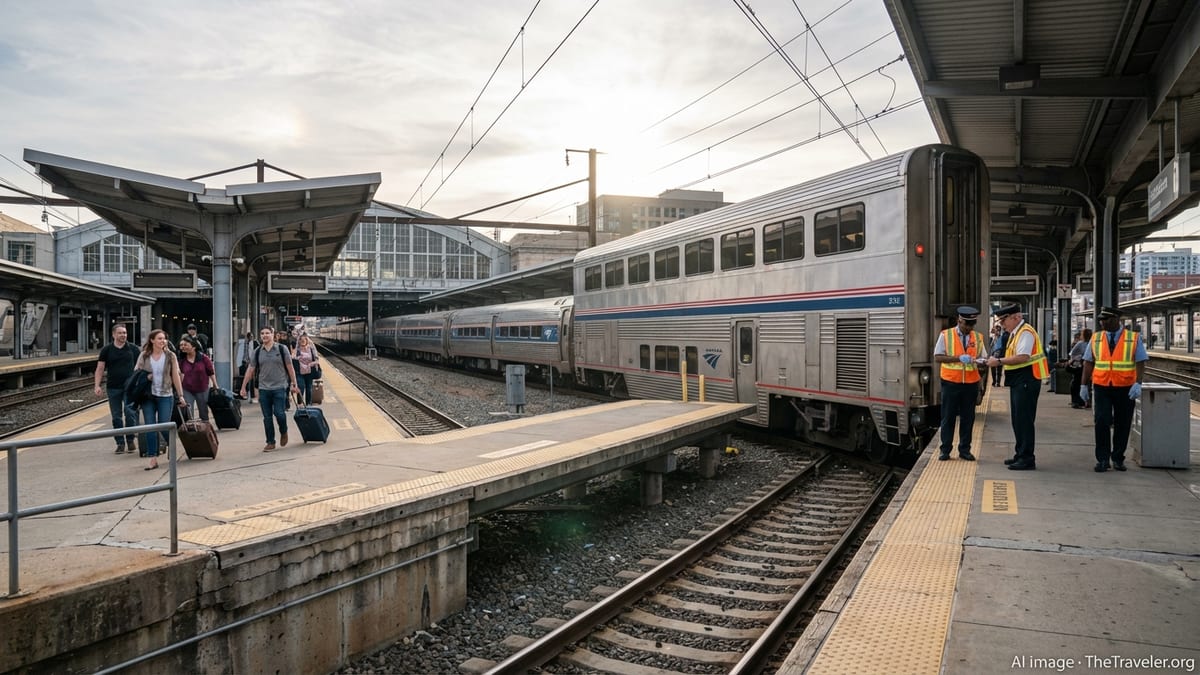
According to regional television coverage and travel industry reporting, a northeast-bound Amtrak train lost power in a tunnel near Baltimore Penn Station during a summer heatwave, leaving passengers in the dark without air conditioning for more than an hour. The train, identified in local reports as a Boston-bound regional service, came to a halt shortly after departing Baltimore, triggering emergency lighting as traction power and onboard systems cut out.
Passengers described a sudden stop followed by a sharp rise in temperature inside several cars. Publicly available accounts indicate that some riders initially believed the delay was routine until it became clear that the train had suffered a major power issue and was unable to move under its own power. As the outage stretched on, riders waited underground while crews assessed options to either restore power or evacuate the train.
Emergency responders and railroad personnel ultimately led passengers out of the tunnel and back toward the station area. Reports indicate that the evacuation required people to walk along the track bed, a scenario that can be disorienting and uncomfortable, especially in high heat and low light. No serious injuries were reported, but the disruption derailed travel plans for many riders who had expected a straightforward trip along the busy Northeast Corridor.
Passenger Says Answers Were Confusing and Incomplete
One passenger whose experience has circulated widely on social media and in follow-up coverage said the most stressful part of the incident was not the heat or the darkness, but the lack of clear information from Amtrak. The rider, identified only by first name in broadcast reports, said announcements on board were infrequent and vague, leaving many on the train unsure whether they were facing a minor delay or a more serious breakdown.
Public comments attributed to this passenger suggest that travelers received only short, general updates indicating that the crew was waiting for instructions, without specific estimates for how long they might remain in the tunnel or what the next steps would be. In interviews cited by local outlets, the rider said that when passengers asked staff directly what was happening, the answers were often tentative or contradictory.
The passenger has argued that, in a confined space with rising temperatures and anxious travelers, the company owed riders more precise explanations about safety, timing and alternative arrangements. These complaints mirror frustrations voiced after other Amtrak disruptions in recent years, when stranded riders have said they felt left in the dark while crews and dispatchers worked behind the scenes to solve complex operational problems.
Communication Gaps Echo Earlier Amtrak Disruptions
The Baltimore power-loss incident follows several high-profile cases in which Amtrak passengers were stranded for extended periods and later criticized the flow of information from the company. In April 2026, riders on the Silver Meteor in Florida reported being stuck for nearly a full day after wildfires shut down key stretches of track, describing long stretches with only minimal updates about when the train might move again or whether buses or hotels would be arranged.
In other cases documented by local television stations and national outlets, Amtrak trains stalled for hours due to downed overhead wires or power problems in the Northeast, leaving travelers in cold or unheated cars. In those events, passengers similarly complained that they did not receive clear or timely explanations, and in some instances said they turned to social media or news sites in an effort to learn more about their own train.
Rail advocates note that any long-distance disruption involves multiple parties, including host freight railroads, power utilities and emergency agencies, which can complicate the task of delivering precise estimates while a situation is still evolving. Even so, critics argue that communication lapses have become a recurring feature of Amtrak service disruptions, fueling frustration even when the underlying cause, such as wildfires or extreme weather, is beyond the company’s direct control.
What Amtrak’s Own Standards Say About Customer Updates
Amtrak’s publicly available service manuals and training documents emphasize the importance of regular customer announcements during delays, instructing crews to provide clear explanations when a train is stopped and to update passengers at set intervals even if there is little new information to share. These standards highlight communication as a core part of the onboard service role, alongside safety duties and ticketing.
The manuals outline sample announcement language for unexpected stops, advising conductors to explain the nature of the delay where possible and to give approximate timelines or next steps. They also encourage staff to move through the train and answer individual questions when conditions allow, particularly during extended disruptions that may leave passengers anxious about missed connections or overnight stays.
Advocates who have reviewed these documents point out that the gap between written standards and passengers’ lived experiences can be stark. In incidents such as the Baltimore tunnel power loss, riders’ complaints about vague or infrequent updates suggest that best practices were difficult to maintain amid operational uncertainty and the practical challenges of managing a stranded train in a confined space.
Growing Pressure for Better Resilience and Transparency
The Baltimore incident underscores broader concerns about the resilience of the Northeast Corridor, where intense heat, aging infrastructure and complex power systems can combine to create cascading disruption. Industry analysts say that while full power failures are relatively rare compared with routine delays, even short outages can be highly disruptive when they occur in tunnels or on bridges with limited evacuation options.
Passenger advocates are calling for more robust contingency planning that treats communication as a critical safety and service issue rather than an afterthought. Proposals circulating among rider groups include standardized update intervals during outages, clearer information about when passengers might be allowed to disembark and pre-planned coordination with local agencies for evacuations in tunnels or other constrained locations.
For the passenger who felt stranded without answers in the Baltimore tunnel, the central question is whether Amtrak will treat episodes like this as learning opportunities. Public comments from travelers affected by recent power failures and wildfire disruptions suggest a growing expectation that, even when infrastructure fails, rail operators should provide riders with prompt, specific and candid information about what is happening and how they plan to get everyone moving again.