


More news on this day
Air travel across Asia and the Middle East has been hit by a new wave of disruption, with publicly available tracking data indicating at least 621 cancellations and more than 5,000 delays in a 24 hour window at major hubs from Tokyo to Doha.
Get the latest news straight to your inbox!
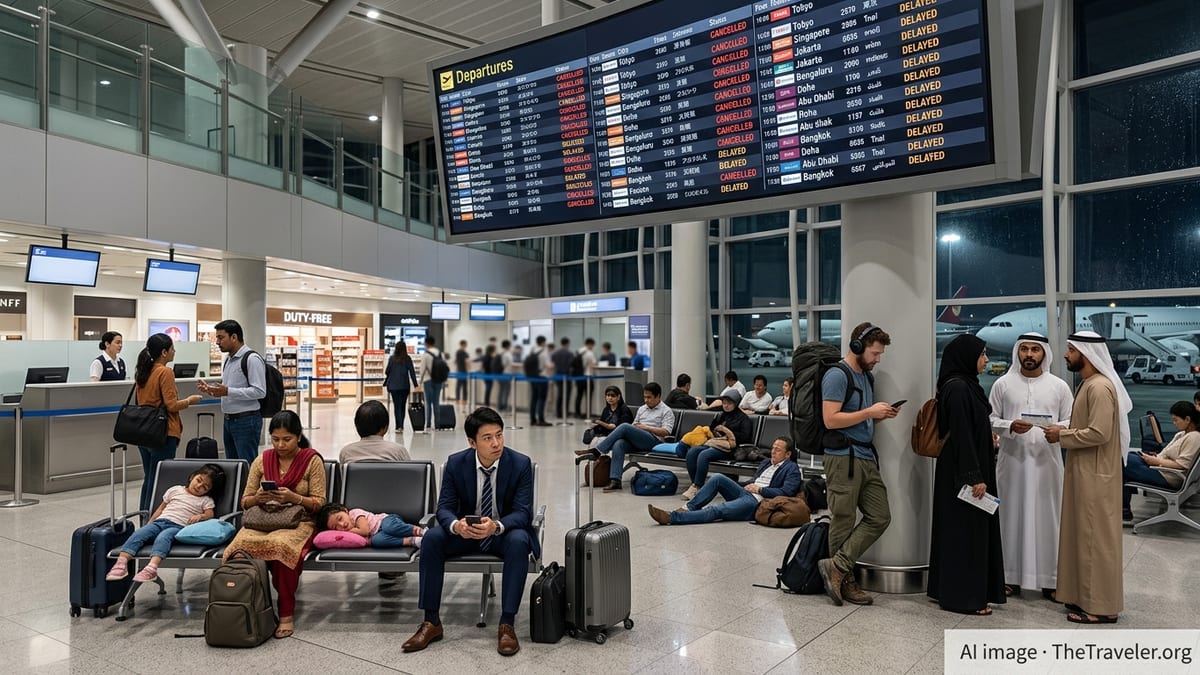
Major Hubs From Tokyo To Doha Struggle To Keep Schedules
Published coverage of the disruption points to a broad swath of airports affected across Japan, Indonesia, the Philippines, Qatar and Lebanon, along with secondary hubs in mainland China. The pattern mirrors earlier episodes where clustered operational problems in one region quickly triggered knock-on delays across entire networks.
In Japan, flight boards at key gateways such as Tokyo show a higher than usual share of services either cancelled or heavily delayed, touching both domestic and regional routes. Japanese and foreign carriers operating dense shuttle schedules between Tokyo and other Asian cities face particular challenges when even a small number of rotations fall out of sync.
Similar strains are visible at Jakarta’s Soekarno Hatta International Airport, where Indonesian and regional low-cost carriers feed an extensive domestic network. When early morning departures slip, aircraft and crews often miss later connections, resulting in a cascade of delays that can extend well into the night.
Further south and east, Manila’s already congested Ninoy Aquino International Airport is once again contending with a compressed schedule, with regional coverage indicating a build-up of delayed departures on routes to Japan, Hong Kong and Southeast Asian points. Limited runway capacity and tight turnaround times amplify the impact of each disruption.
Shenzhen, Doha And Beirut Highlight Network Vulnerabilities
The disruption is not confined to the primary capitals. In China’s Greater Bay Area, Shenzhen Bao’an International Airport has seen fresh irregularities after previous days of heavy delays and cancellations. Reports indicate that dense short-haul traffic from Shenzhen to Japan, South Korea and Southeast Asia is especially exposed when weather or airspace constraints reduce usable capacity.
In the Gulf, Doha’s Hamad International Airport remains a critical junction for Asia bound and Europe bound connections. When a wave of delayed arrivals from Asian cities converges on Doha, banks of onward departures can be held back, pushing wider itineraries off schedule. Publicly available information from regional media and airline travel alerts continues to stress that schedules remain subject to short-notice changes for operational and regulatory reasons.
Beirut’s Rafic Hariri International Airport is also feeling the ripple effects. While Lebanon is not among the region’s largest aviation markets, it sits on important east west corridors linking the Gulf, Turkey and Europe. Cancellations and missed connections at partner hubs can leave aircraft and crews out of position, thinning frequencies and reducing options for travelers attempting to rebook.
Taken together, these pressure points illustrate how closely interconnected Asia’s and the Middle East’s aviation systems have become. A cluster of cancellations in one market can quickly reverberate through seemingly distant airports as aircraft circulate through multi-leg rotations.
Low Cost And Full Service Airlines Both Caught In The Turmoil
The latest wave of disruption is affecting a broad mix of carriers, from low cost specialists to long haul network airlines. Publicly available tracking sites show irregular operations touching airlines such as Shenzhen based operators, FlyDubai, AirAsia group carriers and Garuda Indonesia, alongside the region’s larger flag carriers.
For low cost airlines built on rapid turnarounds and high daily aircraft utilization, even modest ground delays can upend scheduling assumptions. AirAsia units serving Manila, Jakarta and secondary Chinese cities are particularly exposed when overnight curfews or slot constraints prevent late-running flights from operating, turning a delay into a cancellation.
Garuda Indonesia and other full service airlines face different but related pressures. Their role in feeding long haul services means a cancelled domestic segment can strand passengers who intended to connect onto international routes. When this occurs at times of already constrained capacity, rebooking options can become scarce, especially on popular trunk routes around holidays and peak summer travel periods.
Carriers such as FlyDubai, which bridge South and Southeast Asia with the Gulf, are often caught between upstream disruptions at Asian origin airports and downstream constraints at congested Middle Eastern hubs. When both ends of the route are affected on the same day, on-time performance can deteriorate sharply.
Travelers Face Long Queues, Tight Rebookings And Changing Rules
For passengers, the statistics of 621 cancellations and more than 5,000 delays translate into missed events, disrupted holidays and complex rebooking challenges. Social media posts and traveler forums in recent days describe long queues at customer service desks and shifting information on new departure times, particularly at Manila, Jakarta and major Chinese airports feeding into regional hubs.
Publicly available guidance from airlines in the region continues to emphasize the importance of checking flight status repeatedly before heading to the airport. Many carriers are steering travelers toward mobile apps and websites for same day updates, as airport call centers and counters struggle to manage surging demand for assistance during disruption peaks.
At the same time, changing rules and varying policies across jurisdictions add to passenger confusion. Compensation and rerouting rights differ substantially between domestic flights within Asia and international services governed by foreign consumer regulations. Reports from consumer-rights organizations indicate a rise in inquiries from travelers trying to understand whether they are entitled to refunds, rebooking on other airlines, or only travel vouchers.
In practical terms, passengers with time-sensitive travel plans are increasingly advised by published travel commentary to build additional buffer time into itineraries involving tight connections through hubs such as Tokyo, Doha or major Southeast Asian gateways when regional systems are under obvious strain.
Operational And External Factors Combine Behind The Numbers
Analysts following the region’s aviation sector point to a familiar mix of triggers behind the latest wave of disruption. Seasonal storms in parts of East and Southeast Asia, periodic air traffic control restrictions, and lingering aircraft and crew shortages continue to intersect in ways that magnify day-to-day operational issues.
Recent reporting from business and aviation outlets has also highlighted the impact of higher fuel prices and cost containment efforts on scheduling resilience. Airlines that operate with minimal spare capacity have less flexibility to insert backup aircraft or extend operating hours when delays accumulate across their networks.
Infrastructure constraints play a parallel role. Several of the airports most affected by the current pattern of delays, including Manila and Jakarta, have long been flagged in regional assessments for congestion and limited runway capacity relative to demand growth. Even incremental increases in traffic can stretch these facilities close to saturation during peak periods.
While the precise mix of causes varies by airport and carrier, the combined effect is clear in the aggregated data: hundreds of cancellations and thousands of delays concentrated in a short window, touching travelers across Asia and the Middle East and underscoring the fragility of tightly optimized flight schedules when multiple stress factors collide.