


More news on this day
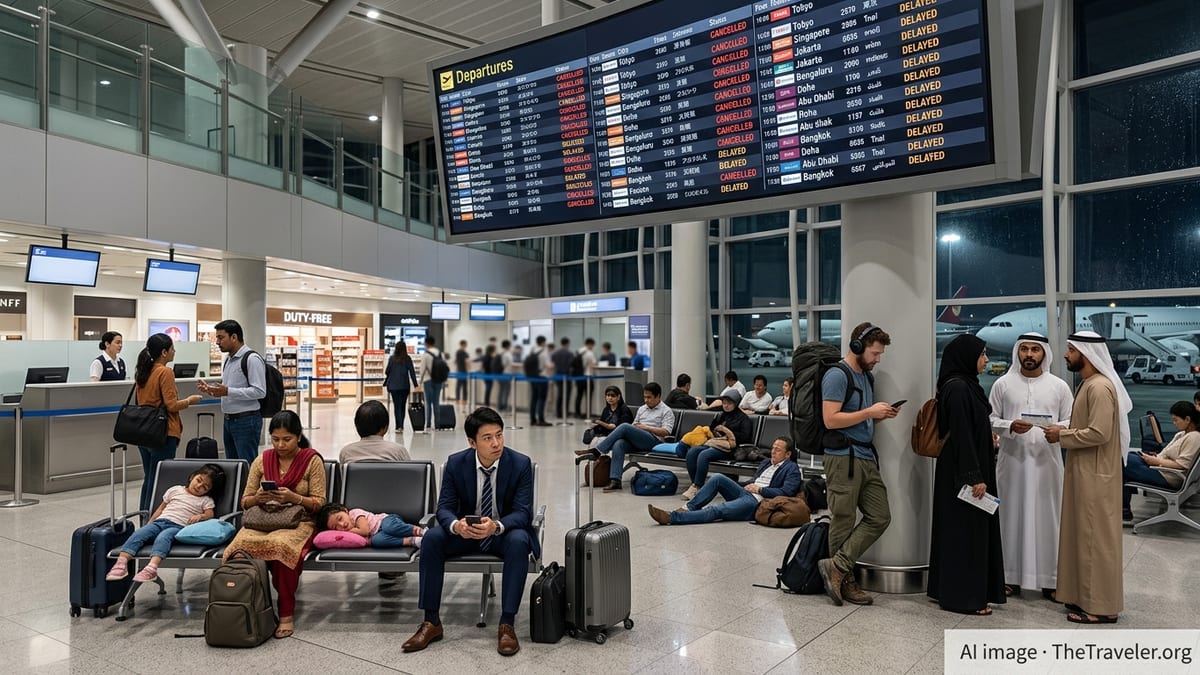
Hundreds of passengers across Asia and the Middle East are facing severe disruption as publicly available flight-tracking data and regional aviation reports point to at least 223 cancellations and more than 2,400 delays affecting services through Bali, Erbil, Shanghai, Larnaca, Singapore, Hong Kong and other major hubs.
Get the latest news straight to your inbox!
Multiple Hubs See Sudden Wave of Cancellations
Aggregated figures compiled from aviation monitoring platforms and regional media coverage indicate that flight operations across several Asian and Middle Eastern hubs deteriorated sharply over the past 24 hours. Indonesia, Iraq, China, Cyprus and Hong Kong feature prominently in the disruption data, with cancellations and late departures clustered at Ngurah Rai International Airport in Bali, Erbil International Airport, Shanghai’s major airports, Larnaca in Cyprus, Singapore Changi and Hong Kong International.
The disruption footprint cuts across both domestic and international networks. In Indonesia, Bali’s role as a leisure and transit gateway means cancellations there immediately reverberate onto long-haul itineraries linking Australia, Europe and North America. In Iraq, schedule cuts at Erbil interrupt both regional business traffic and the growing segment of connecting passengers using the city as a niche transfer point.
China’s and Hong Kong’s involvement adds a further layer of complexity. Recent records of weather-related disruption and airspace constraints in China have already produced days with dozens of cancellations and more than a thousand delays, and today’s numbers follow that pattern. Similar pressure on Hong Kong’s tightly scheduled hub operation appears to be contributing to rolling knock-on delays across the wider network.
In the Mediterranean, Cyprus is featuring in disruption tallies through flight changes at Larnaca, a key leisure entry point for travelers from the Middle East and Europe. Even a limited number of cancellations there can create bottlenecks as aircraft and crews are repositioned to protect higher-priority rotations.
Airlines from Low-Cost to Full-Service Caught Up
The current wave of irregular operations is hitting a diverse mix of carriers, spanning large low-cost groups and full-service airlines. Publicly accessible schedules and tracking data show IndiGo and AirAsia affected on dense short-haul routes within South and Southeast Asia, where tight turnarounds leave little room for recovery when aircraft or crews are delayed.
Full-service airlines including Qatar Airways and Garuda Indonesia are also heavily exposed. Long-haul flights connecting through Bali, Singapore and Gulf hubs rely on precise timing of inbound feeders, and even a modest delay on a preceding sector can push widebody departures outside their assigned slots. Travel-industry commentary in recent weeks has highlighted how these complex networks can see a single cancellation cascade into missed connections for hundreds of passengers on multi-stop itineraries.
Smaller and regional operators, such as Sky Angkor Airlines and other niche carriers serving secondary Asian cities, appear in the disruption data as well. For these airlines, a cancelled rotation represents a much larger share of daily capacity, increasing the difficulty of offering same-day reaccommodation when aircraft utilization is already high.
Recent analyses in aviation trade publications have also pointed to rising fuel costs and shifting airspace patterns as structural headwinds for airlines in the region. Carriers are trimming marginal routes, adjusting frequencies and, in some cases, consolidating services, which can intensify passenger impact when irregular operations strike already-lean schedules.
Weather, Airspace and Operational Strain as Key Drivers
Several overlapping factors appear to be driving the latest cluster of cancellations and delays. Weather remains a significant trigger in parts of China and Southeast Asia, where fast-moving systems have previously resulted in dozens of cancellations and more than a thousand delays in a single day. Today’s figures echo those earlier patterns, with storms and reduced visibility periodically constraining runway capacity.
Airspace limitations across portions of the Middle East and surrounding regions are also influencing flight planning. Industry reports in recent months have described reroutings around sensitive airspace over and near Iraq and neighboring states, pushing airlines to fly longer paths that consume more fuel and narrow schedule margins. When such detours converge with already busy traffic flows at hubs like Doha, Singapore or Hong Kong, airlines have less flexibility to absorb additional delays.
Operational strain at major hubs compounds these primary triggers. At airports such as Shanghai and Singapore, high utilization of runway and gate infrastructure means disruptions early in the day tend to propagate into later departure banks. Travel-industry analysis frequently notes that Asia’s large connecting hubs are particularly vulnerable to what experts describe as delay-heavy disruption profiles, where a relatively small number of initial cancellations are accompanied by thousands of late departures.
In addition, ongoing fleet and crew realignments across multiple airlines are still working through networks as carriers respond to changing demand patterns. Some operators are introducing new aircraft types or reassigning older jets to different routes, and public schedule data suggests that these transitions occasionally lead to last-minute swap-outs or frequency reductions that manifest as cancellations in daily tallies.
Knock-On Impact for Travelers Across the Region
For passengers, the practical impact of 223 cancellations and more than 2,400 delays is being felt in missed connections, forced overnights and rebooked itineraries spreading across several days. Data from earlier disruption events this year shows that even when only a fraction of daily flights are cancelled outright, the concentration of delays can create congested terminals, long queues at service desks and pressure on limited hotel availability near airports.
Travel advisories published by consumer-rights organizations and aviation compensation specialists in recent months have emphasized the importance for affected passengers of retaining boarding passes, booking confirmations and any written notices of schedule changes. These records can be important when seeking refunds, credits or alternative transport under airline policies or, where applicable, regional consumer-protection frameworks.
Publicly available guidance also suggests that travelers consider checking real-time information on both departure and arrival airports, rather than relying solely on an airline’s app or website. On disruption-heavy days, airport departure boards and independent tracking platforms can show rolling changes to gate assignments, estimated departure times and, in some cases, newly announced cancellations.
Travel planners in the region have increasingly recommended building longer connection buffers when itineraries pass through busy Asian hubs such as Singapore, Hong Kong, Shanghai or Bali, especially during peak holiday periods. The current wave of irregular operations illustrates how quickly tight connections can unravel when multiple airports simultaneously experience weather, airspace or operational constraints.
Outlook: Continued Volatility Through Peak Travel Season
Looking ahead, industry commentary suggests that volatility is likely to persist across Asian and Middle Eastern networks as the northern summer travel season intensifies. Demand for leisure travel to Indonesia, Cyprus and other Mediterranean and Indian Ocean destinations remains strong, while business and visiting-friends-and-relatives traffic through hubs in China, Singapore and the Gulf continues to rebuild.
At the same time, regional aviation analyses highlight that airspace restrictions, elevated fuel prices and infrastructure constraints at several major airports leave limited headroom for irregular operations. Even incremental weather events or localized technical issues can therefore trigger the kind of multi-country disruption profile currently visible in daily statistics.
Some airlines have begun to adapt by adjusting schedules, adding recovery time between rotations or selectively reducing frequencies on less profitable routes to preserve resilience on core services. However, published performance data from recent months indicates that cancellation and delay rates across Asia remain above pre-pandemic norms on many days, especially during peak travel periods and in regions affected by geopolitical or weather-related airspace concerns.
For travelers planning journeys that touch Bali, Erbil, Shanghai, Larnaca, Singapore, Hong Kong or other regional hubs in the coming weeks, the prevailing advice from publicly available guidance is to monitor flight status closely, allow generous connection times and be prepared for itinerary changes as airlines and airports work through another period of elevated operational stress.