


More news on this day
Typhoon Dolphin has triggered major air travel disruption across East Asia, with airports in Japan, China and the wider region canceling or delaying hundreds of flights and leaving tens of thousands of passengers facing extended delays and last-minute itinerary changes.
Get the latest news straight to your inbox!
Storm Marches From Okinawa to China’s Eastern Seaboard
The latest disturbance began late last week as Typhoon Dolphin moved across Japan’s southern islands, forcing a shutdown of operations at Okinawa’s main airport and grounding flights into and out of the tourism-dependent prefecture. Published reports indicate that all services at Naha Airport were halted for extended periods as strong winds and heavy rain made operations unsafe.
As the system tracked west-northwest over the East China Sea, airlines across the region introduced rolling cancellations and schedule changes. Carriers serving Okinawa, including Japanese domestic operators, began announcing preemptive cancellations from August 6 onward, advising travelers to rebook or delay nonessential trips. Social media posts and airline advisories show passengers scrambling to secure alternative connections via Kyushu and mainland Japan.
By the weekend, meteorological bulletins described Dolphin as a high-end Category 1 to Category 2-equivalent typhoon as it passed the Ryukyu Islands, before intensifying again over open water. Forecasts showed a likely landfall on the eastern coast of China, setting the stage for a much larger wave of aviation disruption centered on Shanghai and neighboring provinces.
Shanghai Airports Cancel Hundreds of Flights
The most severe aviation impact so far has been recorded in eastern China, where Shanghai’s two major airports have seen large-scale cancellations. According to publicly available information from local airport operators and published coverage by international news agencies, more than 1,300 flights were canceled over the weekend as Dolphin approached the Yangtze River Delta.
Operations were further reduced on Monday as the storm, downgraded to a tropical storm after landfall, continued to dump heavy rain across the region. Additional cancellations and delays were reported at Shanghai Pudong and Hongqiao, as well as at regional airports in Zhejiang and neighboring provinces, with carriers citing continued adverse weather and operational constraints.
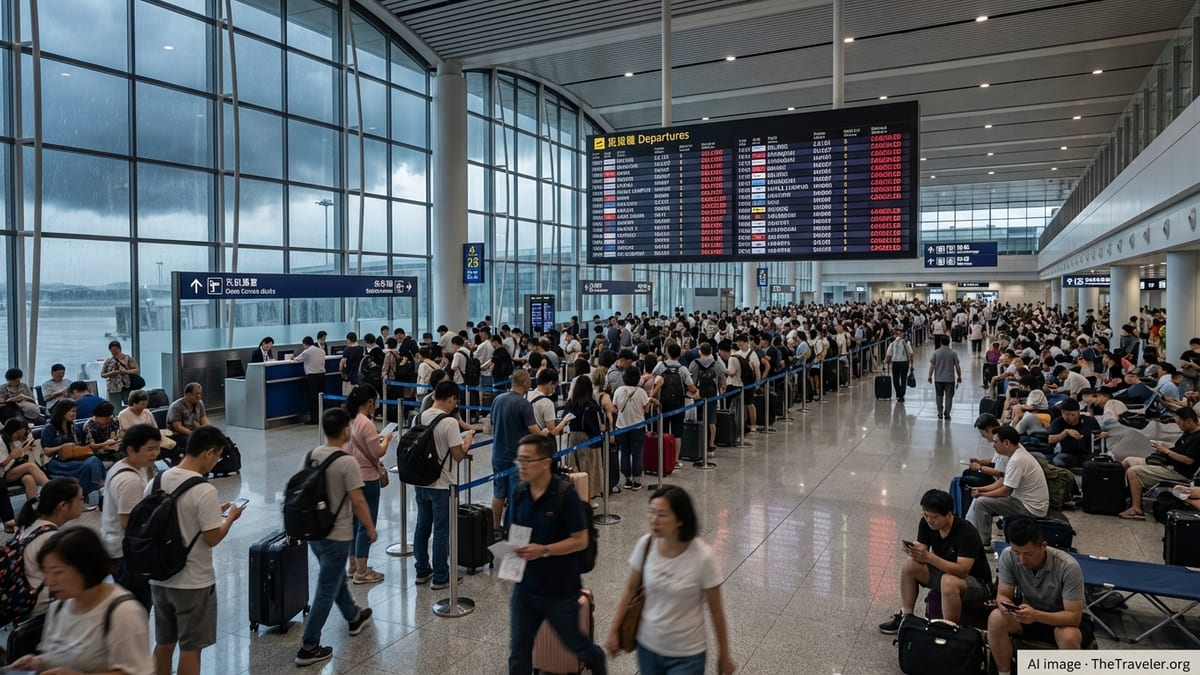
Passenger accounts on travel forums describe long queues at check-in counters and information desks, with some travelers being rebooked days later or rerouted through alternative hubs in northern China, South Korea and Southeast Asia. Others reported being advised to remain at their hotels and monitor airline apps rather than travel to the airport until flights had been reconfirmed.
The disruption has rippled through long-haul networks as well, with cancellations on China–Europe and China–North America routes as aircraft and crews were left out of position. Schedule data indicates that some long-haul services were consolidated, with airlines combining passengers from multiple canceled flights onto a smaller number of departures once conditions marginally improved.
Knock-on Effects Across Regional Routes
Although Dolphin did not make a direct landfall in the Philippines, publicly available meteorological assessments state that the system helped intensify seasonal monsoon rains over northern Luzon, triggering flooding and landslides. This, in turn, created intermittent operational challenges at several Philippine airports, particularly for domestic routes serving affected regions.
Travelers transiting major hubs such as Taipei, Hong Kong and Seoul have also reported turbulence-related delays and rerouting as airlines adjusted flight paths to skirt the worst of the storm. Posts on aviation and travel forums suggest that some services between Taiwan, Japan and the Chinese mainland encountered extended flight times as aircraft were vectored around bands of intense convection associated with Dolphin’s outer circulation.
Major international carriers with extensive Asia-Pacific networks introduced flexible rebooking policies for travelers with itineraries touching affected cities over a several-day window. Publicly posted travel waivers from at least one large North American airline covering dates from August 6 to August 13 highlight the broad geographic footprint of the disruption, spanning Japan, eastern China and nearby transit hubs.
Regional low-cost carriers, which often operate tight schedules with minimal spare aircraft, appear particularly exposed to knock-on delays and aircraft rotations. Industry analysts note that even short suspensions of operations at a hub such as Shanghai can produce operational bottlenecks that take several days to unwind, especially at the height of the summer travel season.
Tourism Hotspots and Business Travel Plans Upended
The storm’s timing in early August has magnified its impact on both leisure and business travel. In Okinawa, closure of the main airport curtailed beach vacations and interrupted domestic tourism, with visitors forced to extend stays or attempt overland and sea connections via Kyushu once ferry services resumed.
In eastern China, reports from Shanghai point to a sharp drop in visitor numbers at attractions and theme parks as Dolphin approached. Tourist-oriented facilities curtailed or suspended outdoor activities in line with local advisories, and many visitors cut short their trips or postponed planned excursions to coastal areas in Zhejiang and Fujian.
Business travelers have also seen schedules upended. Corporate itineraries built around meetings and trade events in Shanghai, Hangzhou and nearby manufacturing hubs were disrupted as flights were canceled or diverted, with some companies opting to shift sessions online rather than wait for flights to resume on normal patterns.
Hotel operators in gateway cities appear to be experiencing a mixed picture. While some report cancellations from would-be visitors deterred by the storm, others are seeing higher occupancy from stranded passengers and airline crews seeking short-notice accommodation near major airports.
Pressure Test for Airline Resilience and Passenger Communication
Dolphin’s path across a densely traveled aviation corridor is serving as another stress test for crisis planning in Asia’s airline and airport sectors. Since the pandemic and subsequent recovery, carriers in the region have repeatedly cited weather-related disturbances as a growing operational concern alongside airspace congestion and crew availability.
Industry observers note that advance typhoon tracking has allowed many airlines to cancel flights proactively, limiting the risk of aircraft and passengers being trapped at smaller airports with limited facilities. However, the volume of same-day cancellations in Okinawa and Shanghai underscores the challenge of balancing safety, customer convenience and operational efficiency when storm tracks shift close to major hubs.
Passenger feedback collected on social platforms indicates that digital communication has been uneven. Some travelers reported receiving timely app notifications and automatic rebooking options, while others described learning of cancellations only upon arriving at the airport, contributing to overcrowded terminals and confusion.
As Dolphin weakens inland over China, attention is turning to recovery operations and the pace at which airlines can restore normal timetables. Aviation analysts suggest it may take several days for schedules across East Asia to stabilize, particularly for carriers with complex intercontinental networks that depend on precise aircraft rotations through Shanghai and other regional hubs.