


More news on this day
Travel across Asia faced fresh disruption on Thursday as real-time flight-tracking data showed elevated delays and cancellations at major hubs including Bangkok and Beijing, increasing misconnection risk for passengers during a peak September travel window.
Get the latest news straight to your inbox!
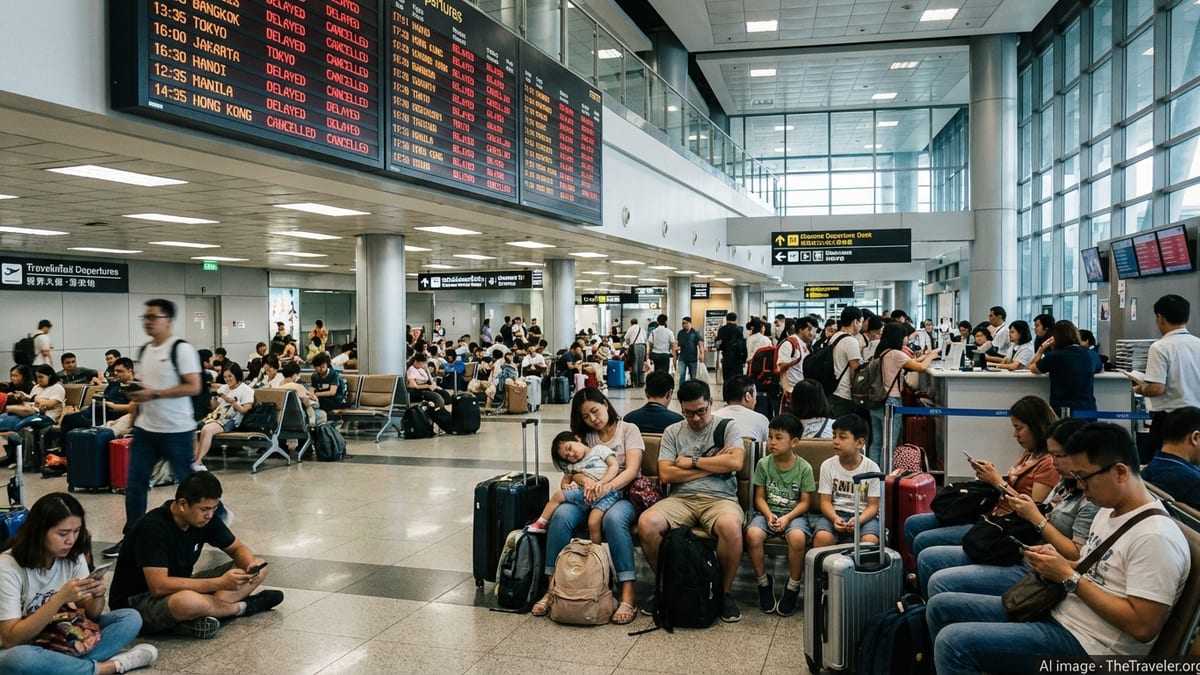
What the latest disruption data shows
Published coverage drawing on live flight-tracking dashboards indicated that operational strain was spread across multiple countries rather than being limited to a single airport or airspace corridor. The same reporting highlighted Bangkok and Beijing as prominent pinch points for travelers because both cities sit at the center of dense regional connecting networks, where even modest delays can ripple into missed onward flights and last-minute rebookings.
On Beijing’s side, publicly available delay and cancellation statistics on FlightAware for Beijing Capital International Airport (PEK) showed delays building during the day, even when outright cancellations remained limited at the time of viewing. That pattern matters for travelers because delays can be enough to break tight minimum connection times, especially when separate tickets are involved.
Separately, disruption maps from flight-tracking services such as Flightradar24 have shown airport-level “problem” indicators across Asia that can shift quickly as weather cells move, runway configurations change, or inbound aircraft arrive late from earlier sectors. For passengers, the practical takeaway is that the situation can look manageable at booking time and then deteriorate just hours before departure.
Bangkok pressure points: BKK and DMK connections under strain
Bangkok’s aviation system is split across two major airports: Suvarnabhumi (BKK), the primary long-haul gateway, and Don Mueang (DMK), a major base for domestic and short-haul services. When disruptions hit either airport, travelers connecting between them can be exposed because the transfer is ground-based and time-sensitive.
Airports of Thailand’s official flight-status tools for Suvarnabhumi and Don Mueang provide real-time listings that passengers can use to confirm whether a specific flight is operating as planned. Airports of Thailand has also encouraged travelers to check real-time flight status during Thailand’s rainy-season period, when weather-driven schedule changes are more common.
For travelers who must change airports in Bangkok, Don Mueang’s published guidance notes a free shuttle bus operating between Suvarnabhumi and Don Mueang, departing from Suvarnabhumi’s international terminal area and running from early morning through midnight. When disruption waves are active, that shuttle option can be useful, but it does not eliminate the need to pad transfer time, particularly if baggage reclaim, traffic, or last-minute gate changes come into play.
Beijing’s dual-airport reality and why delays can be as disruptive as cancellations
Beijing is served by two major commercial airports, Beijing Capital (PEK) and Beijing Daxing (PKX). Most international passengers still associate Beijing primarily with PEK, and even a “delay-heavy” day without many cancellations can still cause widespread passenger disruption because banked schedules depend on reliable on-time performance.
FlightAware’s airport statistics for PEK showed meaningful delay counts during the current operating day at the time of viewing, underscoring that travelers should treat connection margins cautiously. Delays can also compound across a network as aircraft and crews run late, leading to gate congestion and tighter turnaround windows later in the day.
For passengers transiting Beijing, the key risk is that a late inbound can trigger a missed connection even when the onward flight departs, particularly on itineraries with short legal connections or terminal changes. Travelers with checked baggage are typically less able to improvise an alternative routing at the last minute, which is why verifying the inbound flight’s status can be as important as checking the outbound segment.
Why disruption clusters can spread across 20-plus major hubs
Recent published reporting has described Asia’s disruption pattern as uneven and fast-moving, often shaped by a mix of weather, congestion, and network knock-on effects rather than a single point of failure. When multiple hubs experience delays at the same time, airlines can struggle to “recover” schedules because spare aircraft and crew buffers are limited, especially during busy travel periods.
In Thailand, daily air-traffic statistics posted by Aeronautical Radio of Thailand (AEROTHAI) illustrate how high the baseline movement levels can be around Bangkok’s flight information region, with large daily totals at Suvarnabhumi and Don Mueang. High volumes are not the same thing as disruption, but they help explain why even a localized slowdown can cascade quickly during peak banks of arrivals and departures.
Separately, consumer-facing disruption summaries published by claims and passenger-rights firms have also pointed to multi-hub waves in mid-September, reflecting how irregular operations can hit many airports in a single operating cycle. While such summaries are not official traffic control bulletins, they reinforce the idea that travelers should plan for network effects, not just conditions at a single departure point.
Practical steps travelers can take right now
For travelers departing in the next 24 to 72 hours, the most reliable first step is to verify flight status using the airline’s own app and the airport’s official flight-status page, and to re-check multiple times on the day of travel. Airports of Thailand’s official platforms for Suvarnabhumi and Don Mueang publish live flight lists that can help travelers confirm whether a flight number is operating on schedule before leaving for the airport.
Passengers connecting through Bangkok should confirm whether their itinerary requires an airport change between BKK and DMK and, if so, build substantial buffer time. Don Mueang’s published shuttle-bus information provides one transfer option, but it does not account for queues at immigration, baggage delivery timing, road traffic, or airline cut-off times for bag drop.
In Beijing, travelers should treat a delay-prone day as a signal to protect onward connections: consider selecting later connection times when rebooking is possible, and keep documentation of notifications and itinerary changes for any refund or re-accommodation request. Where plans are flexible, choosing itineraries with longer layovers or nonstop alternatives can reduce exposure to a broader regional disruption wave.