


More news on this day
Flight operations across Asia have come under severe strain as more than 6,200 services have been delayed in recent days, with summer storms and airspace constraints disrupting schedules at some of the region’s busiest hubs.
Get the latest news straight to your inbox!
Major Chinese Hubs Bear Brunt of Weather Turbulence
Publicly available flight tracking data for July indicates that China’s core aviation gateways in Beijing, Shanghai and Guangzhou are absorbing a large share of the disruption, with several thousand delays recorded in a matter of days. Recent analysis drawing on FlightAware figures shows that one data snapshot alone captured 6,734 delays and 227 cancellations across Chinese airports, underscoring how quickly storms and congestion can paralyze traffic when they coincide with peak summer demand.
Guangzhou Baiyun International Airport has emerged as one of the most affected hubs, with reports pointing to more than 800 delayed flights in a single day while cancellations remained relatively limited. Shanghai Pudong and Beijing Capital have also seen elevated delay volumes as carriers attempt to keep aircraft moving despite rolling weather cells and intermittent airspace restrictions. The result is that arrival and departure banks have become increasingly compressed, with knock-on effects that radiate across domestic and regional networks.
Industry-focused coverage notes that the pattern of disruption is closely tied to China’s hub-and-spoke model, in which heavy reliance on a handful of primary airports concentrates operational risk. When convective weather or temporary route closures affect those hubs, airlines have little flexibility to reroute traffic without cascading delays across secondary cities and onward international connections. The current episode has highlighted how quickly a localized storm system can translate into thousands of delayed flights once tightly scheduled rotations begin to unravel.
Carriers operating out of these hubs have responded by stretching turnaround times, retiming selected services and prioritizing aircraft positioning over strict adherence to published departure slots. While these steps can limit outright cancellations, they have also contributed to longer average delays for passengers, particularly on evening departures that rely on aircraft arriving from already congested morning and afternoon waves.
Weather Congestion Spreads Across Wider Asian Network
The disruption is not confined to mainland China. Aviation monitoring from early to mid-July shows that major hubs in India and Southeast Asia, including Mumbai, Bengaluru, Jakarta and Bangkok, have also recorded sharp increases in delayed services linked to summer storms and overall network congestion. A recent regional summary of Asia’s aviation performance referenced more than 8,700 delays over a short period across major hubs, illustrating the scale of knock-on effects once multiple airports come under meteorological pressure.
In India, Mumbai’s Chhatrapati Shivaji Maharaj International Airport has been highlighted as one of the most affected non-Chinese hubs, with several hundred delays reported alongside dozens of cancellations during intense weather windows. Further south, Bengaluru’s Kempegowda International Airport has experienced a wave of schedule changes as domestic carriers adjusted operations in response to localized thunderstorms and crew availability constraints.
Across Southeast Asia, publicly available reports indicate that Jakarta’s Soekarno-Hatta International and Bangkok’s Suvarnabhumi have faced repeated congestion as airlines juggling regional connections attempt to absorb delays originating in China and South Asia. Even when weather at these airports has been relatively stable, the arrival of late-running inbound aircraft has compressed turn times and reduced the margin to recover schedules later in the day.
Observers note that Asia’s dense web of short- and medium-haul routes amplifies the scale of disruption once key nodes start to struggle. An aircraft that departs late from a storm-hit Chinese hub may go on to operate two or three additional sectors within the same day, spreading delays into secondary markets in Southeast Asia or the Indian subcontinent. This interconnected structure helps explain how total delayed flights across Asia have climbed past 6,200 in the latest reporting, even though the most severe weather has been concentrated in specific regions and time windows.
Operational Constraints and Airspace Limits Deepen Impact
While thunderstorms and heavy rainfall have been the most visible triggers, operational constraints and structural airspace limits are compounding the situation. Analysts following the region point to tight route capacity over parts of East Asia and continuing military-controlled airspace in certain corridors, which restricts the number of available flight paths and funnels traffic into already busy waypoints.
These constraints leave air traffic managers with limited flexibility to reroute flights around severe weather cells. When holding patterns build up near major hubs, departure slots are often pushed back to keep arrival flows manageable, contributing to the rolling totals of delayed services. This dynamic has been especially evident around Beijing and Shanghai, where high volumes of domestic and international traffic converge on closely monitored approach and departure corridors.
Airport infrastructure and staffing limitations are adding further friction. Ground handling teams across several hubs have been working at or near capacity throughout the peak summer period, and any slowdown caused by lightning warnings, flooded ramp areas or heavy rain can quickly ripple through baggage loading, catering and pushback operations. Terminal congestion, particularly at transfer checkpoints, has also led airlines to hold outbound flights slightly longer to ensure connecting passengers can board, trading punctuality for passenger consolidation.
In some cases, carriers have opted to consolidate lightly booked services or implement tactical cancellations to create spare aircraft capacity for later in the day. While these decisions can help stabilize operations at a network level, they have contributed to visible disruption for travelers caught on affected flights, and to a perception that the system is struggling to cope with the peak of the summer season.
Passengers Face Strains as Airlines Adjust Schedules
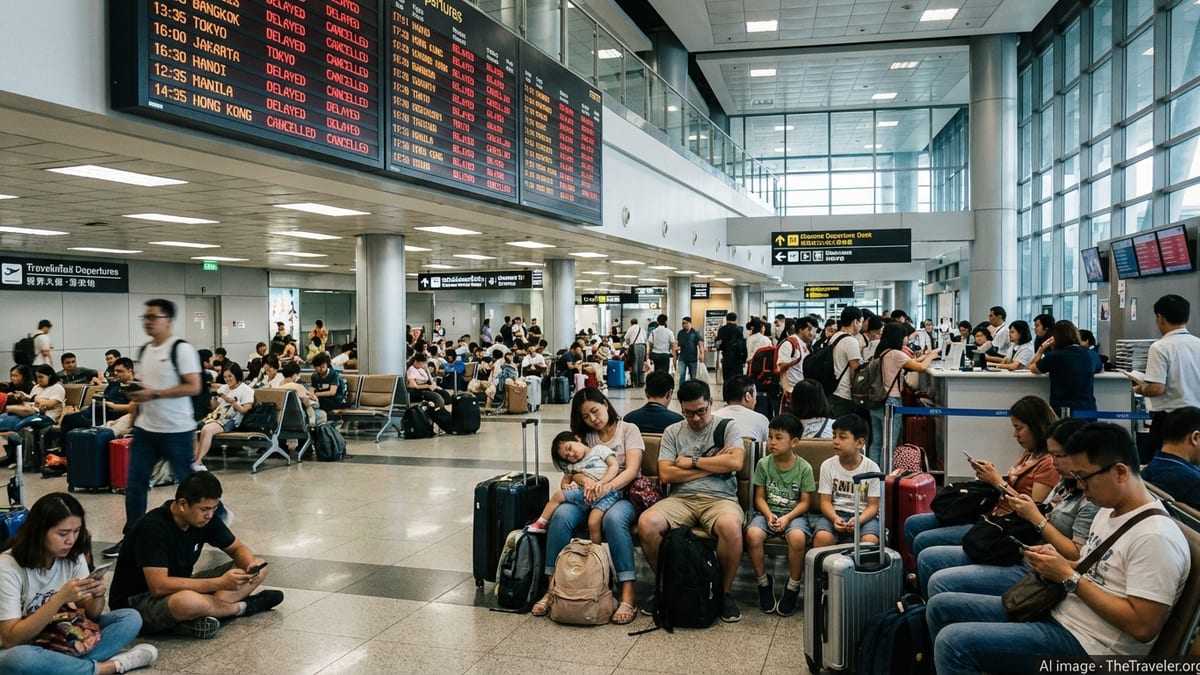
For passengers, the accumulation of more than 6,200 delayed flights across Asia in the latest period has translated into long queues at rebooking desks, crowded terminal areas and rising pressure on customer service channels. Travel-advocacy coverage notes that many affected travelers are turning to airline mobile apps and digital self-service tools as phone hotlines and airport counters become oversubscribed during peak disruption hours.
Published guidance from aviation analysts stresses the importance of monitoring flight status in real time and checking whether disruptions fall within an airline’s operational control or result primarily from extreme weather or air traffic restrictions. This distinction can influence what forms of compensation or support may be available under local consumer-protection regimes or airline-specific policies, particularly for travelers flying on multi-leg itineraries that span different jurisdictions.
Airlines across the region have introduced a range of short-term measures to cope with ongoing congestion. Some carriers have added longer schedule buffers to specific routes viewed as particularly vulnerable to storms, while others have deployed larger aircraft on select services in order to re-accommodate passengers from delayed or cancelled flights. These strategies may ease immediate pressure but can also reduce overall fleet flexibility if disruptive weather persists for several days.
Travelers connecting through major hubs are being advised, in public-facing commentary, to allow additional time for minimum connection windows and to consider booking earlier departures where possible. With aircraft and crew often out of position after several days of disruption, late-evening services may be at higher risk of significant delay, particularly on routes feeding into already congested hubs that have limited overnight recovery options.
Broader Implications for Asia’s Aviation Recovery
The latest wave of weather-related congestion across Asian hubs comes at a time when the region’s aviation sector is still consolidating its recovery from earlier pandemic-era restrictions and subsequent capacity rebuilding. Airlines have ramped up frequencies and reopened routes in response to strong demand, but in many cases fleets and staffing levels remain finely balanced, leaving limited slack when severe weather or airspace disruptions occur.
Industry commentary suggests that repeated episodes of large-scale delays are prompting carriers and airport operators to reassess schedule robustness heading into the latter half of 2026. Options under discussion include adding more generous turnaround times at vulnerable hubs, diversifying connecting flows across secondary airports where feasible, and investing in improved weather forecasting and decision-support tools to anticipate storm-related constraints earlier in the planning cycle.
There are also signs that regulators and infrastructure planners are paying closer attention to the interaction between airspace design, traffic growth and resilience to weather shocks. With summer storms likely to remain a recurring feature across much of Asia, long-term solutions may require adjustments to route structures, additional holding capacity and upgrades to ground infrastructure to improve drainage and lightning protection.
For now, the immediate focus for airlines and airports is on managing day-to-day operations in the face of volatile conditions. As the number of delayed flights across Asia climbs past 6,200, the episode is reinforcing a broader lesson already visible in other regions this summer: that even in a period of strong demand and expanding schedules, aviation networks remain highly sensitive to weather and operational bottlenecks at a small number of critical hubs.