


More news on this day
Passengers across the United States are facing knock-on travel disruptions after Hartsfield-Jackson Atlanta International Airport reported around 180 delayed departures and at least five cancelled flights on Sunday, affecting major carriers including Delta Air Lines, Southwest and Frontier on routes to Chicago, Orlando, Denver and other key destinations.
Get the latest news straight to your inbox!
Nation’s Busiest Hub Sees Fresh Day of Disruption
Hartsfield-Jackson Atlanta International Airport, the world’s busiest passenger hub, entered Sunday with elevated delay levels across its departure board, according to real-time tracking data reviewed from multiple aviation platforms. By midday, roughly 180 flights departing Atlanta were posting delays of at least 15 minutes, while at least five services had been cancelled outright, interrupting travel for thousands of passengers at the height of late May demand.
The disruption comes in a year when Atlanta’s role as a megahub is under renewed pressure. Public aviation statistics show Delta maintains by far the largest share of traffic at Hartsfield-Jackson, with Southwest and Frontier also operating significant schedules that funnel passengers onto dense domestic corridors. High aircraft utilization, tight connection times and strong spring and early summer demand mean even a modest spike in late departures can cascade quickly through airline networks.
While federal airspace monitoring early Sunday listed no formal ground stop for Atlanta, local operations were coping with a combination of lingering weather impacts in the Southeast, aircraft arriving late from other disrupted airports and crew-availability challenges that have been reported periodically since early spring. Together, those factors have translated into rolling schedule adjustments, longer-than-planned tarmac waits and missed connections for travelers using Atlanta as a connecting point.
Recent monthly traffic reports from the airport underscore how much strain a day of disruptions can create. Hartsfield-Jackson handled tens of millions of passengers across the most recent twelve-month period, and internal route data highlight Orlando, Chicago and Denver among the most heavily traveled domestic markets from Atlanta. When departures to those cities fall behind schedule, the effects tend to show up quickly in other parts of the country.
Delta, Southwest and Frontier Among Most Affected Carriers
Delta Air Lines, which operates its primary hub in Atlanta, appeared to shoulder a significant share of Sunday’s disruption, in line with its dominant presence at the airport. Flight-tracking services showed multiple Delta departures to Orlando and Chicago operating behind schedule, building on several weeks in which the carrier has experienced intermittent spikes in delays and cancellations tied to storm systems and crew rotations across its network.
Southwest Airlines, which runs a busy operation in Atlanta linking the Southeast to Chicago, Denver and other Midwestern and Western gateways, also recorded notable delays. Trip-planning forums and recent performance snapshots have described a pattern in which minor boarding and turnaround holdups accumulate across the day, leaving afternoon and evening flights particularly vulnerable when a congested hub such as Atlanta is involved.
Frontier Airlines, a key low-cost competitor at Hartsfield-Jackson with a focus on leisure routes, was likewise caught in Sunday’s disruption. Recent days have already seen select Frontier services between Atlanta and Orlando or Denver run significantly behind schedule, and the additional delays reported on Sunday further complicated travel for budget-conscious passengers with limited rebooking flexibility.
Other domestic carriers flying through Atlanta, including United and American on connecting services, have also been exposed to the ripple effects. When large hub carriers such as Delta, Southwest and Frontier struggle to maintain their schedules out of Atlanta, shared airspace, gate availability and crew positioning can lead to challenges even for airlines with a smaller footprint at the airport.
Key Routes to Chicago, Orlando and Denver Hit Hard
Some of the most visible impacts for travelers on Sunday were seen on the heavy-traffic corridors linking Atlanta with Chicago, Orlando and Denver. These routes rank among the busiest domestic city pairs from Hartsfield-Jackson, and they are served by multiple airlines that rely on tight scheduling to keep aircraft and crews in motion.
Flights between Atlanta and Orlando, a core leisure market, have been especially disruption-prone in recent weeks. Tracking data for late May show repeated short but compounding delays on both full-service and low-cost carriers along this corridor. With school holidays approaching, even modest setbacks are pushing aircraft into later arrival times, contributing to missed connections for passengers onward bound to Latin America or other parts of the Southeast.
On the Atlanta to Chicago corridor, where both Chicago O’Hare and Chicago Midway feed into nationwide networks, delays have created further complexity. Aircraft arriving late from Atlanta often face slot and gate constraints on arrival, and any significant hold in Chicago can in turn push return legs back into the Atlanta operation, perpetuating a cycle of rolling schedule adjustments.
Denver has emerged as another pressure point. Earlier in May, Denver International Airport experienced its own wave of weather-related disruptions that spilled into airline networks across the United States. With Southwest and Frontier heavily represented in both Denver and Atlanta, late-arriving aircraft and crews have left little margin for error on cross-country routings, meaning that even relatively small issues in either city can echo through the day’s schedule.
Weather, Crew Rotations and Network Complexity Under Scrutiny
Publicly available aviation data and prior coverage of recent disruptions at Hartsfield-Jackson point to a familiar mix of contributors behind Sunday’s problems. Thunderstorms and low visibility in the broader region periodically slow arrival and departure rates, forcing airlines to pad schedules or hold aircraft on the ground. When weather systems move across multiple major hubs in quick succession, carriers often struggle to reposition aircraft and flight crews in time to reset their schedules.
In Atlanta’s case, earlier storms this spring already produced multi-day sequences of delays and cancellations. Advocates and analysts have noted that once a carrier’s rotations become significantly out of sequence, it can take several days of relatively clear weather and reduced load to restore normal operations. On peak travel days, airlines face a choice between proactively trimming schedules or managing irregular operations in real time as delays accumulate.
Crew availability has also attracted attention. Public reporting over recent months has described instances where flights that were otherwise ready to depart from Atlanta waited for pilots or flight attendants to be reassigned or to arrive from incoming legs that had themselves been delayed. Labor contract rules governing duty-time limits, combined with the intense utilization common at a megahub, mean that once a bank of flights runs substantially late, additional services may be cancelled outright rather than risk crews timing out.
Underlying all of this is the structural complexity of running large connecting banks through a single, extremely busy hub. Hartsfield-Jackson’s role as the anchor for one of the world’s largest airline hubs means that many passengers have only 45 to 60 minutes to connect between flights. When initial departure banks slip, that buffer erodes quickly, resulting in missed connections that then must be reaccommodated on already crowded later services.
Travelers Confront Long Lines and Limited Rebooking Options
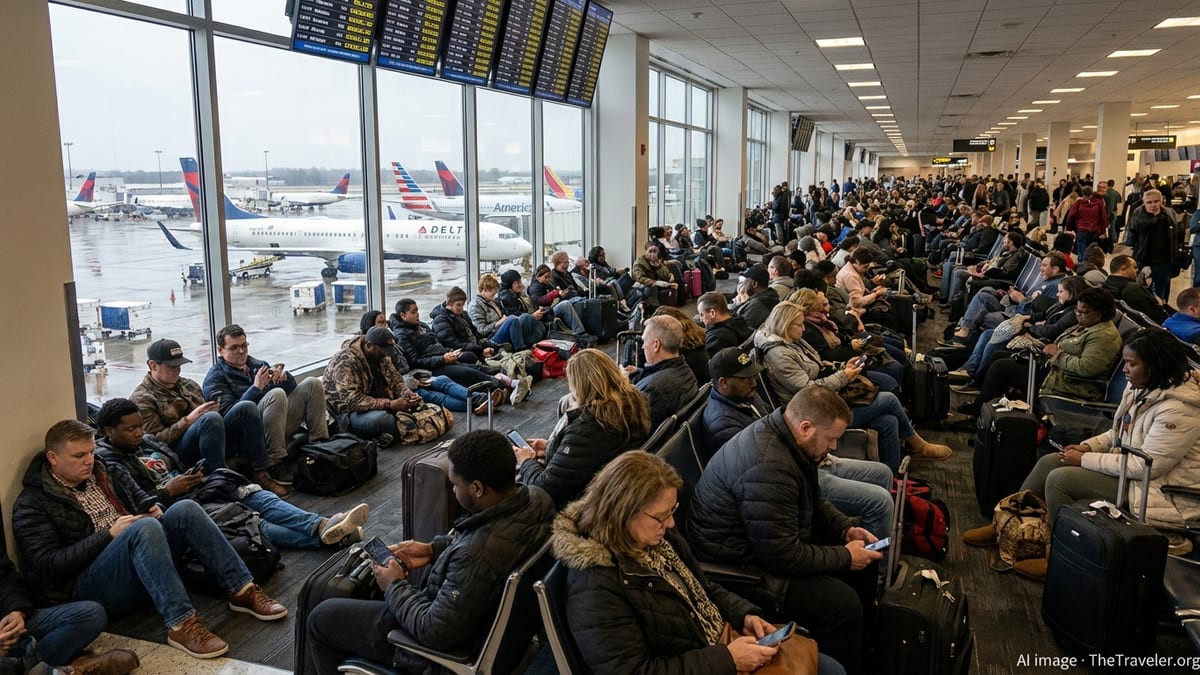
For passengers on the ground in Atlanta and at downline airports such as Orlando, Chicago and Denver, Sunday’s delays translated into crowded concourses, extended customer-service lines and tight competition for remaining seats. Online travel boards and social media feeds showed reports of travelers queueing at rebooking counters as they tried to secure same-day alternatives or overnight accommodation.
With airlines operating close to pre-pandemic capacity on many domestic routes, spare seats for last-minute reaccommodation can be scarce. Travel experts often recommend that passengers caught in disruption use airline mobile apps and web platforms as early as possible to adjust itineraries, rather than waiting in physical lines that can stretch for hundreds of people during major irregular operations events.
Industry guidance also stresses the importance of monitoring flight status closely on days when major hubs such as Atlanta begin to see large numbers of delays. Because schedule changes can propagate rapidly through interconnected networks, a flight that appears on time in the morning may show a significant delay by early afternoon as inbound aircraft and crews fall behind. Passengers with tight connections or important time-sensitive commitments are frequently advised to consider earlier departures or alternative routings when forecasts call for storms or when large delay totals begin to appear.
While the majority of Sunday’s affected flights were expected to operate eventually, the disruption underscored the fragility of high-density airline networks that rely heavily on a handful of key hubs. For travelers planning trips through Atlanta and other major connecting airports in the coming weeks, the pattern of recent days serves as a reminder to build extra time into itineraries, track flights well in advance of departure and be prepared with backup plans if schedules begin to unravel.