


More news on this day
China’s aviation network is facing another turbulent spell as clusters of cancellations and delays at Beijing, Shanghai, Guangzhou, Shenzhen and other hubs ripple across domestic and international routes, stranding passengers and forcing last-minute itinerary changes.
Get the latest news straight to your inbox!
Wave of Cancellations Hits Key Chinese Gateways
Publicly available flight tracking boards and operational summaries for late May 2026 show significant disruption across China’s largest airline groups, including Air China, China Eastern and China Southern. Data compiled from airport departure boards, flight-status platforms and consumer reports indicate that more than one hundred services have been scrubbed or heavily rescheduled over several operational days, with concentrations at Beijing Capital, Shanghai Pudong, Guangzhou Baiyun and Shenzhen Bao’an.
The pattern builds on earlier disruption days in May, when domestic monitoring services logged dozens of cancellations and several hundred delays across major hubs, particularly on rotations operated by China Eastern and Air China. Those earlier events already strained airport infrastructure and airline recovery plans, creating what some aviation analysts describe as rolling instability rather than isolated one-off incidents.
Recent days have added fresh clusters of cancellations on short-haul and medium-haul sectors, including links between Guangzhou and inland cities such as Wuhan, as well as services feeding Shanghai and Beijing. While some long-haul flights have continued to operate, changes to feeder schedules mean that passengers connecting through Chinese hubs to the Middle East, Africa and Europe face a higher risk of missed connections and overnight diversions.
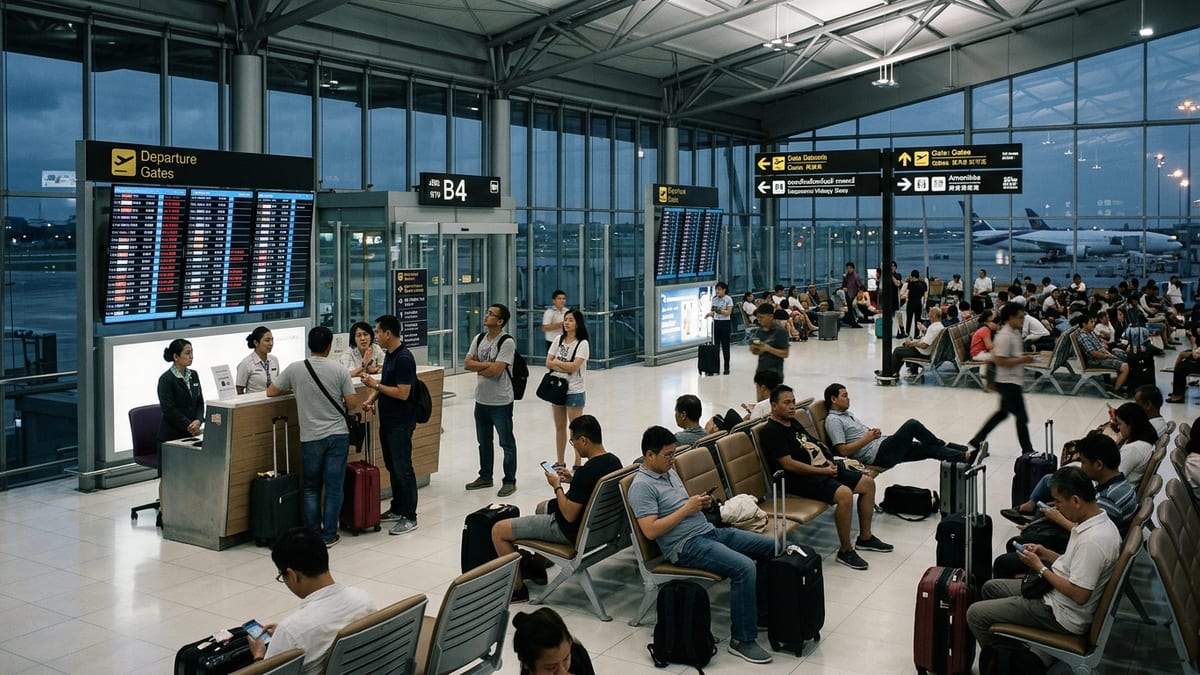
For travelers, the on-the-ground experience has been one of repeated gate changes, delayed boarding times and sudden cancellations, with airport hotels around Beijing and Shanghai again reporting heavy demand during peak disruption windows.
Domestic Corridors, Including Wuhan Links, Under Strain
The latest wave of disruption has been particularly evident on high-frequency domestic corridors that are central to China’s aviation network. Monitoring of reservation systems and day-of-operation status boards shows repeated schedule adjustments on trunk routes linking Beijing, Shanghai, Guangzhou and Shenzhen, as well as on feeder flights to secondary cities such as Wuhan, Kunming and Zhengzhou.
These domestic routes serve as the backbone of China’s air travel system, carrying significant volumes of business and leisure traffic. When cancellations cluster on these corridors, the impact is magnified, as missed rotations can quickly translate into aircraft and crew being out of position for later flights. This knock-on effect contributes to what analysts describe as cascading delays, with one cancellation in Shanghai or Beijing triggering missed onward services in regional markets hours later.
In Wuhan, which functions as a key central-China hub, publicly available flight information suggests that some services have experienced late-notice cancellation or re-timings as airlines attempt to re-balance capacity. That in turn has affected passengers relying on Wuhan as a connection point into China’s coastal megacities or onward to international flights.
Travel forums and passenger reports highlight the growing importance of alternative options on busy days, including high-speed rail on corridors such as Beijing–Shanghai or Wuhan–Guangzhou, as travelers look to avoid being caught up in repeated airport disruptions.
International Routes, Including China–Cairo, Face Knock-On Effects
While the majority of cancellations in recent weeks have been concentrated on domestic sectors, international links have not been immune. Schedule data and airline notices indicate that select long-haul and regional routes have faced thinning frequencies, day-of-operation cancellations or aircraft substitutions, particularly where demand remains volatile or where carriers are juggling aircraft availability.
Connections between China and the Middle East and North Africa are among the routes under close scrutiny. China Eastern’s Shanghai–Cairo service, for example, relies heavily on domestic feeder traffic from cities such as Beijing, Guangzhou and Wuhan. When those domestic legs are disrupted, passengers risk misconnecting in Shanghai, forcing rebookings onto later departures or alternative routings through other regional hubs.
Travelers on itineraries combining domestic segments with long-haul flights have reported itinerary changes in which short-haul legs are consolidated or re-timed to protect long-haul departures. In some cases, however, cancellations on the first domestic sector have resulted in entire journeys needing to be rebooked, especially where no same-day alternative is available.
Airlines have responded through a mix of schedule consolidation, ad hoc capacity increases on stronger days and, in some cases, relaxed change-fee policies during periods of heavy disruption. Consumer advocates note that such measures can ease pressure for some passengers but do not eliminate the uncertainty faced by those traveling on tight schedules or with complex multi-leg itineraries.
Operational Pressures Behind the Travel Chaos
Aviation observers point to a combination of structural and short-term factors behind the latest turbulence in China’s flight schedules. Published analyses and prior disruption days in May highlight the role of fast-moving storms, low cloud and crosswinds in eastern and southern China, which can quickly reduce runway throughput at already congested airports such as Shanghai Pudong and Guangzhou Baiyun.
Air traffic management constraints also remain a recurring feature of China’s aviation landscape. When portions of airspace are temporarily restricted or when traffic flows are metered to manage congestion, carriers are often forced to adjust or cancel flights at relatively short notice. This is particularly challenging on high-density corridors between Beijing, Shanghai and Guangzhou, where even small capacity reductions can have outsized ripple effects.
At the same time, airlines continue to recalibrate networks that expanded rapidly in the post-pandemic recovery period. Industry coverage notes that some carriers have been consolidating underperforming routes or adjusting seasonal capacity, especially on international links where demand patterns are still stabilizing. These strategic cuts, layered on top of weather and airspace disruptions, contribute to a travel environment in which schedules may appear stable weeks out but change sharply in the final days before departure.
Operational buffers, such as spare crew and aircraft, remain limited in some parts of the system, meaning that a single aircraft going out of rotation due to a mechanical inspection or weather diversion can leave a string of subsequent flights vulnerable to delay or cancellation.
What Travelers Should Watch in the Weeks Ahead
With China’s summer travel season approaching, industry watchers expect continued pressure on the country’s major hubs, particularly on Fridays, Sundays and holiday peaks when demand spikes. The recent pattern of concentrated disruption days suggests that travelers using Beijing, Shanghai, Guangzhou or Shenzhen as connection points should build additional time into itineraries where possible.
Publicly available guidance from consumer groups and travel advisors emphasizes close monitoring of airline apps and reservation systems in the days leading up to departure, as well as on the day of travel itself. Keeping boarding passes, receipts and records of extra expenses is recommended where passenger-protection rules or voluntary airline policies may provide for meal vouchers, hotel stays or partial refunds following cancellations.
For routes involving key domestic feeders into long-haul services, such as flights from Wuhan, Kunming or Chengdu into Shanghai and Beijing, travelers are being encouraged to consider earlier same-day departures or even arriving a day in advance when making important onward connections, including services to destinations such as Cairo or European capitals.
Industry analysts suggest that more proactive schedule adjustments and earlier notifications could help reduce last-minute terminal chaos in the months ahead. For now, however, the combination of volatile weather patterns, air traffic constraints and ongoing fleet and network reshuffles means that travelers across China’s busiest air corridors will likely continue to face an elevated risk of last-minute change.