


More news on this day
Aurigny will cut about 15% of its Alderney services from 1 December 2026 to 31 January 2027, prioritising the core Alderney–Guernsey lifeline route after a year of weather, technical and crewing problems that island officials say have throttled essential air links.
Get the latest news straight to your inbox!
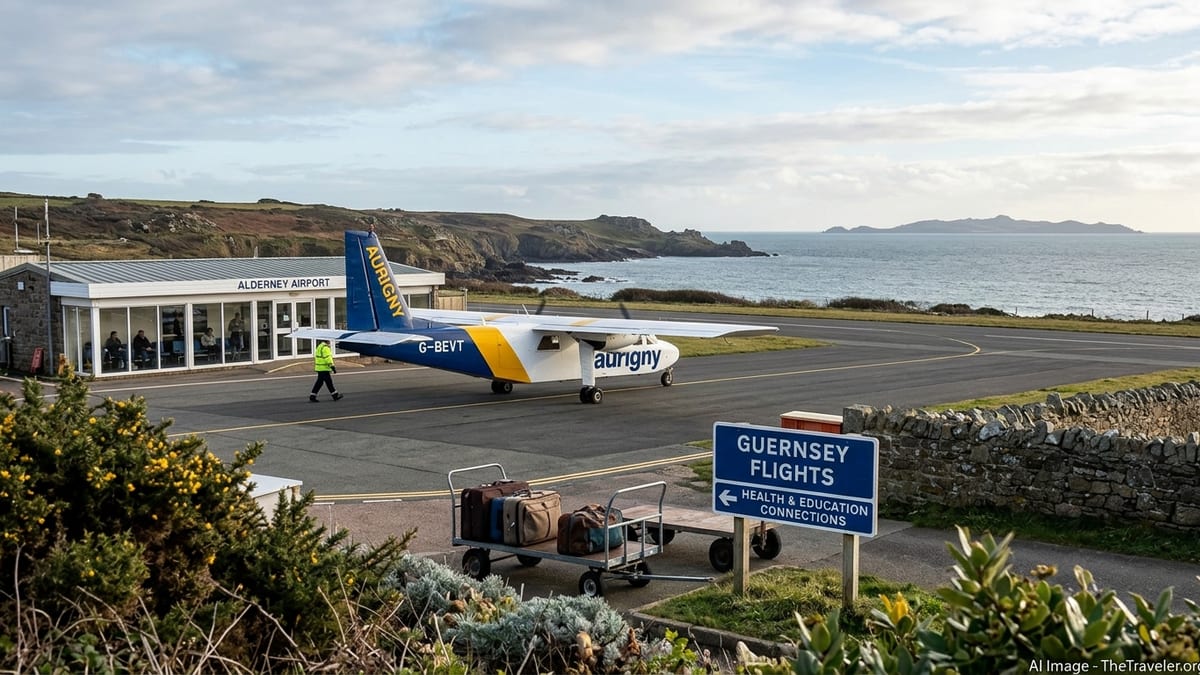
Winter schedule changes focus on Alderney–Guernsey lifeline
From 1 December 2026 until the end of January 2027, Aurigny will operate four return flights a day on the Alderney–Guernsey route and reduce other Alderney services, including direct links to Southampton. The airline has described the adjustment as a temporary response to intense pressure on its small-island operation rather than a permanent cut to Alderney’s connectivity.
The change represents roughly a 15% reduction in total Alderney services compared with the previously published winter schedule. Aurigny said that on Mondays and Fridays it will maintain one direct Alderney–Southampton return flight, while on other days passengers will need to connect via Guernsey for mainland travel. The carrier has begun contacting customers whose itineraries are affected to offer alternative routings or refunds.
For residents, the focus on Alderney–Guernsey is significant because this route underpins access to specialist healthcare, education and government services that are not available on the smaller island. Local authorities have long regarded it as a lifeline connection rather than a discretionary travel option, and Aurigny’s decision positions this shuttle as the core of its winter operation in the northern Channel Islands.
Disruption, crew shortages and Skybus partnership constraints
Aurigny’s move follows a difficult year for its Alderney services, during which only about 85% of flights between Alderney and Guernsey operated as scheduled from January to September 2026. The remaining services were affected by a combination of strong crosswinds and low visibility on Alderney’s short runway, technical issues with aircraft, and crew availability problems that sometimes left scheduled flights unable to depart.
A complicating factor has been Aurigny’s use of Isles of Scilly Skybus under contract to provide additional capacity on the thin Alderney routes. Skybus has publicly faced its own recruitment and training challenges, particularly in attracting and retaining enough pilots qualified for the demanding approach profiles required at small island airports. Aurigny has acknowledged that the partner airline has not been able to supply the crew needed to operate the full timetable it initially planned for the 2026–27 winter season.
The result has been a pattern of late-notice cancellations and extended delays that have drawn criticism from island politicians and passengers. In March 2026 Alderney’s Policy & Finance Committee raised formal concerns with Guernsey’s States Trading Supervisory Board about reliability, citing frequent disruption tied to aircraft availability, weather and crew training. Later that month an estimated 200 residents gathered at Alderney Airport to protest after a run of cancellations which Aurigny attributed to staff sickness and low crew numbers at Skybus.
Guernsey’s wider air network under strain
The Alderney cuts come against a backdrop of broader stresses on Guernsey’s air links in 2026. In early September a prolonged spell of fog at Guernsey Airport forced all Aurigny aircraft already airborne to divert to UK airports after holding patterns failed to produce a safe break in visibility. With aircraft and crews out of position, the airline faced a rolling backlog that took days to clear even after the weather improved.
The timing of that fog event coincided with a peak travel period when visitor numbers to Guernsey were already high, leaving accommodation providers and the island’s tourism authorities scrambling to find extra beds for stranded passengers. The local government’s critical incidents team described significant pressure on hotel capacity as airlines, including Aurigny, sought to house customers who could not depart as planned.
Guernsey’s network has also been reshaped by the collapse of regional carrier Blue Islands in November 2025. Following that failure, Aurigny secured a licence to operate the key Jersey–Guernsey route from January 2026 and leased an additional aircraft in February 2026 to support the expanded operation through March 2027. While the expansion has increased Aurigny’s role as the Channel Islands’ primary regional operator, it has also stretched the airline’s resources across more destinations at a time when its smallest routes, particularly Alderney, are proving hardest to run reliably.
Government oversight and passenger impact
As the state-owned flag carrier of the Bailiwick of Guernsey, Aurigny operates within a government air policy framework that treats core inter-island and Guernsey–UK routes as strategic infrastructure rather than purely commercial services. In early 2026 Guernsey’s Committee for Economic Development acknowledged that the first weeks of the year had been particularly challenging for Aurigny, but said it remained in close contact with the airline and other operators as it worked on a revised air policy framework.
The balancing act is complex. On one hand, Guernsey and Alderney politicians face pressure from residents and businesses who rely on frequent, reliable flights for healthcare, schooling, commuting and tourism. On the other, the small market, short sectors and weather-prone airports mean that operating margins are thin, and aircraft utilisation must be carefully managed to avoid cascading disruption when technical problems or storms hit. Aurigny’s decision to concentrate limited resources on Alderney–Guernsey over the winter reflects this prioritisation of lifeline needs.
For passengers, the immediate impact will be felt most acutely by those who booked direct Alderney–Southampton services on days when these flights will now not operate. Instead of a non-stop hop to the south coast of England, many travellers will need to connect via Guernsey, increasing total journey times and adding another potential point of disruption. Aurigny has said it will rebook affected customers at no extra cost where possible, but availability will depend on seat capacity on the remaining flights.
What travellers should check over the 2026–27 winter
Travellers planning to use Aurigny to or from Alderney between 1 December 2026 and 31 January 2027 should closely check their booking confirmations and any recent airline notifications. Because the revised schedule trims the number of flights while concentrating on Alderney–Guernsey, some itineraries loaded earlier in the year may have changed departure times or routings. Passengers with medical appointments, school term dates or onward international connections should verify that their adjusted flights still provide sufficient time buffers.
Given the combination of winter weather risks and the smaller number of direct mainland flights, travellers with flexibility may find it prudent to schedule critical journeys a day earlier than strictly necessary, particularly when travelling from Alderney to the UK for one-off events or procedures. Those connecting to long-haul departures from London or other major UK hubs should consider building in additional contingency time, especially when their itinerary requires an Aurigny connection via Guernsey to reach Gatwick, Heathrow or other airports.
Aurigny has indicated that the winter adjustments are temporary and intends to review Alderney services ahead of the busier 2027 summer season. Until then, passengers can expect the Alderney–Guernsey shuttle to remain the backbone of northern Channel Islands connectivity, with limited but focused support for direct mainland links. Monitoring flight status on the day of travel, arriving early at the airport and being prepared for re-routing via Guernsey will be key practical steps for anyone relying on these services over the coming months.