


More news on this day
Delta Air Lines says its automated system for calculating aircraft weight and balance is back online after a November 22 outage triggered widespread delays at Hartsfield-Jackson Atlanta International Airport and across its U.S. network, affecting thousands of passengers at the start of the busy Thanksgiving travel period.
Get the latest news straight to your inbox!
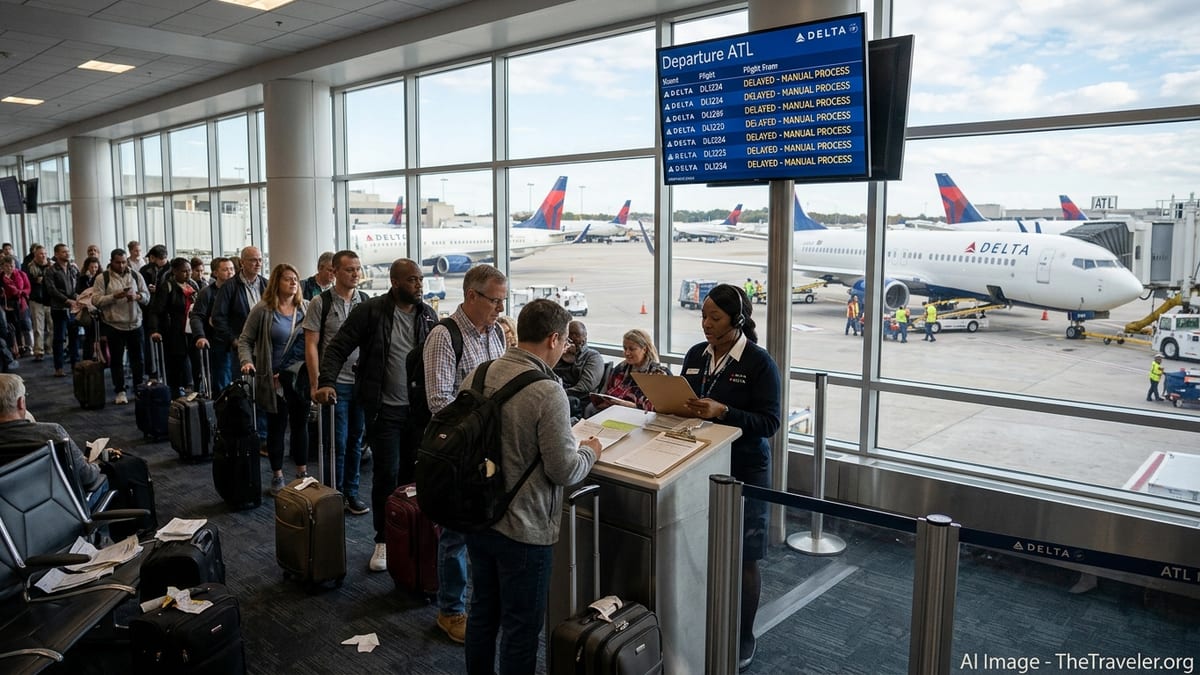
What happened to Delta’s automation system
The disruption began on Sunday, November 22, when Delta reported problems with its automated system that calculates weight and balance for departing flights. The carrier relies on the software, often referred to internally as the Automated Load Instruction System, to combine data on passengers, baggage, cargo and fuel and generate instructions that keep each aircraft within certified safety limits. When the system malfunctioned on Sunday morning, dispatchers and ground crews had to shift to manual procedures, significantly slowing departures across the operation.
By midday Sunday, the Federal Aviation Administration issued a ground stop for Delta flights bound for Atlanta, which was later converted into a ground delay program. The FAA said the measure applied to Delta and its regional affiliates, requiring inbound flights to hold at their departure airports as Hartsfield-Jackson coped with constrained gate space and longer turnaround times. Average delays for affected flights into Atlanta were estimated at close to an hour while the program was active.
Throughout the day, Delta said there were no indications of a cyberattack and stressed that the problem was confined to the airline’s own automation rather than federal air traffic control systems. The outage did not affect other airlines’ weight-and-balance tools, but the knock-on impact of congestion at the world’s busiest airport led to broader delays across multiple carriers using Atlanta.
Scale of delays across Atlanta and the Delta network
The timing of the outage amplified its impact. Delta and Delta Connection had roughly 5,000 flights scheduled on Sunday, November 22, with Atlanta acting as the primary connecting hub for many domestic and international itineraries. Flight-tracking service FlightAware reported that by late afternoon more than 1,000 Delta-operated flights had been delayed nationwide, representing well over half of the airline’s daily schedule. Some independent analyses using evening data put the figure above 2,000 delayed flights once the full day’s operations were counted.
At Hartsfield-Jackson Atlanta International Airport, more than 1,100 arrivals and departures across all airlines were delayed at various points on Sunday, according to real-time tracking data. Only a relatively small share of flights were outright canceled, but rolling knock-on delays built up throughout the day as aircraft and crews arrived late for their next rotations. This created extended waits at gates, lengthy aircraft hold times on the tarmac and missed connections for passengers passing through Atlanta.
The problem was not limited to Georgia. Travelers reported Delta delays and extended ground times at major U.S. airports including New York LaGuardia, Newark, Washington Reagan National, Dulles, Boston, Baltimore, Miami, Minneapolis, Nashville, San Antonio and Birmingham. Long waits for gates and departure slots were also reported at non-Delta hubs when aircraft operating earlier Delta sectors arrived late and crews reached duty limits, causing some flights later in the day to be canceled.
Why weight and balance calculations are critical to safety
Although the outage was ultimately temporary, the system it affected is central to safe flight operations. Weight-and-balance calculations determine whether an aircraft is within its certified maximum takeoff weight and whether that weight is correctly distributed so that the aircraft’s center of gravity remains within allowable limits. These calculations influence takeoff speeds, runway length needed, climb performance and handling characteristics in all phases of flight.
FAA guidance notes that exceeding structural weight limits or allowing the center of gravity to move outside specified ranges can compromise aircraft controllability and structural integrity, particularly during takeoff and landing. While airlines historically performed these calculations manually, modern carriers use automated systems to speed the process and reduce the risk of arithmetic errors, especially in large fleets turning multiple aircraft rapidly throughout the day.
When Delta’s automation failed, the airline reverted to these manual methods. Pilots, dispatchers and load agents had to cross-check passenger counts, baggage loads and fuel quantities by hand, then compute takeoff weight and center-of-gravity positions for each flight. This additional workload, repeated across thousands of departures, is what turned a technical glitch into a system-wide operational event, as aircraft were held at gates until crews were satisfied that all safety margins were correctly observed.
How Delta and the FAA responded as the day unfolded
In statements on Sunday, Delta said its operations teams prioritized safety while engineers worked to restore the automated system. The airline confirmed that flights continued to operate using “manual workarounds” and that the issue was unrelated to the FAA’s own technology. As the morning disruption escalated, Delta requested and coordinated with the FAA on the ground stop and subsequent delay program into Atlanta to prevent gridlock on taxiways and at terminal gates.
The FAA confirmed that the delay program initially applied only to Delta and its regional affiliates, and was structured to meter traffic into Atlanta while the airline worked through a growing backlog of aircraft awaiting departure. By early afternoon, as more flights left gates later than scheduled, arriving aircraft increasingly had no place to park, leading to additional airborne holding and diversions in some cases. Airport officials said their goal was to avoid situations where arriving aircraft remained on the taxiway for extended periods with no gate available.
By Sunday evening, Delta reported that automation for departing flight weight and balance calculations had been restored. The airline said its focus shifted to “stabilizing the operation” and repositioning aircraft and crews to get back on schedule ahead of the peak Thanksgiving travel days. On Monday, November 23, Delta and airport officials in Atlanta reported that operations were largely back to normal, though some residual delays persisted in the early part of the day as aircraft and crew schedules were realigned.
Impact on passengers and what travelers can expect next
Delta has apologized for the disruption and stated that affected customers are being rebooked on the next available flights. The airline has said it is providing meal vouchers and hotel accommodations where necessary, following its existing customer-service policies for significant controllable delays. Passengers whose flights were canceled and who chose not to travel are eligible for refunds for the unused portion of their ticket, in line with U.S. Department of Transportation rules.
Because the outage occurred just days after a separate nationwide ground stop earlier in November that affected multiple airlines, the Delta incident has added to traveler concerns about the resilience of aviation technology ahead of one of the busiest U.S. travel weeks of the year. However, as of Monday, November 23, Delta, the FAA and Atlanta airport officials all reported that schedules had stabilized, with operations running normally even as Thanksgiving volumes ramped up. Travelers with upcoming Delta flights have been advised to monitor their reservations through the airline’s website or app and to allow extra time at the airport in case of lingering congestion at key hubs.
Looking ahead, there has been no public indication from Delta of long-term schedule changes or structural cutbacks linked to the outage. The airline has not yet released technical details explaining precisely why the weight-and-balance automation failed, saying only that the issue has been resolved. For now, the most immediate implications are practical ones for travelers: passengers flying in the days after November 22 should check their flight status frequently, confirm connection times through Atlanta and other Delta hubs, and be prepared for occasional residual delays even as the carrier’s systems and schedules return to normal levels of reliability.