


More news on this day
Norwegian long‑haul low‑cost carrier Norse Atlantic Airways’ main Norwegian operating company has filed for bankruptcy after abruptly suspending all flights and ticket sales this week, leaving transatlantic travelers stranded and raising urgent questions about refunds, rebooking options and the future of its remaining subsidiaries.
Get the latest news straight to your inbox!
What exactly has happened to Norse Atlantic?
The core development is centered on Norse Atlantic Airways AS, the Norwegian operating airline that held the group’s Norwegian air operator certificate. On Friday 27 November 2026, its board resolved to file a bankruptcy petition with Agder District Court in Norway, following two days of suspended operations and an unsuccessful last‑minute search for emergency financing. The filing affects the unit that operated most of Norse’s scheduled long‑haul flights between Europe and North America and brings those services to an immediate end.
The bankruptcy filing came after Norse Atlantic publicly warned on 25 and 26 November that its financial position had become critical. The company said then that it had halted all flights and ticket sales while it sought short‑term funding and that, failing a rapid solution, the board intended to seek bankruptcy protection. By 27 November, management confirmed that no viable rescue package had been found for the Norwegian airline and moved ahead with formal insolvency proceedings.
It is important to distinguish between the operating airline and the wider corporate group. Norse Atlantic ASA, the Oslo‑listed parent company, along with other group entities such as its UK‑based operating arm, are not themselves part of the 27 November bankruptcy petition. Group statements indicate that the parent is exploring options to continue some form of business through non‑Norwegian units, but no concrete restart plans or new schedules have been published. For now, the practical effect for travelers is that Norse’s previous long‑haul network is not operating, regardless of which group company ultimately marketed the flight.
Flight suspensions, stranded passengers and affected routes
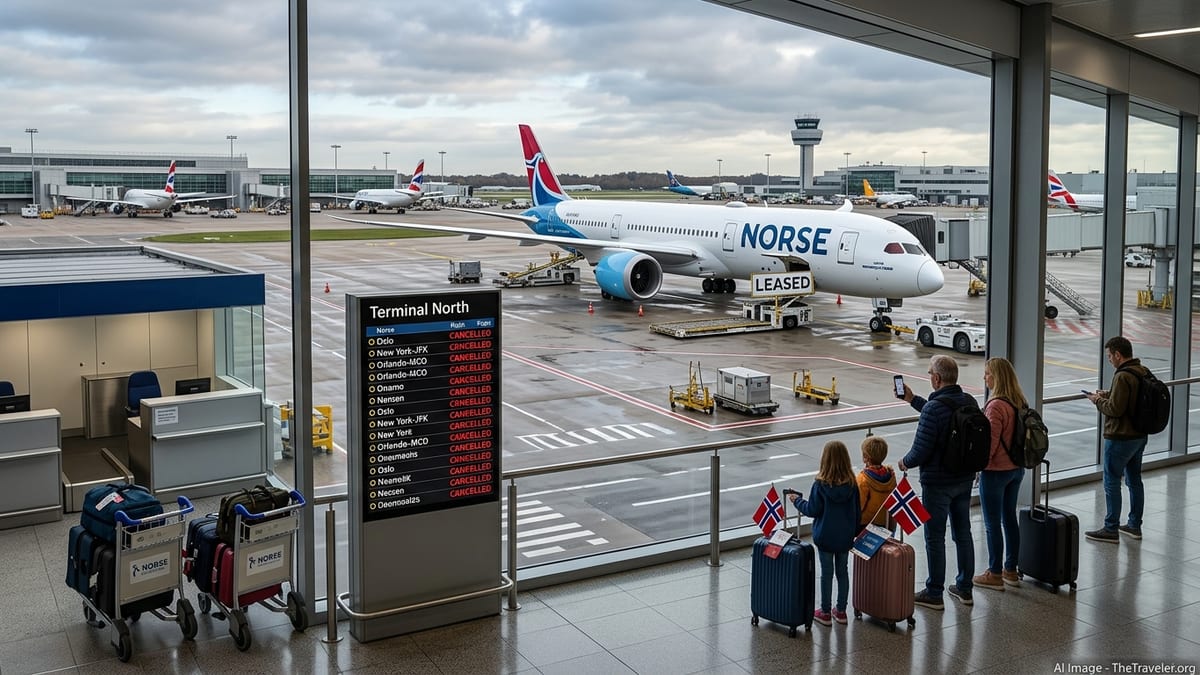
Norse Atlantic began unwinding its operations on Wednesday 25 November 2026, when it suspended all flights and stopped taking new bookings while talks with lenders and investors continued. Over the following 48 hours, the airline progressively canceled its remaining departures, including busy transatlantic services between London Gatwick and U.S. destinations such as New York, Orlando and Las Vegas, as well as routes from Oslo to North America. Reports from airports including London, Oslo and New York describe departure boards showing mass cancellations and Norse check‑in desks closed.
The suspension left passengers overseas without their planned return flights. Travelers who had already flown out on Norse earlier in November reported being notified that their homebound legs were canceled with little or no alternative offered. Consumer groups in Norway and the UK say they have received complaints from passengers stranded in the United States and in European gateway cities as the shutdown coincided with a peak travel period around the U.S. Thanksgiving holiday.
The airline’s own communications have underscored how limited its immediate support is. Norse’s website and public notices have directed customers not to travel to the airport if their flight is shown as canceled and they do not already hold a confirmed ticket on another carrier. Contact center capacity has been sharply reduced and travelers are being funneled toward information pages and, where relevant, toward the court‑led claims process. There is no indication of an organized repatriation program funded by the airline itself. Instead, passengers are generally being left to secure alternative travel at their own expense, with the possibility of later claims in the bankruptcy estate or through payment providers and travel insurance.
Why Norse collapsed and what is happening inside the group
Norse Atlantic launched its first flights in 2022, positioning itself as a dedicated long‑haul low‑cost carrier linking Europe and North America using fuel‑efficient Boeing 787 aircraft. Its business model relied on relatively low fares and high aircraft utilization across a small fleet that was largely leased. Company filings for 2024 and 2025 already pointed to thin margins and vulnerability to fuel price swings and off‑season demand dips, even as the airline carried more than a million passengers a year on its routes.
In 2026, those structural weaknesses were amplified by external shocks. Rising jet fuel prices, driven in large part by the wider disruption and supply uncertainty linked to the U.S. conflict with Iran, pushed operating costs sharply higher. Norse had limited fuel hedging in place, which meant it had to absorb spot market prices on a large share of its fuel needs. At the same time, demand on some discretionary transatlantic routes softened outside major events, putting pressure on yields just as costs were climbing.
The group’s own stock‑exchange updates in late November describe a rapid deterioration in its liquidity position. Bondholder presentations and subsequent notices on 25 and 26 November refer to urgent efforts to secure short‑term financing and parallel negotiations with aircraft lessors. By 27 November, Norse confirmed that several lessors had issued termination notices on leases for all 12 of its Boeing 787‑9s. Without access to its aircraft and without new funding, the Norwegian operating company no longer had a credible path to continue flying, prompting the decision to petition for bankruptcy.
While the Norwegian airline enters formal insolvency, the parent company and its remaining subsidiaries face a more uncertain future. Norse Atlantic ASA has told investors that it will continue to explore restructuring options, including possible use of its UK operating certificate or other parts of the group to relaunch limited services. Any such plans would require regulatory approvals, fresh financing and arrangements with lessors or new aircraft providers. Until concrete decisions are announced and schedules filed, travelers should assume that previous Norse routes are suspended indefinitely.
What rights do affected travelers have and how can they seek refunds?
The options available to Norse passengers depend heavily on how and where they booked. For flights departing from the European Union, the United Kingdom or Norway, Norse tickets were in principle covered by EU and UK air passenger rights rules for delays and cancellations. Those regulations normally entitle travelers to rerouting or refunds and, in some cases, compensation. However, consumer authorities in Norway have already cautioned that when an airline is in acute financial distress or has entered bankruptcy, it may not be able to honor those obligations in practice, leaving passengers reliant on third‑party protections instead.
Travelers who bought Norse tickets using a credit card may be able to request a chargeback or to claim under local consumer credit laws that make card issuers jointly liable when a provider fails to deliver a service. The availability and scope of such protection varies by country and card network, and card issuers usually require documentation that the flight was canceled and that the airline has entered insolvency proceedings. Customers who purchased via online travel agencies or tour operators should contact those intermediaries first, as some may offer alternative flights or refunds under their own booking conditions.
Travel insurance is another potential avenue, but many standard policies either exclude airline bankruptcy outright or cover it only under specific “financial default” clauses. Policy wording is critical. Some travelers have reported that their insurers treat the Norse collapse as an uncovered event, while others with more comprehensive or upgraded policies are being advised that claims may be considered. As always, insured passengers should contact their provider directly, keep all receipts for replacement travel and accommodation, and follow the insurer’s claim procedure carefully.
For customers based in Norway or holding tickets issued in Norway, the national consumer council and transport authorities are publishing guidance on what to expect from the bankruptcy process. Once the Agder District Court formally opens proceedings, creditors, including passengers with claims for unused tickets and out‑of‑pocket expenses, will be able to submit claims to the appointed trustee. Historically, recoveries for unsecured creditors in airline bankruptcies are uncertain and can take considerable time. Travelers should therefore treat any potential payout from the estate as a long‑term possibility rather than a near‑term solution.
What travelers should do now and what to watch next
Anyone holding an upcoming Norse Atlantic booking should first verify the exact status of their flight using the airline’s website or their booking confirmation. As of 28 November 2026, the Norwegian operating company has halted operations and its flights are not running, even if some booking systems have not yet updated. Passengers should not go to the airport unless they have a confirmed alternative ticket on another carrier. For immediate travel needs, the practical priority is to secure replacement transport, ideally before remaining seats on competing airlines fill or prices rise further during the busy late‑November and December period.
When rebooking, travelers affected by the Norse collapse can ask other airlines serving the same routes whether they offer “rescue fares” for stranded passengers of a failed carrier. These special one‑off fares are not guaranteed and depend entirely on each airline’s commercial policy, but they are sometimes made available after high‑profile airline failures. Passengers should expect to provide proof of their original Norse booking when requesting any such consideration. It may also be worth checking whether any existing hotel or car rental reservations can be modified without penalty in light of disrupted flights.
Over the coming weeks, key developments to watch include the Agder District Court’s formal opening of bankruptcy proceedings for Norse Atlantic Airways AS, the appointment and initial reports of the bankruptcy trustee, and any subsequent announcements from Norse Atlantic ASA about the future of its remaining subsidiaries. Regulators in Norway and the UK may also issue further guidance on passenger rights and on how travel agents should handle affected bookings. Until credible restart plans, new ownership structures or replacement services are clearly confirmed, travelers should plan on the basis that Norse’s previous transatlantic network will not be available and should book any essential long‑haul travel with other, currently operating carriers.