


More news on this day
Delta Air Lines says it has restored an automated system used to calculate aircraft weight and balance after a technical failure on Sunday, November 22, triggered a brief ground stop into Atlanta, caused hundreds of delays across the United States and added fresh disruption for travelers heading into one of the year’s busiest Thanksgiving weeks.
Get the latest news straight to your inbox!
What happened to Delta’s automation system on November 22?
According to statements from Delta Air Lines and operational advisories from the Federal Aviation Administration (FAA), the problem began on the morning of Sunday, November 22, 2026, when Delta’s automated system for calculating aircraft weight and balance stopped working reliably. The software is used before departure to compile data on passengers, baggage, cargo and fuel to confirm that an aircraft is within certified weight limits and correctly balanced for safe takeoff.
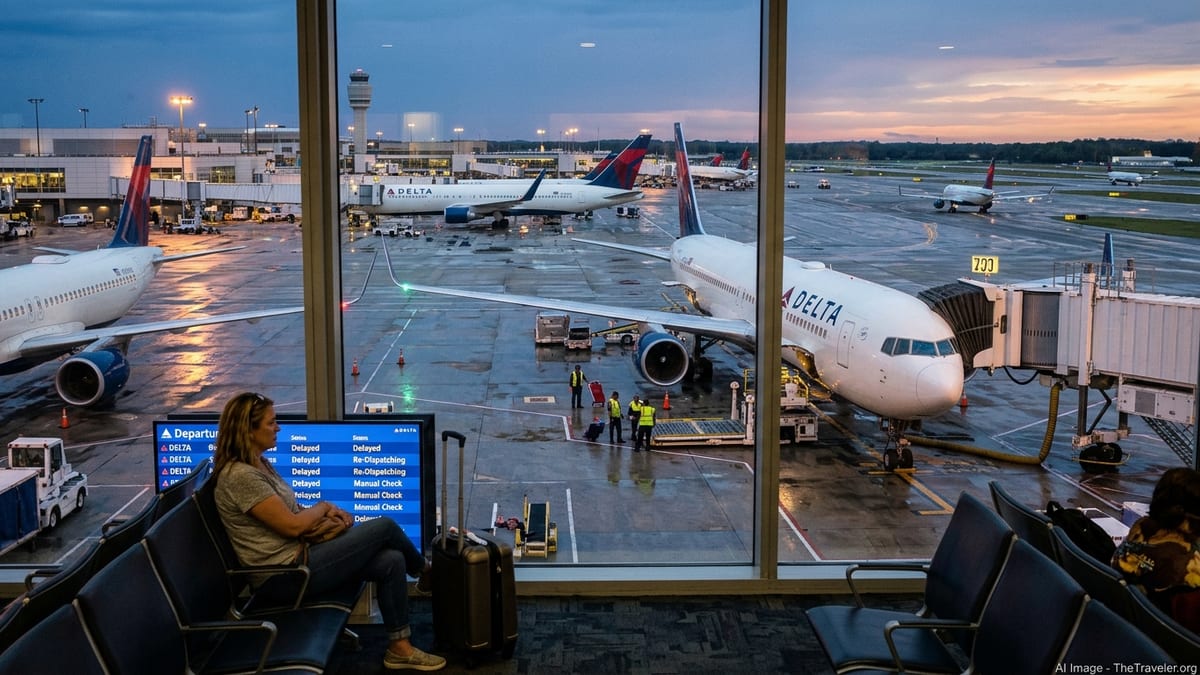
With the automation offline, Delta said its teams switched to manual workarounds, using alternative procedures to complete the required calculations and paperwork before dispatching flights. While this allowed operations to continue, it significantly slowed departure processes across the network. Delta described the disruption as affecting departures “systemwide,” although the worst visible congestion occurred at its Atlanta hub, Hartsfield-Jackson Atlanta International Airport.
As delays mounted, Delta requested that the FAA temporarily hold some of its traffic into Atlanta in order to prevent gridlock on the tarmac and in gate areas. FAA advisories show that an initial ground stop for Delta flights bound for Atlanta from other U.S. airports was issued, then converted within the morning to a ground delay program that spread out arrivals into the hub. Delta and the FAA both stressed that the issue involved Delta’s internal systems rather than FAA air traffic control technology.
Impact on flights at Atlanta and nationwide
Hartsfield-Jackson, the world’s busiest airport by passenger volume and Delta’s largest hub, saw some of the most acute operational strain. Flight-tracking data from services such as FlightAware indicated that by early evening on November 22 nearly 1,250 flights in and out of Atlanta across all airlines were delayed, with Delta and its regional affiliates accounting for a large share of those disruptions. Delta reported that about 70% of its own delays and cancellations recorded that day on FlightAware were directly linked to the automation issue, with the remaining problems tied to weather and associated air-traffic management programs in the Northeast, including the New York City area.
Because departures were taking longer to push back and taxi, gates at Atlanta often remained occupied much longer than scheduled. That limited the airport’s ability to park arriving aircraft and contributed to cascading delays for flights that were otherwise ready to land and deplane passengers. Travelers posting on social media and aviation forums on Sunday reported waiting at gates in cities including Atlanta, New York’s LaGuardia and Newark, Washington Reagan National, Washington Dulles, Boston, Baltimore, Miami, Minneapolis, Nashville, San Antonio and Birmingham as Delta crews completed manual checks before departure or waited for a gate to open on arrival.
Delta and its Delta Connection partners had roughly 5,000 flights scheduled for November 22. While not all of those services were significantly delayed, the airline’s on-time performance for the day deteriorated sharply compared with typical November Sundays, according to publicly available tracking statistics. By afternoon, several hundred Delta flights were showing delays and a smaller number had been canceled outright as the carrier reworked its schedule to restore the system, reposition aircraft and crew, and relieve pressure at its busiest hubs.
Safety role of weight and balance calculations
The failure of the automation system has drawn attention to a largely invisible but critical step in airline operations. Before every commercial flight, airlines must verify that the aircraft’s weight does not exceed certified limits and that the load is distributed within acceptable balance parameters from nose to tail and wingtip to wingtip. The FAA’s published guidance notes that exceeding these limits or miscalculating the distribution can reduce an aircraft’s performance margins, affect controllability and, in extreme cases, compromise structural safety.
In normal operations, automated systems ingest data from reservations, check-in, baggage handling and fuel planning, then generate a set of weight-and-balance figures and load sheets for the cockpit crew and dispatchers. These calculations have built-in safety margins and are cross-checked by pilots as part of their preflight procedures. When that automation becomes unavailable, airlines revert to more manual methods that can involve additional paperwork, more conservative assumptions, extra verification steps and coordination between ground staff, load controllers and flight crews.
Delta has not publicly detailed the precise technical cause of the outage affecting its weight-and-balance automation or whether it originated in airline-owned software, a third-party application or supporting connectivity. The carrier and the FAA have both said there is no indication that Sunday’s event was related to cybersecurity issues, and regulators have not reported any associated safety incidents. All aircraft already airborne during the disruption were able to continue operating normally, as the affected system is used before departure rather than in flight.
Recovery efforts and passenger support
By later in the day on November 22, Delta said it had restored automation for its departing flights’ weight and balance calculations. As the system came back online, the airline focused on launching remaining departures and reducing gate and taxiway congestion at Atlanta and other affected airports. Operational data and airline statements indicate that while most of the same-day delays were resolved by Sunday night, residual knock-on effects extended into the morning of Monday, November 23 as aircraft and crews were repositioned and backlogs of displaced passengers were cleared.
Delta stated that cancellations were being used “as a last resort” and that its customer service teams were rebooking travelers on the next available flights. The carrier said it was providing hotel accommodation and meal support where required by its policies, particularly for passengers who were stranded overnight because of disruption directly related to the automation failure. Travelers whose flights were canceled and who chose not to travel were told they could request refunds.
Some passengers, especially those on long-delay or ultimately canceled flights, reported waiting for several hours on board aircraft or in crowded gate areas during the morning and early afternoon while manual processes were completed and the FAA ground programs remained in effect. Others were rebooked via connections through less congested hubs or moved to flights departing later in the day. As is typical after major disruptions, the speed of resolution varied considerably by route, time of day and destination, with certain heavily traveled holiday markets seeing fewer immediate rebooking options than off-peak routes.
Link to recent nationwide ground stop and wider implications
Sunday’s Delta-specific disruption unfolded less than ten days after a separate, unrelated nationwide ground stop in the United States on Friday, November 13, 2026. In that earlier event, the FAA ordered all domestic departures paused for nearly five hours following a problem affecting communications between air traffic control facilities and aircraft. Federal documents and subsequent briefings describe that incident as the most extensive U.S. ground stop since shortly after the September 11, 2001 attacks, with more than 17,000 flights delayed or canceled across all carriers.
At Hartsfield-Jackson, that November 13 nationwide ground stop caused significant knock-on effects. Airport general manager Ricky Smith described it publicly as a “big test” for the facility’s operations ahead of the Thanksgiving travel period, as staff worked to restore normal schedules while planning for an expected holiday throughput of around 4 million passengers across the week. By November 18, Smith said operations were “approaching normalcy,” although airlines were still working through some residual schedule adjustments.
The proximity of the FAA’s nationwide ground stop and Delta’s internal automation outage has intensified scrutiny of the resilience of both government and airline technology. In the space of less than two weeks, U.S. travelers have faced large-scale disruptions first triggered by a federal communications issue and then by carrier-specific dispatch software problems. Regulators, Congress and airline executives have already signaled that both incidents will be examined closely, but as of late November 2026 no formal findings or corrective mandates have been published beyond standard incident reviews.
What travelers should know and watch for next
For passengers booked on upcoming Delta flights, the airline has said that its weight-and-balance automation is again functioning and that Sunday’s issue has been resolved. There have been no additional FAA ground stops or nationwide programs related to Delta’s systems since November 22. Even so, as the broader U.S. aviation system moves through the remainder of the Thanksgiving period, travelers are likely to encounter higher-than-usual congestion and occasional residual delays, some of which may reflect the time it takes for aircraft rotations and crew schedules to fully stabilize after recent disruptions.
Travelers planning to fly in the coming days are advised to monitor their flight status frequently through airline apps or airport information screens, especially if connecting through Atlanta or major Northeast hubs where weather-related air-traffic programs can interact with airline-specific issues to produce additional delays. Delta has also urged customers to leave additional time at the airport during peak holiday periods and to ensure contact details are up to date in reservations so that any last-minute schedule changes or rebookings can be communicated quickly.
Looking further ahead, formal investigations into the November 13 nationwide ground stop and internal airline technology outages, including Delta’s weight-and-balance failure, are expected to generate recommendations on system redundancy, testing and coordination between airlines, technology suppliers and the FAA. For now, travelers do not face any announced long-term schedule cuts or structural changes linked specifically to Delta’s November 22 incident. The more immediate practical step for passengers is to treat the rest of the holiday period as a time when cautious planning, flexible itineraries and close attention to real-time updates can reduce the risk of extended disruption if further bottlenecks occur.