


More news on this day
A powerful Thanksgiving nor’easter that soaked the U.S. East Coast and forced rare changes to holiday traditions has moved offshore into the Atlantic, but air, rail and road systems remain in recovery mode, with thousands of travelers still facing delays on Friday, November 27, 2026, as airlines, rail operators and highway agencies work to repair damage, reposition equipment and restore normal operations before the heavy return‑travel rush on Sunday, November 29.
Get the latest news straight to your inbox!
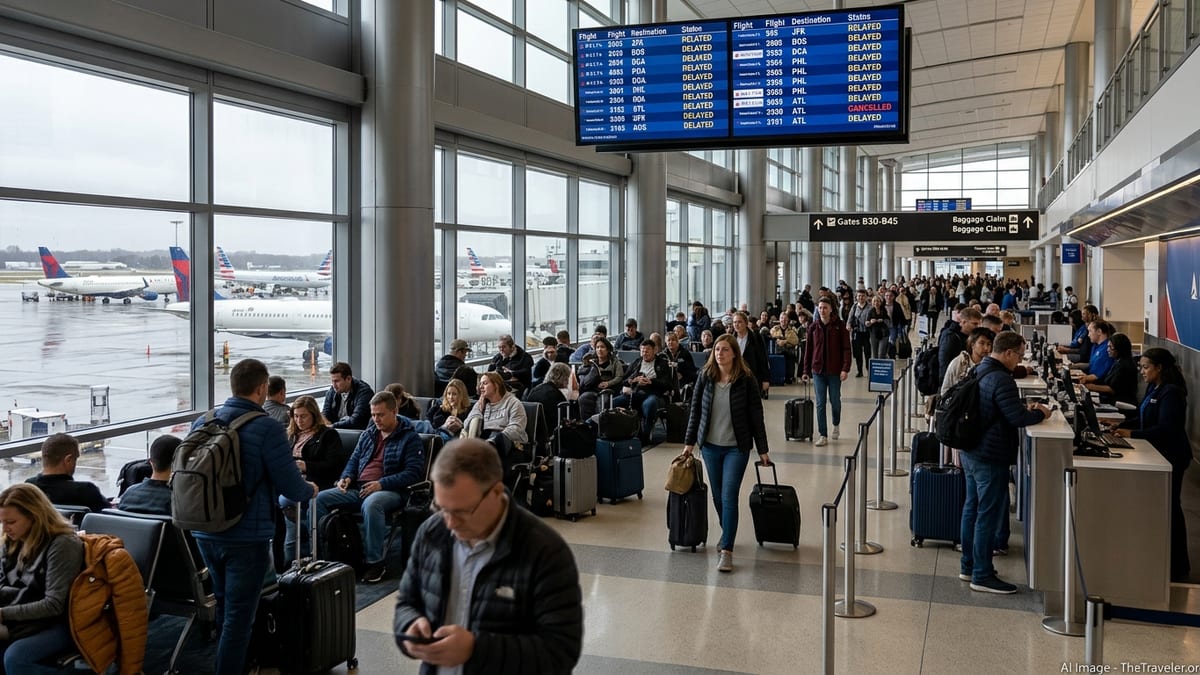
Storm shifts offshore while transport networks play catch‑up
Forecast discussions from the National Weather Service and the National Oceanic and Atmospheric Administration in the days leading up to Thanksgiving highlighted the risk of a strong coastal low developing off the Southeast and then tracking north along the shoreline on Thursday, November 26. Those outlooks called for widespread heavy rain, strong easterly winds and coastal flooding from the Carolinas through New England, with travel impacts likely on one of the busiest days of the U.S. holiday calendar. Subsequent analysis from the Weather Prediction Center shows that the low deepened near the Mid‑Atlantic coast and then moved slowly northeastward, focusing the worst conditions on coastal New Jersey, Long Island, southern New England and Downeast Maine on Thanksgiving afternoon and evening.
By early Friday, November 27, meteorological bulletins indicated that the primary low‑pressure center had shifted eastward over the open Atlantic, with pressure rising and winds gradually easing along much of the Interstate 95 corridor. Short‑range forecasts through the weekend point to improving weather for most major East Coast cities, with showers tapering, ceilings lifting and gusts steadily decreasing at many airports. However, forecasters continue to flag a risk of coastal and tidal flooding in parts of the Mid‑Atlantic and New England during remaining high‑tide cycles, particularly in low‑lying communities that saw multiple successive tide peaks during the height of the storm.
The improving conditions at ground level have not immediately translated into a return to normal for air travelers. Flight‑tracking snapshots from Friday show several thousand flights within, into or out of the United States operating late and a smaller but still significant number of cancellations, a marked improvement from Thanksgiving Day but still above November norms. Airlines are contending with residual low ceilings and gusty crosswinds at some hubs, but the larger challenge is the cascade of delays, diversions and crew displacements caused by Thursday’s interruption, which has left aircraft and crews out of their planned positions across the national network.
Major East Coast hubs absorb the brunt of the storm
The nor’easter’s track placed some of the country’s most capacity‑constrained airports directly in its strongest wind field. In New York City, the National Weather Service reported a gust of 54 miles per hour in Central Park on Thursday afternoon and 66 miles per hour at LaGuardia Airport, conditions that are particularly challenging for LaGuardia’s short, closely spaced runways and dense surrounding airspace. To maintain safety margins for takeoff and landing in strong crosswinds and heavy rain, air traffic controllers reduced the rate of arrivals and departures, triggering queues on taxiways and extended waits for runway access even as terminals remained open.
Across the rest of the New York metropolitan system, John F. Kennedy International and Newark Liberty International saw similar, if not more severe, disruption on Thanksgiving Day. Publicly available delay boards and data from tracking services on Thursday evening showed dozens of cancellations and many more delayed departures and arrivals across the three airports combined, with some of that disruption spilling into the early hours of Friday as airlines worked through the backlog. Because these hubs handle large numbers of connecting passengers to and from the Midwest, West Coast and overseas, delays and cancellations in the New York area rippled widely across domestic and international networks.
Further south, airports around the nation’s capital also experienced significant, if more intermittent, disruption. Washington Reagan National Airport reported periods of low ceilings, heavy rain and crosswinds layered on top of its already constrained runway layout and noise‑sensitive approach paths along the Potomac River. Portions of the Thanksgiving Day schedule at Reagan National were delayed or cancelled when conditions temporarily fell below operating minima for certain runway configurations. Nearby Baltimore/Washington International Thurgood Marshall Airport and Philadelphia International Airport implemented arrival and departure metering at times in response to gusty winds and reduced visibility, which temporarily cut throughput even when rainfall intensity had begun to ease.
In New England, Boston Logan International Airport emerged as one of the focal points for flight disruption. State and local media, citing FlightAware data, reported dozens of cancellations and scores of delays at Logan on Thursday as the center of the storm crossed coastal Massachusetts, bringing a combination of low clouds, heavy rain and strong onshore winds. By Friday morning, Logan was still showing a non‑trivial number of late departures and arrivals, reflecting both residual weather constraints and the knock‑on effects of aircraft and crews arriving from other regions behind schedule. Federal Aviation Administration advisories indicated that at times Logan was placed under a ground delay program, in which some inbound flights were held at their origin airports or given later departure slots to match reduced arrival capacity in Boston.
Broader transport impacts on rail, roads and coastal communities
The coastal low that peaked on Thanksgiving Day did not only affect air travel. Situation reports from emergency management agencies across the Mid‑Atlantic and New England documented widespread coastal flooding, particularly in New Jersey, Delaware, Long Island and parts of coastal Massachusetts and Maine. In New Jersey, for example, state officials had issued an executive order in advance of the storm, citing expectations of tidal flooding, strong winds and heavy rainfall between November 25 and November 27, with the highest risk of coastal inundation focused on the Thanksgiving period. Coastal flood and high surf warnings covered long stretches of shoreline, and early damage assessments noted moderate to locally major flooding during high tides, temporary closures along low‑lying roads, and scattered power outages where saturated soils and strong gusts toppled trees and power lines.
These conditions disrupted road journeys throughout the holiday corridor. Portions of coastal highways experienced lane closures or detours because of standing water or debris, while major urban arteries leading to airports and intercity bus terminals moved slowly under a combination of surface flooding, reduced visibility and heavier than usual traffic. In some metropolitan areas, local transit agencies reduced speeds on rail lines that traverse exposed bridges or cuttings as a precaution, which lengthened journey times for passengers trying to reach or depart from storm‑affected airports.
Passenger rail services were also affected, although core infrastructure remained in operation. Along parts of the Northeast Corridor, Amtrak and several commuter railroads implemented weather‑related speed restrictions and reported delays from signal and power problems linked to wind and water intrusion. In a number of coastal communities, particularly in New England, short‑haul passenger ferries and some smaller harbor services temporarily suspended operations while conditions were at their worst, reflecting elevated seas and strong onshore winds. Most of these services began returning to operation on Friday as conditions eased, although schedules remained subject to change where debris removal and harbor inspections were still in progress.
Existing strains from airline outages and incidents
The recovery challenges facing airlines this weekend are not solely the product of the Thanksgiving nor’easter. On Sunday, November 22, Delta Air Lines experienced a significant outage affecting its automated system for calculating aircraft weight and balance, a core safety tool used to determine takeoff performance and loading for each flight. The carrier said later that day that the system issue had been resolved, but by then more than 2,000 Delta flights had been delayed across the United States, according to figures compiled from FlightAware and industry reports, with around two‑thirds of the airline’s schedule on Sunday affected to some degree.
Because airlines schedule their fleets and crews tightly, particularly during busy holiday periods, the knock‑on effects of Delta’s outage extended into the early part of the Thanksgiving week. Aircraft that were due to overnight at specific airports to operate Monday morning departures ended up in alternative locations, and some pilots and cabin crew reached the limits of their duty‑time regulations after working extended shifts to accommodate manual or workaround procedures. As a result, even after the technical system was restored, the airline spent several days rebuilding its network to its intended pattern, a process that left it with less spare capacity going into the Thanksgiving peak than it might otherwise have had.
In the same pre‑holiday window, at least one high‑profile runway‑related incident further reduced operating flexibility at a major airport. Aviation and local news outlets in South Florida reported that a FedEx MD‑11 freighter experienced a runway overrun at Miami International Airport late on Wednesday, November 25. There were no injuries reported, and investigators subsequently cleared the aircraft for recovery, but the incident temporarily closed all but one of Miami’s runways to allow for inspections and debris checks. The resulting capacity reduction affected both passenger and cargo operations during a period when Miami was already handling diversions and rerouted flights linked to weather elsewhere in the network.
Together, the Delta automation outage and the Miami runway incident meant that, before the Thanksgiving nor’easter reached full strength, the U.S. air travel system was already carrying a degree of operational stress. Airlines had fewer standby aircraft and reserve crews available to step in when bad weather forced schedule changes at major hubs, and some routes were still operating with thinner margins because of earlier disruptions. When ground delay programs and weather‑related cancellations began to roll through New York, Boston, Washington and other coastal airports on Thursday, those pre‑existing strains limited the industry’s ability to mount extra recovery flights or quickly re‑accommodate displaced passengers.
Why delays persist after skies clear, and what travelers should do next
For many travelers, one of the most counterintuitive aspects of a storm like this week’s nor’easter is that long delays and occasional cancellations often continue after local weather appears to have improved. The underlying explanation lies in how airlines and air traffic managers design their operations. During peak periods such as Thanksgiving, carriers aim to keep aircraft flying as many revenue‑generating hours as possible, which means individual jets may be scheduled to operate four, five or more flight segments per day with only short turnarounds. Crews are similarly rostered on legal duty‑time limits that assume broadly on‑time operations.
When a large, slow‑moving weather system forces widespread ground delay programs, route restrictions or outright cancellations during a peak travel day, that finely balanced pattern breaks down. Aircraft end up overnighting at airports that were not in the original plan, while pilots and cabin crew can be left out of position or timed out by regulatory limits. Historical on‑time performance data from the U.S. Department of Transportation show that in a typical month a substantial share of total delay minutes is attributed to late‑arriving aircraft and crew issues rather than to direct weather or air traffic control restrictions. In the immediate aftermath of a major storm, the initial spike in delays is recorded as weather‑related, but as skies clear, the dominant factor becomes the network effort to return aircraft and crews to their intended rotations.
Looking ahead to the rest of the Thanksgiving travel window, short‑range forecasts suggest a gradually stabilising pattern for the eastern United States through Sunday, November 29. Meteorologists expect the core of the Thanksgiving nor’easter to continue moving further out into the Atlantic, with only scattered showers and breezy conditions lingering over parts of the Great Lakes and the interior Northeast. Some coastal communities may still see elevated water levels and minor tidal flooding during the next set of high tides, and localized clean‑up operations could continue along beaches, boardwalks and harborfronts, but there is currently no indication of a second major coastal system coinciding with the main post‑holiday travel days.
Even with calmer weather, however, Sunday after Thanksgiving is structurally among the busiest and most delay‑prone travel days of the year in the United States. Federal aviation briefings ahead of the holiday projected that the November 23 to December 1 period would be the heaviest Thanksgiving flying window in more than a decade, with more than 400,000 flights scheduled nationwide and daily activity expected to peak above 50,000 operations. Several large U.S. carriers have advertised near‑record schedules for the weekend, which means that spare seats on key routes may be limited precisely when disrupted travelers are still seeking rebookings.
For travelers who have yet to complete their journeys, the most practical response is to build in extra margin and stay closely informed rather than assuming a rapid return to normal. Airports and airlines are advising passengers to allow additional time to reach terminals, particularly in coastal or low‑lying areas where residual flooding, detours or ongoing debris clearance could affect access roads and public transport. Checking flight status regularly through airline apps and official airport channels can provide early warning of schedule adjustments, gate changes or reroutings while the broader network is still in recovery mode.
Passengers with connections through constrained hubs such as New York LaGuardia, Newark Liberty, Boston Logan or Washington Reagan National may want to opt for longer connection windows where possible, or to move to earlier flights that build a buffer against potential knock‑on delays later in the day. Where rebooking is necessary after a cancellation or a long delay, availability is likely to be tight on popular East Coast and transcontinental routes, and travelers may need to consider alternative routings or secondary airports. The 2026 Thanksgiving experience underscores how a single intense coastal storm, interacting with existing operational vulnerabilities, can shape travel reliability for several days beyond the actual weather event, a factor worth bearing in mind when planning future holiday itineraries through major hubs in late November.