


More news on this day
A series of deadly attacks, escalating regional conflicts and targeted strikes on civilian infrastructure have prompted several governments to tighten travel advisories for 13 countries, underscoring how quickly security conditions can deteriorate along key routes popular with business and transit travelers.
Get the latest news straight to your inbox!
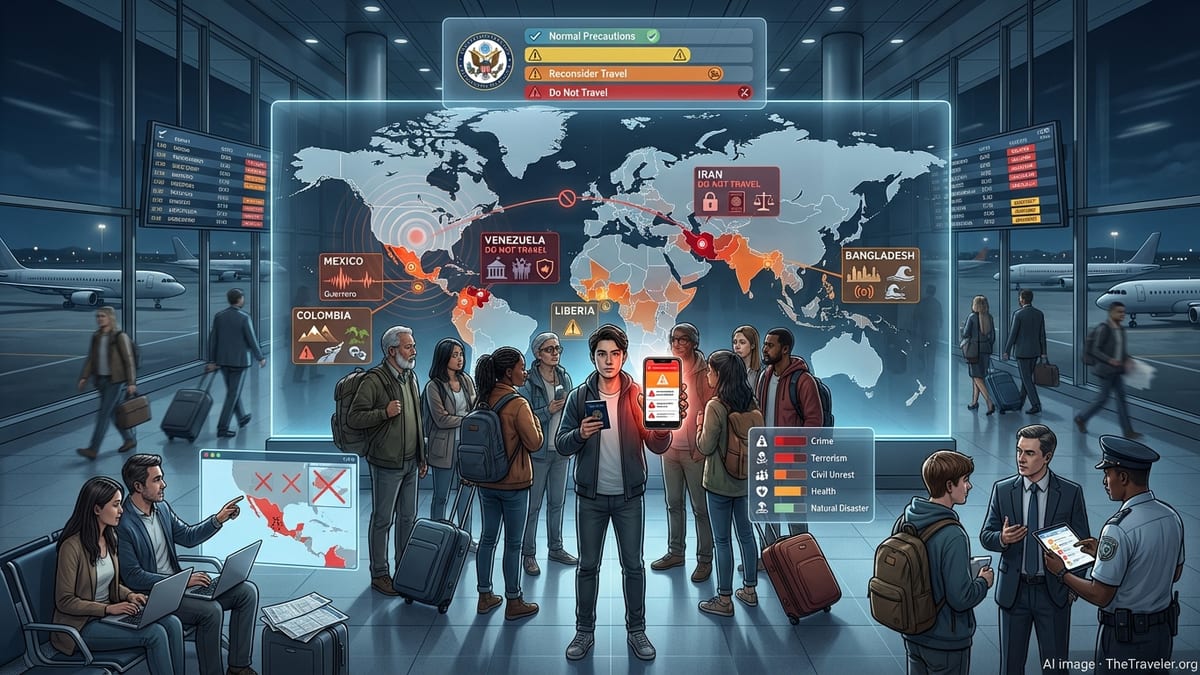
Governments sharpen “do not travel” guidance
Publicly available advisory data from the United States and other governments show a cluster of 13 countries now facing the highest tier of security warnings because of life‑threatening risks linked to terrorism, armed conflict, kidnapping and state fragility. The strictest rating, often labeled Level 4 or “do not travel,” signals that support from consular services could be severely limited during a crisis and that commercial exit routes may close with little notice.
According to the U.S. State Department’s advisory portal, updated in October 2026, countries such as Afghanistan, Yemen, Somalia, Syria and parts of Ukraine remain in this top danger category as fighting, insurgent activity and unexploded ordnance continue to threaten civilians. Other destinations on the highest‑risk list, including Haiti, Burkina Faso and Mali, are flagged for prolonged political instability and armed groups that control territory beyond the reach of central authorities.
Independent aggregators that track travel advisories across multiple governments report that at least 13 countries currently align at the most severe level across several major systems, including the United States, Canada and Australia. These assessments are based on official feeds that are refreshed daily, and they highlight overlapping concerns about terrorist attacks, mass kidnapping and targeted violence against foreigners.
Risk‑mapping reports prepared for multinational companies emphasize that the elevated warning levels are not symbolic. In these destinations, road ambushes, roadside bombs, improvised checkpoints and direct threats to aviation are documented hazards, and emergency medical care outside a small number of facilities is often described as extremely limited or inaccessible.
Middle East flashpoints: airports and shipping under fire
The sharpest recent escalation has occurred in parts of the Middle East, where a series of missile and drone strikes on airports and commercial shipping has reshaped official risk assessments. In Saudi Arabia, public reporting on the October 2026 Houthi attacks on Riyadh’s King Khalid International Airport describes lethal strikes on civilian areas of the terminal complex and repeated disruptions to passenger operations.
International coverage indicates that at least one foreign national was killed and several others injured in this wave of attacks, prompting multiple governments to issue fresh security alerts for travelers in Saudi Arabia and neighboring states. Australia’s Smartraveller service, for example, moved its overall advice for Saudi Arabia to “do not travel” in an update published on 23 October 2026, citing the risk of further strikes on civilian infrastructure and the potential for rapid deterioration in local conditions.
In parallel, maritime security assessments for the Gulf and the Strait of Hormuz warn of a significant increase in attacks on tankers and other commercial vessels during 2026. Open‑source summaries of United Kingdom Maritime Trade Operations notices describe rocket‑propelled grenade strikes and other hostile actions against ships, leading to a sharp reduction in vessel movements through one of the world’s most critical energy corridors.
These developments have led to tighter restrictions on non‑essential travel and stronger recommendations for those who remain in affected countries to keep contingency plans for evacuation. Travel‑risk consultants note that diversion of flights, sudden closure of airspace and temporary suspension of port operations can leave travelers stranded even when violence does not directly target passenger transport.
Conflict, crime and state collapse drive African and Caribbean alerts
Several of the 13 countries now drawing the starkest warnings are in Africa, where overlapping insurgencies, coups and criminal networks have weakened already fragile institutions. Advisory trackers that compile official notices from the United States, Canada and European governments show that Burkina Faso, Mali, Niger, Sudan and parts of the Central African Republic and Democratic Republic of Congo are consistently rated at or near the highest alert level.
In these states, published advisories cite frequent armed clashes, terrorist attacks on hotels and roadside checkpoints, and widespread kidnapping for ransom. Routes linking regional capitals to mining hubs and border crossings are often singled out as especially dangerous, with reports of ambushes on buses, carjackings and improvised explosive devices planted along main highways.
Haiti also features prominently in recent updates. Public information from several foreign ministries describes a surge in gang‑related violence in Port‑au‑Prince and other urban centers, with heavily armed groups blocking key roads, seizing control of neighborhoods and engaging in open gun battles. Some advisories warn that access to the international airport and main seaport can be cut without warning, complicating commercial departures and humanitarian operations.
Security analysts who brief corporations on travel risk say this convergence of political violence, organized crime and weak policing means that even well‑prepared visitors may have limited options if violence suddenly escalates. Insurance providers increasingly treat work trips to these environments as high‑risk deployments requiring dedicated security arrangements and specific sign‑off procedures.
How travelers can interpret and use high‑risk advisories
Government travel advisories vary in format, but most now use a numbered scale to describe risk, with Level 1 indicating that standard precautions are sufficient and Level 4 reserved for locations where life‑threatening dangers are judged to be widespread. Supporting text typically details the primary threats, such as terrorism, civil unrest, wrongful detention, crime or health emergencies, and may list specific regions within a country that face different levels of risk.
Security guidance produced for business travelers emphasizes that a Level 4 designation is not simply a warning about inconvenience. It signals that commercial airlines might curtail or suspend service, that borders could close without advance notice, and that embassies may not be able to organize evacuations, especially if airspace is contested or ports are under threat. Travelers who enter or remain in such areas are often advised to have independent plans for shelter, movement and communication.
Risk‑management toolkits developed with reference to official advisories suggest several practical steps for anyone weighing travel to or through high‑risk regions. These include registering with consular notification services, maintaining multiple means of communication, and arranging flexible tickets that permit rapid changes if security conditions shift. Companies with staff in affected countries are encouraged to track daily updates from official advisory feeds and aviation notices rather than relying on static assessments.
Analysts note that public travel warnings are designed as broad guidance for citizens and do not account for individual risk tolerance, specific local contacts or private security measures. Even so, consistent Level 4 ratings across multiple governments for the same 13 countries signal a rare degree of alignment about the severity of the threats facing foreign travelers there.
Transit hubs and neighboring states feel the impact
The ripple effects from countries under the highest tier of travel warning are increasingly visible in their neighbors, particularly transit hubs that connect conflict zones to global aviation networks. In the Gulf region, carriers and airports in Bahrain, Qatar and the United Arab Emirates have issued security updates and adjusted operations in response to the attacks on Saudi infrastructure and the broader regional conflict.
Publicly available notices reviewed by travel‑risk analysts show patterns of rerouted flights, longer over‑water tracks to avoid contested airspace and heightened screening measures at key airports. These adjustments can lengthen journey times for passengers whose itineraries cross the region, even if they are only transiting and not entering high‑risk countries themselves.
Elsewhere, European and North American hubs are closely monitoring movements from conflict‑affected regions, with some airlines reducing frequencies or temporarily suspending routes to cities that rely heavily on traffic from countries under Level 4 advisories. Insurance and liability considerations also influence these decisions, as underwriters reassess exposure to war‑risk zones and airports revisit contingency plans for receiving diverted aircraft.
For travelers, the tightening net of restrictions and reroutings means that the impact of deadly security risks is no longer confined to those who deliberately choose to visit the world’s most dangerous destinations. Even routine long‑haul journeys can be reshaped by events in the 13 countries now at the center of the most severe travel warnings, reinforcing the importance of checking advisory updates and airline notices repeatedly in the days before departure.