


More news on this day
Czech rail technology company AŽD has launched testing of a battery-powered tram-train on its experimental Kopidlno – Dolní Bousov line, positioning the converted vehicle as a potential low-cost model for decarbonising regional rail where full electrification is unlikely.
Get the latest news straight to your inbox!
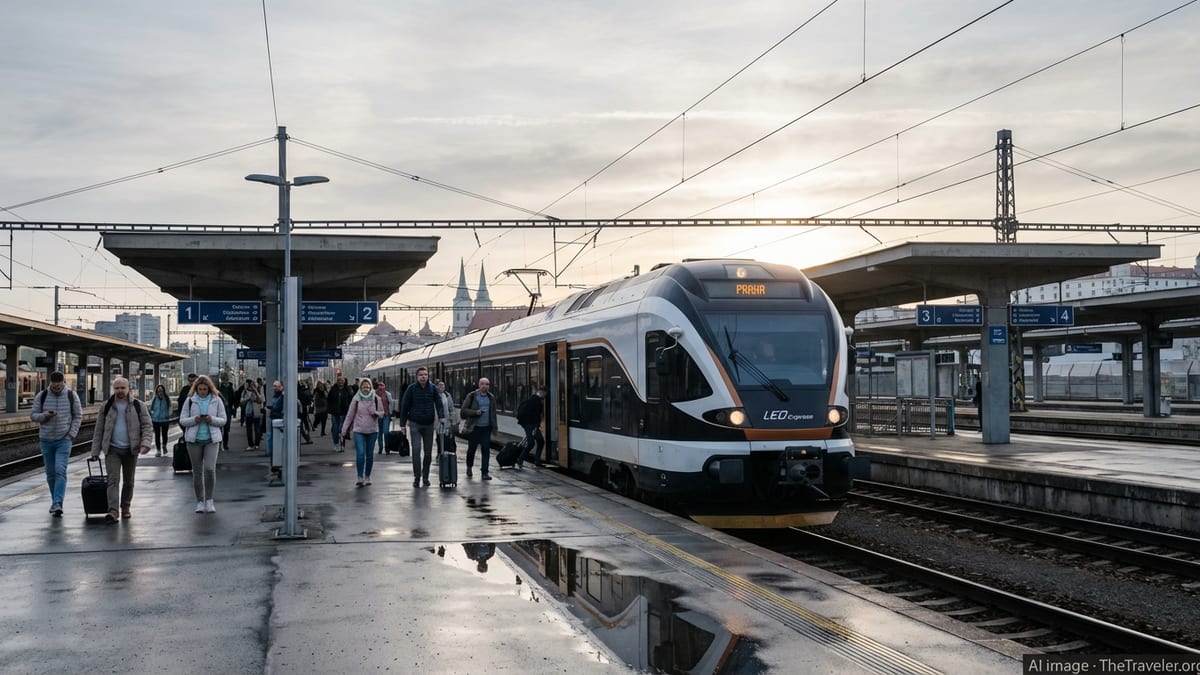
From Brno city tram to battery tram-train LENKA
The vehicle at the centre of the trials is a heavily rebuilt KT8D5R tram that previously operated in the city of Brno. Publicly available information shows that the tram was purchased and converted for AŽD in cooperation with the Brno transport operator’s workshops, which carried out extensive structural and systems changes to enable main line operation.
During the rebuild, the high-floor articulated tram received new doors and internal modifications to suit regional rail use, together with a comprehensive electrical refit. Reports indicate that the traction system was replaced by a new battery-based package, including roof-mounted battery modules, control electronics and adapted braking systems to enable energy recuperation.
AŽD has given the prototype the name LENKA and a dedicated number in the rail vehicle register, underlining its status as an experimental but fully fledged railway vehicle. The company promotes the concept as a lightweight train suitable for lower-density lines, where traditional diesel multiple units are increasingly out of step with climate targets and operating economics.
The conversion cost is reported to be several million Czech crowns, reflecting AŽD’s strategy of using second-hand tram bodies and proven components to create an affordable platform rather than an entirely new-build fleet.
Test operations on the Kopidlnka regional line
The tram-train is being tested on AŽD’s own experimental railway between Kopidlno and Dolní Bousov in the Hradec Králové and Central Bohemian regions, a lightly used rural route commonly known as the Kopidlnka. The line has been under AŽD’s control for several years and is regularly used as a testbed for signalling, digitalisation and autonomous train technologies.
Regulatory documents and recent specialist coverage indicate that the Czech railway authority has granted permission for trial operation of LENKA as a light battery rail vehicle on this route. The authorisation allows AŽD to test the tram-train in a range of operating scenarios, from low-speed technical runs to more intensive service-like patterns.
The line’s characteristics make it a natural laboratory for such testing. It is non-electrified, has modest gradients and moderate speeds, and features small-town and rural stops closely resembling the kind of environment where a battery tram-train might eventually replace diesel traction. The tests are expected to focus on range, charging strategy, ride quality and interactions with existing signalling and level crossing technology.
According to published coverage, AŽD plans to demonstrate how the vehicle could be used both as a railcar on regional tracks and, in future concepts, as a tram-like service closer to town centres if suitable infrastructure is developed.
Battery technology and operating range
The LENKA tram-train is designed to operate exclusively from onboard batteries, without reliance on a catenary or diesel engine. Technical descriptions suggest that its energy storage system has been sized to cope with typical regional branch line runs, including stops, acceleration and low-speed sections through villages.
While precise performance figures have not been publicly detailed in full, the project is framed as a demonstration of how battery-only rail vehicles can cover tens of kilometres between charges under Central European operating conditions. The Kopidlnka’s length and timetable provide a realistic template for validating whether a single charge can support out-and-back journeys or whether intermediate top-up charging would be required in regular service.
Charging is reported to be carried out at designated points on the line, using stationary equipment rather than overhead wires. This arrangement reflects one of the main arguments in favour of battery trains: infrastructure requirements can be limited to charging stations at depots or terminal stations, avoiding the cost and visual impact of continuous electrification.
The testing programme is expected to gather detailed data on battery degradation, energy consumption in different weather conditions and the impact of regenerative braking, all of which will feed into future decisions on whether similar vehicles could be deployed more widely on the Czech regional rail network.
Regional rail decarbonisation and cost pressures
AŽD’s tram-train experiment comes as many European railways look for alternatives to diesel traction on secondary lines. Conventional electrification is often considered economically challenging on routes with low passenger volumes, even as national and regional authorities pursue emissions reductions and improved air quality.
Battery-equipped multiple units are emerging as one potential solution, complementing hydrogen and hybrid options. Industry case studies from France, Denmark and the United Kingdom highlight growing interest in battery trains that can run partly under electric wires and partly on stored energy. AŽD’s project differs by concentrating on a fully battery-powered, single-system vehicle aimed squarely at non-electrified regional lines.
By basing LENKA on a refurbished tram body and focusing on a relatively simple onboard system, AŽD is testing whether a lower-cost approach can still deliver acceptable performance and reliability. Reports in regional and specialist media emphasise the potential for such vehicles to keep lightly used lines open by reducing operating costs and offering a modern passenger experience in place of ageing diesel stock.
The Czech Republic’s mix of dense main lines and thin rural branches provides a varied backdrop for these trials, and observers in neighbouring countries are watching to see whether the model could be transferred to similar networks in Central and Eastern Europe.
Next steps and wider tram-train interest
The current tests on the Kopidlnka are still described as experimental, but they form part of a broader portfolio of innovation by AŽD on the same line, including work on autonomous driving functions and digital signalling. Public materials from company events reference plans to integrate battery propulsion with advanced train control, suggesting a vision of regional rail vehicles that are not only cleaner, but also more automated and flexible.
Within the Czech transport sector, interest in tram-train concepts has been growing, with academic institutions and newly formed companies exploring vehicles capable of running from city streets onto regional lines. AŽD’s battery tram-train is seen as one strand in this wider movement, offering a practical proof-of-concept built from existing rolling stock.
The coming months of testing are expected to clarify how the LENKA prototype behaves in daily operation, how passengers perceive such a vehicle on traditional railway tracks, and what adaptations might be needed for full commercial deployment. Depending on the outcomes, the project could influence future procurement strategies for regional transport authorities looking for alternatives to diesel and costly full-scale electrification.
For now, the modest rural Kopidlnka line has become an unlikely focal point in the search for more sustainable and affordable regional rail services, with AŽD’s battery-powered tram-train providing a tangible example of how that future might look.